

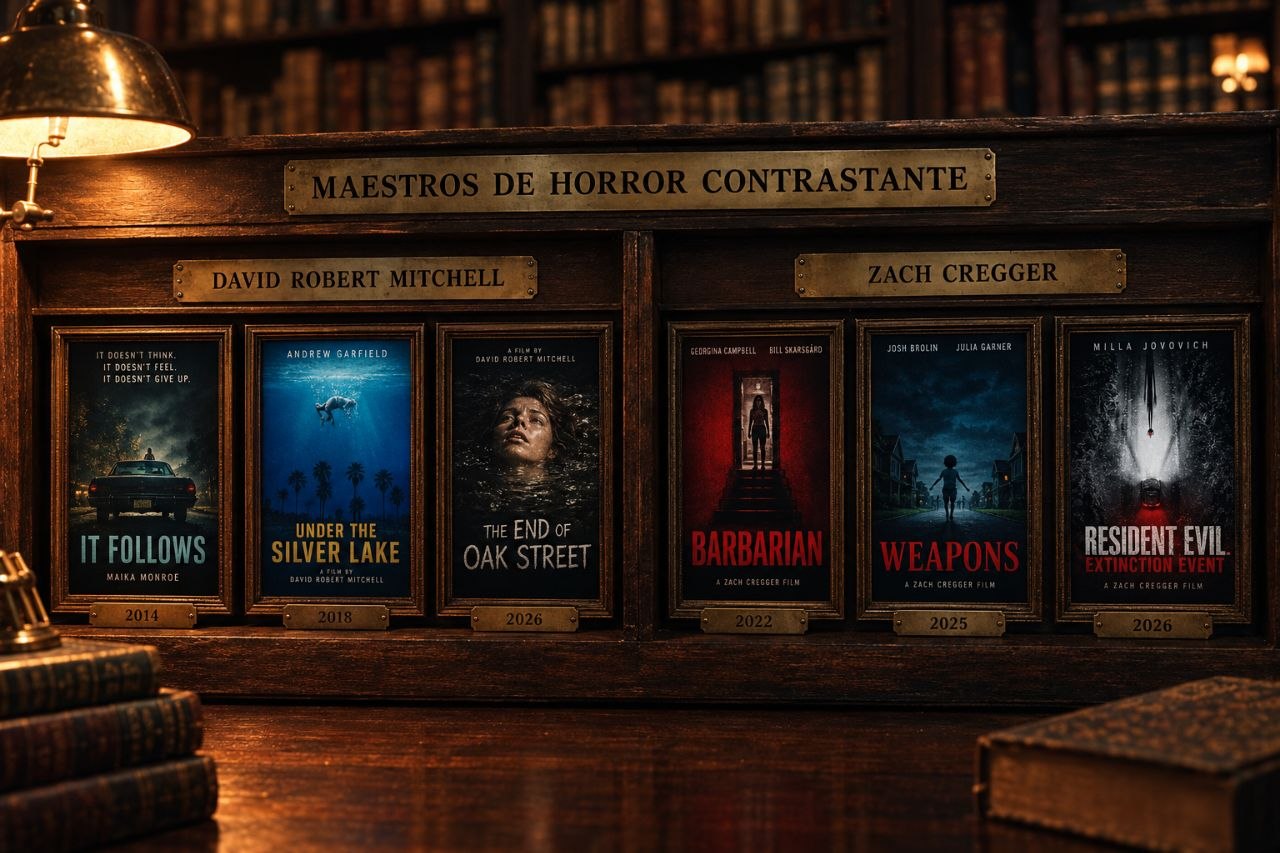
The New Wave of Fear: Two Architects of Chaos
In the vast and often suffocating graveyard of contemporary horror cinema, finding a voice that doesn't smell of recycled plastic or algorithmic marketing is a near-suicidal task for the cinephile. Gone are the days when prefab scares and generic CGI ruled the box office without opposition, offering the audience a sterile and predictable product. Today, the hungry cinephile seeking independent cinema, cult works, and deeply authorial perspectives looks for something completely different. They seek palpable discomfort, horror that breathes in the light of day, or narrative twists that yank the breath away and destroy expectations.
At this crossroads of modern filmmaking, two names shine with a disturbing but absolutely fascinating light: David Robert Mitchell and Zach Cregger. Though their origins, thematic obsessions, and narrative rhythms differ drastically, both share a creative DNA that connects deeply with the purest and most crafty lovers of horror. They have each, in their own way, demonstrated that cinematic fear is not simply a monster jumping from the shadows, but a toxic atmosphere that slowly inoculates itself into the mind of the viewer.
"Fear is not a leap into the dark; it is the paralyzing certainty that daylight does not protect you from what is coming."
Through an analysis of their works, their visual styles, and their firm commitment to physicality on screen, we unravel how these two architects of tension are redefining the boundaries of genre cinema. They are not mere directors; they are healers of modern anxiety, using the camera as a scalpel to dissect our own insecurities.
Mitchell: Expanded Paranoia and Daytime Terror
David Robert Mitchell burst onto the modern cult cinema pantheon with an unusual force and maturity. His visual and narrative style, above all, is a brilliant exercise in collective hypnosis. Mitchell doesn't rush; his camera moves with the cadence of a feverish nightmare from which it's impossible to wake. Using slow 360-degree panoramas and meticulously composed wide shots, he forces the viewer to become a paranoid voyeur, scrutinizing every corner of the frame for a threat that always seems to be lurking.

In his incontestable masterpiece, It Follows (2014), Mitchell completely redefined the concept of supernatural harassment. However, what truly connects him with the deepest concerns of horror cinephiles—and particularly with the always fascinating daytime terror—is his masterful ability to terrify under a sun of justice. In Mitchell's universe, danger does not need to wait for nightfall; it walks implacably toward you at three in the afternoon in the quiet streets of a suburban neighborhood or in the middle of a crowded beach.
Mitchell creates anachronistic terror, a space where CRT TVs coexist in harmony with unclassifiable reading devices, immersing the audience in a suspended time that is as melancholic as it is terrifying. This incurable fixation on dense mystery and oniric logic expanded massively in Under the Silver Lake (2018), a surreal neo-noir labyrinth that draws equally from Thomas Pynchon and David Lynch. With it, Mitchell cemented himself as an untamed author who does not fear alienating mainstream audiences in favor of building his own cryptic cult mythology.

His ability to mutate within the genre without losing his voice has been further evidenced by his foray into '80s survival sci-fi in The End of Oak Street, released in August 2026. Meanwhile, the legion of horror acolytes holds its breath for They Follow, the long-awaited sequel to his great success. Mitchell thus solidifies himself as the undisputed poet of slow, cosmic threat, where horror is not an event but a state of being.

Cregger: The Architecture of Subversion and Visceral Violence
At the other end of the cinematographic quadrilateral, we find Zach Cregger, whose dazzling debut in the horror landscape with Barbarian (2022) was the equivalent of a brutal and bloody magic trick. Coming from the world of sketch comedy with the irreverent group The Whitest Kids U' Know, Cregger proved to the world an irrefutable maxim: the internal mechanisms that provoke laughter and those that unleash fear are exactly the same. Both depend entirely on time manipulation, the sustained building of tension, and, finally, the radical and violent breaking of expectations.

If David Robert Mitchell slowly drowns you like a silent tide, Zach Cregger throws you off a cliff just when you thought you were taking a safe walk through the countryside. Cregger's style is characterized by structural audacity that borders on kamikaze. He has no qualms about splitting his film in half, abruptly changing protagonists, altering the overall tone, and modifying the aspect ratio in a single cut. It's impossible to forget that legendary and disorienting temporal jump to Justin Long's character driving a sun-soaked convertible, right after subjecting the viewer to the maximum asphyxiation in the darkness of a basement.

"Laughter and a scream are the same frequency; only the direction of the blow changes."
His use of the camera is infinitely more urgent, nervous, and claustrophobic, always deeply anchored in a production design that seeks oppression. Cregger's visceral talent was, and is not, a one-day flower. With Weapons (2025), he demonstrated that his pulse for dark, morally complex, and coral thriller was sharper than ever. His recent and ambitious leap into Hollywood's big leagues came with a heavyweight: the new cinematic reboot of Resident Evil, released this September 2026.

With this project, he has shown that he is fully capable of injecting his particular and ruthless vision into a historic franchise, respecting its roots in the video game while maintaining its original bite. All this, just before diving into pure sci-fi with his next enigmatic project, The Flood. Cregger does not direct films; he dissects the very structure of narrative to see what bleeds first.
The Triumph of the Tactile: Flesh Against Code
Where both filmmakers find an absolute point of convergence—and a monumental victory for those who fiercely defend physical, palpable, and purely analog cinema—is their deep respect for practical effects. Both share an evident creative allergy to burying their narratives under tons of soulless CGI, that endemic evil that plagues modern horror blockbusters and turns monsters into insipid digital phantoms.
For any true enthusiast of independent cinema, classic B-series films, and visceral horror, the organic texture of traditional makeup effects, the weight of latex prosthetics, or the flow of artificial blood are irreplaceable elements. David Robert Mitchell achieves supreme terror in It Follows by relying purely on physical work and the actors' performances that embody the demonic entity, culminating in subtle but effective makeup jobs. In his cinema, there are no CGI-rendered monsters; there are tangible, corrupted human bodies that invade the protagonists' physical space with a realism that chills the blood.

Zach Cregger, on the other hand, embraced and carried this tactile philosophy to its ultimate consequences in Barbarian through the masterful design of "The Mother." That deformed, overwhelmingly terrifying yet strangely tragic creature came to life before the camera thanks to a monumental effort of prosthetic and makeup design applied to the body of actor Matthew Patrick Davis. In an era where any commercial studio would have solved the issue by filming an actor in a motion capture suit in front of a green screen, Cregger bet everything on latex, sweat, layers of silicone, and real dirt.

This inescapable physicality makes terror transcend the screen, feeling grotesquely close and real, a craftsmanship approach that has undoubtedly carried over to the biological mutations of his vision for Resident Evil. Both filmmakers understand, with artisan clarity, that the human eye always detects digital deception; synthetic flesh and palpable textures always carry infinitely greater emotional weight than any bright pixel.
Space, Light, and Atmosphere: Two Faces of the Same Fear
The treatment of space is another fascinating territory where their visions diverge to arrive at the same dead-end alley of panic. Mitchell is undeniably a master of horizontality. In his cinema, the threat almost always approaches from the vastness of distance; it comes slowly walking toward the center of the frame from the far-off, out-of-focus end of a high school hallway, or inexorably crossing the vast expanses of a Midwestern park. It is the cinematic embodiment of inevitable horror: the suffering of knowing with absolute certainty what is coming and being conscious of one's inability to stop it.
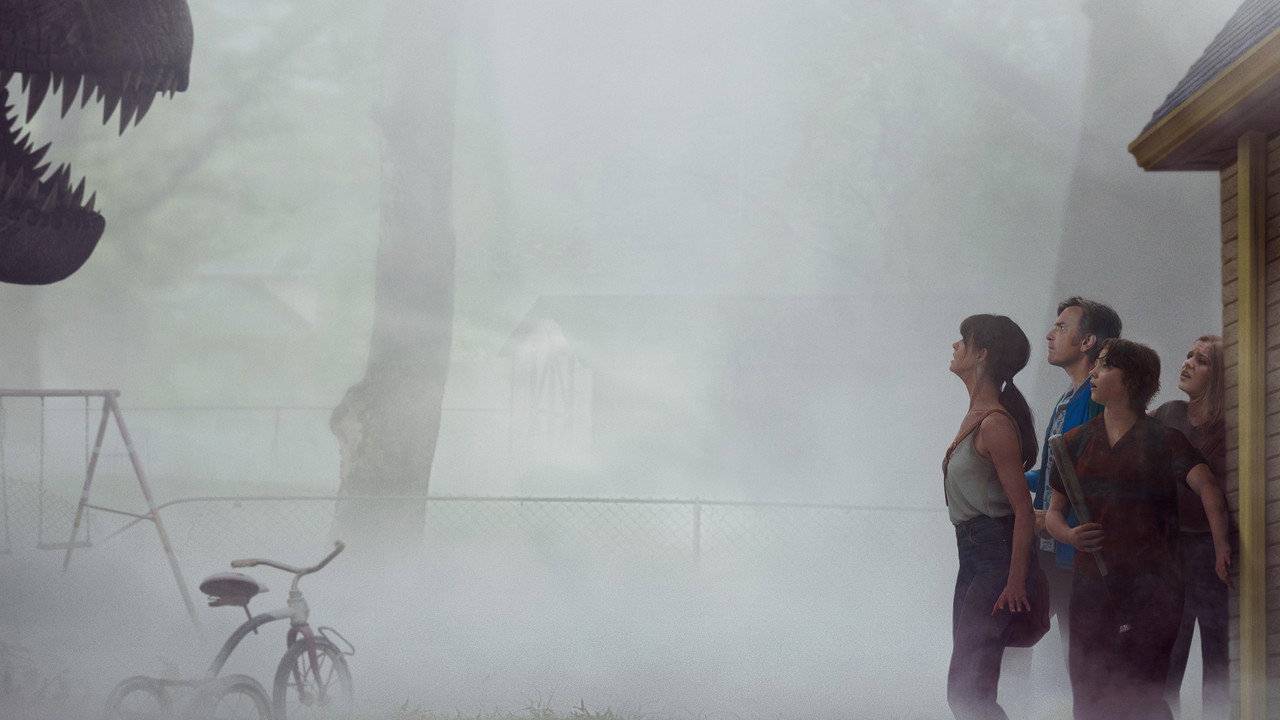
His terror dwells in open spaces, in daylight that offers no refuge. Light, in Mitchell, is not salvation; it is a trap that exposes the protagonist to the gaze of the unknown. On the other hand, Cregger rises as the implacable architect of verticality and confinement. His horrors are subterranean; they lurk hidden beneath the thin, deceptive surface of bourgeois normality. He forces us to look down, into the dense darkness of stairs that logically shouldn't be there, into concrete tunnels descending directly to hell.

The danger in Cregger's cinema does not come from afar; it is crouching behind the wall, on the other side of the measuring tape, waiting patiently in the blind spot of the room to jump into your jugular. While Mitchell makes you feel small in the face of the vastness of the world, Cregger makes you feel trapped in the narrowness of your own existence. They are two sides of the same coin of fear: total exposure and total asphyxiation.
Claqueta Ácida's Verdict
Having contemporary filmmakers of the caliber of David Robert Mitchell and Zach Cregger operating at the absolute peak of their narrative capabilities is an invaluable luxury for any lover of the seventh art. Especially for those who tirelessly scour the margins of the industry in search of untamed voices that refuse to be tamed by the algorithm.
Mitchell is here to remind us with every shot that terror can be a deeply melancholic mental state, a feverish dream bathed in paranoia, ominous synthesizers, and suburban solitude. It is the terror of introspection, of doubt, of reality crumbling under the weight of suspicion. Cregger, with a sadistic smile, prefers to grab us by the lapels and laugh at how tragically predictable our expectations are as viewers, only to deliver a purely instinctive, visceral, and savage blow of terror.
Together, each entrenched in their own conception of cinema—the anachronistic, angst-filled contemplation on one side and the brutal, bloody surprise on the other—they rise as beacons of resistance against the standardization of genre cinema. They are the undeniable triumph of intelligent writing, meticulously framed cinematography, and genuine love for cinematic craftsmanship, proving that the vision of the author will always prevail over the cold, corporate algorithm. As long as they keep placing themselves behind a camera, whether orchestrating the escape of a supernatural force in the streets of Detroit or guiding us into a basement of nightmare, we will be in the front row, wide-eyed, waiting for the slaughter. 💀


