«El ego es el único guionista que nunca se corta»: Bruno Martín ante el abismo de 'Luger'

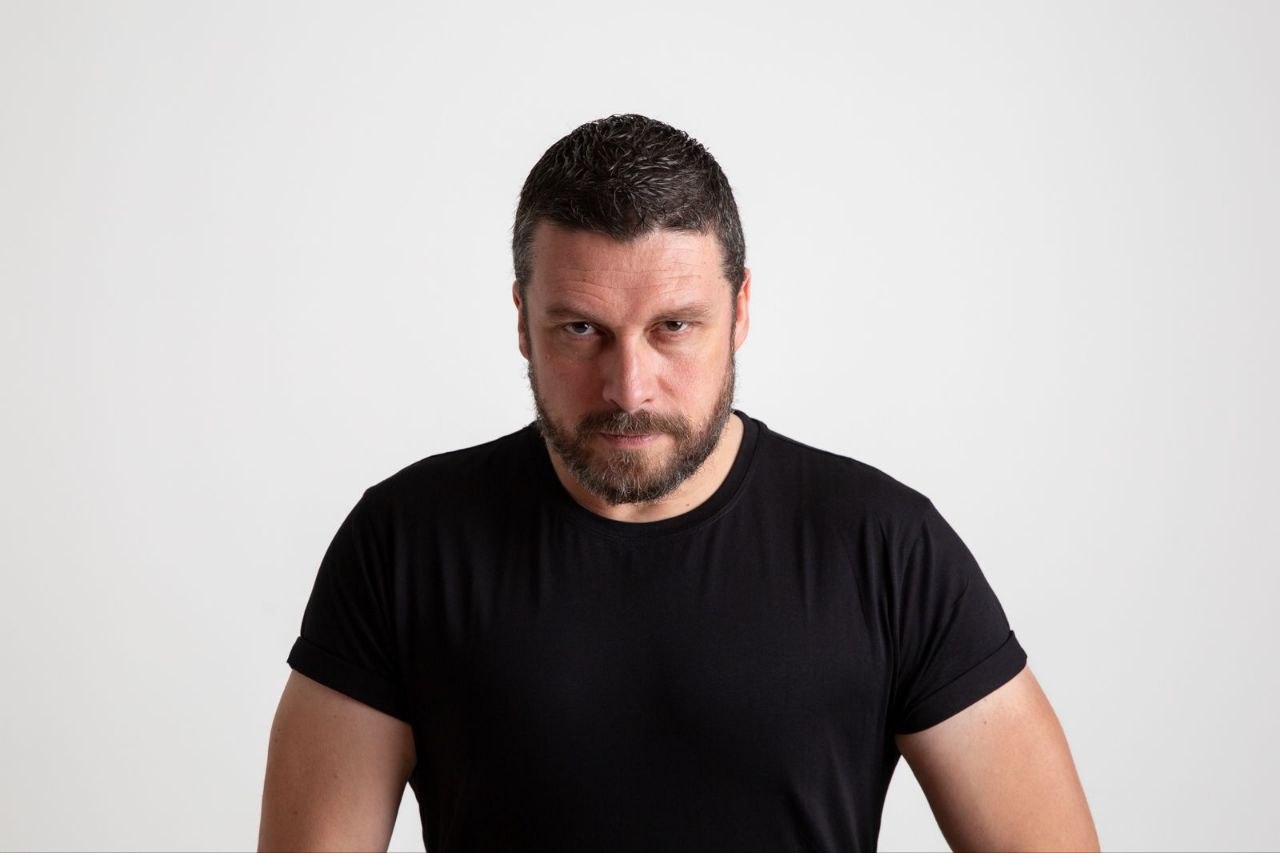
Independent cinema is always a resounding plan B. But sometimes plan B is the best film you can make.
In a dusty warehouse in the P29 industrial estate of Collado Villalba, surrounded by the smell of burnt oil, rusted sheet metal, and reheated coffee from an old machine, Bruno Martín talks about cinema with the wild calm of someone who owes nothing to official offices or the condescension of salon festivals. Behind him, between editing monitors and boxes of shooting materials stacked against the wall, lie the scars of Os reviento and the gestation of Luger, a rough, dry, and tough-guy thriller that dynamites the corporate solemnity of the Spanish police procedural to transform it into a point-blank urban western. There is no lukewarmness here: there are precise shots, mud on the boots, and a devilish pulse for genre in its purest state.
I. BREAKING THE ICE AND 'LUGER'
Inevitably, the shadow of Os reviento and your background as an editor project the idea that Luger is pure rhythm and muscular hyperbole, but the bar sequence functions almost like a minimalist camera piece; to what extent was the rhythm of this film built at the editing table, or was it already dictated by the spatial claustrophobia of the script?
Bruno Martín:
[Pause while finishing his coffee and smiling with a certain cynicism]
I have always been clear that time is gold. If you can convey the same idea and perform a task of synthesis to tell a story in the shortest time possible, the viewer will unconsciously appreciate it throughout the runtime. I don't mean to say that all films must be told in a vertiginous manner; each sequence, each character, and each story in general has a determined tempo. Finding that tempo is the hard part.
I always feel comfortable with devilish rhythms and, of course, Luger and its rhythm were already dictated from its beginnings during the script process. As you mention, the bar/restaurant sequence —like some others in the film— changes the tone and rhythm because the tension occurring within it demands it. That specific sequence even changes the tone of the film to become, for a few minutes, an urban western.

In a landscape where the Spanish thriller usually takes refuge in the sobriety of the corporate police procedural or institutional solemnity, you bet on a tough-guy and pulp thriller; did you feel there was a deliberate void in our box office towards playful and uncomplexed violence, or was it simply an egoistic viewer's impulse?
Bruno Martín:
Pure egoism. I never intended to fill any void at the box office since I don't understand the box office. I simply made the film I would like to see. I thought there would be more crazy people like me in the world who would appreciate it.
You openly define yourself as a son of the cinema of Tarantino, Guy Ritchie, or Bielinsky, but in Luger the 🎓MacGuffin that triggers the catastrophe is not a golden briefcase or a drug shipment, but a World War II war relic locked in a safe; how is the Anglo-Saxon cinephile reference balanced with the mud, picaresque, and sociological squalor of a Madrid outskirts industrial estate?
Bruno Martín:
The Luger pistol is an icon with historical, cinematic, and collectible weight; placing that macrocosm of World War II against the microcosm of some losers having a bad Thursday in a Madrid outskirts industrial estate creates a very interesting contrast and dramatic risk.

Visually, I use composition and dry editing, raw light, medium shots, and colloquial dialogue for the scenes; thus the MacGuffin drives the plot without nullifying the local flavor. The idea is that the object opens the box of the story, but it is the picaresque, the fears, and the everyday decisions of the characters that mark its resolution. The Luger only gives its name to a film that deals with loyalty and second chances.
II. CREATIVE DECISIONS AND STAGING
You have mentioned on occasion that action cinema does not admit "falsities" in the physical plane. Having a martial arts specialist and natural athlete like Mario Mayo in the cast, how much was there of resignation in having to rein in the purely physical display to submit it to the dramatic narrative and a "Goliath with a heart"?
Bruno Martín:
It really wasn't resignation, but rather something similar to discipline. We reined in the physical display when the scene demanded emotion and verisimilitude. No matter how much street cred and fighting Mario's character (Toni) has, there is always someone tougher, more dangerous, and in greater numbers.
We took advantage of Mario's power with measured sequences and concrete actions that multiply his impact without turning the film into a succession of punches. The result is a kind of Goliath who can knock you out on screen but whose inner conflict and small vulnerabilities make him credible and deeply human.
For years you have been the right-hand man as an actor and sometimes co-screenwriter to David Sainz, someone with an incontestable auteur seal in the format of audiovisual guerrilla; when putting him in front of the camera as the protagonist and directing him yourself, how many times did you have to turn off the Director-David on set so that the vulnerable and impulsive Actor-David that Luger required could survive? (By the way, tell him he owes us a retweet of our review of Luger).
Bruno Martín:
Fortunately, David and I respect each other a lot within the profession (and outside too, hahaha!), and besides, the role was written expressly for him. David knew Luger very well and had my consent and absolute authority to contribute what, within his professionalism, he deemed appropriate. Sometimes trying to improve a detail can lead to slowing down and, in the end, it is counterproductive. David moves wonderfully within a shoot and knows the times: when to opine and when not to.
Surrounding myself with a director-protagonist, a director-director of photography (David Hebrero), and a director-executive producer (Raúl Cerezo), has been enormously beneficial for an action film that had to be shot in just 20 days within a moving industrial estate.

The trunk shot is a 🎓Tropes burned to a crisp by nineties noir cinema. We learned that you tried to shoot it through the rear window of a Mustang and that the physics of the car itself forced you to end up inside the trunk in an almost comical way; how many of the decisions that critics today label as "brilliant genre tributes" were actually born of a pure technical setback with the water at your neck?
Bruno Martín:
I don't hide my inspirations, but I believe that, in most cases, tributes add nothing. This is why many "tributes" were born of pure necessity. Because some master had already invented them one day, because it was the simplest and most elegant way to resolve it. It is true that we tried to avoid that trunk shot but, as you rightly say, the physics of the vehicle prevented us. We ended up inside because it was the only physical way to place the camera.
Analysts usually label the long take as an aesthetic show-off or technical arrogance, but you admitted that the long takes of Luger were a desperate Plan B due to lack of time and lighting. Is Spanish independent genre cinema sustained more on the skill of design or on the capacity for wild last-minute improvisation?
Bruno Martín:
For me, 90% of long takes are a call for attention from directors. It is a "Hey! Look what I do with the camera!" that rarely contributes to the narrative. Great directors make you forget the camera, as their job is to tell you a story. Inevitably, all directors have a certain degree of narcissism and we all want to be listened to from time to time.
Independent cinema is at the service of the greatest enemy of cinema and of life: time (and also resources). Independent cinema —genre or not— is always a resounding Plan B.

At the press screening in Sitges, the film started with laughs and a rough comedy atmosphere, but as the second act progresses, the violence becomes rough, dull, and without space for jokes. Were you not afraid of frustrating the viewer who paid for a ticket looking for a lighthearted comedy and suddenly came face to face with a drama about loyalty and forgiveness?
Bruno Martín:
The goal that Santiago Taboada and I had while writing the film was always to frustrate the viewer. But wait, that sounds bad and it isn't. We offer characters with whom to empathize, with whom to feel comfortable and strong. But there comes a point when tougher and stronger guys cross their path. And that is when the laughs fade.
But the tension continues, and we do this a couple of times more during the runtime so that, when certain moments arrive, you feel pleased with how events are unfolding. I consider Luger to be frustrating but satisfying. If someone had the idea of seeing a rough comedy, neither the poster nor the trailer gave those signals... Although now that I think about it, maybe the mistake was featuring David Sainz big on the cover, hahahaha.
III. CRAFT AND ACTOR DIRECTION
Raúl Cerezo, your executive producer, suggested cutting from the original script a mass sequence with 35 people, gunfights, and even a tiger. Did that exercise of pruning the excess turn the film into a more subtle and intriguing work, or when editing it did you still sigh for the wild spectacle that remained on the drawing board?
Bruno Martín:
Having someone seasoned in the battlefield that a shoot is, like Cerezo, is an indisputable added value. Santi and I did a first reading with him of the first version, which was inevitably somewhat enthusiastic. The sequence was spectacular, but it required about five or six days of shooting and 35 actors with their respective salaries for all those days.
He suggested that, in general, in the second round we cut what was not essential: we merged several characters into one, removed sequences and subplots until a very different but much more subtle, more interesting, and better film remained. It was no problem letting go of all those scenes. We kept many in our hearts to recycle and adapt them in future projects where we can have much more means to carry them out.
Throughout your career you have gone through practically all the ranks of the industry: production assistant, assistant director, editor, actor in daily series like Acacias 38 or Patria, and creator of web series; which of all those previous "Brunos" suffered the most when you stepped onto the set of your first feature film as a director?
Bruno Martín:
I think all those "Brunos" were jumping for joy like kids with a new bicycle. In this vocation-driven profession, many people are clear about what they want to be within it. I have gone through many facets until finding those places where I feel comfortable. And all of them have given me weapons to face and understand this profession in a certain way.
I don't think any of them suffered; they were all part of my life until I had to give my all with my first real film. They all contributed something to that process that led me exactly to the place where I had to be.
Calling the production company A Man From Murcia or shooting from start to finish in the P29 industrial estate of Collado Villalba demonstrates a very marked pride in the periphery. Why has Spanish genre cinema taken so long to realize that an industrial warehouse in an estate on a weekday is a thousand times more threatening setting than a studio set?
Bruno Martín:
We are not the first and will not be the last Spaniards to shoot something in an industrial estate. But I believe we are the first to turn it into a character in its own right. Almost all the shorts and almost all the web series I have made have had one or several sequences in that estate. I grew up there, I used to meet my buddies in a wasteland next to some tracks where one particular sequence was shot. We spent afternoons sitting on old abandoned car seats next to a scrapyard where we snuck in to cause trouble while drinking kalimotxo.
And I always felt it was a magical place because it came from the strong industrial culture of the 80s, where many of my favorite films, arcade video games, and music videos began or ended in dirty and dark alleys of industrial estates. Industrial warehouses are a universal and beautiful urban setting. They are practically the same here, as in Berlin, as in Michigan. Besides, all that brick, sheet metal, and those smoking chimneys helped form the perfect background, trapping our protagonists in a labyrinth of repetitive and disorienting structures.

You decided to reserve the role of Charlie in the film, jokingly arguing that this way you saved casting budget to rent a steadycam. Beyond the economic joke, does having training as an actor change the way a director communicates with their cast when the shooting space becomes a claustrophobic hell?
Bruno Martín:
As we mentioned before and as Michael Caine said in his book Acting for the Camera, a film is a temporary enterprise. If you know all the departments of said enterprise, it will be infinitely easier for you to move around and be decisive in the face of adversities that don't even have to do directly with your department. Having a global vision gives you many more weapons to face the shooting of a film and ensure that external elements —which are many— do not excessively dilute the cinematic idea you had in your head.
In Luger, the female characters —from the lawyer with relaxed morals played by Ana Turpin to the pawnshop owner or the waitress— completely break the inertia of "tough guy cinema". Was it a conscious decision to air out the "turniposphere" of the genre or simply a consequence of having lived the real neighborhood environment?
Bruno Martín:
The film has an evident testosterone component. But Santiago and I consciously decided that in Luger the women would maintain weight, fangs, and nuances: not only intelligence and bravery within a markedly masculine world (the estate and the physical strength jobs), but also emotional complexity.
I worked with the actresses to forge survivors who would not fear facing anything, but who at certain moments would be overwhelmed by the brute force of other characters. So it was not just a "neighborhood thing" nor a simple politically correct gesture: it was a deliberate narrative choice to break the inertia of "tough guy cinema" and add social reality. We were looking for a palpable recognition of the difficulties that many women face without ever losing dramatic verisimilitude.

IV. INDUSTRY, POLITICS AND CONTRADICTIONS
With the international backing of festivals like Austin or Strasbourg, the applause at the Sombra Festival and the undeniable haul of 6 awards at Isla Calavera and 5 awards at the 2026 Blogos de Oro (including Best Film, Direction, and Screenplay) among so many others (the film accumulates 25 awards), the inevitable institutional conversation comes into play: do you see any real crack for a rabid, independent, and tough-guy action film like Luger to have a place in the Goya Awards nominations, or does the Academy still suffer from an incurable allergy towards pulp genre cinema? And, by the way: if the penny drops and you end up nominated, will you keep the promise you made to us on Twitter after our review in Claqueta Ácida and will we get that VIP pass for the gala, or will we have to cover the red carpet from the street?
Bruno Martín:
I don't think I will go too deep into that garden beyond commenting that to get to the Goyas you need tremendous human and economic backing to be able to make a good visibility campaign among the academics. I don't think it is a matter of allergies towards certain genres. If a film has few means, imagine the resources that remain almost a year after its production.
However, and with my hand on my heart, I will tell you that we are going to do everything in our power to reach the 2027 gala. Unfortunately, and in that case, I don't think I can fulfill the promise about the VIP pass as it will not be in my hands. What I can guarantee you is that if they let me shoot another film, you will have a VIP pass for its premiere.
You have raised Luger through private financing and the tenacity of La Dalia Films, apart from the traditional subsidies of the official evaluation commissions. Does the current system of public aid condemn Spanish action or horror cinema to always be a guerrilla feat?
Bruno Martín:
The truth is that my duties as a producer have been scarce and forced... Os reviento, Luger and little else, and I hope never to do it again. I don't understand the bureaucracy, the paperwork, the points, the subsidies, and all that crap. I know that Luger applied for the aid from the Community of Madrid and that they didn't grant it to us. They gave us 47%. Insufficient, no matter how much you cry to the teacher, he won't give you a 5. We didn't fight for it much nor waste energy on it. The desire to start shooting the film was above any office.
Regarding what parameters, themes, and genres those institutional decisions are based on, I prefer not to opine. I dedicate myself to making films about what interests me. If it doesn't fit within the imposed standards, perfect: I to my roll and them to theirs. No one is going to tell me what story I have to tell.
The film's soundtrack and sound design receive almost unanimous praise for the way every punch or shot resonates. How did you work on the sound mix to avoid that endemic evil of Spanish cinema where the music devours the dialogues or the slaps sound like plaster?
Bruno Martín:
In both departments (music and sound) we had true titans like Leví Star (with whom I have been working my whole life), Dani Bravo (direct sound and mixes), and Pertigosaurio (sound design and mixes). Dani Bravo did incredible work on set alone... with sequences where there were up to 8 characters at the same time (like the claustrophobic office one, for example). We went to post-production with first-rate quality material that Martín Jiménez finished in his studio.
Technically, each impact carries between seven and eight superimposed tracks to give it body and verisimilitude; we didn't use "plaster slaps", but layers of real bass and ambient textures. With Leví, I spent 15 days in the studio looking for the music and its identity for the editing, as it was the only thing I didn't have totally clear before shooting. We used very few very local elements (claps, flamenco cajón) and some disruptive element (cello) to maintain the tension without masking the dialogues. The result is a powerful and clear mix where the punches resonate with weight and the music accompanies without ever devouring the voices. And above all: there is no need to keep turning the TV volume up and down.
In a market obsessed with algorithms and streaming consumption metrics, you defend the mythology of the physical object with a Blu-ray edition full of extras. Is there still space for cinephile collecting in the era of ephemeral streaming consumption?
Bruno Martín:
Not the remotest idea. Sadly, I suppose it will disappear, but I don't think completely. Who the hell was going to tell us in the year 2000 that you would go to a department store and not find players but hundreds of vinyl records? VHS is back in fashion... I don't know... What I do know is that I have a collection of more than 2,000 physical titles and I am passionate about it. The physical format offers promotional pieces, tangible extras, and information for fans that are priceless.
The Luger Blu-ray, in charge of the distributor 79 (with whom we already collaborated on the collector's edition of Os reviento), will come loaded with physical and digital extras. If all goes well, we expect to be signing copies at the 79 stand in October during the Sitges festival.
V. DIGITAL GUERRILLA, FUTURE AND FINAL VERDICT
You have raised the possibility of expanding the narrative universe of the "Santos 117" estate in future installments, prequels, or spin-offs. Is there a danger that the modern obsession with creating "cinematic universes" suffocates the self-contained freshness of a debut film?
Bruno Martín:
It would be very easy to screw it up with a poorly planned prequel, sequel, series, crossover, or spin-off. We would love to explore those paths because, although the film works 100% independently, it leaves an open ending. The idea of a prequel has always fascinated me especially, but right now we want to focus on other projects and tell new stories.
The most important thing is to maintain the standard: we made the best film we were capable of making with the means we had, and we don't want to rush or disappoint ourselves with the next one. Hopefully, we can return to the audience, who have treated us with so much affection, an equal or even superior experience.
You have been defending the web series format and self-produced internet productions like A todo riesgo or Jauría Nick for years. What lesson learned in the "mud" of YouTube do you keep intact today that you shoot feature films with a larger budget?
Bruno Martín:
I think I would rephrase the question, as I haven't shot with a high commercial budget, but enough to raise a "real" film.
The lesson is clear: optimize resources to 200%. If there is money, details; if not, pure concept. Luger has no empty flourishes and I believe that is precisely its strong point: that I couldn't do free nonsense with the camera. I had to make sure that every shooting day we took the sequence resolved to the editing. Maybe the day they give me ten million euros I will become an idiot and my films will start to be pretentious garbage. I will try to avoid that and keep my feet on the ground. But I only promise to try.
It is usually said that a director's first film is where all the energy accumulated during youth is burned. Now that Luger no longer belongs to you and is the audience's, what cinematic certainty that you had absolutely clear before starting to shoot has blown up?
Bruno Martín:
That I have made mistakes, that I will make them again, and that I will never stop learning. That I have no damn idea about cinema beyond being a mere viewer who has had the luck to count on a handful of wonderful human beings who have granted him the opportunity to captain a film.
«Independent cinema is always a resounding Plan B. But sometimes Plan B is the best film you can make.»
🎬 Filmografía de Bruno Martín

Luger
★ Leer Crítica
Grasa
Filmografía oficial
Polis corruptos
Filmografía oficialConversación Registrada en Claqueta Ácida
Este expediente fue transcrito sin censura ni concesiones promocionales. Prohibida su dilución en lugares comunes.