Don't Move — When Horror Freezes Solid in the Undergrowth
We dissect Maclain Nelson's Don't Move, where a prehistoric arachnid reduces creature-feature horror to an exercise in absolute static.


Don't Move: full review
There is a bizarre ambition in deciding to title your movie exactly like the command that invalidates traditional cinematic grammar. If cinema is movement, projecting frames that celebrate pure static flirts with conceptual provocation or industrial cluelessness. Maclain Nelson abandons any shred of dynamism we might have glimpsed in his previous Amazonian foray to surrender to a geometry of boredom so meticulously calculated it's actually frightening. There are no frenzied chases or desperate escape choreographies here; the premise demands that bodies stop throbbing with the usual violence of the survival subgenre. Inmobility becomes the backbone of a proposal that tests the patience of even the most hardened B-movie veteran. This isn't a editing glitch; it's a declaration of principles that reeks of incense and the director's cold sweat on set.
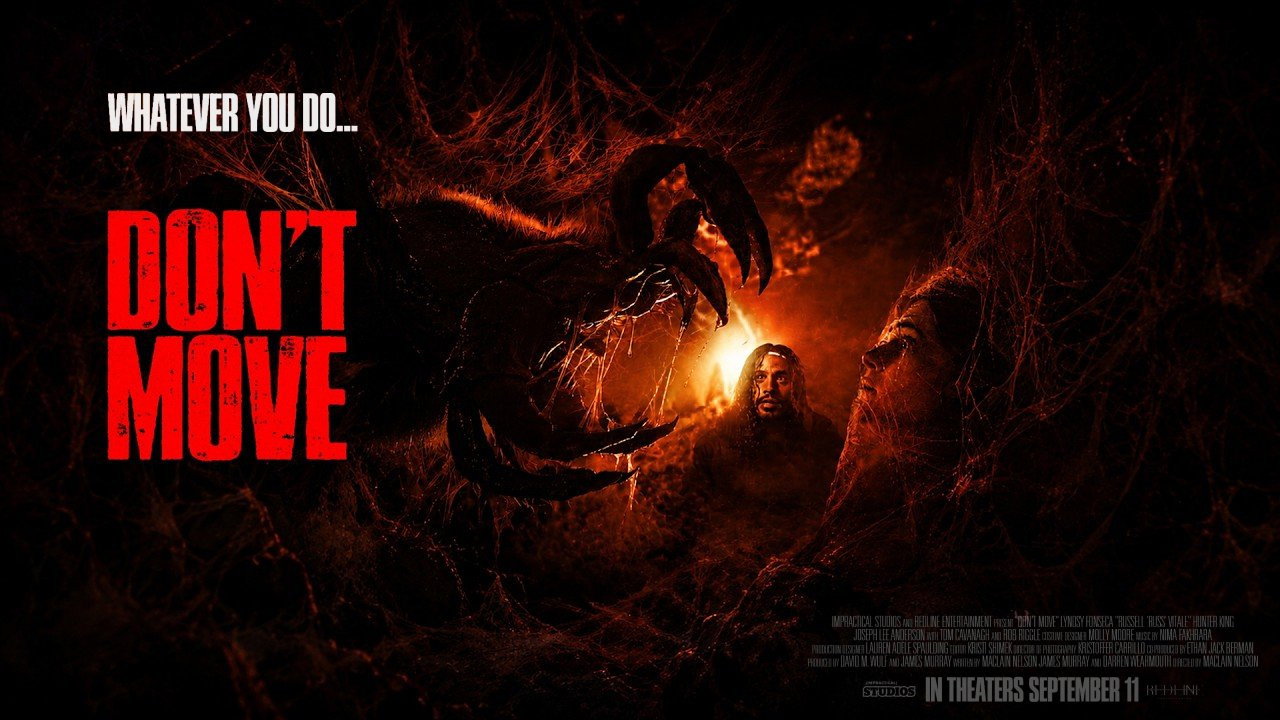
Our premise drops us amidst a group of hikers who pick the absolute worst bend in nature to get lost. It's not so much the wrong forest as the wrong screenplay—a territory where the characters' decisions seem dictated by an algorithm of forced passivity. When a prehistoric arachnid makes an entrance, one would expect the visceral explosion of the monster subgenre, that honest gore we celebrate in our archives. Instead, we encounter an absolute time mechanism that wipes out the agency of everyone involved. They just stand there, staring into the abyss, waiting for the threat to decide whether it breathes or yawns. It's a paralysis born not from fear, but from the complete lack of clear instructions given to the viewer on what to do with their eyeballs.
This formal drift turns the experience into a sort of involuntary art installation on catatonia. We cannot speak of a mere pacing slip, but rather of a structural choice that confuses tension with a frozen screen. Nima Fakhrara's ambient score attempts to patch the gaps with a sonic insistence that gives away the utter emptiness of what's happening on screen. Every single shot stretches to the biological limit of discomfort, reminding us that cinema sometimes prefers to choke to death on its own rhetoric rather than take a basic narrative risk. The viewer becomes yet another prisoner, chained to the seat by the morbid curiosity of seeing just how far silence can stretch before someone screams or the credits finally roll.

The direction and statism as dogma
Maclain Nelson's mise-en-scène entirely renounces the kinetic energy presupposed for a fossil-origin creature lurking in the thicket. Kristoffer Carrillo does what he can with the lighting, trying to sniff out textures in the forest gloom, but the camera itself seems infected by the protagonists' lethargy. Static framing rolls on like slides from a boring zoology textbook, rejecting any grammar of pursuit. The direction doesn't seek claustrophobia, but deliberate tedium—a high-risk gamble that ends up devouring whatever sparse virtues the production might have had on paper. Nelson seems obsessed with the notion that horror lies in waiting rather than action, forgetting that waiting without visual payoff is simply punishment. The camera doesn't breathe, doesn't shake, doesn't react; it's a cold, distant witness that flatly refuses to empathize with its subjects' panic. It's an aesthetic choice that, instead of ratcheting up tension, squashes it beneath the weight of its own rigidity. The result feels much more like a poorly edited nature documentary than a survival thriller, where the only permitted emotion is the spectator's awkwardness at not being able to change the channel.

Underfunded performances
The cast carries material that literally forbids them from acting in the dynamic sense of the word. Lyndsy Fonseca as Megan Forrester holds down peak tension moments with commendable restraint, staring blankly into the void while danger creeps in with exasperating slowness. Beside her, Tom Cavanagh and Rob Riggle wander the set desperately trying to inject urgency into dialogue born dead under the premise's weight. No one can shine when the script demands that your character's grandest dramatic arc is to not blink for five consecutive minutes in front of a giant insect. Fonseca nails a realistic degree of psychological terror, but she is left stranded in her effort. Cavanagh, a TV veteran, seems to have forgotten how to play an action scene, limiting himself to moving his mouth with the precision of a broken robot. Riggle, who should supply comic relief or an over-the-top reaction, gets stuck in a middle-ground of confusion that's neither funny nor terrifying. The script robs them of life, and professionals that they are, they try to salvage the unsalvageable through micro-expressions that the static camera fails to capture with proper clarity. It's a crying shame to see actors of this caliber reduced to porcelain mannequins in a forest that doesn't belong to them.
Technical department: Sound as a lifeline and cinematography as a brick wall
If the image is static, the sound tries to compensate with almost violent aggressiveness. Nima Fakhrara crafts a score that doesn't seek to accompany, but to dominate. Low rumbles and wood creaks take center stage, flooding the soundscape so the audience won't notice that visually, absolutely nothing is happening. It's a cheap yet effective magic trick: if you can't move the camera, move the ear. Kristoffer Carrillo's cinematography, however, falls painfully short. The color palette is monotonously drab, dominated by dark greens and muddy browns blending into an indistinguishable sludge. There's no depth of field inviting us to explore the frame, but rather a flat sharpness that flattens the scene entirely. The arachnid's production design is functional yet lacks that organic quality that makes a monster believable; it looks more like a rubber puppet than a living creature. The lighting doesn't play with shadows to breed mystery, but uniformly floods the scene, snuffing out any chance of visual ambiguity. It's a flick that leans way too hard on the concept and neglects technical execution, leaving viewers with the sensation of watching a rough draft of what could have been.
The best
- Conceptual commitment: Absolute fidelity to the movie's title, turning immobility into a genuine formal torture for the viewer.
- Lyndsy Fonseca: Her uncanny ability to transmit raw panic without moving a single facial muscle during the film's most critical stretches.
- Nima Fakhrara: A musical score desperately trying to rescue the most static sequences from a coma with dignity.
The worst
- Lethargic pacing: A narrative structure that confuses suspense suspension with absolute cerebral paralysis.
- Maclain Nelson's script: Flat dialogue and repetitive situations where the hikers seem to make everything worse simply by not moving.
- The arachnid: A prehistoric creature generating way more yawns than visceral terror with each of its appearances.
The Verdict of Claqueta Ácida
Don't Move is a laboratory experiment on the limits of cinematic tedium sitting awkwardly halfway between a prank and an involuntary avant-garde manifesto. Maclain Nelson has shot a monument to stillness where the only prehistoric creature truly terrifying is the script's own inertia. In the end, the only thing moving in the theater is your hand desperately hunting for the emergency exit before the arachnid decides to freeze you solid forever too. 💀
🎬 Tráiler Oficial
Abrir en YouTube
Don't Move: frequently asked questions
- What is the rating of "Don't Move" on Claqueta Ácida?
- "Don't Move" scored 4.5/10 on Claqueta Ácida in the review by Lúa Ácida.
- Is "Don't Move" worth watching?
- No. We gave it 4.5/10 (Sulfuric Acid), our rating for films we don't recommend.
- Who directed "Don't Move"?
- "Don't Move" was directed by Maclain Nelson.
Theater Collateral Damage Report
Psychophysical impact certificate issued by Lúa Ácida
Un letargo magnético que te invita a abrazar el sueño profundo antes del primer giro de guion.
Dan ganas de mirar el reloj cada vez que un personaje decide quedarse mirando un arbusto durante tres minutos.
Una cafetera industrial en vena, aunque ni el doble exprés salvará tus retinas del tedio.
"Cuando el arácnido prehistórico hace su primera aparición y el ritmo narrativo decide jubilarse anticipadamente."

The rebuttal from Odin Lagbert (Senior Cynicism Academic)
In stark disagreement with the review given by Lúa Ácida.
“Me hallo perplejo ante la acusación de que la obra se empeña en una quietud forzada; la verdad es que la cámara, con una precisión casi cirúrgica, registra la dilatación del espacio como si cada plano fuera una pintura de Vermeer, y esa deliberada lentitud revela la fragilidad de la memoria humana, un tema que Bresson abordó con reverencia. La ausencia de persecuciones desenfrenadas no es falta de energía, sino una elección estética que privilegia la atmósfera sobre la adrenalina, recordándonos que el terror puede nacer del silencio (silence est le vrai cri). La criatura prehistórica, lejos de ser un mero adorno, funciona como espejo de la propia vanidad del espectador, obligándolo a confrontar su propia inercia. No es aburrimiento, es reflexión. 6.8/10. No hay nada más vacío que pretender dinamismo.
💬 Community Verdict
What did you think of the film? Rate it from 0 to 10 to compare it with the editorial review.
You haven't voted yet
📢 ¿Te ha gustado el ácido?
Comparte esta crítica con tus amigos cinéfilos o desata la polémica en redes.
⚡ THE CINEMATIC VENOM YOUR INBOX CRAVES
No sugarcoated ratings, no corporate fluff. Subscribe for our uncensored weekly analysis or join the private Telegram for press previews, poll clashes, and instant alerts.
Alertas de estrenos en 1 segundo, encuestas en caliente y audios al salir de pases de prensa.
Recibe la dosis semanal en tu mail + regalo inmediato del PDF con 50 joyas ocultas de culto.
Related Reviews
Recommended autopsies for demanding film buffs.
 ⚠️ Ácido Sulfúrico 3.2
On the Run: A Senseless Sprint
⚡ Ambas sentenciadas al vertedero con ⚠️ Ácido Sulfúrico.
A marathon of clichés and marketing sweat that leaves the audience feeling like they've run in circles. 💀
 ⚠️ Ácido Sulfúrico 3.2
The Mutiny: The Mutation of Cheap Machismo
⚡ Ambas sentenciadas al vertedero con ⚠️ Ácido Sulfúrico.
Jason Statham returns to the screen with a movie that reeks of sweat and cheap marketing. Acidic, unfiltered review.
 ⚠️ Ácido Sulfúrico 3.2
Head to Head: Marfil – Acid Review
⚡ Ambas sentenciadas al vertedero con ⚠️ Ácido Sulfúrico.
A review that unearths the industrial garbage of 'Head to Head: Marfil', the Pokeepsie Films scam that leaves you with a red account and a headache.
Editorial Ecosystem
Cinephile connections, archive interviews and related analyses.
💬 Debate Cinéfilo & Autopsia de Lectores
0 veredictos¿Discrepas con nuestra nota? ¿Es una obra maestra o veneno puro? Deja tu veredicto abajo sin necesidad de registro.


Aún nadie ha dejado su veredicto para esta película.
Sé el primero en clavarle el colmillo rellenando el formulario de arriba.