Splinter — Bugs, Sweat, and Cheap Gasoline
A mutant parasite hijacks four misfortunates in a roadside gas station. 82 minutes of cheap but pulsating creature feature. It's not The Thing, but it hits hard.

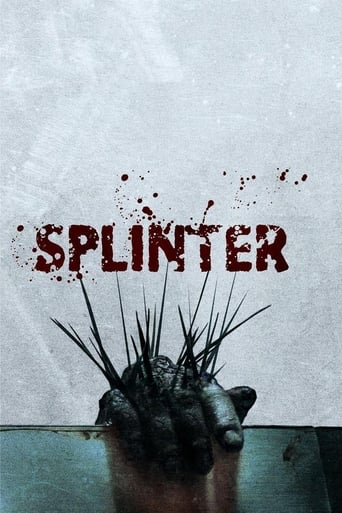
Splinter: full review
There are films that are born with a debt owed to the audience before the first light in the theater even flickers off. Splinter is one of them. It arrived in 2008 without making a sound, without a marketing campaign, without any pretense of changing the horror genre. And that, in an era where the remake of Dawn of the Dead had already proven that fast zombies could be business, was almost a declaration of principles. Toby Wilkins came from the world of visual effects and short films, and here he was given eighty-two minutes and four actors to prove whether he knew how to tell a story or just make corpses look pretty. The result is an uneven fight where the filmmaker wins on points, not by KO, but he stays standing when many others would have kissed the canvas in the first round.
The industrial context is the usual one: small production companies like Indion Entertainment Group and ContentFilm International pooling the few coins they had in their pockets to finance a roadside creature feature. The script by Kai Barry invents absolutely nothing. A couple, a fugitive criminal, an isolated gas station, and a parasite that turns its victims into spiky creatures. It is Carpenter's The Thing diluted with neighborhood gas station water, and it knows it. There is no metaphysics, no political subtext, no allegory about the fear of the other. There is a bug, there are people who want not to die, and there is a service station that smells of gasoline and panic. And sometimes, only sometimes, that is enough.
What surprises me about Splinter is that Wilkins understands something that many horror directors with ten times his budget do not: fear lives in what you don't show. The parasite is hinted at more than shown for a good part of the runtime. We see the effects of its passage—twisted bodies, limbs moving in directions God did not approve—but the creature itself is reserved for moments where the impact needs to be physical, not psychological. It is an intelligent decision that betrays Wilkins' training in visual effects: he knows what each shot with a creature costs and does not waste them. When he finally reveals the beast in all its cheap splendor, the effect is one of stifled laughter rather than genuine terror, but at least he has earned the right to that laugh.
The reception of the film reflects exactly what it is: a correct movie that neither offends nor enchants. And that is where I raise my hand and say: okay, it deserves some love, but don't ask me to declare my eternal love for it.

Direction and Staging
Toby Wilkins directs like someone who has seen too many Larry Cohen and John Carpenter films and has decided he wants to play too. The limitation of locations—basically a car, a gas station, and the surroundings—turns it into a confined space film where tension depends on geometry: who is where, which door is closed, which window is the exit. Wilkins handles that geometry with a pulse that is not brilliant but is competent, and in low-budget horror, competence is already half a victory.
There is a shot that stuck with me: the first time we see an infected arm moving on its own will, twisting as if it had a life of its own, bones cracking under the skin. It is an effective moment of body horror that reminds me of Cronenberg in his cheapest version, and Wilkins holds it just long enough to make your stomach turn without giving you time to laugh at how cheap it is. That balance is hard to maintain, and he maintains it for almost the entire runtime. Almost.
The problem arrives when Kai Barry's script decides it needs to explain things. There are moments where the characters start deducing the parasite's biology with a precision that would make a microbiologist smile, and there the film loses steam. Horror works better when it is instinct, not when it is theory. Every time someone opens their mouth to say "the parasite responds to temperature" or something similar, the suspension of disbelief wobbles like a boxer who has taken a hook to the jaw.

Cast and Performances
This is where Splinter unexpectedly stands tall. Shea Whigham, years before Boardwalk Empire consecrated him as one of the best character actors of his generation, carries this film on his shoulders. His Dennis Farell is an ex-convict who could have been a walking cliché—tattoos, bad attitude, hidden soft heart—but Whigham gives him a texture the script hasn't earned. There is a moment where he looks through the gas station glass and you see a man who has spent years locked up and is now facing something worse than prison. It is a silent shot, without dialogue, and it is the best part of the movie.
Paulo Costanzo and Jill Wagner as the newlywed couple fulfill their roles without standing out. Costanzo has the unenviable task of playing the nerd biologist who explains the plot, and he does so with the dignity of someone who knows his character is a narrative device with legs. Wagner has more physical presence and handles the action moments well, but the script doesn't give her much more than screaming and running. Charles Baker, who would later be Skinny Pete in Breaking Bad, appears briefly as Blake Sherman Jr. and leaves an impression of unease that is appreciated. Rachel Kerbs as Lacey has the most unenviable role: the criminal's girlfriend who exists mainly so there is someone else to scare.
Technical Aspects
Nelson Cragg's cinematography is textbook low-budget horror: cold tones, sickly greens, darkness that hides more due to budget than aesthetic choice. But within that limitation, Cragg finds moments of dirty beauty. The gas station at night, with its flickering fluorescent lights, is a space that conveys isolation and threat without anyone needing to say a word. The production design, what there is of it, works because it doesn't try to be what it isn't: a real roadside gas station, dirty, abandoned, with the bathroom nobody wants to use.
Elia Cmiral's soundtrack is an unexpected strong point. Cmiral, who had already worked in horror with films like They, understands that sound is half the scare. His score is not memorable as independent music, but as an atmospheric texture it fulfills its function: it unsettles without overwhelming, underscores without screaming. The sound design in general is solid, especially the creaks and cracks of the infected bodies, which have an organic quality that makes you squirm in your seat.
Editing is where Splinter shows its seams with the least shame. There are rhythm jumps that are noticeable, transitions that look like patches, and a couple of sequences where you feel material was missing or time was surplus. Eighty-two minutes is a runtime that should be mandatory for many horror films, but here it feels like Wilkins had to compress more than he wanted in some stretches.
The best
Shea Whigham: An actor who makes a three-line script character seem to have a novel behind him. He carries the film with a clenched jaw and the look of someone who has seen hell and is not impressed. The body horror: The practical effects of the infected bodies are cheap but effective. That arm twisting on its own will stays with you after you turn off the TV. The runtime: 82 minutes without fat. In an era where everything lasts two and a half hours, this is almost an act of rebellion. Cmiral's soundtrack: Unsettling without stepping into melodrama territory. It knows how to stay in the background when needed.
The worst
Kai Barry's script: It invents nothing and when it tries to explain the parasite's biology, it loses all credibility. Horror needs mystery, not improvised biology classes. The revealed creature: When it finally shows it whole, the practical effect looks like what it is: a doll with spikes. Imagination was more effective. The supporting characters: Rachel Kerbs and Laurel Whitsett do what they can with characters that are little more than parasite meat with dialogue. The uneven editing: Rhythm jumps that betray the seams of the budget and the rush of the editing room.
The Verdict of Claqueta Ácida
Splinter is like that regional boxing match you watch on a Sunday with nothing better to do: it doesn't change your life, you won't remember it in three months, but while it lasts, it keeps you watching. Wilkins proves he knows where to put the camera, and Whigham proves he knows how to carry an entire film with pure presence. But the script is lazy, the creature disappoints when revealed, and the whole thing smells of what it is: a correct horror movie made with little money and a lot of will. It fulfills its function as Sunday entertainment, but it stays three rounds short of being something that deserves reverence. If you like bugs and roadside gas stations, give it a chance. If you are looking for the next Carpenter, keep looking. 💀
🎬 Tráiler Oficial
Abrir en YouTube
Splinter: frequently asked questions
- What is the rating of "Splinter" on Claqueta Ácida?
- "Splinter" scored 6.2/10 on Claqueta Ácida in the review by Camilo K.O..
- Is "Splinter" worth watching?
- With reservations. We gave it 6.2/10 (Citric Acid), our rating for uneven films with something worth saving.
- Who directed "Splinter"?
- "Splinter" was directed by Toby Wilkins.
Theater Collateral Damage Report
Psychophysical impact certificate issued by Camilo K.O.
1 amago en el tramo intermedio; pestañeo pesado en las transiciones más innecesarias.
Un par de miradas al reloj en el tramo intermedio, comprobando cuánto quedaba de suplicio.
1 espressos para no dejarse vencer por la mediocridad cómoda.
"A mitad del segundo acto cuando la subtrama secundaria empezó a pesar más de lo que aportaba."
💬 Community Verdict
What did you think of the film? Rate it from 0 to 10 to compare it with the editorial review.
You haven't voted yet
📢 ¿Te ha gustado el ácido?
Comparte esta crítica con tus amigos cinéfilos o desata la polémica en redes.
⚡ THE CINEMATIC VENOM YOUR INBOX CRAVES
No sugarcoated ratings, no corporate fluff. Subscribe for our uncensored weekly analysis or join the private Telegram for press previews, poll clashes, and instant alerts.
Alertas de estrenos en 1 segundo, encuestas en caliente y audios al salir de pases de prensa.
Recibe la dosis semanal en tu mail + regalo inmediato del PDF con 50 joyas ocultas de culto.
Related Reviews
Recommended autopsies for demanding film buffs.
 ⚡ Ácido Cítrico 7.1
28 Years Later: The Bone Temple: when cult cinema trips over its own shadow
⚡ Afinidad temática directa en atmósfera, estilo y fijaciones visuales.
A sequel that smells rotten from the very first frame. Garland and DaCosta try to revive the genre, but the result is a technical knockout dressed up as a masterpiece.
 ⚡ Ácido Cítrico 5.8
A Serbian Film: The Snuff That Thought It Was Art (and Ended Up a High-School Nightmare)
⚡ Afinidad temática directa en atmósfera, estilo y fijaciones visuales.
Srđan Spasojević serves up a depravity feast swinging between gratuitous shock and social commentary. Genius or pretentious trash? Claqueta Ácida dissects it with surgical precision.
 ⚡ Ácido Cítrico 6.0
Adolescence, Sex, and Death at Camp Miasma: The Slasher That Reeks of Teen Sweat and a Recycled Script
⚡ Afinidad temática directa en atmósfera, estilo y fijaciones visuales.
Jane Schoenbrun turns a summer camp into a dumpster fire of hormones and clichés. Art or autopsy of a dying subgenre?
Editorial Ecosystem
Cinephile connections, archive interviews and related analyses.
💬 Debate Cinéfilo & Autopsia de Lectores
0 veredictos¿Discrepas con nuestra nota? ¿Es una obra maestra o veneno puro? Deja tu veredicto abajo sin necesidad de registro.


Aún nadie ha dejado su veredicto para esta película.
Sé el primero en clavarle el colmillo rellenando el formulario de arriba.