Pearl — When Technicolor Bleeds and Melodrama Becomes Nightmare
Ti West and Mia Goth team up for a mesmerizing and unhinged retro slasher that pays homage to classic Hollywood melodrama and deranged minds.

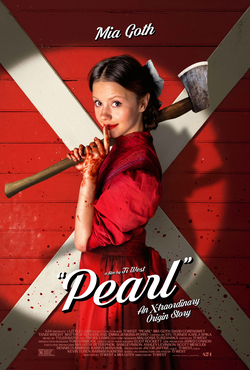

Pearl: When Technicolor Bleeds and Melodrama Becomes Nightmare
In a world where horror cinema has become a dumping ground for prefab jump scares, zombified franchise sequels, and remakes that reek of corporate mothballs, Ti West decided in 2022 that it was the perfect time to play Victor Fleming and Alfred Hitchcock at the same time. And boy, did he pull it off. With Pearl, the director didn’t just prove that a prequel could outshine its predecessor (X); he also reminded us that psychological horror can be as visually lush as a Busby Berkeley musical… as long as you’re willing to watch that lushness drip with blood and madness.
A Trip to the Dark Heart of the American Dream (Or How Technicolor Masks the Rot)
If X was a grimy, sweaty love letter to 70s exploitation cinema, Pearl is its stylistic antithesis: a nightmare drenched in the most saturated colors celluloid can handle. West and cinematographer Eliot Rockett didn’t just recreate the look of 1930s classic cinema—they perverted it with almost sadistic intent. Every frame looks plucked from The Wizard of Oz (1939) or Gone with the Wind (1939), but with a macabre twist: the golden fields of Texas aren’t the backdrop for a rural idyll but the stage for a mind unraveling. Pearl’s dresses, a passionate red that looks painted with her victims’ blood, clash with the pastel tones of her surroundings, creating a visual dissonance that mirrors her duality—the innocent girl who never grew up and the killer who couldn’t hold back.
This aesthetic choice isn’t just window dressing. West uses classic melodrama as a funhouse mirror, showing how the American Dream—that ideal of prosperity, fame, and happiness—can rot from within. Pearl isn’t just a psychopath; she’s the product of a society that promised her the world and gave her a farm in the middle of nowhere, a disabled father, an oppressive mother, and a pandemic that wiped out half of humanity. Her obsession with becoming a star isn’t whimsy; it’s a pressure valve for an existence that reeks of manure and despair. And when that dream is denied (as it is in a key scene where a casting director rejects her with a cruel euphemism), the violence isn’t just an act of madness—it’s a distorted form of poetic justice.
Mia Goth: The Performance That Should’ve Won an Oscar (And That Hollywood Ignored Due to Gender Bias)
If there’s one element that elevates Pearl from “good horror movie” to “contemporary cinema masterpiece,” it’s Mia Goth’s tour de force performance. The British actress doesn’t just chew the scenery—she devours it, masticates it, and spits it out unrecognizable. Her Pearl is a hurricane of contradictory emotions: cloying sweetness, pent-up rage, childlike desperation, and a cruelty that oozes like pus from an infected wound. Goth doesn’t play a character; she becomes it, with an intensity that recalls the great dames of classic melodrama—Bette Davis, Joan Crawford—but with a modern twist: her character isn’t a tragic victim but a killer who victimizes herself.
The pinnacle of her performance comes in that nearly ten-minute single take where Pearl confesses her crimes to her sister-in-law (played by Tandi Wright). No cuts, no escape, no redemption. Just Goth, a chair, a static camera, and a torrent of words that swing from self-pity to veiled threats, punctuated by a nervous laugh that cracks into sobs. It’s a scene that should be studied in acting schools—not just for its technique, but for its ability to generate pure discomfort. And then there’s that final smile, held for three minutes during the credits, with bloodshot eyes and an expression that oscillates between ecstasy and horror. It’s the kind of detail that separates great actors from mere performers: Goth doesn’t just act, she inhabits madness.
The Soundtrack: When Melodrama Becomes a Symphony of Madness
If the cinematography is Pearl’s body, the soundtrack is its sick soul. Composed by Tyler Bates and Ti West himself, the film’s music is a brilliant pastiche of classic Hollywood symphonic scores, but with a perverse twist. The themes are grandiose, almost operatic, as if Max Steiner had scored a Dario Argento film. There are waltzes that sound like debutante balls but accompany scenes of graphic violence; angelic choirs that overlay double-entendre-laden dialogue; and a recurring leitmotif that evokes both Gone with the Wind and Psycho (1960).
This musical choice isn’t accidental. West uses the score to underscore Pearl’s tragic irony: her life is a 1930s movie, but one where the heroes are villains and the villains are victims. When Pearl dances in the barn, dreaming of stardom, the music is cheerful and nostalgic; when she buries a body, the same theme sounds distorted, as if the gramophone in her mind has broken. It’s a masterful way of showing how reality and fantasy blur in her head until she can no longer tell them apart.
The Pacing: Slower or Deeper?
One of Pearl’s few weak points—and one some viewers might consider a flaw—is its pacing. Unlike X, which was a breakneck slasher with the rhythm of The Texas Chain Saw Massacre (1974), Pearl is a more measured, almost contemplative film. The first two acts focus on character development, with an oppressive atmosphere that recalls Rebecca (1940) or The Shining (1980), though without Kubrick’s psychological density. West takes his time building Pearl’s psyche, showing her daily life, her shattered dreams, and her toxic relationship with her mother (a scene-stealing Tandi Wright with her Germanic chill).
The murders, when they arrive, are brutal and well-choreographed, but they’re packed into the final third of the film. This might disappoint those expecting a bloodbath from the get-go, but it’s consistent with West’s vision: Pearl isn’t a slasher, it’s a character study in horror. The violence isn’t the point; it’s the result of a mind cracking under the weight of its own expectations. That said, there’s no denying the film loses steam at times, especially in the second act, where tension dissipates in favor of development that, while necessary, might feel slow to audiences used to modern cinema’s frenetic pace.
The Connection to X: Necessary Prequel or Stylistic Exercise?
One question that arises when watching Pearl is whether it needed to be a prequel to X. The answer is a resounding no… and an enthusiastic yes. On one hand, the film works perfectly as a standalone story: it’s a psychological drama with gothic horror elements, and its connection to X is more thematic than narrative. Pearl could be any woman in any era, trapped in an oppressive system that drives her to madness. That her fate is tied to Maxine’s (the X protagonist) is almost incidental.
But on the other hand, knowing X adds layers of meaning to Pearl. The post-credits scene, where we see Pearl in her old age (played again by Goth in a twist reminiscent of Gloria Swanson in Sunset Boulevard), doesn’t just close the loop—it reinforces the idea that horror isn’t something that emerges out of nowhere but is cultivated over decades. Pearl isn’t a monster; she’s the product of a lifetime of repression, loneliness, and broken dreams. And Maxine, in X, is her distorted reflection: a woman who, in the 1970s, tries to take control of her sexuality and destiny but is also doomed to repeat the mistakes of the past.
Cinephile Comparisons: When Horror Embraces Classicism
Pearl doesn’t exist in a vacuum. It’s a film that draws from multiple sources, both classic cinema and modern horror, fusing them into something unique. Here are some of the most evident (and necessary) comparisons:
1. The Wizard of Oz (1939) + The Shining (1980): Pearl’s saturated color palette and dreamlike settings inevitably recall Victor Fleming’s masterpiece, but with Kubrick’s claustrophobic madness. If Dorothy had been a psychopath instead of a lost girl, her journey down the yellow brick road would’ve ended in a bloodbath.
2. Gone with the Wind (1939) + Carrie (1976): Pearl’s obsession with fame and glamour evokes Scarlett O’Hara, but her final violent outburst has the bitter taste of Carrie White’s revenge. Both are women pushed to the edge by a world that rejects them, but while Carrie is a victim, Pearl is an executioner who believes she’s the victim.
3. Psycho (1960) + Sunset Boulevard (1950): Pearl’s duality—the sweet girl and the killer—recalls Norman Bates, but her obsession with stardom and tragic ending align her more with Norma Desmond. Both are women trapped in a dream that will never come true, but while Norma drowns in self-pity, Pearl drowns in homicidal insanity.
4. The Cabinet of Dr. Caligari (1920) + Suspiria (1977): Pearl’s visual distortion, with its expressionist framing and use of color as a psychological element, evokes German cinema of the 1920s, but with Dario Argento’s baroque, bloody aesthetic. It’s as if Caligari had directed a Technicolor horror musical.
Conclusion: An Uncomfortable and Necessary Masterpiece
Pearl is one of those films that defies expectations. It’s not a conventional slasher, nor a traditional psychological drama, nor a nostalgic homage. It’s all of those things and none of them at once. Ti West has created a film that is, above all, a stylistic exercise—but one with soul. He doesn’t just imitate classic cinema; he perverts it, subverts it, and turns it into something new.
Mia Goth, for her part, delivers a performance that should be studied in film schools. It’s not just one of the best performances of the year; it’s one of the best of the decade. Her Pearl is a complex, tragic, and terrifying character—a woman who could’ve been a heroine in another film but is a villain here, one who steals the viewer’s heart despite her crimes.
Is Pearl a perfect film? No. Its pacing might feel slow to some, and its reliance on X (though not strictly necessary) adds a layer of meaning not everyone will appreciate. But these are minor flaws in a film that, at its core, is a masterpiece of psychological horror and gothic melodrama.
In a cinematic landscape dominated by soulless franchises and unimaginative remakes, Pearl is a breath of fresh air… or rather, a breath of poisoned air. It’s a film that will leave you smiling, yes, but with an uncomfortable smile, as if you’ve just witnessed something you shouldn’t have seen. And that, in the end, is what makes great horror cinema.
finalExplicado: "Pearl, consumida por el rechazo, la humillación y la fantasía de ser una estrella, asesina brutalmente a su madre, a su padre inválido y a su amante projectionista. En el clímax, baila eufóricamente ante el cadáver de su madre mientras las lágrimas y la sangre se mezclan, luego sonríe con locura absoluta a cámara en un plano fijo de Technicolor saturado. Simbólicamente, el final significa la completa victoria del delirio sobre la realidad: Pearl se convierte en la monstruosa diva que siempre soñó ser, pero a costa de aniquilar todo lo humano. El arcoíris psicótico no es esperanza, sino la máscara brillante de una psicopatía rural americana que devora todo lo que toca. El sueño de Hollywood y el infierno se funden en un mismo color."
The Best
- Mia Goth devours the screen (and her co-stars): A performance so histrionic yet precise it swings between tenderness and horror as naturally as flipping channels. If this didn’t earn her an Oscar, it’s because the Academy still thinks horror isn’t “serious cinema.”
The Worst
- The pacing: when patience becomes saintly endurance: The first 40 minutes are a fascinating character study, but also a reminder that not everyone has the patience of a Buddhist monk waiting for Pearl to start killing.
The Verdict of Claqueta Ácida (8.7/10)
Pearl is that rare horror gem that manages to be a homage, a social critique, and a visual nightmare all at once. Ti West proves you can make an auteur film with blood, sweat, and tears (literal ones), while Mia Goth delivers a performance that should be enshrined in the pantheon of horror’s sacred monsters. Is it uncomfortable? Of course. Will it leave you grinning ear to ear with a knot in your stomach? Absolutely. After all, the best horror isn’t the kind that makes you scream—it’s the kind that whispers in your ear while plunging a knife into your back. And Pearl whispers very well.🎬 Tráiler Oficial
Abrir en YouTube
Ending Explained: Pearl
Ficha de Daños Colaterales en Sala
Certificado de impacto psicofísico emitido por Héctor Veneno
Cero. La pantalla absorbió cada segundo de atención disponible.
Ninguna comprobación del tiempo. Se agradece la rareza.
Ninguna. Guarda el café para la sesión siguiente.
"No aplica. La obra se sostiene sola."
💬 El Veredicto de la Comunidad
¿Qué te ha parecido la película? Deja tu nota de 0 a 10 para contrastarla con el análisis de la redacción.
Aún no has votado
📢 ¿Te ha gustado el ácido?
Comparte esta crítica con tus amigos cinéfilos o desata la polémica en redes.
⚡ THE CINEMATIC VENOM YOUR INBOX CRAVES
No sugarcoated ratings, no corporate fluff. Subscribe for our uncensored weekly analysis or join the private Telegram for press previews, poll clashes, and instant alerts.
Alertas de estrenos en 1 segundo, encuestas en caliente y audios al salir de pases de prensa.
Recibe la dosis semanal en tu mail + regalo inmediato del PDF con 50 joyas ocultas de culto.
Related Reviews
Recommended autopsies for demanding film buffs.
 🔥 Fusión Nuclear8.5
*X: The Bloody, Sweaty Resurrection of Analog Slasher Cinema*
⚡Del mismo director (Ti West): analiza la evolución o degradación de su estilo.
Ti West delivers a filthy, lascivious, and razor-sharp love letter to '70s indie porn and rural slasher classics, set on a Texas farm where the only thing sharper than the knives is the satire.
 🔥 Fusión Nuclear8.0
Abigail: Ballet, Rivers of Hemoglobin, and the Worst Nightmare of a Discount Kidnapping Gang
⚡Afinidad temática directa en atmósfera, estilo y fijaciones visuales.
Radio Silence signs a delightfully entertaining, bloody, and hyperbolic vampire slasher within a mansion where a twelve-year-old ballerina is the monster.
 🔥 Fusión Nuclear8.5
*Alleluia: Love as a Terminal Illness (or How to Turn Crimes of Passion into a Sweaty, Fleshy Spectacle)*
⚡Afinidad temática directa en atmósfera, estilo y fijaciones visuales.
Fabrice Du Welz reimagines the myth of the lonely hearts killers in a feverish whirlwind of jealousy, submission, and blood, led by Lola Dueñas in a performance that’s equal parts hypnotic and harrowing.
Editorial Ecosystem
Cinephile connections, archive interviews and related analyses.
🎞️ In Claqueta Cinematheque1
💬 Debate Cinéfilo & Autopsia de Lectores
0 veredictos¿Discrepas con nuestra nota? ¿Es una obra maestra o veneno puro? Deja tu veredicto abajo sin necesidad de registro.


Aún nadie ha dejado su veredicto para esta película.
Sé el primero en clavarle el colmillo rellenando el formulario de arriba.