Sirat — Trance in the Desert: Oliver Laxe Turns the Sahara into a Single-Take Ecstasy of Mystic Sweat and Existential Dread
Oliver Laxe delivers a hypnotic masterpiece where the Moroccan desert becomes a character in its own right—sweaty, hallucinogenic, and transcendent. Raw, filthy, and pure cinema. 9/10.

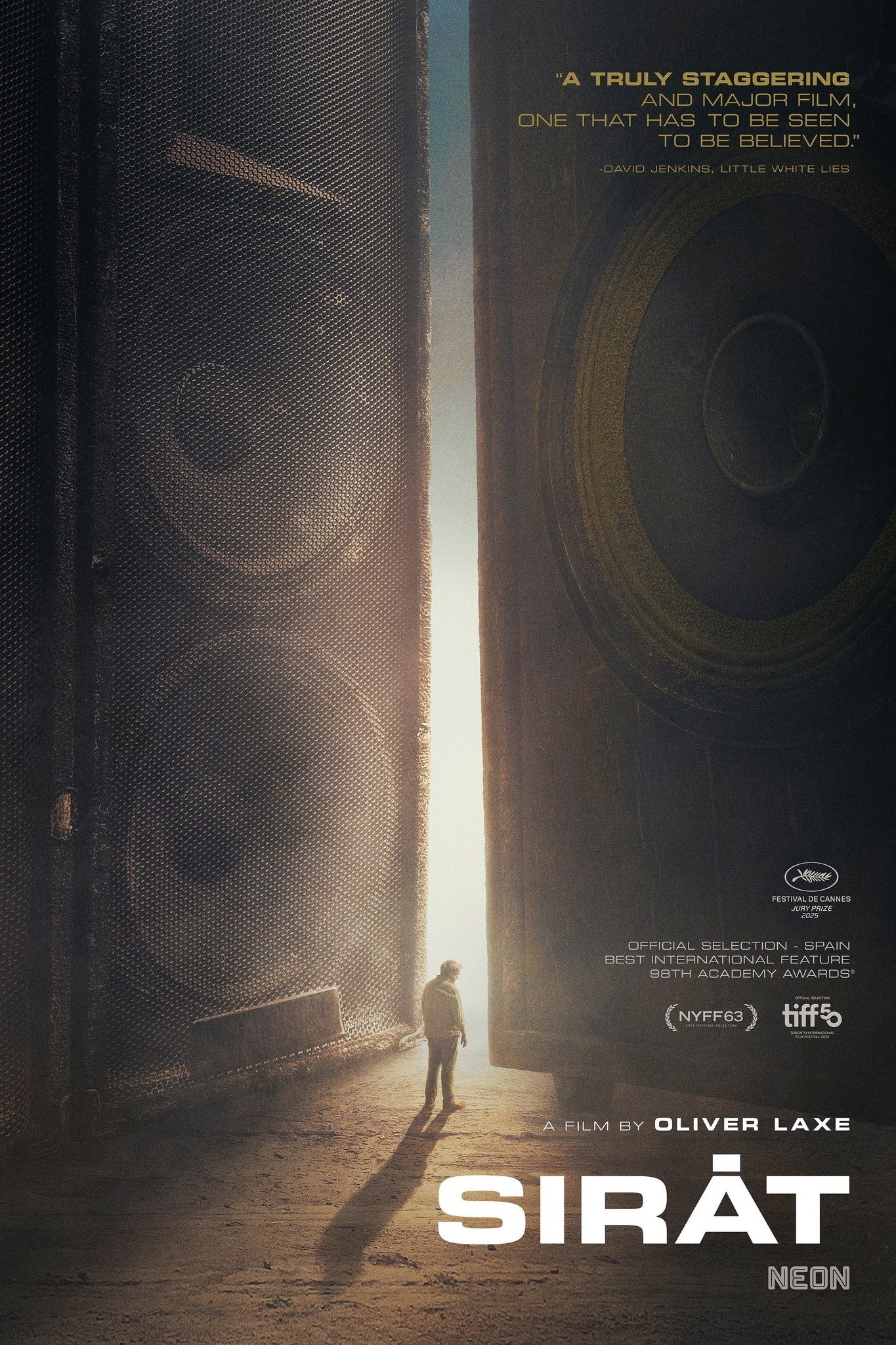

The desert has never been this articulate. Oliver Laxe, that Galician alchemist who turned the Moroccan Atlas into his personal canvas with Mimosas (2016), returns with Sirat: Trance in the Desert to prove that cinema can still be an act of visual sorcery. It’s no coincidence his filmography echoes those cursed directors who’d rather vanish into hostile geographies than shoot a single frame in an air-conditioned studio. Laxe, like Béla Tarr or Apichatpong Weerasethakul, understands that cinematic time isn’t measured in minutes, but in the density of the air, the texture of dust clinging to skin, and the light that sears your retinas. Here, southern Morocco isn’t a backdrop—it’s a character, a living organism that breathes, perspires, and, above all, hallucinates. Sirat isn’t watched; it’s endured, sweated through, chewed like a dried date under a merciless sun. Welcome to the Laxean trance, where ecstasy doesn’t come in pills, but in single-takes that last as long as a sigh from Allah in the middle of nowhere.
The genesis of Sirat is as fascinating as its result. After the critical success of Mimosas—which snagged the Grand Prix at Cannes’ Critics’ Week—Laxe could’ve retreated into the elite festival circuit, signing screenplays in Parisian cafés while linen-clad producers whispered about serious projects in his ear. But no. The Galician, a true heretic of contemporary cinema, decided his next film would be shot in the middle of a rave lost in the Anti-Atlas mountains, with a skeleton crew, a budget that wouldn’t buy a coffee at the San Sebastián Film Festival, and a cast where Sergi López—that fetish actor of physical endurance—would play a father dragging his son into the unknown. The premise sounds like a documentary on human madness, but Laxe turns it into a sensory experience oscillating between a mystical road movie and a lysergic trip filmed with the solemnity of a Sufi ritual. There’s no script in the traditional sense, just a series of situations unfolding like dunes shifted by the wind: unpredictable, hypnotic, sometimes irritating, but always necessary.
The industrial context in which Sirat was born is equally revealing. In an era where Spanish cinema vacillates between shoddy blockbusters and cookie-cutter social dramas, Laxe operates as a lone sniper, financed by Movistar Plus+—which, against all odds, still bets on risky auteur cinema—and Los Desertores Films, a production company that seems plucked from a Bolaño novel. There are no Prime Video stars, no influencer cameos, no dialogue written for viral tweets. Here, the only influencer is the sun, beating down on the characters like an implacable judge. Yet Sirat isn’t hermetic or an empty stylistic exercise. It’s pure cinema: dirty, sweaty, sometimes frustrating, but always alive. As if Andrei Tarkovsky had directed a Mad Max remake on a student short-film budget, with dialogue improvised in Darija. The result is a work that defies categories, a film that refuses to be tamed by Netflix algorithms or festival palmarès. It’s what happens when cinema refuses to be a product and decides, once again, to be a miracle.
The choice of Mauro Herce as cinematographer isn’t accidental. Herce, Laxe’s frequent collaborator, is a master at capturing light as if it were a thick liquid, something that spills over characters and landscapes with an almost obscene intensity. In Sirat, the camera doesn’t just record—it devours. The wide shots of the desert seem plucked from a fever dream, with those ochre and reddish tones that burn the screen as if the projector were about to burst into flames. And then there are the close-ups—those faces weathered by sun and wind, where every wrinkle seems to tell a millennia-old story. Herce and Laxe work with a color palette ranging from ochre to absolute black, punctuated by electric blues that appear in moments of peak ecstasy—as if the sky had split open to let through a divine glimmer. The editing, meanwhile, is deliberately slow but never boring. Every cut carries the weight of an existential decision, as if the editor were choosing between saving a soul or condemning it to oblivion. And amid it all, the soundtrack—a mix of ambient sounds, electronic music, and eloquent silences—acts as another character, a heartbeat accompanying the protagonists on their journey into the unknown.
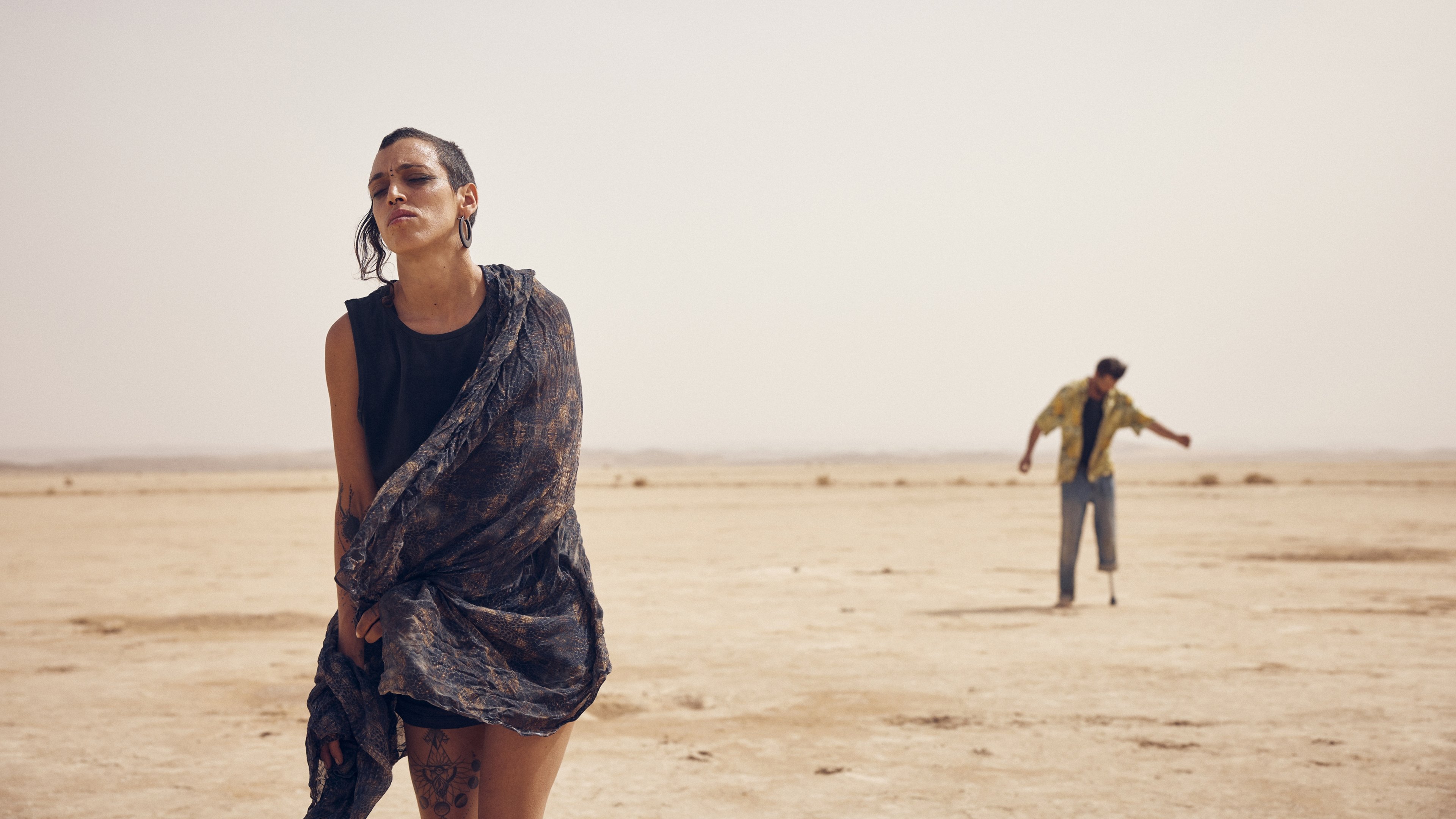
The direction: The desert as an existential single-take
Oliver Laxe doesn’t direct—he conjures. Every frame of Sirat feels like the product of a pagan ritual where celluloid is the altar and the sun, the high priest. The Galician proves once again he’s one of the few contemporary filmmakers capable of turning the mundane into the transcendent without lapsing into pretension or cheap mysticism. His style, a direct heir to the Romanian New Wave and the slow cinema of Lav Diaz, is built on patience: the camera waits, observes, breathes in sync with the characters. There’s no rush, because in the desert, time doesn’t exist. Some sequences last as long as a sigh, others stretch like an agony, but all share that hypnotic quality that makes Sirat a near-physical experience. Laxe isn’t afraid of silence, empty frames, or the viewer’s discomfort. On the contrary, he seems to revel in it, as if he knows cinema, in its purest form, is an act of resistance against the speed of the modern world.
The opening sequence—a nearly ten-minute single-take of Sergi López and Bruno Núñez walking through an arid landscape while the camera stalks them like a predator—is a statement of intent. No dialogue, no music, no explanations. Just the sound of their footsteps, the wind, and the crunch of earth beneath their feet. It’s cinema in the raw, unadorned, uncompromising. Laxe understands that cinema’s greatness lies not in what’s shown, but in what’s suggested, and in Sirat, every frame seems to contain an entire universe of hidden meanings. The desert, with its barren mountains and endless valleys, becomes a mirror of the human condition: arid, implacable, yet capable of moments of overwhelming beauty. And Laxe, like a modern shaman, knows exactly how to capture that duality.

The performances: Flesh, sweat, and ecstasy
The cast of Sirat is a mix of professionals and non-actors, but they all share one essential quality: they seem real. No overacting, no grandiose gestures, no forced dialogue. Sergi López, as the father, is simply masterful. His performance is physical, visceral, as if every step in the desert costs him a piece of his soul. López, an actor who’s worked with Álex de la Iglesia and Guillermo del Toro, proves here he can also shine in the most contemplative cinema. His chemistry with Bruno Núñez, who plays his son, is one of the film’s great triumphs. Núñez, a non-professional actor, has a magnetic, almost animal presence. He doesn’t act—he exists. His gaze, sometimes lost, sometimes defiant, perfectly reflects the confusion and fascination he feels toward the journey his father has imposed on him.
The rest of the cast delivers, especially Stefania Gadda, who plays a mysterious woman the protagonists encounter in the middle of nowhere. Gadda, with her angular face and piercing gaze, seems plucked from a Caravaggio painting. Her character is enigmatic, almost supernatural, and her presence adds a layer of mystery that Laxe exploits with mastery. The supporting actors, like Joshua Liam Henderson or Richard Bellamy, add nuance to a story that, in less capable hands, could’ve slipped into Manichaeism. But Laxe doesn’t judge his characters: he observes them, understands them, and shows them in all their complexity. There are no heroes or villains in Sirat, just lost human beings in a landscape that overwhelms them.
The technical department: When the desert becomes art
The script of Sirat is deliberately minimalist. There are no spectacular plot twists, no memorable dialogue, no conventional narrative structure. What there is, is atmosphere, and that’s enough. Laxe and his team have crafted a film where what matters isn’t what happens, but how it happens. The script, written by Laxe himself, functions like a musical score: it sets a rhythm, outlines themes, but leaves room for improvisation and surprise. There are moments when the film seems to meander, lost in its own labyrinth, but even those instances have an internal logic, as if Laxe were reminding us that life doesn’t follow a script—it unfolds chaotically and beautifully.
The cinematography by Mauro Herce is, quite simply, dazzling. Herce, who already proved his talent in Mimosas, takes his style to new heights here. His frames are painterly compositions where light and color combine to create images of almost unbearable beauty. The wide shots of the desert, with their reddish tones and elongated shadows, seem plucked from a fever dream. And the close-ups, especially those of the actors’ faces, are brutally intense. Herce isn’t afraid of darkness, extreme contrasts, or saturated colors. His photography is visceral, almost tactile, as if you could feel the sun’s heat on the screen.
The editing, by Nicolas van Hemelryck, is another of the film’s strengths. Van Hemelryck, a frequent Laxe collaborator, understands that Sirat’s rhythm can’t be conventional. Some sequences stretch to the point of discomfort, while others pass in a breath, but all are perfectly calculated to create a sense of trance. The editing doesn’t aim to entertain—it aims to immerse, and in that sense, it succeeds brilliantly. The soundtrack, composed by Xabier Erkizia, is equally brilliant. Erkizia blends ambient sounds—the wind, the crunch of earth, the murmur of voices—with minimalist electronic music to create a unique atmosphere. There are no catchy melodies or recurring themes, but the music fulfills its role: accompanying the characters on their journey without imposing itself or distracting.
The best
- Oliver Laxe’s direction: A masterclass in patience and visual mastery that turns the desert into a hypnotic, transcendent character.
- Mauro Herce’s cinematography: Images that burn the screen, with a color palette ranging from ochre to absolute black, punctuated by electric blues that seem like divine glimmers.
- The performances of Sergi López and Bruno Núñez: Physical, visceral performances that feel stolen from reality. López is masterful, and Núñez is a flesh-and-blood revelation.
- The editing and soundtrack: A deliberately slow rhythm that immerses the viewer in a hypnotic trance, accompanied by music that seems to emerge from the desert itself.
The worst
- The pacing: Not a film for the impatient. Some sequences drag longer than necessary, and the overall tempo may frustrate those seeking action or witty dialogue.
- The lack of context: Laxe chooses not to explain almost anything, which may leave some viewers lost in the narrative desert.
- The ending: Not disappointing, but abrupt. Some viewers may feel the film ends too soon, without a clear resolution.
The Verdict of Claqueta Ácida
Sirat: Trance in the Desert is one of those films that arrives to remind us cinema can still be an act of magic. Oliver Laxe has created a hypnotic, visceral, and profoundly human work where the desert isn’t a backdrop, but a mirror of our own souls. It’s not an easy film, nor a complacent one, nor designed for quick consumption. It’s pure cinema—dirty and transcendent—that demands from the viewer the same things the desert demands from its characters: patience, endurance, and blind faith in the unknown. If Mimosas was his masterpiece, Sirat confirms him as one of the great filmmakers of our time. Don’t watch it—live it. And then, when you leave the theater, try not to get lost on your way home. 💀
🎬 Tráiler Oficial
Abrir en YouTube
Ending Explained: Sirat
Ficha de Daños Colaterales en Sala
Certificado de impacto psicofísico emitido por Odin Lagbert
Cero bostezos. Pupilas dilatadas y tensión mandibular constante.
Ninguna comprobación del tiempo. Se agradece la rareza.
Ninguna. Guarda el café para la sesión siguiente.
"No hubo. La coherencia se mantuvo hasta el último fotograma."
💬 El Veredicto de la Comunidad
¿Qué te ha parecido la película? Deja tu nota de 0 a 10 para contrastarla con el análisis de la redacción.
Aún no has votado
📢 ¿Te ha gustado el ácido?
Comparte esta crítica con tus amigos cinéfilos o desata la polémica en redes.
⚡ THE CINEMATIC VENOM YOUR INBOX CRAVES
No sugarcoated ratings, no corporate fluff. Subscribe for our uncensored weekly analysis or join the private Telegram for press previews, poll clashes, and instant alerts.
Alertas de estrenos en 1 segundo, encuestas en caliente y audios al salir de pases de prensa.
Recibe la dosis semanal en tu mail + regalo inmediato del PDF con 50 joyas ocultas de culto.
Related Reviews
Recommended autopsies for demanding film buffs.
 🔥 Fusión Nuclear8.5
*Alleluia: Love as a Terminal Illness (or How to Turn Crimes of Passion into a Sweaty, Fleshy Spectacle)*
⚡Afinidad temática directa en atmósfera, estilo y fijaciones visuales.
Fabrice Du Welz reimagines the myth of the lonely hearts killers in a feverish whirlwind of jealousy, submission, and blood, led by Lola Dueñas in a performance that’s equal parts hypnotic and harrowing.
 🔥 Fusión Nuclear8.5
*High Tension (Haute Tension): The Brutal Birth of the New French Extremism – Or How to Turn Flesh into Poetry with a Machete*
⚡Afinidad temática directa en atmósfera, estilo y fijaciones visuales.
Alexandre Aja shocked global screens with a relentless rural bloodbath, redefined by breakneck pacing and a divisive twist that splits serious cinephiles right down the middle.
 🔥 Fusión Nuclear8.5
*Aterrados: The Rebirth of Ghost Stories in the Raw Grit of Buenos Aires*
⚡Afinidad temática directa en atmósfera, estilo y fijaciones visuales.
Demian Rugna revolutionizes paranormal horror—possessions, poltergeists, and all—by transplanting it to a residential neighborhood in Buenos Aires, armed with a devastating sound design that rattles your bones.
Editorial Ecosystem
Cinephile connections, archive interviews and related analyses.
💬 Debate Cinéfilo & Autopsia de Lectores
0 veredictos¿Discrepas con nuestra nota? ¿Es una obra maestra o veneno puro? Deja tu veredicto abajo sin necesidad de registro.


Aún nadie ha dejado su veredicto para esta película.
Sé el primero en clavarle el colmillo rellenando el formulario de arriba.