Wild Horse Nine — The Farce of the Duel and Cardboard Geopolitics
Martin McDonagh transplants Malkovich and Rockwell to Easter Island in Wild Horse Nine, a tragedy disguised as a CIA conspiracy.


Wild Horse Nine: full review
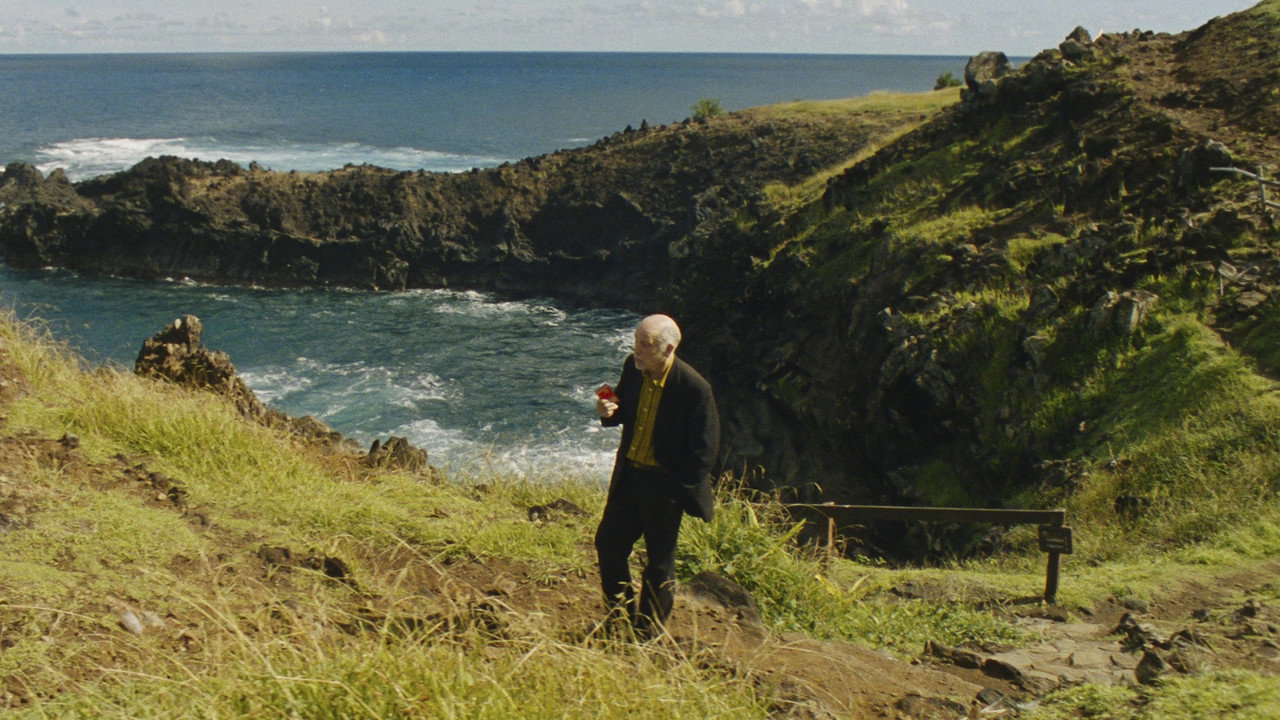
There are directors who seem incapable of abandoning their own auteur inertia, as if each new script were an exercise in conscious repetition before the mirror of public recognition. Martin McDonagh returns with Wild Horse Nine, a proposal that takes official history as a pretext to construct a territory where Cold War geopolitics becomes a minor excuse to talk about intimate guilt. Far from delivering the typical dark-office thriller, the British filmmaker transfers the nervousness of American intelligence to an enclave as unusual as Easter Island, right in the weeks leading up to the 1973 Chilean coup d'état. The choice of setting is neither casual nor seeks the postcard exoticism of a tourist catalog, but rather establishes a deliberate contrast between the millenary heaviness of the moai and the moral lightness of bureaucrats who believe they control the world board. It is a risky, almost suicidal bet for a filmmaker who usually prefers claustrophobic interiors and the explosive verbal violence of his previous works. Here, the space opens up to infinity and silence becomes another character, as heavy and oppressive as the salty wind that lashes the island.
The plot kicks off when office chief MJ, played with a dry demeanor by Parker Posey, dispatches agents Chris and Lee from Santiago to this confines of the Pacific. We have John Malkovich and Sam Rockwell on the board, two acting presences who carry the weight of the narration as if every line were a verbal fencing duel. However, the film's engine does not lie in the machinations of the CIA or the imminent shadow of Salvador Allende's overthrow, but in the manifest inability of these veterans to process their own historical irrelevance. McDonagh uses conspiracy theory not as a suspense mechanism, but as an elaborate tragic mask that prevents his characters from accepting that their passage through the world lacks transcendence. It is a fierce critique of the secret agent's ego, that figure who believes himself to be the center of the universe while, in reality, he is just an interchangeable piece in a crumbling machinery.
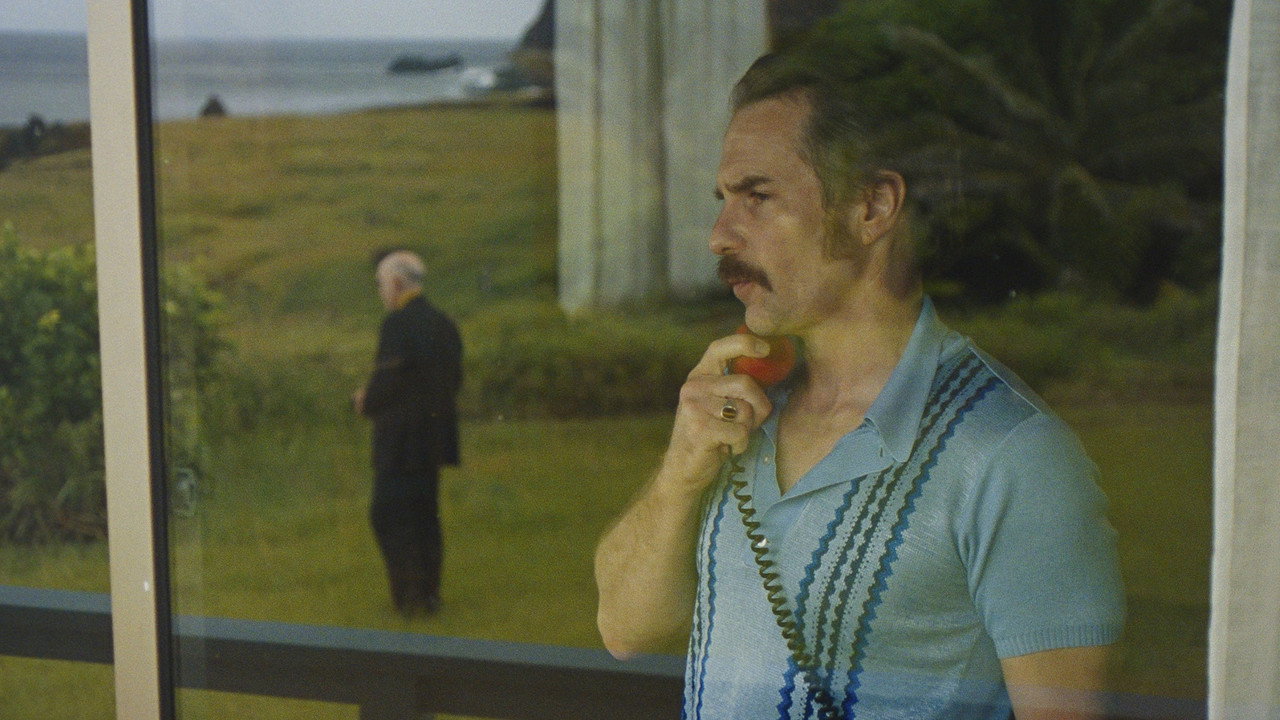
The faces of disillusionment facing the monoliths
The true conflict erupts when John Malkovich's character establishes an unexpected bond with a pair of local students embodied by Mariana di Girolamo and Ailín Salas. That youthful interference in the spies' routine acts as a corrosive agent that destabilizes the facade of professional cynicism both men have built over decades. Sam Rockwell, on the other hand, paces through the runtime with an almost desperate urgency, reflecting an agent who intuits political disaster on the continent but who is only capable of articulating his frustration through sarcasm and alcohol. The direction of actors avoids dramatic sensationalism, preferring prolonged silences and sidelong glances in front of the millenary statues that seem to silently judge the pettiness of human intrigues. Malkovich, in particular, finds a new dimension of vulnerability in this role, moving away from his usual calculating coldness to show a man broken on the inside, incapable of connecting with the reality surrounding him. Rockwell, for his part, brings a nervous energy that contrasts with his companion's stillness, creating a dynamic of constant tension that keeps the viewer on the edge of their seat, not through action, but through the emotional weight of each exchange.
The score of guilt and staging

On a technical level, Ben Davis's cinematography takes advantage of the relentless Pacific light to underline the vulnerability of men trapped out in the open, very far from the securities of central bureaucracy. There is no gratuitous aestheticism in the framing; each wide shot of the monoliths functions as a visual reminder of the agency's pettiness in the face of geological time. The camera moves with a deliberate slowness, inviting the spectator to contemplate the vastness of the landscape and the loneliness of the characters. Added to this is the original score composed by Carter Burwell, whose music flows with exemplary restraint, avoiding underscoring moments of tension with the usual cheap tricks of commercial spy cinema. The score accompanies the protagonists' descent into melancholy with sober notes that remind us that, in the end, empires fall while men argue over insignificant details. The production design, meanwhile, manages to recreate the atmosphere of the seventies with a fidelity that does not feel like an artificial set, but like a living and inhabited place, where every object and every texture tells a story of decay and abandonment.
The best
- John Malkovich and Sam Rockwell: The magnetic chemistry between both performers sustains the densest moments of the script with solvency, elevating the dramatic material to heights of emotional intensity.
- Ben Davis's cinematography: His handling of open spaces on Easter Island brings a unique visual texture to the tale, transforming the landscape into another character.
- Carter Burwell's score: An intelligent soundtrack that avoids commercial noise to focus on the atmosphere of moral defeat, complementing the narrative with elegance.
The worst
- The weight of the historical premise: The context of the Chilean coup is often used as a mere backdrop without the necessary political depth, reducing a historical event to a simple set.
- The detour with the students: Some interactions with the youth sector unnecessarily slow down the rhythm in the second act, breaking the accumulated tension.
- Self-consciousness: A certain tendency of the script to constantly remind us that we are facing an existential tragedy disguised as dark comedy, which can become exhausting for the viewer.
The Verdict of Claqueta Ácida
Wild Horse Nine confirms that Martin McDonagh still prefers the theater of impotence over the efficiency of conventional genre cinema. We are not looking at a standard political satire, but at an elegy disguised as a secret mission where CIA bureaucrats discover that their greatest enemies are not rival services, but the mirror of their own empty lives. Malkovich and Rockwell deliver a masterclass in weariness that single-handedly justifies the trip to this insular confines. An imperfect, cerebral, and profoundly cynical work that demands viewers willing to bear the weight of silence between statue and statue 💀.
🎬 Tráiler Oficial
Abrir en YouTube
Ending Explained: Wild Horse Nine
Wild Horse Nine: frequently asked questions
- What is the rating of "Wild Horse Nine" on Claqueta Ácida?
- "Wild Horse Nine" scored 7.3/10 on Claqueta Ácida in the review by Odin Lagbert.
- Is "Wild Horse Nine" worth watching?
- With reservations. We gave it 7.3/10 (Citric Acid), our rating for uneven films with something worth saving.
- Who directed "Wild Horse Nine"?
- "Wild Horse Nine" was directed by Martin McDonagh.
- How does "Wild Horse Nine" end?
- Spoilers in Wild Horse Nine ending explained .
Theater Collateral Damage Report
Psychophysical impact certificate issued by Odin Lagbert
Cero bostezos, aunque requiere una sobredosis de paciencia aristocrática para digerir la densidad de los diálogos.
Apetece mirar el reloj exactamente cuando los agentes intentan explicar por cuarta vez una conspiración que a nadie le importa.
How much second-hand embarrassment the film causes (10 = maximum). It is not the review score.
Un espresso bien cargado, servido con la misma amargura que el pasado de los protagonistas.
"Cuando los estudiantes rebeldes irrumpen en la conversación geopolítica y la película decide abrazar el absurdo absoluto."
Another critic from the newsroom scores the same film. The main score is still the one at the top of the review.

The rebuttal from Lúa Ácida (Queen of the Box Office)
In stark disagreement with the review given by Odin Lagbert.
Siento la piel rasgada, como si la cámara raspara mi epidermis con cada plano estático. La atmósfera se vuelve una autopsia de la tensión, no la supuesta “carga histórica” que el crítico alaba. Los actores, aunque brillantes, se pierden en un desierto sonoro; la música se cuela como feromona tóxica, sin sustancia, solo perfume de vacío. La puesta en escena pretende un grotesco sagrado, pero termina en una mutilación lírica de ritmo, donde la pulsión de muerte se queda atrapada en diálogos que se arrastran como sangre coagulada. No hay nada de “ligereza moral” que justifique la amplitud del paisaje; es una pantalla que se dilata hasta el punto de desintegrarse. El intento de ampliar el espacio se vuelve una herida abierta, y el silencio, lejos de ser personaje, es una ausencia que me ahoga. 4.8/10.
📋 Ficha Técnica
| Año | 2026 |
| Duración | 118 min |
| País | United Kingdom, United States of America |
| Guión | Martin McDonagh |
| Fotografía | Ben Davis |
| Productora | Searchlight Pictures, Blueprint Pictures, Film4 Productions, TSG Entertainment |
| Dónde ver | |
| Letterboxd | Ver Ficha ↗ |
⭐ Estrella Emergente
Sam Rockwell
Sam Rockwell brings a neurotic and unhinged physicality that anchors every scene of tension on the island.
💬 Community Verdict
What did you think of the film? Rate it from 0 to 10 to compare it with the editorial review.
You haven't voted yet
📢 ¿Te ha gustado el ácido?
Comparte esta crítica con tus amigos cinéfilos o desata la polémica en redes.
⚡ THE CINEMATIC VENOM YOUR INBOX CRAVES
Every Sunday: the week’s reviews, a recommended antidote and the editors’ verdict (in Spanish). No sugarcoated ratings, no corporate fluff. Or join the private Telegram for press previews, poll clashes, and instant alerts.
Alertas de estrenos en 1 segundo, encuestas en caliente y audios al salir de pases de prensa.
Get the weekly dose in your email, every Sunday.
By subscribing you agree that we use your email only to send you the newsletter. Unsubscribe at any time. Privacy policy
Related Reviews
Recommended autopsies for demanding film buffs.
 ⚠️ Ácido Sulfúrico 3.2
On the Run: A Senseless Sprint
⚡ Afinidad temática directa en atmósfera, estilo y fijaciones visuales.
A marathon of clichés and marketing sweat that leaves the audience feeling like they've run in circles. 💀
 ⚠️ Ácido Sulfúrico 3.8
Apocalypse Z: New World: The Repetition Virus in the Canary Shelter
⚡ Afinidad temática directa en atmósfera, estilo y fijaciones visuales.
Relentless critique of Apocalypse Z: New World, Carles Torrens' sequel that turns the end of the world into an exercise in inertia and generic recycling.
 ⚡ Ácido Cítrico 6.8
Azrael: Samara Weaving and the Hell of Silence
⚡ Afinidad temática directa en atmósfera, estilo y fijaciones visuales.
E.L. Katz and Simon Barrett deliver a brutal, relentless mute survival horror film where Samara Weaving once again proves why she is the modern scream queen.
Editorial Ecosystem
Cinephile connections, archive interviews and related analyses.
💬 Debate Cinéfilo & Autopsia de Lectores
¿Discrepas con nuestra nota? ¿Es una obra maestra o veneno puro? Deja tu veredicto abajo sin necesidad de registro.
📏 Normas: se critica la película, no a las personas. Los insultos y los ataques personales se pueden borrar.