

«Lo que nos da pánico no es el enfermo antipático, es descubrir que morirse no te mejora»: Isabel Coixet destripa 'Tres adioses'


What scares us isn’t the unlikeable sick person. It’s discovering that dying doesn’t make you better, doesn’t put you in order, and doesn’t turn you into anything. You remain yourself, only with less time and a worse mood.
Isabel Coixet (Barcelona, 1960). Director, screenwriter, operator of her own camera, and a compulsive hoarder of paper. She is the woman with the most Goya awards in the history of our cinema and the only one capable of shooting in English in Oregon, jumping into a terminal-illness melodrama in Rome ('Three Goodbyes'), debuting on French television with 30-minute episodes ('Someone Should Prohibit Sunday Afternoons'), exhibiting fifty collages at the Thyssen-Bornemisza Museum while declaring herself an "absolute impostor," and preparing her reunion with Penélope Cruz by adapting Elena Ferrante ('The Days of Abandonment').
Today, she submits to the Claqueta Ácida questionnaire. No institutional filters, no sugar-coating, and no chewed-up press-kit phrases. To answer with total freedom and at her own pace.
I. MELODRAMA WITHOUT CROCODILE TEARS AND FINITUDE
After filming death in 'My Life Without Me' over two decades ago, you return to grief and terminal cancer in 'Three Goodbyes,' adapting the posthumous texts of Michela Murgia. With Alba Rohrwacher (Marta) and Elio Germano, you dynamite the archetype of the "exemplary victim": there is bad temper, contradictions, cheek, and irony. Why are we so terrified of showing that someone who is dying can also be unpleasant, selfish, or tremendously funny?
Filmmaker:

Because the pleasant dying person doesn't make anyone uncomfortable. It’s a comfortable character: they are grateful, they forgive, they give lessons, they fade away, and that’s it. Michela Murgia didn't write that, and I wasn't going to film it.
When someone knows they don't have much time left, politeness is the first thing to go. Anger appears, selfishness, the urge to tell your mother what you’ve been keeping quiet for thirty years. And a wild comedy also appears, because nobody makes jokes as good about cancer as the person who has it.
What terrifies us isn't the unpleasant sick person. It’s discovering that dying doesn't improve you, doesn't tidy you up, and doesn't turn you into anything. You are still you, with less time and a worse mood.
You’ve dropped the statement that "identity is overrated and shrunken." When an abrupt breakup and a medical diagnosis strip you of your profession, partner, and future, what exactly remains beneath that identity shell? Eating an ice cream, a casual chat with a stranger, or resigning yourself to the void?
Filmmaker:

Beneath the shell, there is no core waiting for you. That is what nobody wants to hear.
We live convinced that if they take away our job, our partner, and our future plans, the authentic, clean, essential self will finally remain. And what remains is a woman sitting on a curb wondering if she feels more like strawberry or chocolate, or both. It’s not little. It is literally everything.
The ice cream and the conversation with the stranger are not the lesser consolation after losing what matters because they are the material we were made of from the beginning. What happens is that our schedule was too full to notice.
Fleeing from the monumental postcard Rome to lock yourself in Testaccio or Pigneto, and framing the action in an academic format (1:37), is almost an act of guerrilla warfare against mass tourism and the shadow of 'La Dolce Vita.' What were you looking for with that restrained aesthetic, close to the skin, in contrast to the mythified postcard?
Filmmaker:

Monumental Rome is exhausted. Eight million people have photographed it this month, and they’ve all taken the same photo. I have nothing to add to that. Testaccio and Pigneto have small kitchens, stairwells that smell of bleach, and neighbors who shout. That’s where something can actually happen.
I chose 1:37 out of greed. The widescreen format forces you to fill the sides, and you always end up putting in a dome. The academic format leaves the city out and leaves you inside a face. If you are going to film someone who is dying, the last thing you need is for the viewer to look out the window.
A ceramic bowl, a cardboard figure of a K-pop idol, a used ticket, or a shared glass of wine. Are these everyday details the true lifebuoy of the human being, or our most pathetic and endearing way of pretending we are still in control?
Filmmaker:

Both things at once, and that’s the charm.
A ceramic bowl doesn't cure anything. A cardboard figure of a K-pop idol is ridiculous, and whoever has it knows it perfectly well. But when the body stops obeying you, objects are the only thing that stays where you left it.
I keep a bus ticket from Reykjavik from 2011 for no defensible reason. When I die, someone will throw it away, and they’ll be right to do so. In the meantime, it’s in a drawer, and knowing it’s there organizes my day more than I’d like to admit.
II. THE SCALPEL OF COLLAGE AND IMPOSTURE
You jumped from commanding sixty people on a film set to hanging fifty collages at the Thyssen Museum alongside Estrella de Diego. You declared without hesitation that you felt like an "absolute impostor" in the contemporary art circuit. How much real imposture is there in galleries today for someone with four decades of creating images to feel embarrassed to call themselves a visual artist?
Filmmaker:
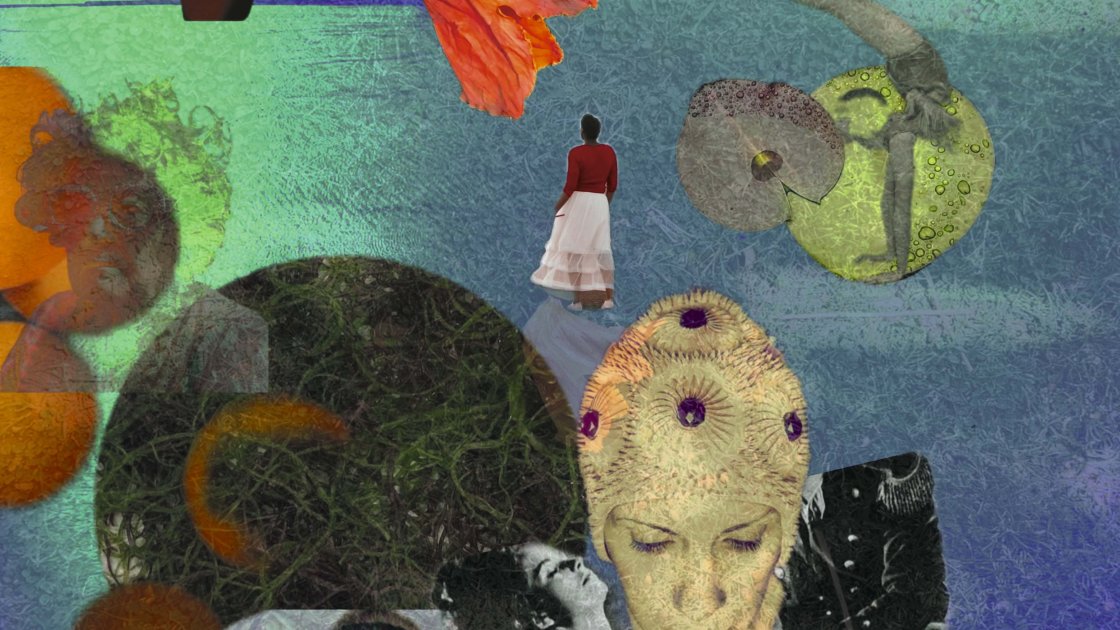
Imposture in galleries is abundant, but my embarrassment didn't come from there. I’ve been making images that stand on their own for forty years: there’s a crew, a budget, a room full of people who have paid. I make the collage sitting on the floor of my house, in pajamas, with cheap scissors. Calling that art sounded like misappropriation to me.
Estrella de Diego took away my argument in two sentences and with a certain brutality. Her thesis is that embarrassment is a learned mechanism and that the men who exhibit rusted cubes have never felt any. I’m still not entirely convinced, but I hung the fifty of them.
You hoard used bus tickets, seventies erotic photo-novels, and photo booth strips from Porta Portese. At what point does the flea market looting ("magpie spirit") stop being a collector’s mania and become legitimate visual art?
Filmmaker:
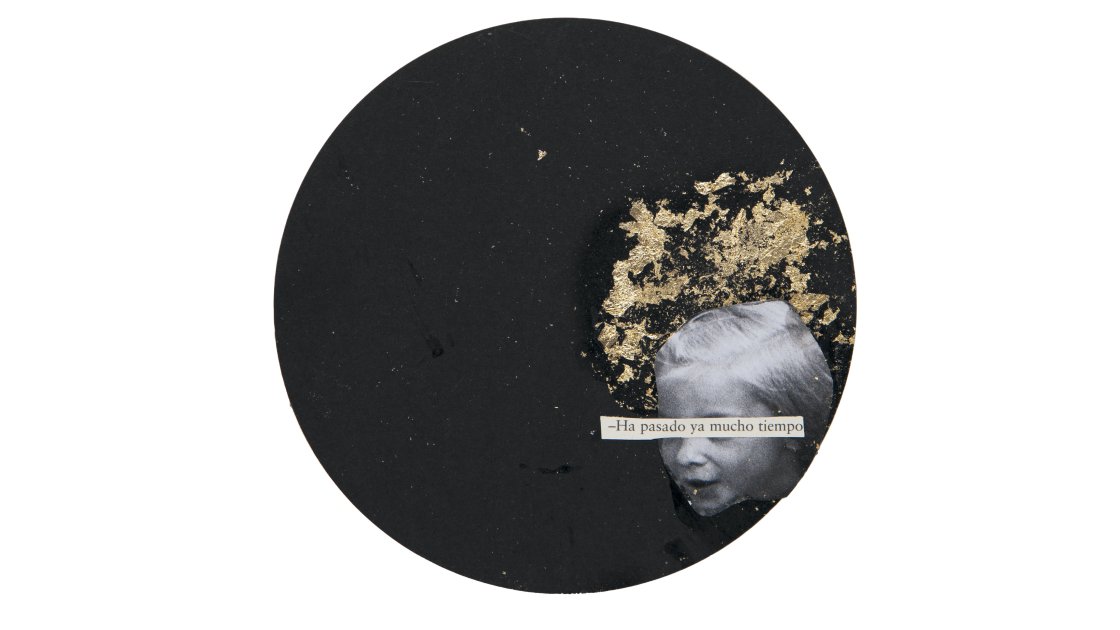
It never stops being a mania. It’s just that, sometimes, the mania produces something.
I buy erotic photo-novels from the seventies at Porta Portese because the faces of those women are extraordinary and because they cost two euros. There is no project behind it. The pile grows for years on a shelf, and one Sunday afternoon you cut out a head and put it over a detergent ad, and suddenly the whole thing says something that neither of the two pieces said.
Legitimacy is provided by the cut, not the accumulation. Anyone with space at home can accumulate.
You maintain that whoever organizes materials linearly is obedient, and that you prefer disobedience. Faced with the dictatorship of the feed and millions of identical, polished photos on social media, is the glue stick your last analog trench of resistance?
Filmmaker:
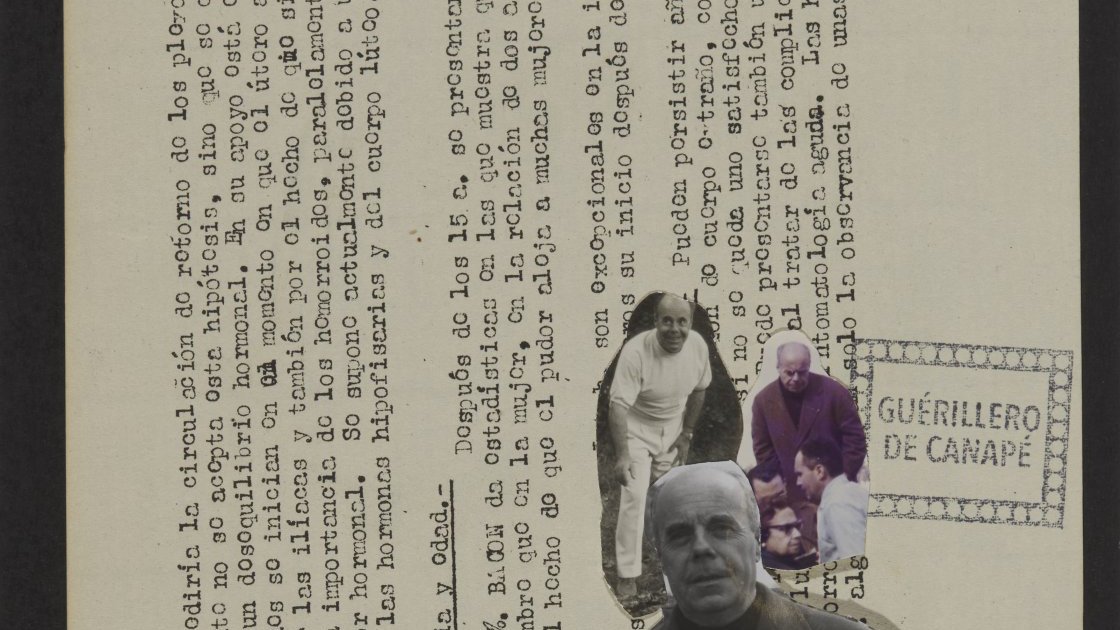
The glue stick smells like school and costs one euro twenty. As a trench, it’s not very heroic.
What interests me about collage is that it forces you to ruin the original. You cut the magazine, and there is no magazine anymore. On a screen, everything is reversible, everything is undone with two fingers, and that infinite reversibility produces images that haven't risked anything.
The feed rewards the identical because the identical is consumed without friction. Putting one thing next to another that doesn't belong to it is still free and still difficult to automate. For now.
III. SUNDAYS AND THE DISORIENTED YOUTH
In your French series 'Someone Should Prohibit Sunday Afternoons,' you bet on 30-minute episodes. Why this compressed format to narrate the vital clash of an aspiring filmmaker and her tribe in Paris? Does the speed of the medium-length film suit you better than the sluggishness of cinema?
Filmmaker:

Your twenties are lived in half-hour episodes. Nobody at that age has a two-hour arc: you have a humiliation on Tuesday, an inexplicable euphoria on Thursday, and by Friday you’ve forgotten everything.
Thirty minutes don't let you explain. You arrive late, you leave early, and you trust the viewer to fill in the blanks. That forced me to throw away a lot of material that I would have defended in cinema.
I still like sluggishness, but it’s a form of comfort. In half an hour, you can't hide behind a pretty three-minute shot, and it was very good for me to have that prohibited.
The story portrays the precariousness of being twenty, the illusion of filming, and the clash with veteran mentors (with Tim Robbins in the cast). How much of your own self-taught learning stage and how much disillusionment with the industry's sacred cows beats in that fiction?
Filmmaker:

I learned on my own and late, so I never had the destructive mentor. I had something worse: the fantasy that if I met the right director, something would rub off on me.
What beats there is the realization that almost no sacred cow can withstand a dinner. People who have made films that changed my life and who, in person, are vain, boring, or downright cruel to those who are of no use to them.
Disillusionment, however, is useful. The day you understand that no one is going to give you permission, you start shooting. Tim Robbins understood it without needing it to be explained, and that also says something about him.
What existential and unresolved trauma do Sunday afternoons hold that they continue to structure your radio programs, your books, and your fiction titles?
Filmmaker:
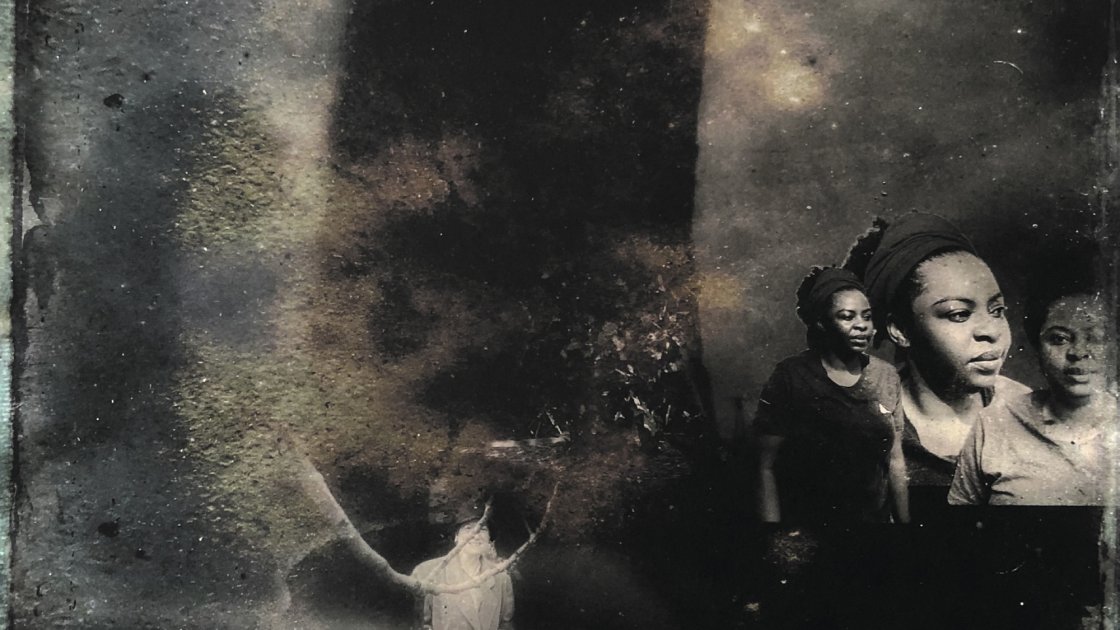
Sunday afternoon is the only hour of the week that has no alibi. You don't work, you don't rest, you don't celebrate anything. You are simply there, with your life in front of you, with no noise to cover it up.
As a child, it was the smell of cold food and the certainty that Monday existed. As an adult, it is exactly the same thing with better heating.
It keeps appearing in what I write because it is the moment when people ask themselves the questions they avoid the rest of the week. Any story that starts on a Sunday at six already has half the work done.
IV. AWARDS, TRENCHES, AND ALLERGY TO TRENDS
You receive the Antonio de Sancha Award from Madrid publishers and the Fotogramas de Plata Lifetime Achievement Award. Having passed Roth, Sara Mesa, Penelope Fitzgerald, or Michela Murgia through your filter: do you write cinema to correct literature or to return the favor to the books that saved your life?
Filmmaker:

Neither to correct nor to return the favor. To argue.
When I adapt Roth, Sara Mesa, Penelope Fitzgerald, or Michela, I don't try to improve anything, among other things because I couldn't. What I do is answer them with the tools I have, which are a camera and an actress. Sometimes the answer is worse than the question. Even so, I prefer to have given it.
Books saved my life at a time when no one in my circle understood what I was doing locked up reading Ginzburg. Gratitude doesn't consist of treating them like relics. It consists of handling them.
You boast of operating the shoulder-mounted camera yourself, of being bored to death if you go over three takes, and of not marrying hegemonic currents. At this point in the game, what is the one thing you would never be willing to negotiate on a set?
Filmmaker:

The time with the actors before shooting. That is non-negotiable.
Everything else I have given up at some point: shooting days, locations, a scene that mattered to me and was cut due to money. You survive. But if I arrive on set without knowing how that person breathes, the shoulder-mounted camera is useless and the three takes turn into eleven.
My getting bored after the third take isn't a pose. It’s that by the fourth, they are already acting out what they did in the second, and that shows. Anyone can see it.
«The day you understand that no one is going to give you permission, you start shooting.»
🎬 Filmografía de Isabel Coixet
En recuerdo a John Berger
★ Leer Crítica
Quelqu’un devrait interdire les dimanches après-midi
Filmografía oficial
Tres adioses
Filmografía oficial
Ingredientes para la vida
Filmografía oficial
Un amor
★ Leer Crítica
El techo amarillo
Filmografía oficial
Cuidarnos entre nosotros nos hace humanos
Filmografía oficial
Peace Peace Now Now
Filmografía oficial
Nieva en Benidorm
Filmografía oficial
Elisa y Marcela
Filmografía oficial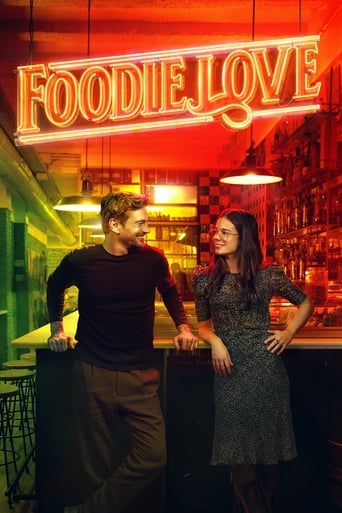
Foodie Love
Filmografía oficial
La librería
Filmografía oficial
El espíritu de la pintura
Filmografía oficial
Proyecto Tiempo
Filmografía oficial'Normal'
★ Leer Crítica
No es tan fría Siberia
Filmografía oficial
Spain in a Day
Filmografía oficialParler de Rose, prisonnière de Hissène Habré
Filmografía oficial
Nadie quiere la noche
Filmografía oficial
Aprendiendo a conducir
Filmografía oficial
Ayer no termina nunca
Filmografía oficial
Venezia 70: Future Reloaded
Filmografía oficial
Mi otro yo
★ Leer Crítica
Marea blanca
Filmografía oficial
Escuchando al juez Garzón
Filmografía oficialAral, el mar perdido
Filmografía oficialDear John
Filmografía oficial
Mapa de los sonidos de Tokio
Filmografía oficialLa mujer, cosa de hombres
Filmografía oficial
Elegy
Filmografía oficial
Invisibles
Filmografía oficialCartas a Nora
Filmografía oficial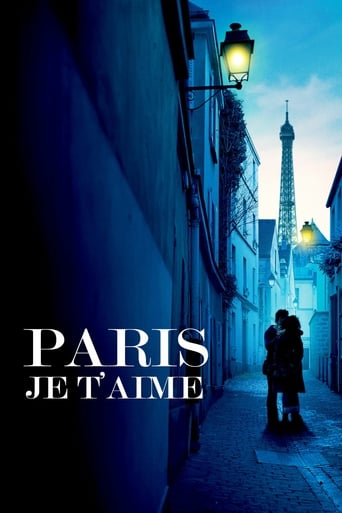
París, je t'aime
Filmografía oficial
La vida secreta de las palabras
Filmografía oficial
¡Hay motivo!
Filmografía oficial
Mi vida sin mí
Filmografía oficial
Viaje al corazón de la tortura
Filmografía oficial
A los que aman
Filmografía oficial
Cosas que nunca te dije
Filmografía oficial
Demasiado viejo para morir joven
Filmografía oficialMira y verás
Filmografía oficialLight on Broken Glass
Filmografía oficialThis Man, This Woman
Filmografía oficialNobody’s Heart
Filmografía oficialBike Me Up
Filmografía oficialConversación Registrada en Claqueta Ácida
Este expediente fue transcrito sin censura ni concesiones promocionales. Prohibida su dilución en lugares comunes.


