Green Room — Punk Rock, Butcher Knives, and a Lethal Chokehold in a Neo-Nazi Bunker
Jeremy Saulnier delivers an ultra-violent, claustrophobic survival thriller that traps a punk band in a deadly, inescapable nightmare.

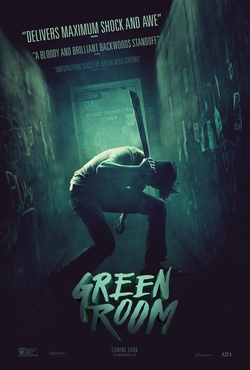
Green Room (2015): The Thriller That Turns You Into an Accomplice in a Punk Slaughterhouse
In a cinematic landscape oversaturated with invincible heroes, expository dialogue, and mass-produced happy endings, Green Room lands like a fist to the throat. Jeremy Saulnier—a director who seems to despise Hollywood as much as its audiences (and thank God for that)—gifts us his second consecutive masterpiece after Blue Ruin (2013), proving that extreme survival doesn’t need million-dollar budgets—just a simple premise, ruthless execution, and an ironclad refusal to spare either the audience or its characters. Here, there are no calculated jump scares or villains with philosophical monologues: just a broke punk band, a dressing room reeking of blood and sweat, and a Patrick Stewart so cold he makes Hannibal Lecter look like an encyclopedia salesman.
The Premise: Punk, Fascism, and a Perfect Trap
Green Room’s genius begins with its structure—a modern Greek tragedy: a touring band (The Ain’t Rights), led by the always-brilliant Anton Yelchin (Pat), takes a gig at a dive bar lost in the Oregon woods for a few bucks. The venue, a wooden bunker stinking of stale beer and rotten testosterone, turns out to be the headquarters of a white supremacist group. Saulnier wastes no time hammering home the symbolism: the punks play Dead Kennedys’ Nazi Punks Fuck Off in front of an audience straight out of an ‘80s KKK rally. The provocation is deliberate, almost suicidal—and when the band witnesses a murder backstage, the film becomes an hourglass where every grain of time is a drop of blood.What’s fascinating about this setup is its raw political edge. Saulnier doesn’t moralize, but he doesn’t sugarcoat either: the neo-Nazis aren’t cartoonish villains with swastika tattoos and maniacal laughs, but a cold, hierarchical, and lethal criminal organization, with Darcy (Patrick Stewart) as its leader—a man who orders executions with the same calm he’d use to sign a check. The film avoids easy moral binaries: the protagonists aren’t heroes, just victims improvising, making mistakes, and, in some cases, dying like cornered animals. There’s no redemption, only survival.
The Dressing Room as a Character: Claustrophobia in Its Purest Form
90% of Green Room unfolds in a single confined space: the dressing room, a rectangle of peeling walls, sticky floors, and flickering fluorescent lights that pulse like a bad omen. Saulnier and cinematographer Sean Porter turn this place into a character in its own right, a labyrinth of tension where every object—a fire extinguisher, a broken phone, a rusty knife—could be a weapon or a death sentence. The lighting, with its sickly greens and bilious yellows, evokes the hell of The Texas Chain Saw Massacre (1974), but with a realism that stings more than any gore fantasy.The editing, by Julia Bloch, is a masterclass in tension management. Saulnier alternates between deceptive calm (characters planning their escape, negotiating with Darcy) and bursts of violence so brutal they leave you breathless. There’s no incidental music to soften the blows—just silence, ragged breathing, and, at key moments, the distorted roar of punk guitars. The score, by Brooke and Will Blair, is minimalist but effective, with that dirty lo-fi sound reminiscent of Black Flag or Minor Threat recordings.
The Violence: Analog Gore for the Strong-Stomached
If anything defines Green Room, it’s its rejection of stylized violence. Saulnier doesn’t film deaths like a bloody ballet (à la Tarantino) or a digital spectacle (like modern blockbusters), but as what they are: messy, painful, and traumatic acts. The practical effects, supervised by the makeup team, are so realistic they’re repulsive. A box cutter slicing open an arm to the bone, a shotgun blast tearing off half a face, a pitbull attack leaving a character bleeding out on the floor... Saulnier doesn’t glorify violence; he shows it for what it is: an act of cruelty that leaves physical and psychological scars.This approach recalls the "dirty realism" of directors like Sam Peckinpah (The Wild Bunch) or John Carpenter (The Thing), but with a more intimate, claustrophobic focus. The camera doesn’t pull away during moments of horror—it gets closer, forcing the audience to look. There’s no escape, neither for the characters nor for us.
The Cast: Performances That Reek of Desperation
Anton Yelchin, in one of his final roles before his tragic death, delivers a nuanced performance as Pat, the band’s leader. He’s no hero, just an ordinary guy trapped in a nightmare, with moments of bravery and others of sheer cowardice. Imogen Poots (Amber) brings unexpected toughness, while Alia Shawkat (Sam) and Joe Cole (Reece) round out the quartet of victims with performances that radiate real panic.But the film’s true monster is Patrick Stewart as Darcy. Far from the over-the-top villains he’s known for, Stewart crafts an antagonist terrifyingly mundane: a man who speaks in whispers, smiles politely, and orders murders with the same indifference as ordering a coffee. His chilling calm is more unnerving than any scream or threat. It’s, without a doubt, one of the best performances of his career.
Cinematic Comparisons: Where Does Green Room Fit?
Green Room draws from several sources but surpasses them all:- The claustrophobic survival of The Descent (2005): But without supernatural monsters, just humans.
- The realistic violence of Straw Dogs (1971) and The Wild Bunch (1969): Though with a punk edge and less epic scope.
- The political horror of The Belko Experiment (2016): But with a script a thousand times better and no cheap dark humor.
- The punk-as-weapon ethos of Repo Man (1984): Though here, the music doesn’t save—it condemns.
What makes Green Room unique is its blend of elements: the grindhouse vibe of the ‘70s, the dirty realism of the ‘90s, and a punk sensibility that permeates every frame. It’s not a film for everyone, but for those seeking a thriller that leaves them breathless (and nail-less), it’s an absolute masterpiece.
finalExplicado: "En el clímax, los dos supervivientes (Pat y Amber) quedan atrapados en el green room junto a Darcy y sus últimos hombres. Tras una carnicería mutua con cúteres, pistolas y una escopeta, Pat mata a Darcy de un disparo en la cabeza a bocajarro. La policía irrumpe y remata a los neonazis restantes. Pat, gravemente herido, es evacuado mientras ve cómo los cuerpos son sacados como carne muerta. Simbólicamente, el desenlace significa que no hay victoria ni catarsis: solo supervivencia sucia y accidental. El mal burocrático (Darcy) muere como un cerdo más, sin épica. El punk no triunfa; simplemente no se deja exterminar del todo. La casa se traga a casi todos y la única recompensa es seguir respirando, exhausto y cubierto de sangre ajena. Un final tan nihilista como un acorde distorsionado que se apaga en el vacío."
The Best
- Claustrophobia as an extreme sport: Saulnier turns a 100-square-foot dressing room into the most terrifying place on Earth. Every second spent in that hellhole is torture, and the audience feels it in their bones.
- Patrick Stewart, the villain who doesn’t need to raise his voice: His Darcy is the embodiment of bureaucratic evil—a man who orders deaths with the same calm he’d use to sign a contract. Scarier than any chainsaw-wielding maniac.
The Worst
- The first act, a bit slow for the impatient: If you’re expecting nonstop action from minute one, the musical and atmospheric prologue might drag. But it’s necessary—without it, the plunge into hell wouldn’t hurt as much.
- The gore, for iron stomachs only: The wounds are so realistic even seasoned viewers might feel queasy. Not a film to watch after a big meal.
The Verdict of Claqueta Ácida (9.3/10)
Green Room is the kind of film Hollywood wouldn’t dare make—filthy, desperate, with no heroes or happy endings, and violence so raw it hurts. Jeremy Saulnier gives no quarter, neither to his characters nor to us. It’s a thriller that grabs you by the throat, drags you into a blood-soaked dressing room, and doesn’t let go until the last punk chord fades. If you leave the theater without feeling exhausted, you weren’t paying attention. A masterpiece of realistic horror, where the only consolation is that, at least, you can get up and walk away. The characters can’t. 🔪🎸🎬 Tráiler Oficial
Abrir en YouTube
Ending Explained: Green Room
Ficha de Daños Colaterales en Sala
Certificado de impacto psicofísico emitido por Héctor Veneno
Ni un solo parpadeo voluntario. El asiento, inusualmente cómodo.
Ni una sola mirada al móvil.
Ninguna: la adrenalina cinematográfica es suficiente.
"Inexistente: pulso de hierro hasta los créditos finales."
💬 El Veredicto de la Comunidad
¿Qué te ha parecido la película? Deja tu nota de 0 a 10 para contrastarla con el análisis de la redacción.
Aún no has votado
📢 ¿Te ha gustado el ácido?
Comparte esta crítica con tus amigos cinéfilos o desata la polémica en redes.
⚡ THE CINEMATIC VENOM YOUR INBOX CRAVES
No sugarcoated ratings, no corporate fluff. Subscribe for our uncensored weekly analysis or join the private Telegram for press previews, poll clashes, and instant alerts.
Alertas de estrenos en 1 segundo, encuestas en caliente y audios al salir de pases de prensa.
Recibe la dosis semanal en tu mail + regalo inmediato del PDF con 50 joyas ocultas de culto.
Related Reviews
Recommended autopsies for demanding film buffs.
 🔥 Fusión Nuclear9.0
*Blue Ruin (2013): Revenge as a DIY Disaster and the Pontiac as a Metaphor for Self-Destruction*
⚡Del mismo director (Jeremy Saulnier): analiza la evolución o degradación de su estilo.
Jeremy Saulnier reinvents the revenge genre with a stark, tense, and brutally realistic portrait of violence’s disastrous consequences.
 🔥 Fusión Nuclear8.5
*Alleluia: Love as a Terminal Illness (or How to Turn Crimes of Passion into a Sweaty, Fleshy Spectacle)*
⚡Afinidad temática directa en atmósfera, estilo y fijaciones visuales.
Fabrice Du Welz reimagines the myth of the lonely hearts killers in a feverish whirlwind of jealousy, submission, and blood, led by Lola Dueñas in a performance that’s equal parts hypnotic and harrowing.
 🔥 Fusión Nuclear8.5
*High Tension (Haute Tension): The Brutal Birth of the New French Extremism – Or How to Turn Flesh into Poetry with a Machete*
⚡Afinidad temática directa en atmósfera, estilo y fijaciones visuales.
Alexandre Aja shocked global screens with a relentless rural bloodbath, redefined by breakneck pacing and a divisive twist that splits serious cinephiles right down the middle.
Editorial Ecosystem
Cinephile connections, archive interviews and related analyses.
🎞️ In Claqueta Cinematheque1
💬 Debate Cinéfilo & Autopsia de Lectores
0 veredictos¿Discrepas con nuestra nota? ¿Es una obra maestra o veneno puro? Deja tu veredicto abajo sin necesidad de registro.


Aún nadie ha dejado su veredicto para esta película.
Sé el primero en clavarle el colmillo rellenando el formulario de arriba.