Dragged Across Concrete — Molten Lead, Twilight Cynicism, and the Moral Suffocation of America’s Asphalt
S. Craig Zahler delivers a monumental, nihilistic neo-noir heist thriller—corrupt cops, bone-dry violence, and nearly three hours of unrelenting suspense.

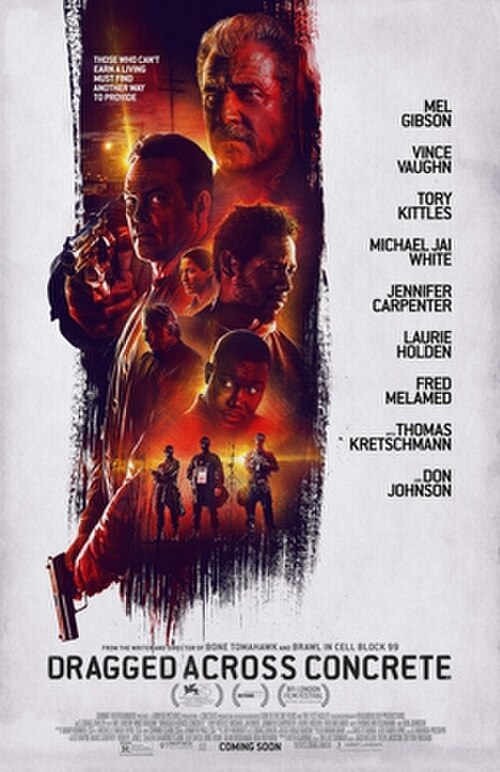

Dragged Across Concrete (2018) isn’t just a movie. It’s an act of cinematic warfare, a manifesto against the visual anesthesia peddled as "entertainment." S. Craig Zahler, that sniper of filmic storytelling who fires intellectual lead bullets instead of commercial confetti, gifts us his third feature—and he does so with the subtlety of a jackhammer at a funeral. Three hours of runtime that aren’t a stroll through the park but a descent into the genre’s hellscape, where buddy cop movie conventions are dismembered, dipped in acid, and reassembled into a Frankenstein of rotting flesh, stale testosterone, and existential nihilism.
finalExplicado: "En el clímax, los dos policías corruptos, Ridgeman y Lurasetti, son masacrados sin piedad tras un largo y claustrofóbico asalto a un banco. Lurasetti es torturado y ejecutado a sangre fría delante de su compañero; Ridgeman, herido, muere desangrado mientras ve cómo el criminal Henry Johns escapa con el botín y su hermana. La secuencia final es un plano estático de Ridgeman agonizando en el asfalto, solo, mientras la cámara se aleja lentamente. Simbólicamente, el desenlace sella el nihilismo absoluto de Zahler: no hay redención, justicia ni catarsis. El sistema devora a sus propios perros guardianes corruptos con la misma indiferencia con que ellos pisoteaban a los débiles. La lentitud extrema del final no es capricho; es la asfixia moral convertida en forma cinematográfica. El asfalto se traga a los hombres que creían dominarlo. Fin."
The Liturgy of Frozen Suspense: When Boredom Becomes a Weapon
Zahler doesn’t believe in fast pacing. He doesn’t believe in quick cuts, snappy dialogue, or the instant gratification demanded by Netflix algorithms. Dragged Across Concrete is a film that takes its time like an executioner sharpening his knife: calmly, precisely, sadistically. The opening sequence, where Brett Ridgeman (Mel Gibson) and Anthony Lurasetti (Vince Vaughn) are caught on camera beating a low-level drug dealer, isn’t just an introduction to the characters—it’s a statement of intent. Zahler shows us latent racism, police brutality, and societal hypocrisy without filters, as if he’s spitting in our faces and then inviting us for coffee to discuss it.
But where other directors would cut to action, Zahler lingers in the void. Ten minutes inside a car, watching an empty street. Ten minutes of awkward silence, furtive glances, hard-boiled egg sandwiches chewed with disdain. Ten minutes where the viewer wonders: "Is this cinema or a contemporary art installation on urban alienation?" And then, when the tension has reached its boiling point, violence erupts like a geyser of blood and shell casings, as sudden as it is brutal, so real it hurts.
This is Zahler’s dark magic: he turns boredom into suspense. It’s not Hitchcock’s suspense, where the audience knows there’s a bomb under the table. It’s the suspense of a man who knows he’s going to die but doesn’t know when or how—and in the meantime, he has to keep breathing, sweating, existing in that limbo of uncertainty. It’s unbearable. It’s brilliant.
The Ironclad Heist: When Crime Doesn’t Pay (And Thank God for That)
The plot of Dragged Across Concrete is deceptively simple: two suspended cops, Ridgeman and Lurasetti, decide to pull off a heist to solve their financial woes. Tracking a European bank robber, Lorentz Vogelmann (Thomas Kretschmann, a villain so cold he seems carved from dry ice), they plan to steal his loot. But Zahler isn’t interested in the heist itself—he’s interested in the moral decay of his protagonists.
Ridgeman is a veteran cop, a man who’s seen too much and no longer believes in anything. Gibson plays him with a mix of existential weariness and contained fury, as if he’s been dragging an emotional corpse for decades. Lurasetti, meanwhile, is the ambitious young cop who still believes in the system but is willing to corrupt himself for a fistful of dollars. Vaughn, in a role that proves he’s more than just the funny guy from Swingers, plays him with calculated coldness, as if measuring every word and gesture to avoid betraying his desperation.
And then there’s Vogelmann, the bank robber who isn’t just a criminal but a paramilitary psychopath with the manners of a Prussian aristocrat. Kretschmann plays him with eerie elegance, like a ghost from World War II who’s wandered into the 21st century. His on-screen presence is chilling, not because of his violent outbursts (though they’re brutal), but because of his inhuman calm, his smile carved from marble.
The heist itself is a masterclass in accumulating tension. Zahler spares no detail: the preparations, the stakeouts, the endless waiting. And when the violence erupts, it does so with a rawness that leaves you breathless. There are no heroes here. No redemption. Just men trapped in a spiral of violence, dragged into the abyss like dead leaves in a hurricane.
The Cinematography: A Visual Poem of Asphalt, Neon, and Despair
Benji Bakshi, Zahler’s cinematographer, doesn’t film Dragged Across Concrete—he paints it with oils of grime and desperation. The shots are long, static, as if the camera is a helpless witness to the unfolding tragedy. The colors are muted, dominated by the grays of asphalt, the sickly yellows of neon, and the rusted reds of dried blood.
Zahler and Bakshi turn the city into another character, a labyrinth of dark streets, abandoned buildings, and lonely gas stations where human life feels like a temporary accident. The interiors are claustrophobic, lit as if filtered through layers of filth. And when violence erupts, the camera doesn’t look away. There are no quick cuts to soften the impact. There are close-ups of open wounds, blood splattering walls, bodies writhing on the ground.
This isn’t a movie for those seeking escapism. It’s a dirty mirror reflecting the world’s ugliness, and it does so with an honesty that hurts.
The Soundtrack: Silence as a Lethal Weapon
Jeff Herriott, the film’s composer, understands something many film scorers have forgotten: sometimes, silence is more terrifying than any score. The music in Dragged Across Concrete is sparse, almost nonexistent at times, as if Zahler wants the audience to hear their own accelerating heartbeat.
When the music does appear, it’s subtle, like a whisper. A lone piano, a distorted guitar, a bassline pulsing like a diseased heart. There are no epic orchestrations or grand choruses. Just a sonic atmosphere reinforcing the sense of desolation and hopelessness.
And then there are the diegetic sounds: the crunch of a sandwich, the click of a magazine being loaded into a gun, the thud of a body hitting the ground. Zahler uses them like a conductor, dosing them to create a symphony of discomfort.
The Performances: Gibson and Vaughn, Titans in the Twilight of Their Careers
Mel Gibson and Vince Vaughn aren’t just actors. They’re forces of nature, and in Dragged Across Concrete, they prove why they’re still relevant decades after their first hits.
Gibson, as Brett Ridgeman, is monumental. He’s not the hero of Braveheart or the madman of The Passion of the Christ. He’s a broken man, a cop who’s seen too much and no longer believes in anything. Gibson plays him with a mix of exhaustion and contained rage, as if every word is a Herculean effort. There’s a scene where Ridgeman talks to his daughter about racism, and Gibson delivers it with brutal honesty, avoiding melodrama. It’s one of the best performances of his career—and that’s saying something.
Vince Vaughn, meanwhile, sheds his "funny guy" image to play Anthony Lurasetti, a young, ambitious cop willing to corrupt himself for money. Vaughn plays him with calculated coldness, as if measuring every word and gesture to hide his desperation. There’s a scene where Lurasetti talks to his girlfriend on the phone, and Vaughn conveys all the frustration and fear of a man who knows he’s about to cross a line he can’t uncross.
And then there’s Thomas Kretschmann, who plays Lorentz Vogelmann with sinister elegance. Kretschmann doesn’t need to shout or overact to convey his character’s menace. His cold stare, calculated smile, and measured voice are enough. He’s one of those villains who makes you uncomfortable just by being on screen.
Cinematic Comparisons: Zahler as Heir to the Greats
Dragged Across Concrete doesn’t exist in a vacuum. It’s the heir to a cinematic tradition that includes some of the masters of the crime and neo-noir genres.
- Michael Mann: Zahler shares Mann’s obsession with realistic details, urban atmosphere, and characters trapped in spirals of violence. But while Mann tends to idealize his protagonists, Zahler shows them as they are: broken, corrupt, desperate men.
- Sam Peckinpah: The violence in Dragged Across Concrete has the same rawness and brutality as Peckinpah’s films. But Zahler doesn’t glorify violence. He shows it as it is: dirty, painful, without redemption.
- David Fincher: There’s something in Zahler’s cold, calculated tone that recalls Fincher, especially in films like Zodiac or Se7en. But while Fincher intellectualizes violence, Zahler presents it with almost documentary-like rawness.
- John Carpenter: The oppressive atmosphere of Dragged Across Concrete recalls Carpenter’s films, particularly Assault on Precinct 13 and The Thing. But Zahler lacks Carpenter’s dark humor. His worldview is darker, more hopeless.
The Hostage Subplot: When Cynicism Borders on Sadism
There’s a moment in Dragged Across Concrete that’s particularly hard to stomach. It’s the subplot involving the bank teller, Kelly Summer (Jennifer Carpenter), a new mother taken hostage during the heist. Zahler doesn’t just show her suffering—he stretches it, twists it, turns it into an inescapable nightmare.
There’s a scene where Kelly is forced to swallow a key, and then the robbers cut her open to retrieve it. It’s not gratuitous in the traditional sense (there’s no gushing blood or over-the-top CGI), but it’s gratuitously cruel. Zahler doesn’t give us a break, doesn’t let us look away. He forces us to confront the violence, its rawness, its pointlessness.
Some might argue this scene is necessary to show the criminals’ true nature, but it borders on auteur sadism. Zahler isn’t interested in redemption or poetic justice. He’s only interested in showing the world as it is: an ugly, cruel, unjust place.
The Best
- The lead duo: Mel Gibson and Vince Vaughn ooze a twilight, cynical chemistry that’s pure gold—like two action-movie dinosaurs refusing to go extinct, choosing instead to trample everything in their path.
- Masterful time management: Zahler turns 159 minutes into a hypnotic experience, where boredom morphs into suspense and waiting becomes unbearable. It’s like watching paint dry—if the paint were mixed with gunpowder.
- Analog brutality: The shootouts aren’t balletic choreography but realistic slaughterhouses, where every wound hurts and every death leaves a trail of blood and shell casings no one bothers to clean up.
The Worst
- Unrelenting moral pessimism: Zahler doesn’t believe in redemption, hope, or anything beyond the most unflinching cynicism. If you’re looking for a feel-good movie, this is like getting punched in the gut with a rusty boxing glove.
- The bank teller subplot: There are moments where Zahler seems to revel in his characters’ suffering, like a kid burning ants with a magnifying glass. The key scene is so cruel it verges on sadistic exhibitionism.
The Verdict of Claqueta Ácida (8.9/10)
Dragged Across Concrete is a sucker punch to the jaw of mainstream cinema—a masterpiece of cinematic nihilism proving S. Craig Zahler is one of the few directors still brave enough to make movies for adults in a world of childish blockbusters. It’s not a film for everyone: it’s rough, brutal, hopeless, and at times unbearably cruel. But it’s also one of the most honest and necessary cinematic experiences in recent years. Zahler doesn’t offer comfort, heroes, or happy endings. He just drags you through the filthy asphalt of the human condition and leaves you there—bruised, bleeding, and wondering if it was worth it. And the answer, of course, is hell yes, it was worth it. Because real cinema shouldn’t be a soul massage—it should be a mirror reflecting your own ugliness back at you. And Dragged Across Concrete is that mirror: cracked, bloodstained, but more honest than a thousand superhero movies. 🩸🔫🎬 Tráiler Oficial
Abrir en YouTube
Ending Explained: Dragged Across Concrete
Ficha de Daños Colaterales en Sala
Certificado de impacto psicofísico emitido por Héctor Veneno
Cero. La pantalla absorbió cada segundo de atención disponible.
Ni una sola mirada al móvil.
Ninguna. Guarda el café para la sesión siguiente.
"Inexistente: pulso de hierro hasta los créditos finales."
💬 El Veredicto de la Comunidad
¿Qué te ha parecido la película? Deja tu nota de 0 a 10 para contrastarla con el análisis de la redacción.
Aún no has votado
📢 ¿Te ha gustado el ácido?
Comparte esta crítica con tus amigos cinéfilos o desata la polémica en redes.
⚡ THE CINEMATIC VENOM YOUR INBOX CRAVES
No sugarcoated ratings, no corporate fluff. Subscribe for our uncensored weekly analysis or join the private Telegram for press previews, poll clashes, and instant alerts.
Alertas de estrenos en 1 segundo, encuestas en caliente y audios al salir de pases de prensa.
Recibe la dosis semanal en tu mail + regalo inmediato del PDF con 50 joyas ocultas de culto.
Related Reviews
Recommended autopsies for demanding film buffs.
 🔥 Fusión Nuclear8.8
*Bone Tomahawk: A Classic Western with a Side of Brutal Cannibalism*
⚡Del mismo director (S. Craig Zahler): analiza la evolución o degradación de su estilo.
S. Craig Zahler made a colossal directorial debut, patiently blending twilight western aesthetics with auteurist dialogue and the most unflinching cannibalistic body horror imaginable.
 🔥 Fusión Nuclear9.2
*Brawl in Cell Block 99: Shattered Bones, Vince Vaughn as a Steamroller, and the Most Savage Prison Ordeal of the Century*
⚡Del mismo director (S. Craig Zahler): analiza la evolución o degradación de su estilo.
S. Craig Zahler delivers a staggeringly dry, deliberate, and brutal crime-and-prison thriller, featuring a colossal and relentless Vince Vaughn.
 🔥 Fusión Nuclear8.5
*Alleluia: Love as a Terminal Illness (or How to Turn Crimes of Passion into a Sweaty, Fleshy Spectacle)*
⚡Afinidad temática directa en atmósfera, estilo y fijaciones visuales.
Fabrice Du Welz reimagines the myth of the lonely hearts killers in a feverish whirlwind of jealousy, submission, and blood, led by Lola Dueñas in a performance that’s equal parts hypnotic and harrowing.
Editorial Ecosystem
Cinephile connections, archive interviews and related analyses.
🎞️ In Claqueta Cinematheque2
💬 Debate Cinéfilo & Autopsia de Lectores
0 veredictos¿Discrepas con nuestra nota? ¿Es una obra maestra o veneno puro? Deja tu veredicto abajo sin necesidad de registro.


Aún nadie ha dejado su veredicto para esta película.
Sé el primero en clavarle el colmillo rellenando el formulario de arriba.