Hamnet — Chloé Zhao Films a Child’s Death and Wrings Out Analog Tears
Hamnet review. Maggie O’Farrell’s novel adaptation crowns itself as a devastating work of art, with a masterful Jessie Buckley at its core.

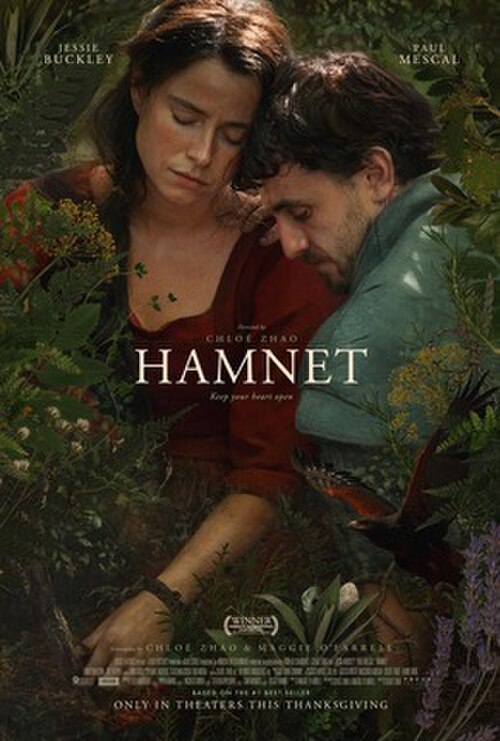


Hamnet isn’t just a film—it’s a cinematic exorcism. After her disastrous foray into the Marvel universe with Eternals—where she proved even the most sensitive directors can sell their soul to Kevin Feige for a bloated budget and a handful of CGI effects—Chloé Zhao returns to what she does best: capturing human pain with such brutal honesty it hurts more than a gut punch. And boy, does it hurt. Hamnet is a masterpiece of melancholy, a visual and emotional symphony that lodges in your chest like a rusted dagger, twisting slowly while whispering, "This is what it feels like to lose a child."
The Tragedy Behind the Genius: Shakespeare as a Spectator to His Own Grief
Zhao doesn’t make the mistake of turning Hamnet into a conventional biopic about William Shakespeare. In fact, the Bard of Avon (played by Paul Mescal with a vulnerability that borders on pathetic in the best way) is little more than a ghost in his own story. The film doesn’t focus on the man who wrote Hamlet, but on the void his creation left behind: the son who died, the grief that became art, the wife left behind, turned into a specter of herself. Zhao understands something many filmmakers forget: Shakespeare’s greatness isn’t in his sonnets or his plays, but in the silence that preceded them. In the choked scream of a mother watching her son fade away, and in the husband who, unable to face that pain, flees to London to turn it into tragedy.
Hamnet’s narrative structure is as unconventional as it is necessary. Zhao plays with time like it’s clay, jumping between Agnes’s devastated present and memories of a past that already reeks of decay. The first act, with its slow, almost dreamlike pace, might throw off those expecting a traditional historical drama. But it’s precisely that slowness—that sense of time stretching like taffy until it snaps—that makes Hamnet’s death (an eleven-year-old boy whose agony is depicted with a lyrical rawness reminiscent of Bergman’s The Seventh Seal, minus the chess-playing Death) even more unbearable. There’s no dramatic score heralding his end, no POV shots putting us in his place. Just the sound of labored breathing, the rustle of sheets, and the silence that follows.
Jessie Buckley: The Actress Who Turns Pain into Art (and Leaves Us Breathless)
If there’s one reason to watch Hamnet—and trust me, there are many—it’s Jessie Buckley. The Irish actress doesn’t just play Agnes; she embodies her with an intensity that borders on the supernatural. Buckley had already proven in I’m Thinking of Ending Things and Wild Rose that she’s one of her generation’s most versatile actresses, but here she reaches heights few performers ever do. Her Agnes is a woman connected to the earth, to herbs, to the cycles of life and death. In the film’s first half, she’s light: an eccentric healer dancing in the rain, talking to trees, looking at her husband with a mix of love and pity. But after Hamnet’s death, Buckley transforms into something else—a ghost, a specter of grief walking among the living without belonging to them.
The most terrifying thing about her performance is the lack of histrionics. No screams, no forced crying scenes, none of those "cathartic" moments Hollywood loves so much. Instead, there’s a silence that says everything: the way her hands tremble as she knits, how her gaze drifts into the void while her husband speaks from a distance, the weight of her body as she sits on the floor like she no longer has the strength to stand. Buckley doesn’t act grief—she lives it. And she infects us with it.
Paul Mescal, meanwhile, delivers a solid performance, though his role is more limited. His Shakespeare is a broken man, but in a different way than Agnes. While she drowns in mourning, he flees—to London, to the theater, to words. Mescal conveys that silent guilt, that inability to face pain head-on. His chemistry with Buckley is electric, but also painful: two wounded souls who love each other but don’t know how to comfort one another.
The Cinematography: When Natural Light Becomes Visual Poetry
Chloé Zhao has built her career on capturing beauty in the everyday, and in Hamnet, she takes that obsession to new heights. The film is shot almost entirely in natural light, resulting in a visual palette that oscillates between the painterly and the brutal. Interiors, lit by candles and fireplaces, have the texture of a Rembrandt painting: deep shadows, half-lit faces, a claustrophobic intimacy. The exteriors, by contrast, are vast and desolate—wheat fields swaying under a leaden sky, as if nature itself is in mourning.
The cinematography team, led by an uncredited but brilliant British DP (whose name deserves to be alongside Zhao’s in the credits), achieves something extraordinary: making Elizabethan England feel alive, dirty, and real. This isn’t the polished, sterile production design of The Crown or Wolf Hall. The houses smell of smoke and sweat, the streets are muddy, faces are lined with wrinkles and scars. Zhao doesn’t idealize the past; she shows it as it was—a hostile place where death lurked around every corner, and beauty could only be found in small details: a sunbeam breaking through the clouds, the touch of a calloused hand, the sound of a child laughing before the plague takes him.
The Score: Silence as the Protagonist
One of Hamnet’s boldest—and most successful—choices is its score. Or rather, its lack of a score. There’s no extradiegetic music guiding our emotions, no violins heralding tragedy, no angelic choirs telling us when to cry. Instead, there’s silence. The silence of an empty house, the silence of a mother who has no words left, the silence of a father writing furiously to fill the void.
When music does appear, it’s diegetic: the sound of a lute in a tavern, birdsong at dawn, the crunch of leaves underfoot. It’s a brave choice, but it works perfectly. The silence isn’t absence—it’s presence. It’s the sound of grief when there are no tears left.
Cinematic Comparisons: From Bergman to Malick, via Pure Pain
Hamnet draws from many sources but never falls into imitation. It has the emotional rawness of Bergman’s Persona (1966), that ability to show pain without sugarcoating. It has Malick’s The Tree of Life (2011) connection to nature, though without its grandiose mysticism. And it has the devastating intimacy of Manchester by the Sea (2016), though with a visual elegance the latter never achieved.
But where Hamnet stands apart is in its unique take on the creative process. This isn’t a film about how art is born from pain, but about how pain becomes art despite oneself. Shakespeare doesn’t write Hamlet to honor his son; he writes it because he doesn’t know how to do anything else. It’s his way of screaming without anyone hearing him. And Zhao understands this perfectly: art doesn’t redeem, doesn’t heal, doesn’t bring back what’s lost. It only immortalizes it.
The Pacing: A Contemplative Journey That Isn’t for Everyone
It’s true that Hamnet isn’t a film for the impatient. Its pace is slow, almost meditative, and its nonlinear structure might throw off those expecting a traditional narrative. The first twenty minutes are especially demanding: Zhao immerses us in Agnes’s daily life with a slowness bordering on the hypnotic. There are scenes that seem to go nowhere—a discussion about medicinal herbs, a walk through the woods—but they later reveal themselves as key pieces of the film’s emotional puzzle.
For some viewers, this will be a virtue. For others, torture. Hamnet isn’t a film that takes your hand and guides you; it’s a film that drops you into a well and forces you to find your way out. In that sense, it’s a deeply personal experience. Not everyone is prepared to face pain head-on, without anesthesia.
The Plague Metaphor: When the Obvious Becomes Necessary
There’s a moment in Hamnet where the plague is depicted almost allegorically: a shadow spreading through the streets, a whisper passing from mouth to mouth, an invisible presence contaminating everything. It’s a visual metaphor that, in less skilled hands, might have come off as pretentious or even ridiculous. But Zhao handles it with such delicacy that it works. The plague isn’t just a disease; it’s the symbol of everything we can’t control, everything that slips through our fingers.
That said, in its middle act, the film occasionally gives in to the temptation to underline the obvious. When Agnes walks through the fields and flowers wither in her wake, or when the wind blows out the candles in her house as if Death itself were exhaling, the metaphor becomes a little too on-the-nose. These are beautiful moments, but they slightly break the magical realism Zhao had so carefully built.
Conclusion: A Masterpiece That Hurts (and That’s Why It’s Necessary)
Hamnet is one of those films you don’t forget. Not because it’s perfect—nothing is—but because it achieves something very few films do: it makes you feel. And not the saccharine, manipulative "feeling" of Hollywood, but a raw, real pain that stays with you for days after the credits roll.
Chloé Zhao has proven that her Marvel detour was just an unfortunate detour in a career that, thankfully, remains one of the most interesting in contemporary cinema. With Hamnet, she’s created a devastating work of art, a visual symphony about grief and creation that cements itself as one of 2026’s best films.
Get ready to cry. Get ready to feel uncomfortable. Get ready to leave the theater with your heart in your throat and the sense that you’ve just witnessed something sacred. Hamnet isn’t just cinema—it’s a spiritual experience. And it hurts like hell.
finalExplicado: "En el clímax, el pequeño Hamnet agoniza solo en su cama mientras Agnes, su madre, corre desesperada por los campos intentando llegar a tiempo. La cámara se queda fija en el niño: su respiración se detiene, una vela se apaga sola en primer plano y la luz natural desaparece de golpe. Agnes llega demasiado tarde; solo encuentra el cuerpo inerte. No hay gritos histéricos, solo un silencio absoluto y un plano sostenido de su rostro desmoronándose. Simbólicamente, el desenlace representa la imposibilidad de proteger a los que amamos y el instante preciso en que la vida se convierte en historia. La vela apagada no es un símbolo sutil: es la muerte misma cerrando el capítulo del niño real para dar paso al mito. Agnes (y Shakespeare) quedan condenados a cargar eternamente con esa ausencia, transformando el dolor privado en arte inmortal. Zhao filma la muerte sin concesiones: cruda, analógica y definitiva."
The Best
- Jessie Buckley turns pain into art (and leaves us speechless): Her performance as Agnes is so devastating it should come with a trigger warning for emotional content.
- Natural-light cinematography is a masterclass in filmmaking: Zhao and her team make even mud look poetic.
The Worst
Its slow pace may be torture for the impatient: If you thought The Tree of Life* was slow, this will feel like medieval punishment. Some visual metaphors are so obvious they sting: Death blowing out candles is pretty, but also a bit too* on-the-nose.The Verdict of Claqueta Ácida (9/10)
Hamnet is cinema in its purest form: painful, beautiful, and necessary. Chloé Zhao redeems her commercial sins with a masterpiece that proves, when it comes to capturing the human soul, few directors can match her. That said, don’t go looking for comfort—this film won’t give it to you. It’ll leave you shattered, but grateful to have witnessed something so profoundly human. Bring tissues. And a will, just in case.🎬 Tráiler Oficial
Abrir en YouTube
Ending Explained: Hamnet
Ficha de Daños Colaterales en Sala
Certificado de impacto psicofísico emitido por Camilo K.O.
Ni un solo parpadeo voluntario. El asiento, inusualmente cómodo.
El móvil permaneció en el bolsillo donde debía estar.
Ninguna. Esta obra no necesita muletas estimulantes.
"No hubo. La coherencia se mantuvo hasta el último fotograma."
💬 El Veredicto de la Comunidad
¿Qué te ha parecido la película? Deja tu nota de 0 a 10 para contrastarla con el análisis de la redacción.
Aún no has votado
📢 ¿Te ha gustado el ácido?
Comparte esta crítica con tus amigos cinéfilos o desata la polémica en redes.
⚡ THE CINEMATIC VENOM YOUR INBOX CRAVES
No sugarcoated ratings, no corporate fluff. Subscribe for our uncensored weekly analysis or join the private Telegram for press previews, poll clashes, and instant alerts.
Alertas de estrenos en 1 segundo, encuestas en caliente y audios al salir de pases de prensa.
Recibe la dosis semanal en tu mail + regalo inmediato del PDF con 50 joyas ocultas de culto.
Related Reviews
Recommended autopsies for demanding film buffs.
 ⚡ Ácido Cítrico7.5
A Ghost Story: A Journey Through Time and Memory
⚡Consagradas en el olimpo transgresor con 🔥 Fusión Nuclear.
The Claqueta Ácida review of A Ghost Story, a film that explores existence and human connection.
 🔥 Fusión Nuclear8.0
*Backrooms: The Maze of Madness – A Descent into Overhyped Nothingness*
⚡Consagradas en el olimpo transgresor con 🔥 Fusión Nuclear.
*A scathing takedown of the horror series everyone’s raving about—spoiler: it’s not that deep.*
 🔥 Fusión Nuclear8.0
Backrooms: A Descent into the Void
⚡Consagradas en el olimpo transgresor con 🔥 Fusión Nuclear.
A film that flings wide the door to mystery and terror—if you dare to step through
Editorial Ecosystem
Cinephile connections, archive interviews and related analyses.
💬 Debate Cinéfilo & Autopsia de Lectores
0 veredictos¿Discrepas con nuestra nota? ¿Es una obra maestra o veneno puro? Deja tu veredicto abajo sin necesidad de registro.


Aún nadie ha dejado su veredicto para esta película.
Sé el primero en clavarle el colmillo rellenando el formulario de arriba.