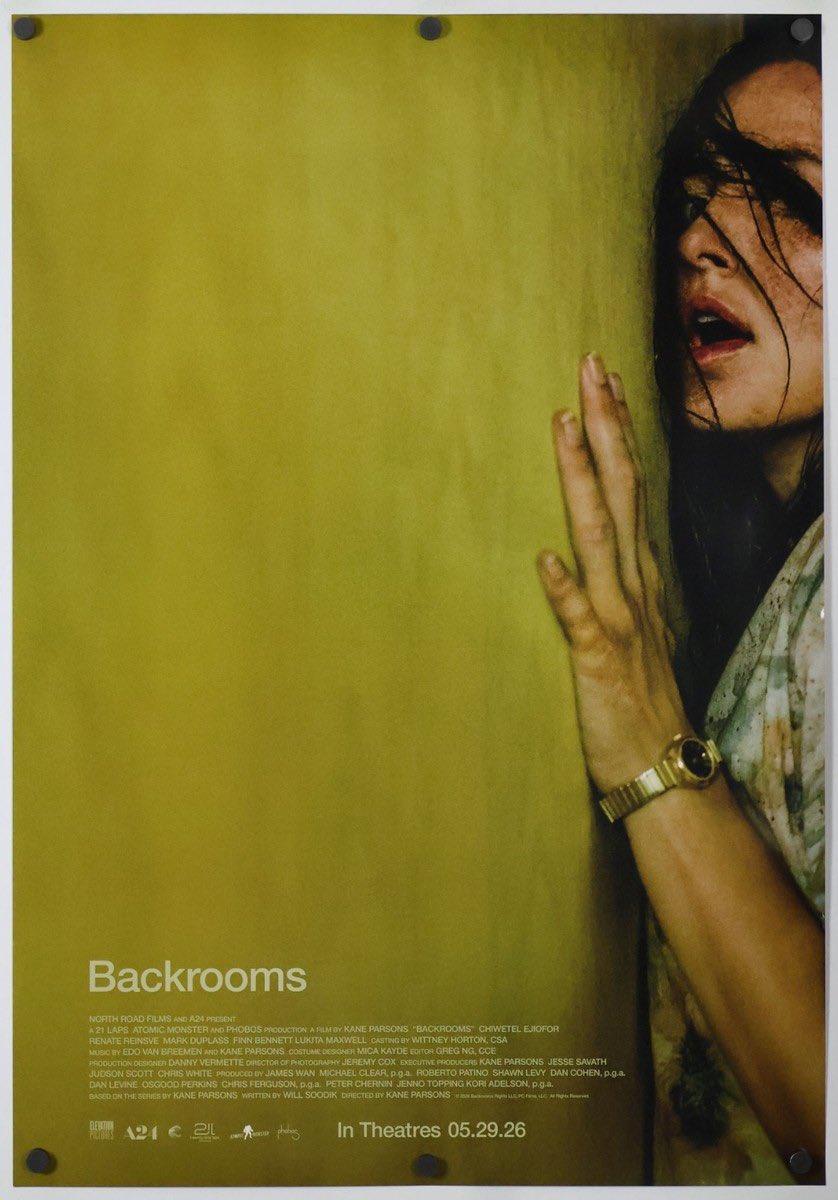
Backrooms — A Descent into the Void
A film that flings wide the door to mystery and terror—if you dare to step through


Backrooms: full review


I sank into my seat at the Cine Doré with the kind of anticipation usually reserved for those who know they’re about to witness something different—something that reeks of found footage but promises to transcend the subgenre like a ghost refusing exorcism. Backrooms isn’t just a film; it’s a sensory ordeal that drags you into a labyrinth of jaundiced hallways, sticky carpets, and the relentless hum of dying fluorescents. Kane Parsons, a name hitherto echoing only in YouTube’s viral underbelly, has pulled off the impossible: turning an internet meme into a cinematic nightmare with blockbuster budgets and the soul of a cult classic. But is fear enough to sustain 110 minutes of runtime? The answer, much like the corridors of the Backrooms, is far more complicated than it seems.
The film kicks off with a single-take sequence already destined for the annals of modern horror: a handheld camera follows a group of furniture store employees who, after a power outage, stumble upon a door in the basement that shouldn’t exist. It opens into an endless hallway, bathed in that sickly yellow light we all recognize instantly. Parsons doesn’t reinvent the wheel—he sharpens it into a blade. The found footage here isn’t a cheap gimmick to skimp on effects; it’s a narrative choice that amplifies claustrophobia and paranoia. Every camera shake, every ragged breath, every stifled whisper in the dark reminds you this could be real. And that, my friends, is terror in its purest form.
But Parsons isn’t content with mere scares. There’s a visual ambition in Backrooms that transcends jump scares. The film treats architecture like a character: hallways twist, doors vanish and reappear, and low ceilings press down with physical weight. In one standout scene, Clark—played by a Chiwetel Ejiofor who looks plucked from a Lovecraftian fever dream—crawls through a ventilation shaft while a bird’s-eye shot reduces him to a tiny, vulnerable figure. This is the kind of image that haunts you for days.
Will Soodik’s script is another triumph. It’s not packed with quotable dialogue or grand monologues, but it’s brimming with details that build a coherent, terrifying world. The characters aren’t mere horror archetypes; they have motivations, fears, and chemistry that make their interactions feel real. When the characters argue over whether to keep moving or stay put, the tension doesn’t come from what they say—it’s what they don’t: the fear of the unknown, mutual distrust, the creeping dread that any choice might be the wrong one. This is horror with a brain, not a cheap thrill factory.
Direction and staging: the art of getting lost (and making sure you stay that way)
Kane Parsons knows exactly what he’s doing, even when he seems not to. The film blends found footage with traditional sequences—a risky move that could’ve collapsed in lesser hands. But Parsons orchestrates the chaos with surgical precision. The long takes, like the basement opener, are masterclasses in tension-building without a single cut. The camera moves as if it’s alive, as if it too is trapped in the Backrooms, creating an immersion few horror films achieve.
Sound design is another highlight. Edo van Breemen’s score is a mix of industrial drones, electronic hums, and distorted choirs, like transmissions from the bottom of a well. But the real terror isn’t the music—it’s the silence. Entire scenes unfold with nothing but the characters’ breathing, the creak of carpet underfoot, or the click of a switch that does nothing. Parsons understands terror doesn’t need noise to be effective—sometimes, the echo of your own breath is enough.
Danny Vermette’s production design is another win. The Backrooms’ hallways aren’t mere sets; they’re living, breathing spaces that shift and feel alive. Walls are caked in grime that looks real, fluorescents flicker with unsettling irregularity, and abandoned objects (a teddy bear, a typewriter, a dead phone) tell stories without words. This is the kind of design that makes you believe if you stare at a wall long enough, something might crawl out.
Performances: when fear is real (and so are the actors)
Chiwetel Ejiofor is the undeniable heart of Backrooms. His Clark—the patient who vanishes after stepping through a door in a furniture store’s basement—blends vulnerability and determination in a way that recalls Jeff Goldblum’s best work. Ejiofor doesn’t act fear; he embodies it. This is the kind of performance that leaves you breathless.
Renate Reinsve, for her part, plays Mary, the therapist who ventures into the unknown to rescue him, and she is the perfect counterbalance to Ejiofor’s despair. Reinsve, who dazzled in The Worst Person in the World, carries the journey with a mix of fear and stubbornness that’s genuinely moving. She is the one who turns the maze into a story.
The rest of the cast delivers, though none reach Ejiofor and Reinsve’s heights. Mark Duplass, Finn Bennett, Lukita Maxwell and Avan Jogia round out a cast that sustains the bewilderment without fuss.
Technical breakdown: when terror becomes art
Jeremy Cox’s cinematography is nothing short of breathtaking. Cox ensures every frame of Backrooms is a visual nightmare. His lighting is particularly masterful: the yellow fluorescents don’t just illuminate the hallways—they warp them, stretching shadows into grotesque shapes that seem to move on their own. Cox turns the mundane into the sinister with a mere camera angle.
Greg Ng’s editing is another strength. Ng knows precisely when to cut and when to let a scene linger until it’s unbearable. There’s a moment where the camera follows Ejiofor down a hallway for what feels like minutes. Nothing happens. No jump scares. No music. Just the sound of footsteps and the hum of fluorescents. And yet, it’s one of the most terrifying sequences in the film.
Edo van Breemen’s score deserves its own paragraph. He doesn’t compose a traditional soundtrack but a collection of sounds that burrow into your brain like needles. There are moments when the music seems to vanish, leaving only a constant hum—the pulse of the Backrooms themselves. It’s the kind of score you don’t notice until it’s too late.
The best
- Chiwetel Ejiofor’s performance: It’s not just that Ejiofor is a brilliant actor—it’s that his work here is haunting. He carries the film almost without words.
- Jeremy Cox’s cinematography: Cox turns the Backrooms’ hallways into a character. His lighting and framing are masterful, and every shot feels like it’s ripped from a nightmare. This is the kind of cinematography that makes you want to rewatch the film just to study the shots.
- Production design: The Backrooms aren’t just sets—they’re living, shifting spaces that feel alive. This is the kind of design that makes you believe if you stare long enough, something might crawl out of the walls.
The worst
- Pacing in the second act: While the film starts with explosive energy, the second act loses some steam. It’s not boring, but it does sag. It’s like Parsons knows the destination but isn’t entirely sure how to get there.
- Lack of answers: Backrooms raises plenty of questions but doesn’t always provide answers. For some, this will be frustrating. It’s the kind of film that leaves you with more doubts than certainties—and not everyone’s willing to accept that.
- Underdeveloped side characters: While the leads shine, some side characters feel like afterthoughts. They’re not bad, but they’re clearly there to fill space. With a little more development, they could’ve been memorable.
The Verdict of Claqueta Ácida
Backrooms isn’t a perfect film, but it’s one of those rare gems that proves horror can still be intelligent, visceral, and—above all—terrifying. Kane Parsons has turned an internet meme into a cinematic nightmare that lingers long after the credits roll. This isn’t a film for everyone: if you want clear answers or a happy ending, look elsewhere. But if you’re willing to get lost in its endless corridors, let fear consume you, and accept that some questions have no answers, then Backrooms is an experience you won’t soon forget. Just don’t say we didn’t warn you: once you’re in, you might never find your way out. 💀🎬 Tráiler Oficial
Abrir en YouTube
Ending Explained: Backrooms
Backrooms: frequently asked questions
- What is the rating of "Backrooms" on Claqueta Ácida?
- "Backrooms" scored 8.0/10 on Claqueta Ácida in the review by Dr. Cinismo.
- Is "Backrooms" worth watching?
- Yes. We gave it 8/10 (Nuclear Fusion), our rating for must-see films.
- Who directed "Backrooms"?
- "Backrooms" was directed by Kane Parsons.
- How does "Backrooms" end?
- Spoilers in Backrooms ending explained .
Theater Collateral Damage Report
Psychophysical impact certificate issued by Dr. Cinismo
Cero. La pantalla absorbió cada segundo de atención disponible.
El móvil permaneció en el bolsillo donde debía estar.
How much second-hand embarrassment the film causes (10 = maximum). It is not the review score.
Ninguna. Guarda el café para la sesión siguiente.
"No hubo. La coherencia se mantuvo hasta el último fotograma."
💬 Community Verdict
What did you think of the film? Rate it from 0 to 10 to compare it with the editorial review.
You haven't voted yet
📢 ¿Te ha gustado el ácido?
Comparte esta crítica con tus amigos cinéfilos o desata la polémica en redes.
⚡ THE CINEMATIC VENOM YOUR INBOX CRAVES
No sugarcoated ratings, no corporate fluff. Subscribe for our uncensored weekly analysis or join the private Telegram for press previews, poll clashes, and instant alerts.
Alertas de estrenos en 1 segundo, encuestas en caliente y audios al salir de pases de prensa.
Recibe la dosis semanal en tu mail + regalo inmediato del PDF con 50 joyas ocultas de culto.
By subscribing you agree that we use your email only to send you the newsletter. Unsubscribe at any time. Privacy policy
Related Reviews
Recommended autopsies for demanding film buffs.
 🔥 Fusión Nuclear 8.0
*Backrooms: The Maze of Madness – A Descent into Overhyped Nothingness*
⚡ Hermana de saga: otro capítulo diseccionado con rigor forense.
*A scathing takedown of the horror series everyone’s raving about—spoiler: it’s not that deep.*
 ⚡ Ácido Cítrico 7.5
A Ghost Story: A Journey Through Time and Memory
⚡ Afinidad temática directa en atmósfera, estilo y fijaciones visuales.
The Claqueta Ácida review of A Ghost Story, a film that explores existence and human connection.
 ⚡ Ácido Cítrico 7.5
Bugonia: The Cosmic Snatch
⚡ Afinidad temática directa en atmósfera, estilo y fijaciones visuales.
Two young men convinced an executive is an alien kidnap her. Will they save Earth—or just their own delusions?
Editorial Ecosystem
Cinephile connections, archive interviews and related analyses.
🎞️ In Claqueta Cinematheque 1
💬 Debate Cinéfilo & Autopsia de Lectores
¿Discrepas con nuestra nota? ¿Es una obra maestra o veneno puro? Deja tu veredicto abajo sin necesidad de registro.
📏 Normas: se critica la película, no a las personas. Los insultos y los ataques personales se pueden borrar.