The Skin I Live In — Almodóvar’s Masterclass in Surgical Sadism
Almodóvar drags us into a world where fascination and terror stitch themselves together like a second skin—literally.




I staggered out of the cinema feeling like Almodóvar had reached into my chest, wrung out my guts, and hung them up like a haute couture dress on a silk thread. The Skin I Live In isn’t just a film—it’s a live autopsy of human morality, performed with a silver scalpel and a sense of style only a Manchego obsessed with the color red could pull off. And the worst—or best, depending on how you look at it—is that there’s no anesthetic. From the very first frame, when the camera lingers on that body draped in a synthetic second skin straight out of a chic Frankenstein lab, you know what’s coming isn’t your run-of-the-mill psychological thriller. No, this is a gothic horror experiment with more layers than a rotten onion in a Versace closet.
The setting couldn’t be more almodovariano: 2011, Spain in the throes of an economic crisis, the country selling its soul to low-cost tourism while culture got repackaged as a flamenco-and-tapas theme park. While politicians wrung their hands over budget cuts, Almodóvar locked himself in a studio to craft his coldest, most calculated, most inhuman film to date. It’s no coincidence he chose to adapt Tarantula, Thierry Jonquet’s novel that reeks of sweat and formaldehyde. The director had toyed with identity and transformation before (All About My Mother, Talk to Her), but here he takes the concept to its extreme: this isn’t about changing skin—it’s about fabricating it from scratch, as if the human body were a blank canvas and pain, the brush. And damn, does it hurt.
The first gut punch comes with that opening tracking shot, the camera prowling through Dr. Ledgard’s mansion like a caged beast. The house, designed by Antxón Gómez, is a character in its own right: a cross between a luxury clinic and a gothic dungeon, with hallways that seem to lead straight to hell and an operating room that gleams brighter than a private hospital’s. Almodóvar doesn’t bother hiding his influences—Franju’s Eyes Without a Face, Hitchcock’s Vertigo, Powell’s Peeping Tom—but he chews them up, digests them, and spits them out with a taste of lipstick and menstrual blood only he could conjure. José Luis Alcaine’s cinematography is key here: every frame looks painted in oils, a palette of reds, blacks, and whites that echoes Bacon’s canvases but with a kitsch twist that stops the film from drowning in its own pretension. There’s a moment when Vera (Elena Anaya) appears for the first time in that transparent dress, seemingly made of cellophane, and the light passes through her like she’s a ghost. It’s beautiful and repulsive at once, like biting into a chocolate and finding a maggot inside.
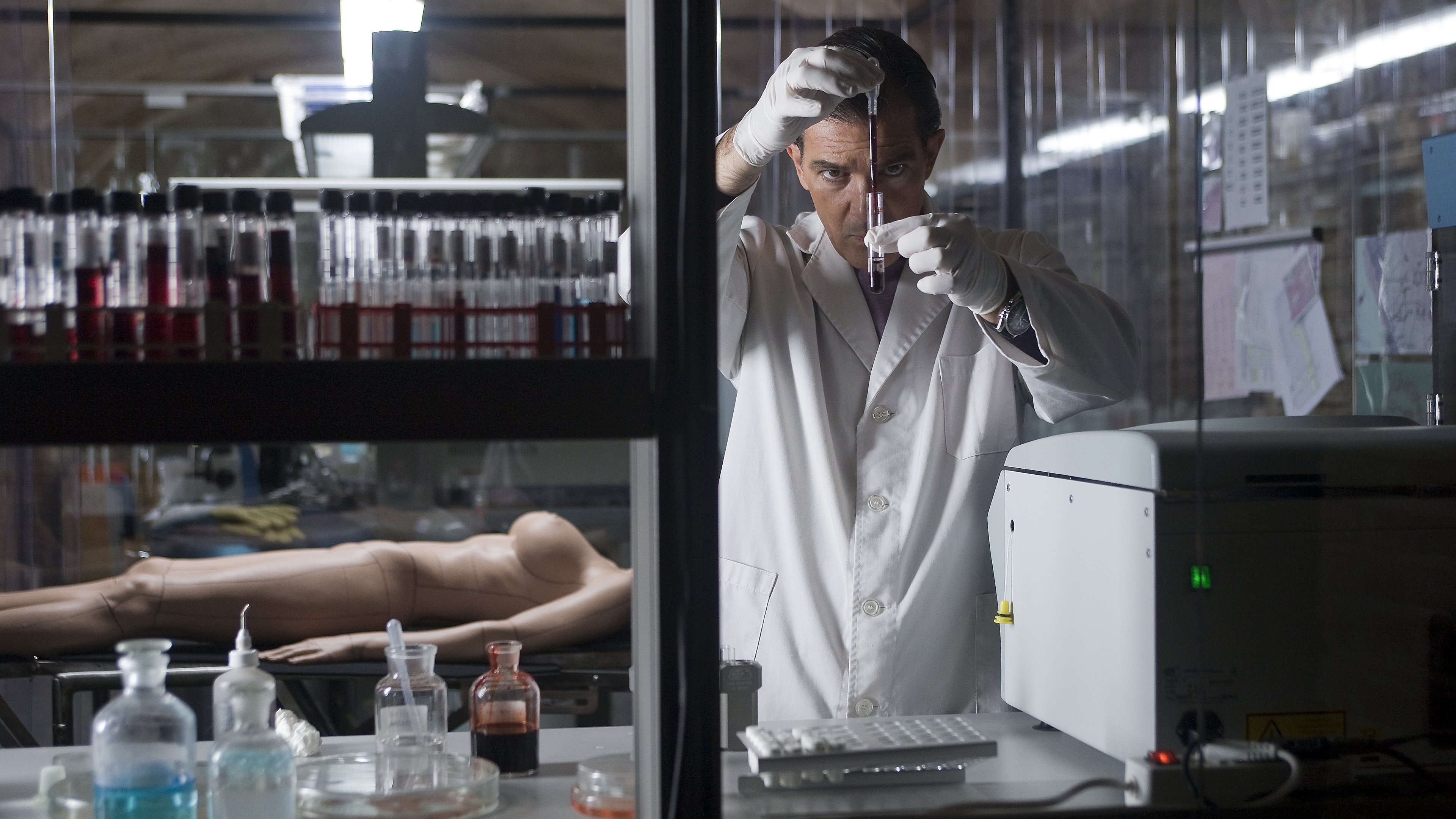
Direction and Mise-en-Scène: The Surgeon and His Plaything
Almodóvar directs this film like a scientific experiment—and in a way, it is. Every camera movement, every cut, is calculated to induce discomfort. There’s no respite, no concessions. Even when the plot seems to relax with a flashback or an innocuous line of dialogue, the tension lingers, like a tumor. The director plays with time masterfully: the film lurches forward and backward like a living organism, revealing only what’s necessary to keep the audience on edge. There’s a specific moment, when Vera’s origins are unveiled, where the narrative structure shatters like a bone under a hammer. It’s no spoiler to say that José Salcedo’s editing is so precise it hurts: the cuts are like lashes, and the ellipses, open wounds.
But where Almodóvar truly shines is in his ability to turn the grotesque into poetry. The scene where Vera dances to Jeanette’s Porque te vas, in that transparent dress with her body marked by scars, is one of the most disturbing and beautiful moments in recent Spanish cinema. It’s not just that the song is a ‘70s earworm—Almodóvar wields it like a weapon: that childlike, sweet, melancholic melody contrasts with the implicit violence of Vera’s body, a body that isn’t hers, that never was. It’s as if the director is telling us: Look what we’ve done to beauty. Look what we’ve turned into garbage. And the worst part? You can’t look away.
The sound design deserves its own chapter. Alberto Iglesias composes a score that seems plucked from a fever dream: strings stretched to breaking point, synthesizers that sound like dialysis machines, choirs that whisper from beyond the grave. There’s a scene, when Dr. Ledgard operates on Vera, where the silence is so thick you can hear the actors sweating. The sound doesn’t accompany the image—it devours it. And then there’s the silence, those moments when the film seems to hold its breath, as if it knows what’s coming next is going to hurt.
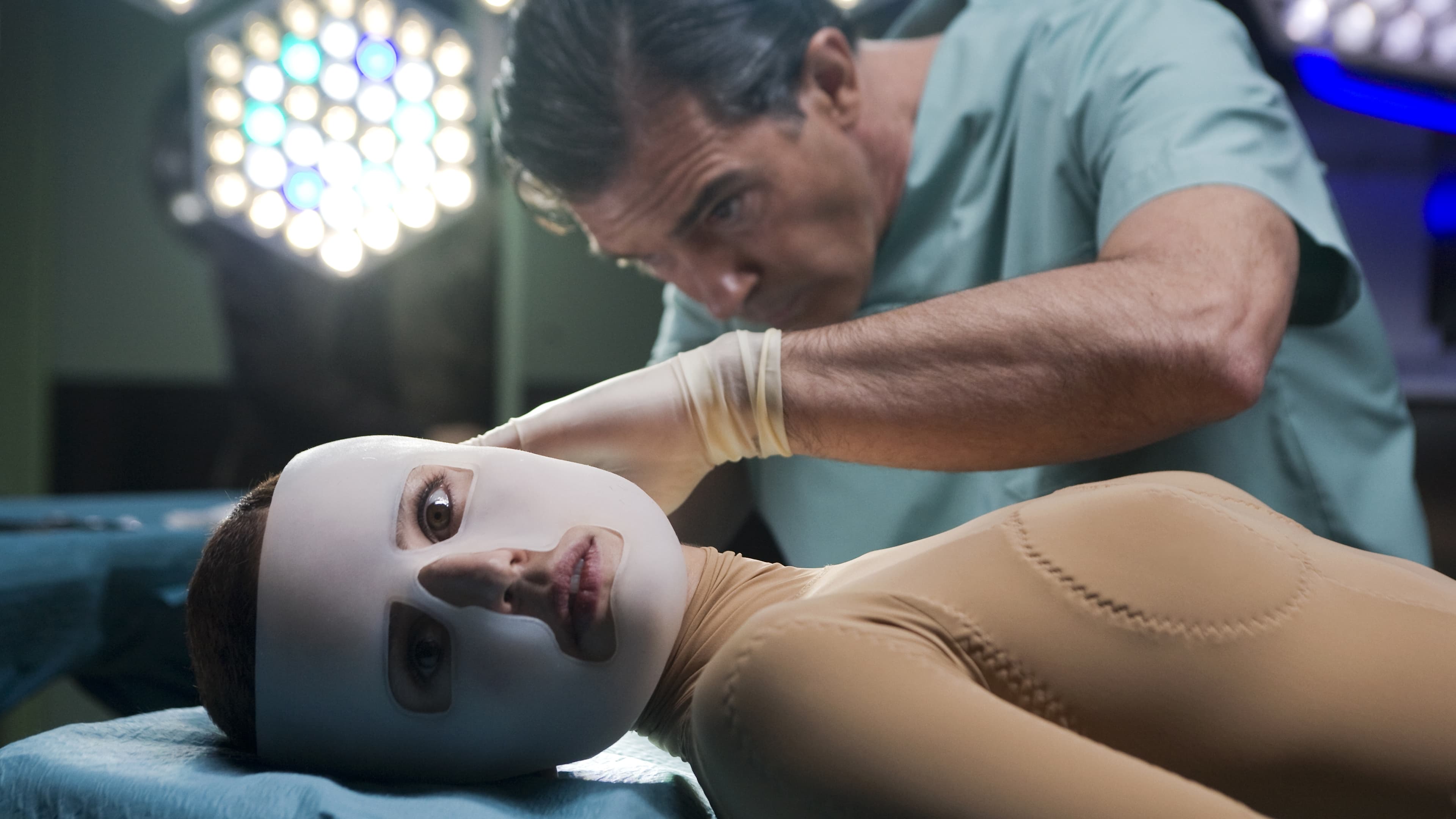
Performances: Cannon Fodder (and Lab Rats)
Antonio Banderas returns to Almodóvar’s universe after years in Hollywood, and he does so with a performance that’s like a velvet-wrapped dagger. Dr. Robert Ledgard is a monster, but not the kind that roars and bares its fangs—he’s the kind that smiles while driving a scalpel into your gut. Banderas plays him with a chill that freezes the blood, but also with a vulnerability that makes him all too human. There’s a moment, when Ledgard confesses his obsession with synthetic skin, where Banderas lowers his voice to a whisper. He’s not a villain—he’s a broken man, and that makes him even more dangerous. It’s the best role of his career, and that’s saying something.
But if Banderas is the scalpel, Elena Anaya is the wound. Her portrayal of Vera is a masterclass in restraint and despair. Anaya conveys terror, submission, and, in the most unexpected moments, defiance from a character who is both victim and accomplice. There’s a shot, when Vera looks in the mirror for the first time after the operation, where her face shows no relief, no joy, not even resignation. Just a void so deep it seems like it’s going to swallow the camera. And then there’s that macabre detail: the scars etched into her skin, as if someone had tried to write a message on her body and run out of ink. Anaya wears them with a naturalness that sends shivers down your spine. She’s not an actress playing a victim—she’s a woman who’s survived something unspeakable and isn’t sure she wants to keep living.
The supporting cast doesn’t lag far behind, though some characters suffer from that almodovariano affliction of being too eccentric for their own good. Marisa Paredes, as Marilia—the housekeeper with family secrets—steals every scene she’s in with that mix of elegance and cruelty only she can pull off. Then there’s Jan Cornet as Vicente, the young man whose life intersects with Ledgard’s at the worst possible moment. Cornet doesn’t have the gravitas of Banderas or Anaya, but his performance is key to understanding the film: he’s the missing link, the catalyst for the entire tragedy. His final scene, where Ledgard reveals the truth, is so brutal it feels like it’s been ripped from a nightmare.
The best
- José Luis Alcaine’s cinematography: Every frame is a painting, but not the kind you’d hang in your living room—the kind that makes you avert your eyes because you know it’s hiding something rotten. The contrasts between light and shadow, the saturated reds, the clinical whites... Alcaine turns the film into a visual feast that, paradoxically, kills your appetite. There’s a moment when Vera appears for the first time in that transparent dress, and the light passes through her like she’s a ghost. This isn’t cinematography—it’s witchcraft.
- Antxón Gómez’s production design: Dr. Ledgard’s mansion is a character in its own right: a mix between a luxury clinic and a gothic dungeon. The hallways seem to lead straight to hell, and the operating room gleams brighter than a private hospital’s. It’s the perfect setting for a design nightmare.
The worst
- The development of some supporting characters: Almodóvar has a bad habit of creating secondary characters so eccentric they feel like they’ve been ripped from a comic book. Marilia (Marisa Paredes) is fascinating, but others, like Zeca (Roberto Álamo), come off as caricatures. They don’t not work—they’re just as out of place as a pimple on the Mona Lisa’s nose.
- The pacing in the second half: The film starts like a bullet train and then suddenly hits the brakes. It’s not that it slows down, but there are moments where the plot lurches forward like Almodóvar isn’t quite sure how to close the loop. It doesn’t ruin the film, but it leaves a stain.
- The excess of symbolism: Almodóvar can’t help but toss out metaphors like confetti at a wedding. The skin, the dress, the mirror... sometimes it feels like you’re watching a PowerPoint presentation for a cheap psychoanalysis course. Less is more, Pedro.
- The lack of nuance in some dialogues: There are moments where the characters spout lines so laden with meaning they sound like they’ve been lifted from a bargain-bin philosophy manual. They’re not uninteresting—they just sound like prepared speeches.
The Verdict of Claqueta Ácida
The Skin I Live In is one of those films that leaves a mark, like a badly done tattoo you can’t erase. Almodóvar doesn’t just direct—he tortures: with his camera, his music, his actors. It’s a masterpiece of gothic horror, but also a funhouse mirror that forces you to look at yourself and ask what lies beneath your own skin. It’s not a film for everyone—and thank god for that—but if you dare to step into its world, you’ll leave feeling like something’s been torn from you and you don’t even know what it is. Score: 8.7. A feast of flesh and celluloid you won’t forget, even if you wish you could. 💀
tweets_alternativos:
🎬 Tráiler Oficial
Abrir en YouTube
Ficha de Daños Colaterales en Sala
Certificado de impacto psicofísico emitido por Héctor Veneno
Cero. La pantalla absorbió cada segundo de atención disponible.
El móvil permaneció en el bolsillo donde debía estar.
Ninguna: la adrenalina cinematográfica es suficiente.
"No aplica. La obra se sostiene sola."
💬 El Veredicto de la Comunidad
¿Qué te ha parecido la película? Deja tu nota de 0 a 10 para contrastarla con el análisis de la redacción.
Aún no has votado
📢 ¿Te ha gustado el ácido?
Comparte esta crítica con tus amigos cinéfilos o desata la polémica en redes.
⚡ THE CINEMATIC VENOM YOUR INBOX CRAVES
No sugarcoated ratings, no corporate fluff. Subscribe for our uncensored weekly analysis or join the private Telegram for press previews, poll clashes, and instant alerts.
Alertas de estrenos en 1 segundo, encuestas en caliente y audios al salir de pases de prensa.
Recibe la dosis semanal en tu mail + regalo inmediato del PDF con 50 joyas ocultas de culto.
Related Reviews
Recommended autopsies for demanding film buffs.
 🔥 Fusión Nuclear8.0
Bitter Christmas: Almodóvar Comes Home (And Saves Us from Corporate Holiday Hell)
⚡Del mismo director (Pedro Almodóvar): analiza la evolución o degradación de su estilo.
Almodóvar turns holiday grief into an intimate, visually stunning, and emotionally raw drama. Bárbara Lennie shines, but the script stumbles in the third act. 8/10.
 🔥 Fusión Nuclear8.0
The End of Oak Street: David Robert Mitchell Reinvents Cosmic Horror Without Losing Its Human Core
⚡Consagradas en el olimpo transgresor con 🔥 Fusión Nuclear.
Anne Hathaway and Ewan McGregor lead this claustrophobic descent where the unknown isn’t a monster—it’s reality itself unraveling at the seams. Mitchell proves once again that the most terrifying horror is the kind that festers in the intimate.
 🔥 Fusión Nuclear9.0
The Odyssey: Nolan’s Epic Ego Trip
⚡Consagradas en el olimpo transgresor con 🔥 Fusión Nuclear.
Christopher Nolan’s *The Odyssey*: A cinematic masterpiece—or a bloated vanity project drowning in its own pretensions?
Editorial Ecosystem
Cinephile connections, archive interviews and related analyses.
🎞️ In Claqueta Cinematheque1
💬 Debate Cinéfilo & Autopsia de Lectores
0 veredictos¿Discrepas con nuestra nota? ¿Es una obra maestra o veneno puro? Deja tu veredicto abajo sin necesidad de registro.


Aún nadie ha dejado su veredicto para esta película.
Sé el primero en clavarle el colmillo rellenando el formulario de arriba.