
Apex Predator — When Grief Becomes a Survival One-Take Thriller
Baltasar Kormákur drags the hunt thriller into the realm of the one-take shot and Icelandic Nouvelle Vague. Charlize Theron shines, but the script limps like a wounded stag.


Apex Predator: full review

The hunt movie has always been a subgenre as predictable as an episode of Survivor: a pack of humans, a masked psychopath, and a forest that looks like it was plucked from an IKEA catalog. But Apex Predator (Apex for the purists) arrives with the intent to shatter the mold, and it does so with the grace of a bull in an Icelandic china shop. Baltasar Kormákur, that director who oscillates between blockbusters (Everest, 24: Live Another Day) and auteur cinema with pretensions (The Deep, Contraband), here tackles material that, on paper, reeks of testosterone and clichés. Yet there’s something in his staging that recalls Béla Tarr’s long takes more than The Expendables shootouts. The result? A film that works, even if not always as it should, proving the genre still has room for intelligence—or at least for intelligent pretension—amidst all the gunfire and choked screams.
The context of Apex is as fascinating as its premise. Kormákur, a director who’s repeatedly shown he knows how to handle suspense (see The Deep, where an Icelandic fisherman battles the sea and himself in a masterclass of cinematic minimalism), ventures here into more commercial territory, though without completely shedding his DNA. The film was shot in Australia, a setting not exactly fresh for the genre (just recall Wolf Creek or The Invisible Man), but here it takes on an almost obsessive prominence. Lawrence Sher, the cinematographer who previously worked with Kormákur on Everest, turns the Australian landscapes into a character in their own right: the golden light of sunset filtering through the trees, the earthy tones contrasting with the sickly green of the vegetation, and those wide shots that seem lifted from a BBC documentary on predators. But the real magic isn’t the what—it’s the how. Kormákur uses space like a chessboard, and every camera movement—whether a lateral tracking shot or a long take following Charlize Theron as she sprints through the trees—is calculated to generate tension. It’s no coincidence the film evokes The Revenant at times: there’s an obsession with gritty realism, with blood staining clothes and sweat fogging the lens. Yet unlike Alejandro G. Iñárritu, Kormákur doesn’t get lost in technical virtuosity. Here, the long take isn’t an end in itself but a tool to immerse the viewer in the protagonist’s despair.
Speaking of the protagonist, Charlize Theron once again proves why she’s one of the most underrated actresses in action cinema. This isn’t her first physical role (Mad Max: Fury Road, Atomic Blonde), but in Apex there’s something beyond muscles and flying kicks. Theron plays a woman in mourning—literally, as the script insists on reminding us her character is dragging recent loss—and she does so with a restraint that contrasts with the violence around her. She’s not the invincible heroine: she stumbles, hesitates, cries, and in one particularly brutal moment, crawls on the ground like a wounded animal. It’s in these details where the film shines, because Kormákur understands suspense isn’t built solely on chases and gunfire but on the silence before chaos. That said, Jeremy Robbins’ script isn’t always up to par. Some dialogues sound forced, as if someone scribbled profound lines on a bar napkin, and the villain (played by Zachary Garred), while functional, lacks the depth to be anything more than a knife-wielding cliché. But even in its weakest moments, Apex manages to hold interest thanks to its relentless pacing and that sense that, at any moment, everything could go to hell.
The supporting cast delivers but doesn’t particularly stand out. Taron Egerton, who proved his worth in Rocketman and Kingsman, is reduced here to Theron’s sidekick, a role any mid-tier actor could’ve played. Eric Bana appears in such a brief part he feels like a luxury cameo, while Caitlin Stasey and Bessie Holland are given little more to do than scream and run. It’s a shame, because the material had potential to flesh out these characters, but the script seems more interested in action than character development. Still, there’s a moment where Egerton and Theron share a frame that recalls ‘80s buddy-cop movies, but with a chemistry that avoids cheese. It’s a breather amid the chaos, a reminder that even in action cinema, characters can be more than cannon fodder.
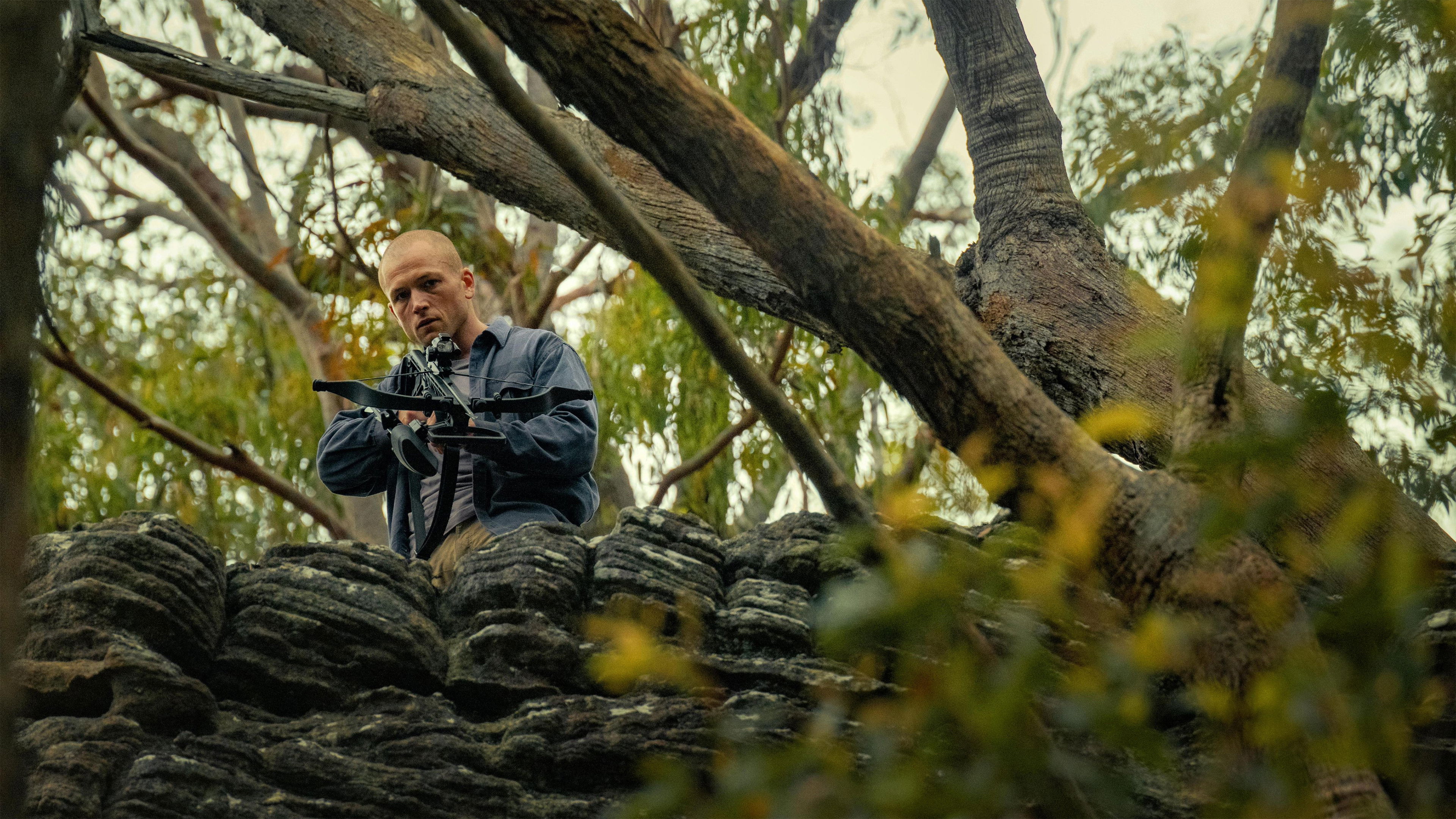
Direction and Staging: The Frame as a Weapon
Baltasar Kormákur isn’t a director who hides behind the camera. In Apex, every shot seems designed to destabilize the viewer: whether through a tight frame that forces us to feel the protagonist’s claustrophobia or a wide shot reminding us how small we are against nature. There’s one scene in particular—a long take following Theron as she flees her predator—that’s pure cinematic magic. The camera doesn’t just follow her: it breathes with her, pauses when she pauses, and accelerates when she does. This isn’t an empty technical flourish, like those long takes in 1917 that feel more like ego exercises than storytelling. Here, the camera movement has a purpose: to plunge us into the protagonist’s experience, to make us feel every branch whipping her face, every rock cutting her feet. Kormákur proves suspense isn’t built with blaring music and quick cuts but with silence and anticipation.
But not everything is perfect. There are moments when the film seems to lose itself in its own ambition. The villain, for instance, is such an archetype it’s hard to take him seriously. Garred does his best with the material, but his performance oscillates between menacing and ridiculous, as if he’s in a completely different movie. Plus, the script keeps hammering home that Theron is grieving, as if afraid the audience might forget the trauma driving her into the woods. It’s a narrative device that works early on but becomes repetitive, like a scratched record. Fortunately, Kormákur compensates for these flaws with impeccable direction. Theron, in particular, is superb, and there’s a moment where her character removes her shirt to bandage a wound that’s so raw and realistic it hurts. It’s not a glamorous moment but one of survival, and that’s what makes the film connect.

Technical Breakdown: Nature as a Character
Lawrence Sher, the cinematographer, had already proven his talent in films like Joker and The Hangover, but in Apex he takes his work to another level. The Australian landscapes aren’t just a backdrop: they’re another character, almost an antagonist. Sher uses a palette of earthy tones and sickly greens that contrast with Theron’s pale skin, creating an image that’s both beautiful and unsettling. There’s a shot where the protagonist reflects in a murky puddle that looks like it’s straight out of a Caravaggio painting: light filters through the trees, creating a play of shadows and highlights reminiscent of Baroque chiaroscuro. But the most impressive thing is how Sher conveys the texture of the forest: leaves crunch underfoot, fog tangles between the trees, and the wind seems to whisper threats in every corner. It’s not just about aesthetics—it’s about immersion. The viewer isn’t watching a movie: they’re living a nightmare.
The sound design, meanwhile, is another of the film’s strengths. There’s no music during tense moments, just ambient sound: the crack of branches, the wind howling through the trees, and Theron’s ragged breathing as she runs. It’s a minimalist approach reminiscent of The Blair Witch Project, but without the amateurism. Silence becomes another character, and when violence finally erupts, the contrast is so brutal it stings. The editing, handled by Robert Duffy, is another success. The cuts are precise but never call attention to themselves. There’s a scene where Theron and Egerton argue while walking through the forest that’s edited like a Rohmer dialogue: the shots are long, the cuts are subtle, and the tension builds slowly, like poison seeping into the blood.
The best
- Charlize Theron’s performance: She doesn’t just run, shoot, and fight like a modern Olympian goddess. She acts. Every glance, every gesture, every tear is calculated to convey her character’s pain and determination. It’s a physical and emotional performance that lifts the film above the genre.
- Lawrence Sher’s cinematography: The Australian landscapes aren’t a set but a character in their own right. Sher turns every shot into a work of art, with a color palette that oscillates between beauty and unease. The forest has never seemed so threatening.
- Sound design: The absence of music in key moments is a masterstroke. Silence becomes a weapon, and when violence erupts, the contrast is brutal. The ambient sound—the crunch of leaves, the wind, the gasps—is so realistic it hurts.
- Kormákur’s direction: He’s not a director who hides behind the camera. Every shot, every movement, is designed to immerse the viewer in the protagonist’s experience. The escape long take is pure cinematic magic.
The worst
Jeremy Robbins’ script: It has brilliant moments, but also forced dialogue and a villain straight out of a CSI* episode. The insistence on Theron’s grief becomes repetitive, like a broken record.
- The supporting cast: Taron Egerton and Eric Bana deliver, but their characters are underdeveloped. Caitlin Stasey and Bessie Holland are given little more to do than scream and run. A shame, because the material had potential for more.
- The villain: Zachary Garred does his best, but his character is such an archetype it’s hard to take him seriously. He oscillates between menacing and ridiculous, as if he’s in a completely different movie.
- The pacing in the second act: The film loses steam in the middle, when the script seems more interested in action than character development. Fortunately, the third act regains the initial tension.
The Verdict of Claqueta Ácida
Apex Predator isn’t a masterpiece, but it’s one of those films that works despite its flaws. Baltasar Kormákur proves action cinema still has room for intelligence, even if it’s a bit clumsy. Charlize Theron is superb, the cinematography is stunning, and the sound design is so brutal it stings. The script limps, the villain is a walking cliché, and the supporting cast deserved more, but even with all that, Apex manages to convey that sense of desperation and survival the genre often forgets. It’s not the film that will change cinema, but it’s a reminder that sometimes the relative frame can be deadlier than any knife. 💀
🎬 Tráiler Oficial
Abrir en YouTube
Ending Explained: Apex Predator
Apex Predator: frequently asked questions
- What is the rating of "Apex Predator" on Claqueta Ácida?
- "Apex Predator" scored 8.0/10 on Claqueta Ácida in the review by Odin Lagbert.
- Is "Apex Predator" worth watching?
- Yes. We gave it 8/10 (Nuclear Fusion), our rating for must-see films.
- Who directed "Apex Predator"?
- "Apex Predator" was directed by Baltasar Kormákur.
- How does "Apex Predator" end?
- Spoilers in Apex Predator ending explained .
Theater Collateral Damage Report
Psychophysical impact certificate issued by Odin Lagbert
Cero. La pantalla absorbió cada segundo de atención disponible.
El móvil permaneció en el bolsillo donde debía estar.
How much second-hand embarrassment the film causes (10 = maximum). It is not the review score.
Ninguna: la adrenalina cinematográfica es suficiente.
"Inexistente: pulso de hierro hasta los créditos finales."
💬 Community Verdict
What did you think of the film? Rate it from 0 to 10 to compare it with the editorial review.
You haven't voted yet
📢 ¿Te ha gustado el ácido?
Comparte esta crítica con tus amigos cinéfilos o desata la polémica en redes.
⚡ THE CINEMATIC VENOM YOUR INBOX CRAVES
No sugarcoated ratings, no corporate fluff. Subscribe for our uncensored weekly analysis or join the private Telegram for press previews, poll clashes, and instant alerts.
Alertas de estrenos en 1 segundo, encuestas en caliente y audios al salir de pases de prensa.
Recibe la dosis semanal en tu mail + regalo inmediato del PDF con 50 joyas ocultas de culto.
By subscribing you agree that we use your email only to send you the newsletter. Unsubscribe at any time. Privacy policy
Related Reviews
Recommended autopsies for demanding film buffs.
 🔥 Fusión Nuclear 8.5
*Alleluia: Love as a Terminal Illness (or How to Turn Crimes of Passion into a Sweaty, Fleshy Spectacle)*
⚡ Afinidad temática directa en atmósfera, estilo y fijaciones visuales.
Fabrice Du Welz reimagines the myth of the lonely hearts killers in a feverish whirlwind of jealousy, submission, and blood, led by Lola Dueñas in a performance that’s equal parts hypnotic and harrowing.
 🔥 Fusión Nuclear 8.5
*High Tension (Haute Tension): The Brutal Birth of the New French Extremism – Or How to Turn Flesh into Poetry with a Machete*
⚡ Afinidad temática directa en atmósfera, estilo y fijaciones visuales.
Alexandre Aja shocked global screens with a relentless rural bloodbath, redefined by breakneck pacing and a divisive twist that splits serious cinephiles right down the middle.
 🔥 Fusión Nuclear 8.5
*Aterrados: The Rebirth of Ghost Stories in the Raw Grit of Buenos Aires*
⚡ Afinidad temática directa en atmósfera, estilo y fijaciones visuales.
Demian Rugna revolutionizes paranormal horror—possessions, poltergeists, and all—by transplanting it to a residential neighborhood in Buenos Aires, armed with a devastating sound design that rattles your bones.
Editorial Ecosystem
Cinephile connections, archive interviews and related analyses.
💬 Debate Cinéfilo & Autopsia de Lectores
¿Discrepas con nuestra nota? ¿Es una obra maestra o veneno puro? Deja tu veredicto abajo sin necesidad de registro.
📏 Normas: se critica la película, no a las personas. Los insultos y los ataques personales se pueden borrar.