Inglourious Basterds — The Revenge That Tastes Like Blood and Rotten Celluloid
Tarantino rewrites history with a scalpel of razor-sharp dialogue and black humor that reeks of gunpowder. Christoph Waltz steals the corpse.


Inglourious Basterds: full review

The stench of burning celluloid and stale gunpowder hit me square in the face when the lights dimmed. This wasn’t my first time watching Inglourious Basterds, but every viewing feels like unearthing a corpse that still breathes: you know it’s dead, yet its fingers twitch. Quentin Tarantino didn’t make a movie about World War II; he built a labyrinth of mirrors where history is the monster and cinema its sole executioner. The year was 2009, and the world was still reeling from the shock of Kill Bill and the acid hangover of Death Proof. Tarantino, in the prime of his creative life—or his most dangerous phase, depending on who you ask—decided it was time to play God. Not the merciful kind, but the one who delights in watching his creations burn while whispering in their ear: This is just a movie, darling. And oh, was it ever. A film that smelled of fake blood and hand-rolled tobacco, of dialogue that tasted like cheap whiskey and shots ripped from a fever dream of Sergio Leone. The press split like a scalpel: some hailed its audacity, others called it irresponsible. But the audience, that ruthless judge, surrendered to the magnetism of a villain who spoke four languages and killed with the grace of a cat stalking a mouse. Christoph Waltz didn’t play Hans Landa; he exhumed him from Europe’s nightmares and sat him in a director’s chair to stare us down while sipping his milk. And stare he did.
The shoot was a hellscape of precision and obsession. Tarantino, they say, forced his actors to learn their lines in the original languages—French, German, Italian—with flawless pronunciation. It wasn’t a whim; it was a statement of intent. This wouldn’t be a film where Nazis spoke English with a German accent for the audience’s comfort. No. Here, language was another weapon, as lethal as a knife or a bullet. Robert Richardson, the cinematographer, lit every scene as if painting a Caravaggio: chiaroscuro that hid more than it revealed, faces emerging from the dark like ghosts. The production design, helmed by David Wasco, turned Paris into a 1940s set where every object—from cinema posters to SS uniforms—seemed to have its own history, a layer of grime and sweat that made them real. And then there was the music: a soundtrack that was a collage of stolen sounds, from The Green Leaves of Summer to David Bowie’s Cat People, to Ennio Morricone’s Rabbia e Tarantella. Tarantino didn’t compose a score; he created a living organism, a sonic tumor that grew inside the film until it burst from within.
Direction: Tarantino as a War Surgeon
Quentin Tarantino doesn’t direct scenes; he operates on them. And in Inglourious Basterds, his scalpel shows no mercy. The film is divided into five chapters, each with its own rhythm, texture, and way of killing. The first, Once Upon a Time in Nazi-Occupied France, is a masterclass in sustained tension. A single take of Hans Landa arriving at the Dreyfus farm, the camera slithering like a serpent between the furniture, the cold sweat of the Jewish family hiding beneath the floorboards. No music, just the creak of Landa’s boots and the sound of his voice, smooth as silk and sharp as a razor. When the Nazi colonel orders his men to fire through the floorboards, the audience feels the impact of every bullet as if a piece of their soul had been torn out. Tarantino doesn’t show us violence; he makes us choke on it. Then there’s the third chapter, German Night in Paris, where Shosanna’s revenge simmers slowly. Mélanie Laurent, with her icy gaze and predator’s smile, is the true protagonist of this story. She’s no hero; she’s a force of nature, a storm contained in a red dress. When she fires up the projectors in her cinema and the flames consume the Nazis, it’s not just an action scene: it’s a pagan ritual, a purge of centuries of oppression. Tarantino films the fire as if it were the apocalypse, but a small, intimate, almost domestic apocalypse. As if the end of the world could fit inside a movie theater.
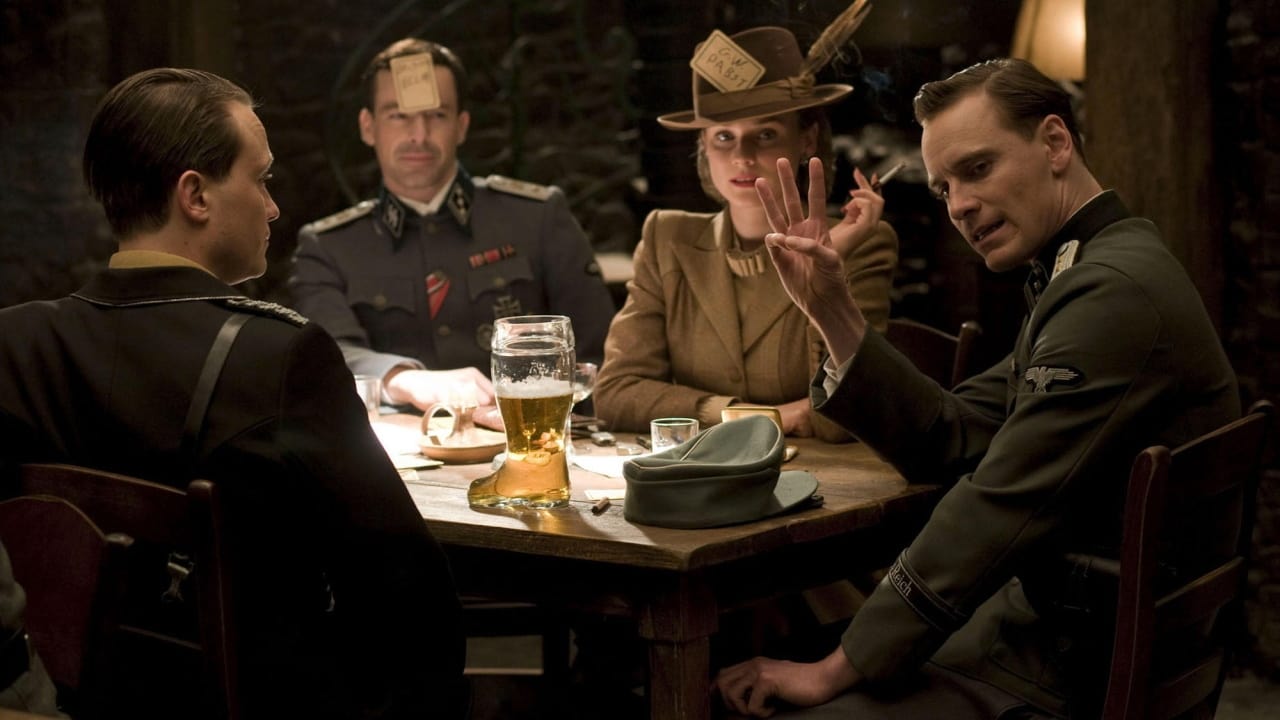
The editing, by Sally Menke—Tarantino’s most loyal collaborator, who passed in 2010—is a precision machine. Every cut is a lash, every transition a stab. The bar scene, where the Basterds meet the German actress Bridget von Hammersmark, is a perfect example: the dialogue overlaps, the shots flow with hypnotic fluidity, and suddenly, a mispronounced word—«Three!» instead of «Drei!»—triggers a massacre. Tarantino doesn’t warn us; he shoves us into the abyss and then asks if we enjoyed the fall. And the worst part? We always say yes.
Performances: The Cast That Bleeds in Technicolor
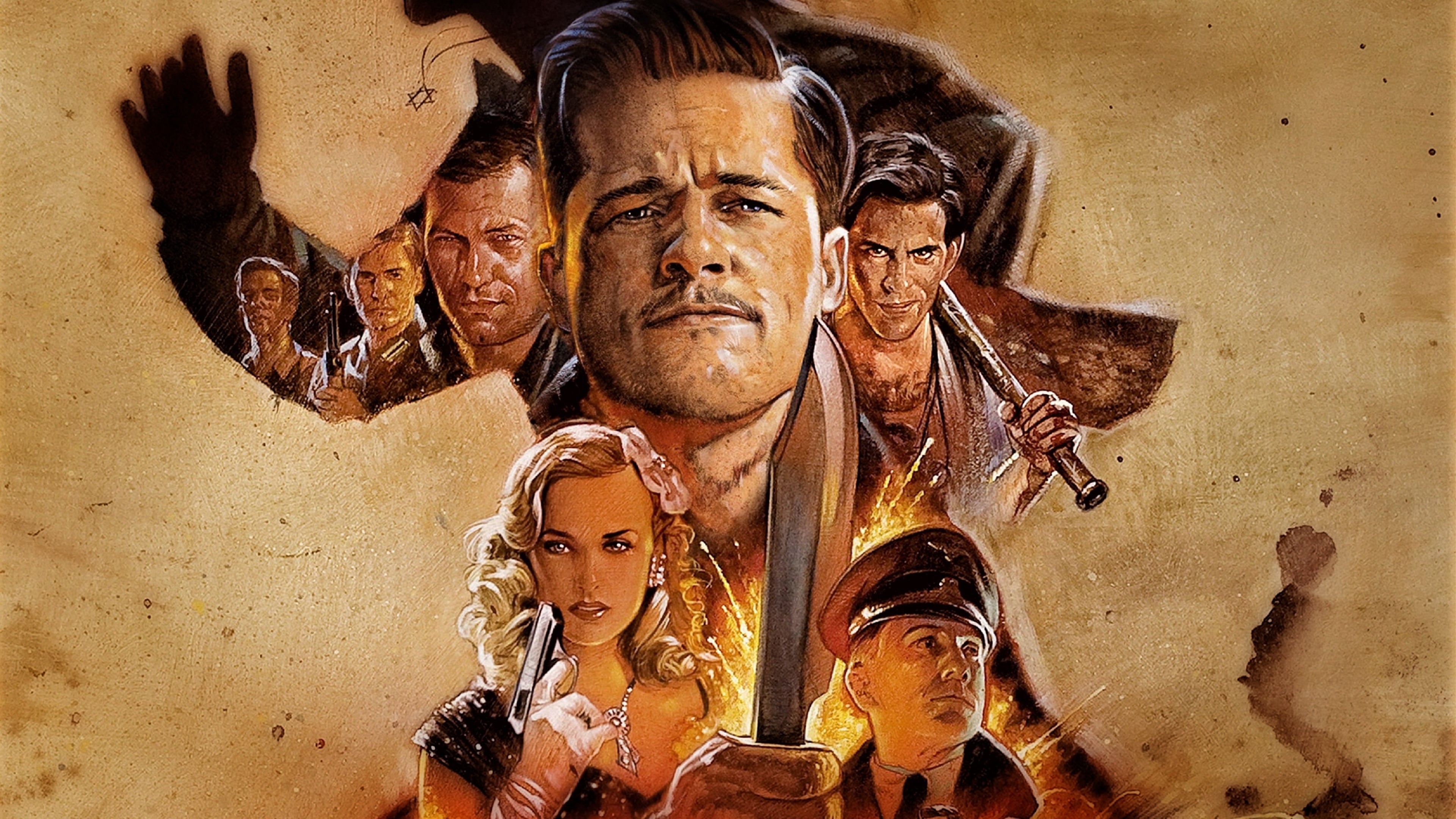
Christoph Waltz didn’t win an Oscar by accident. His Hans Landa is a masterpiece of duality: charming and monstrous, cultured and sadistic, a man who could sell you life insurance while stabbing you in the back. Waltz doesn’t act; he inhabits Landa, as if the character had always been inside him, waiting for his moment to emerge. His scene with the French actress in the restaurant—«Milk or sugar, madame?»—is one of the greatest dialogue sequences in cinema history. No action, no special effects, just two actors talking and an audience holding its breath. Then there’s Brad Pitt, who plays Aldo Raine like a comic book character come to life. He’s not a subtle actor, but he doesn’t need to be here. Raine is a brute force with a Southern drawl, a man who carves swastikas into Nazis’ foreheads as if he were whittling wood. Pitt nails it because he understands his character isn’t a hero, but a ghost of war, a man who’s seen too much and couldn’t care less.
Mélanie Laurent, meanwhile, is the film’s dark heart. Her Shosanna isn’t a victim; she’s a survivor who’s learned to bite. When she looks into the camera in the final close-up, her eyes filled with tears and hatred, she’s not asking for pity. She’s declaring war. And then there’s the rest of the cast: Eli Roth as Sergeant Donny Donowitz, the «Bear Jew», a character plucked from a Brothers Grimm nightmare; Michael Fassbender as Lieutenant Archie Hicox, a film critic turned spy; Diane Kruger as Bridget von Hammersmark, an actress playing double agent with the elegance of an ice queen. Each brings something unique, but they all share one quality: they know they’re in a Tarantino film, and they act accordingly. There’s no naturalism here; there’s theater of cruelty, controlled exaggeration, a sense of black humor that reeks of charred flesh.
The best
- Christoph Waltz as Hans Landa: A villain who redefines elegance. Every word he speaks is a slow-acting poison, every smile a veiled threat. Waltz doesn’t play Landa; he exhumes him and sits him at the tea table like just another guest.
- The restaurant scene: Ten minutes of dialogue worth more than most entire films. Tarantino proves tension doesn’t need action, just two actors and an audience willing to break a sweat.
- Robert Richardson’s cinematography: Chiaroscuro straight out of a Renaissance painting, but with fresh blood. Richardson lights the film as if every shot were an open wound.
- Sound design: From the creak of Landa’s boots to the crackle of flames in the cinema, sound is as important as the image. Tarantino doesn’t just show us war; he makes us hear it.
The soundtrack: A collage of stolen tracks that functions like a sonic tumor. From Bowie’s Cat People to Morricone’s Rabbia e Tarantella*, every song is a stab to the ear.
The worst
- Forced humor in some moments: Scenes like the «Bear Jew» beating a Nazi with a baseball bat teeter on the edge of caricature. Tarantino sometimes confuses satire with slapstick, and it doesn’t always work.
- Uneven pacing: The first chapter is a masterclass in tension, but there are moments when the film loses itself in its own ambition. The fourth chapter, for example, stumbles along as if Tarantino wasn’t quite sure how to connect all the plots.
- Some secondary characters: Til Schweiger as Sergeant Hugo Stiglitz is little more than a mustachioed cliché. His character doesn’t bring anything we haven’t seen before in other war films.
- The ending too neat: Tarantino rewrites history with an ending that smells of adolescent fantasy. It’s not that it doesn’t work, but after so much brutality, the conclusion feels like it’s been lifted from a macabre fairy tale.
The Verdict of Claqueta Ácida
Inglourious Basterds isn’t a movie about World War II. It’s a love letter to cinema, an homage to westerns, spaghetti westerns, 60s war films, and anyone who’s ever dreamed of burning the world down and watching it burn. Tarantino doesn’t rewrite history; he bleeds it dry with style, black humor, and a cruelty that hurts because it’s beautiful. Christoph Waltz takes home the Oscar, but the film belongs to Mélanie Laurent, to that girl who looks into the camera and reminds us that revenge isn’t a dish best served cold—it’s a feast devoured with eyes wide open. It’s not perfect—nothing is—but it’s necessary, like a bullet to the temple or a kiss in the dark. And that, dear readers, is more than most films can claim. 💀
🎬 Tráiler Oficial
Abrir en YouTube
Inglourious Basterds: frequently asked questions
- What is the rating of "Inglourious Basterds" on Claqueta Ácida?
- "Inglourious Basterds" scored 9.2/10 on Claqueta Ácida in the review by Bastian Noir.
- Is "Inglourious Basterds" worth watching?
- Yes. We gave it 9.2/10 (Nuclear Fusion), our rating for must-see films.
- Who directed "Inglourious Basterds"?
- "Inglourious Basterds" was directed by Quentin Tarantino.
Theater Collateral Damage Report
Psychophysical impact certificate issued by Bastian Noir
Ni un solo parpadeo voluntario. El asiento, inusualmente cómodo.
El móvil permaneció en el bolsillo donde debía estar.
Ninguna. Esta obra no necesita muletas estimulantes.
"No aplica. La obra se sostiene sola."
💬 Community Verdict
What did you think of the film? Rate it from 0 to 10 to compare it with the editorial review.
You haven't voted yet
📢 ¿Te ha gustado el ácido?
Comparte esta crítica con tus amigos cinéfilos o desata la polémica en redes.
⚡ THE CINEMATIC VENOM YOUR INBOX CRAVES
No sugarcoated ratings, no corporate fluff. Subscribe for our uncensored weekly analysis or join the private Telegram for press previews, poll clashes, and instant alerts.
Alertas de estrenos en 1 segundo, encuestas en caliente y audios al salir de pases de prensa.
Recibe la dosis semanal en tu mail + regalo inmediato del PDF con 50 joyas ocultas de culto.
Related Reviews
Recommended autopsies for demanding film buffs.
 🔥 Fusión Nuclear 9.3
 2001: A Space Odyssey — The Day Kubrick Left Us Speechless (and Oxygenless)
⚡ Afinidad temática directa en atmósfera, estilo y fijaciones visuales.
Kubrick turned science fiction into pure art: 149 minutes of eloquent silence, bone-wielding apes, and a psychopathic computer. Masterpiece or pretentious fraud? Here’s the verdict.
 🔥 Fusión Nuclear 8.5
 *A Clockwork Orange: The Sweet, Rusty Aftertaste of Violent Haute Couture*
⚡ Afinidad temática directa en atmósfera, estilo y fijaciones visuales.
A scathing review of Kubrick’s masterpiece, where ultraviolence meets 60s fashion in a twisted pas de deux.
 🔥 Fusión Nuclear 8.5
 *Airbag: The 90s’ Orgy of Chaos with Style (or How the Decade Taught Us to Laugh at Death)*
⚡ Afinidad temática directa en atmósfera, estilo y fijaciones visuales.
Juanma Bajo Ulloa turns mayhem into art with this psychedelic road movie, where the A/C reeks of cheap whiskey and the celluloid sweats testosterone. A cult gem that time hasn’t been able to tarnish.
Editorial Ecosystem
Cinephile connections, archive interviews and related analyses.
💬 Debate Cinéfilo & Autopsia de Lectores
0 veredictos¿Discrepas con nuestra nota? ¿Es una obra maestra o veneno puro? Deja tu veredicto abajo sin necesidad de registro.


Aún nadie ha dejado su veredicto para esta película.
Sé el primero en clavarle el colmillo rellenando el formulario de arriba.