Natural Born Killers — Oliver Stone’s Media Circus or How to Turn Nausea Into Art (With MTV Subtitles)
An in-depth review of Natural Born Killers (1994). We dissect Oliver Stone and Quentin Tarantino’s unhinged satire on criminal fame.

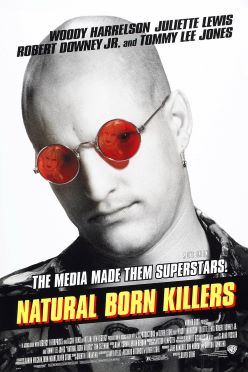


Natural Born Killers: Oliver Stone’s Media Freak Show or How to Turn Revulsion Into Art (With a Side of MTV Subtitles)
Released in 1994 amid a storm of censorship, parliamentary debates, and accusations of inspiring copycat crimes—because, of course, the blame for humanity’s moral sewer always lies with art, not, say, public education or the glorification of violence on the evening news—Natural Born Killers marks the moment when Oliver Stone, that director who mistakes activism for histrionics and depth for megaphone rants, decided to take an original script by Quentin Tarantino—yes, that Tarantino, the one with razor-sharp dialogue and characters who sound like they just walked out of a Crime SuspenStories comic—and toss it into an industrial blender filled with psychedelics, reality show fragments, and the visual aesthetic of a Nine Inch Nails music video directed by someone mid-seizure. The result isn’t a movie; it’s a cinematic happening, a sensory assault as ruthless as a Fox News broadcast during primetime, but with twice the style and half the self-awareness.
Stone doesn’t film a story; he stages an existential channel-surfing session where 35mm film rubs shoulders with high-definition video, psychedelic animation overlays disaster footage, and editing cuts mimic the frenetic pace of a teenager with ADHD flipping through channels every two seconds. It’s as if Apocalypse Now and Beavis and Butt-Head had an illegitimate lovechild on the set of The Jerry Springer Show. And yet, despite all the noise, chaos, and visual overload—or perhaps because of it—the film achieves something extraordinary: it turns nausea into art, revulsion into fascination, and social critique into a spectacle as hypnotic as a highway pileup.
finalExplicado: "Mickey y Mallory, convertidos en superestrellas mediáticas, son liberados por una turba de fans durante una entrevista en directo con Wayne Gale. En el caos, asesinan a Gale en cámara, escapan y terminan años después como una anodina pareja de clase media con hijos, anónimos en una gasolinera. El desenlace revela que la fama criminal no es un castigo ni una condena, sino un producto perecedero: la sociedad devora, eleva y luego olvida a sus monstruos. Stone cierra con ironía ácida: los asesinos natos no mueren ni van a prisión; simplemente se normalizan, porque el sistema que los creó ya ha pasado al siguiente espectáculo. El verdadero monstruo sobrevive intacto."
Mickey and Mallory: The Bonnie & Clyde of the Infotainment Era
The plot, if you can even call it that, follows Mickey Knox (Woody Harrelson) and Mallory Knox (Juliette Lewis), a serial-killer couple who leave a trail of fifty-two corpses along Route 66—because, like good crime influencers, they know you’ve got to feed the media algorithms. What’s fascinating isn’t that they kill, but how they do it: with the choreography of a Broadway musical, the aesthetic of a Calvin Klein ad, and the attitude of rock stars who know their legacy depends on at least one witness surviving to tell the tale. They’re not monsters; they’re products, perfect creations of a society that’s turned horror into a trending topic.
Stone, in his infinite subtlety—read: with the grace of a bull in a china shop—doesn’t bother humanizing them. Mickey and Mallory aren’t victims of society; they’re its funhouse mirror, the grotesque reflection of a culture that idolizes criminals while consuming their violence in primetime. Television, embodied by Wayne Gale (Robert Downey Jr. in a role so over-the-top it feels like a parody of himself), doesn’t judge them: it sells them. Gale isn’t a journalist; he’s a showman, a ringmaster who turns suffering into ratings and corpses into clicks. His show, American Maniacs, is the dystopian precursor to Making a Murderer or Tiger King, but with 200% more hysteria and 0% journalistic ethics. Downey Jr., with that fake Australian accent straight out of an SNL sketch, nails the role of the sensationalist host, a guy who stares into the camera with the same intensity a shark eyes a wounded fish. He’s repulsive, brilliant, exactly what Stone wants him to be: a caricature of yellow journalism that, ironically, works better as critique than as a character.
Trauma as Sitcom: When Canned Laughter Drowns Out Screams
But if there’s one sequence that defines the twisted genius—and the lack of restraint—of Natural Born Killers, it’s the one depicting Mallory’s childhood abuse. Stone, in a display of formal audacity that borders on sadism, chooses to film the scene like an episode of I Love Lucy or Leave It to Beaver: laugh tracks, exaggerated reaction shots, and a monstrous father (played by Rodney Dangerfield, yes, that Rodney Dangerfield) beating his daughter while a studio audience applauds. It’s uncomfortable, grotesque, brilliant. Because what better way to show how society normalizes horror than by dressing it up as a family sitcom?
The sequence is a slap in the face to the audience, a reminder that trauma doesn’t exist unless there’s an audience consuming it. Stone doesn’t just criticize desensitization to violence; he recreates it, forcing it through the aesthetic of trash TV. It’s as if David Lynch had directed an episode of Full House, but with more blood and less redemption. And yet, as effective as the scene is as social critique, it also exposes the film’s biggest flaw: its lack of subtlety. Stone doesn’t whisper; he screams. He doesn’t hint; he pummels. He doesn’t build an argument; he vomits it onto the screen with the elegance of a drunk in a bar brawl.
A Formal Collage That Smells of Burnt Celluloid and Wasted Genius
Aesthetically, Natural Born Killers is a visual Frankenstein’s monster, a mashup of formats, textures, and references that seems designed by a committee of artists tripping on LSD. Stone mixes 35mm with 16mm, high-definition video with animation, and projects images of demons, snakes, and natural disasters onto walls like hell decided to host an exhibit at the MoMA. The cinematography, by Robert Richardson—Stone’s frequent collaborator and master of expressionist lighting—drenches every frame in fluorescent greens, saturated reds, and electric cyans, as if the film were shot inside a neon tube. The editing cuts are so rapid that following the action can be a challenge, but that’s precisely the point: Stone doesn’t want you to see the violence; he wants you to feel it, to drown in it like you’re trapped in a CNN loop during a humanitarian crisis.
The soundtrack, composed and assembled by Trent Reznor (Nine Inch Nails), is another masterpiece within the disaster. Reznor doesn’t just drop songs; he constructs a sonic atmosphere that oscillates between industrial ambient, distorted dialogue samples, and drumbeats that sound like whiplashes. It’s a score that hurts, that unsettles, that reminds you you’re watching something that shouldn’t be entertaining. And yet, it is. Because, in the end, Natural Born Killers is a film about addiction: addiction to violence, to shock, to voyeurism. And Stone, like a good cinematic dealer, knows exactly how to dose the product to keep you coming back for more.
Tarantino’s Script vs. Stone’s Blender: When Pulp Turns to Mush
Here we arrive at the elephant in the room—or, better yet, the corpse in the trunk: Quentin Tarantino’s original script. Because, yes, Natural Born Killers began as a Tarantino project, a script the then-emerging director of Reservoir Dogs wrote in 1988 and sold to Stone, hoping he’d bring it to the screen with his signature style. What Stone did instead was take that script—packed with razor-sharp dialogue, eccentric characters, and a nonlinear structure—and toss it into his infamous idea blender, adding a dash of political paranoia, a spoonful of media critique, and a generous splash of visual overdose.
The result is a film that, in its first half, retains some of Tarantino’s punch—the banter between Mickey and Mallory has flashes of that verbal chemistry we’d later see in Pulp Fiction—but in the second half, it sinks into a quagmire of gratuitous prison violence, pretentious monologues, and a third act that feels like it was directed by an Oliver Stone deep in a peyote trip. Tarantino, as expected, disowned the film, and it’s not hard to see why: what in his hands would’ve been a sharp, stylized satire became, in Stone’s, a visual manifesto as subtle as a sledgehammer to the temple.
Prison as Dante’s Inferno: When Excess Devours the Message
The final stretch of Natural Born Killers, set in a prison that looks like it was designed by H.R. Giger after reading 1984, is where the film collapses under the weight of its own ambition. Stone, obsessed with denouncing the U.S. penal system—and, while he’s at it, every other system in his path—turns the prison into a circus of violence, abuse, and riots that borders on parody. There are scenes of gang rapes filmed with the same clinical detachment as a nature documentary about ants, and a prison riot that looks like it was lifted from Mad Max but with less internal coherence.
The problem isn’t the violence itself—cinema can and should show horror—but that Stone uses it as a crutch when the script falters. It’s as if, when running out of ideas, he decides to resolve every scene with a blood-and-guts jump scare. And yet, even in these moments of self-indulgence, the film has flashes of brilliance: the scene where Mickey, locked in solitary confinement, hallucinates a Native American spirit lecturing him on the nature of evil is as ridiculous as it is mesmerizing, a mix of bargain-bin shamanism and afterschool special philosophy that only Stone could sell as profound.
The Legacy of Natural Born Killers: Masterpiece or Authorized Snuff Film?
Over thirty years after its release, Natural Born Killers remains a film that divides, fascinates, and repulses in equal measure. It’s not a masterpiece—the term is too grand, like an Armani suit on a clown—but it’s not a failure either. It’s more of a flawed experiment with moments of genius, a film that, like its protagonists, exists in that limbo between the sublime and the ridiculous.
Stone wanted to critique the media, the culture of shock, the trivialization of violence, but in the process, he created something that, ironically, became part of the problem. Natural Born Killers isn’t a film that invites reflection; it’s a film that assaults you, that forces you to look even when you don’t want to, that leaves you feeling visually violated. And yet, in that assault, there’s a strange beauty, like a car crash you can’t look away from.
Is Natural Born Killers a good movie? It depends. If you’re looking for narrative coherence, deep characters, or a clear message, run for the hills. But if you want a cinematic experience that leaves you exhausted, confused, and in need of a shower, then welcome to Oliver Stone’s freak show. Just don’t say we didn’t warn you.
The best
Stone’s unhinged visual virtuosity, turning every frame into a psychedelic collage* worthy of a 1960s acid trip, but with more blood and less peace. Harrelson and Lewis’s performances, making two charismatic psychopaths more appealing than 90% of Hollywood’s romantic couples. Love is a battlefield*—with more bullets. The family abuse scene in sitcom format, a low blow so brilliant it leaves you breathless and nauseous at the same time. Canned laughter to drown out screams*: the American dream in one scene.The worst
Stone’s lack of subtlety, confusing social critique with evangelical preacher sermon at rush hour. If the message were a hammer, the audience would end up with a smoothie* for a head. The prison third act, a festival of gratuitous violence that feels like it was directed by an Oliver Stone in "More blood! More!" mode. Spoiler*: No, it’s not necessary. Tarantino’s script, butchered beyond recognition, as if Stone decided witty dialogue was too mainstream and replaced it with monologues about existential evil. Mickey and Mallory deserved better than this*.The Verdict of Claqueta Ácida (7.5/10)
Natural Born Killers is the cinematic equivalent of a mosh pit at a Nine Inch Nails concert: chaotic, violent, exhausting, and, at times, strangely liberating. Oliver Stone delivers a film that’s both a manifesto and a car crash, a work that shouts its message with the subtlety of a Donald Trump tweet at 3 a.m., but that, in its best moments, hypnotizes you with its nightmare aesthetic. It’s not cinema for everyone—in fact, it’s not cinema for almost anyone—but it is cinema, with all its contradictions, grandiosity, and power to leave a mark. Like Mickey and Mallory, Natural Born Killers doesn’t apologize for existing. And in a world of sanitized films and sugar-coated messages, that’s already a victory. Even if it’s a victory that smells like gunpowder and dried blood.🎬 Tráiler Oficial
Abrir en YouTube
Ending Explained: Natural Born Killers
Ficha de Daños Colaterales en Sala
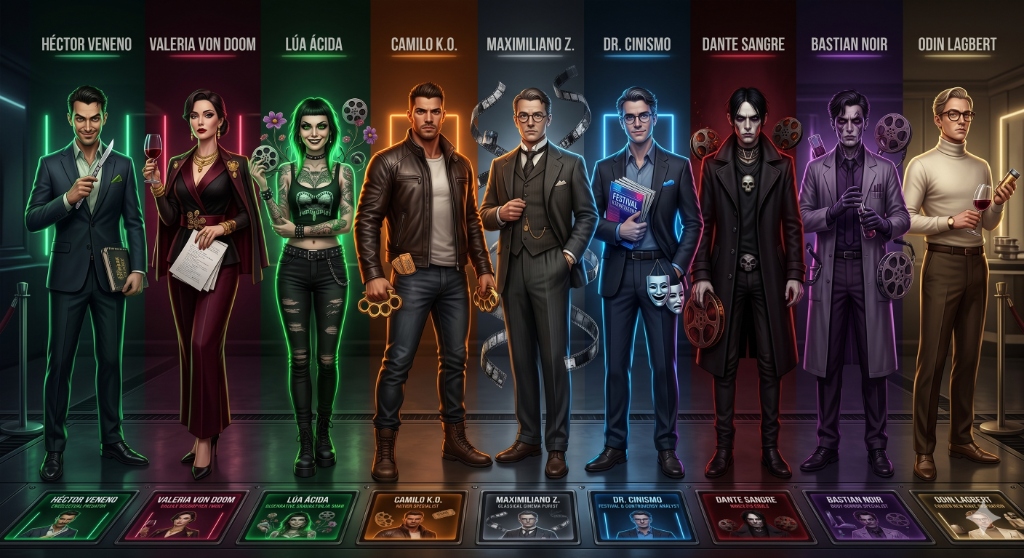
Certificado de impacto psicofísico emitido por Valeria Von Doom
2 amagos en el tramo intermedio; pestañeo pesado en las transiciones más innecesarias.
Minuto 47 y minuto 85 (comprobando cuánto quedaba de suplicio).
2 espresso para no dejarse vencer por la mediocridad cómoda.
"A mitad del segundo acto cuando la subtrama secundaria empezó a pesar más de lo que aportaba."
💬 El Veredicto de la Comunidad
¿Qué te ha parecido la película? Deja tu nota de 0 a 10 para contrastarla con el análisis de la redacción.
Aún no has votado
📢 ¿Te ha gustado el ácido?
Comparte esta crítica con tus amigos cinéfilos o desata la polémica en redes.
⚡ THE CINEMATIC VENOM YOUR INBOX CRAVES
No sugarcoated ratings, no corporate fluff. Subscribe for our uncensored weekly analysis or join the private Telegram for press previews, poll clashes, and instant alerts.
Alertas de estrenos en 1 segundo, encuestas en caliente y audios al salir de pases de prensa.
Recibe la dosis semanal en tu mail + regalo inmediato del PDF con 50 joyas ocultas de culto.
Related Reviews
Recommended autopsies for demanding film buffs.
 🔥 Fusión Nuclear9.5
*2001: A Space Odyssey – A Monkey, a Monolith, and Two Hours of Cosmic Pretentiousness*
⚡Afinidad temática directa en atmósfera, estilo y fijaciones visuales.
We dissect Stanley Kubrick’s magnum opus. A visual feast of minimalism and space hypnosis that cemented "serious" sci-fi—and bored half of humanity to tears.
 🔥 Fusión Nuclear9.3
2001: A Space Odyssey — The Day Kubrick Left Us Speechless (and Oxygenless)
⚡Afinidad temática directa en atmósfera, estilo y fijaciones visuales.
Kubrick turned science fiction into pure art: 149 minutes of eloquent silence, bone-wielding apes, and a psychopathic computer. Masterpiece or pretentious fraud? Here’s the verdict.
 🔥 Fusión Nuclear8.5
*A Clockwork Orange: The Sweet, Rusty Aftertaste of Violent Haute Couture*
⚡Afinidad temática directa en atmósfera, estilo y fijaciones visuales.
A scathing review of Kubrick’s masterpiece, where ultraviolence meets 60s fashion in a twisted pas de deux.
Editorial Ecosystem
Cinephile connections, archive interviews and related analyses.
💬 Debate Cinéfilo & Autopsia de Lectores
0 veredictos¿Discrepas con nuestra nota? ¿Es una obra maestra o veneno puro? Deja tu veredicto abajo sin necesidad de registro.

Aún nadie ha dejado su veredicto para esta película.
Sé el primero en clavarle el colmillo rellenando el formulario de arriba.