Primitive War — The War Nobody Asked For
A war movie that promises everything and delivers a dud


Primitive War: full review


I staggered out of the theater with the same vibe as a soldier after an ambush: dazed, clammy, and wondering what the hell just happened. Primitive War, Luke Sparke’s latest brainchild, is the kind of movie that promises a Vietnam War on steroids with Lovecraftian undertones and ends up being Rambo directed by a YouTube film school’s star pupil. It’s not that it’s bad—it’s insultingly mediocre, like someone blended the script of Predator with the budget of an X-Files episode shot in a Queensland backyard. And the worst part? At some point, it almost convinces you this could’ve been more than a cheap nostalgia trip with chroma effects straight out of a 2008 Call of Duty mod.
The industrial context of this film is as fascinating as it is depressing. Shot in Australia with an international cast that looks like it was plucked from a The Unit casting call but with even less charisma, Primitive War is the quintessential genre flick that survives on coproductions, tax credits, and investors who confuse “low budget” with “high concept.” Luke Sparke, its director and screenwriter, has already proven he can move cameras and actors in films like Occupation (2018) and The 34th Battalion (2024), but here, it feels like he mainlined one too many Red Bulls. What starts as a homage to war classics with horror twists devolves, in under 30 minutes, into an unintentional found footage of how not to make a monster movie. The problem isn’t that Sparke lacks ambition—he’s got plenty—but ambition without resources is like a sniper without a scope: he fires at everything, but rarely hits the mark.
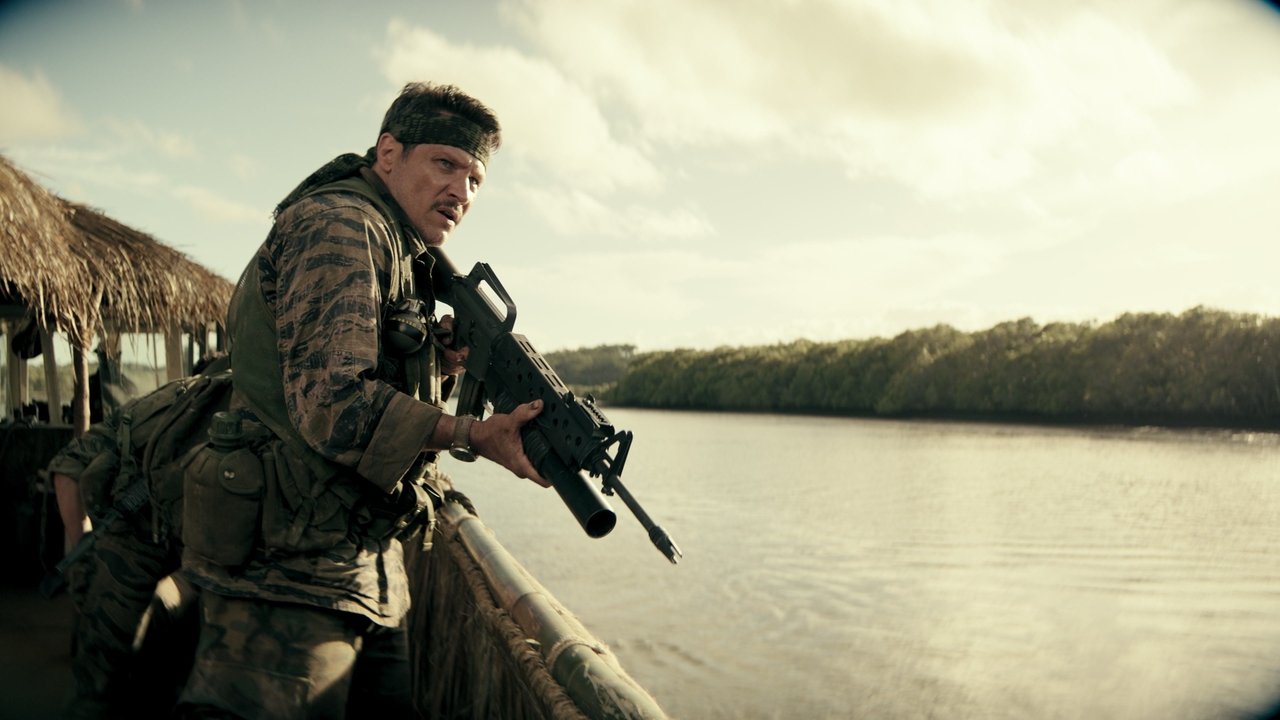
The premise is as old as war cinema itself: a recon squad, the Vulture Squad, ventures into a Vietnamese valley to find a missing Green Beret platoon. So far, so good. The issue? Instead of corpses or Vietcong traps, they stumble upon something that shouldn’t exist: an invisible threat that stalks them, kills them, and—worst of all—turns them into involuntary memes. Let’s be real, some scenes in this movie seem tailor-made for TikTok clout, like the moment a soldier screams, “It’s not human!” while staring at a bush that’s definitely moving on its own. Spoiler: the bush isn’t moving on its own. It’s a guy in a cheap ghillie suit with a desktop fan aimed at a branch. And no, this isn’t a nod to the original Predator. It’s what happens when your VFX department has the same budget as a Power Rangers episode.
Shooting, according to Sparke’s sparse interviews, was a three-week hellscape in the Australian bush, where the crew battled heat, mosquitoes, and the creeping realization they were making something that would age worse than a Sharknado. The cast, led by Ryan Kwanten (True Blood), Tricia Helfer (Battlestar Galactica), and Nick Wechsler (Revenge), does what it can with a script scribbled on a napkin during a layover. Kwanten, in particular, tries to give depth to his character, Sergeant Rake, but every time he opens his mouth to deliver a line like, “This isn’t Vietnam, this is hell,” he sounds like he’s reading a teleprompter with the enthusiasm of a late-night infomercial host. Helfer, meanwhile, has that “sci-fi TV veteran who’s done this a thousand times” vibe, but even she seems aware she’s in a product that won’t win any awards. Then there’s Wechsler, whose Lieutenant Carter is so generic you could swap him with a mannequin from an army surplus store and no one would notice.
Analytical Breakdown

#### Direction and Staging: The Art of Doing a Lot with Little (and Making Sure Everyone Notices)
Luke Sparke is the kind of director who understands genre cinema doesn’t need to be boring, but he’s also the kind who mistakes “pace” for “running around like a headless chicken.” Primitive War opens with a promising sequence: the Vulture Squad moves through the jungle in silence, the camera weaving between trees like a predator stalking its prey. For a few seconds, you almost believe you’re watching something serious. Then comes the first jump scare—a soldier popping out of nowhere screaming—and you know this is going to be a rollercoaster without seatbelts. Sparke tries to build tension with long takes and awkward silences, but the tonal inconsistency ruins everything. One minute, you’re watching a gritty war film; the next, an X-Files episode directed by Michael Bay on his worst day.
The biggest issue with Sparke’s direction is that he doesn’t seem to know what movie he’s making. Is it a survival thriller? An ‘80s war flick homage? A monster movie? The answer is “all of the above,” and the result is a narrative Frankenstein that changes skin every ten minutes. There are scenes ripped straight from Platoon, complete with futility-of-war monologues and close-ups of soldiers sweating under their packs. But then a character gets dragged off by something invisible, and suddenly you’re watching The Descent with worse effects. And no, this isn’t a commentary on psychological warfare. It’s a guy in a harness with a neon-green cable that looks like it was borrowed from a YouTube tutorial titled “How to Fake Practical Effects for $50.”
Wade Muller’s cinematography is, by far, the film’s saving grace. Muller, who also worked with Sparke on Occupation, knows how to exploit Australia’s natural landscapes to create an oppressive, claustrophobic atmosphere. There are shots of the valley where the action takes place that are simply gorgeous, with golden light filtering through the trees, creating a perfect contrast between nature’s beauty and the ugliness about to unfold. The problem? Every time the film tries to be “epic,” Muller is forced to rely on wide shots that betray the lack of extras and the poverty of the production design. Like that moment when the Vulture Squad faces off against a horde of invisible enemies, and instead of a chaotic battle, you see five guys running in circles while the camera desperately tries to hide the fact there’s no one else in the frame. It’s like watching a soccer match with only two players on the field.
#### Performances: When the Cast Tries to Save a Sinking Ship
Ryan Kwanten is, without a doubt, the most committed actor in this mess. His character, Sergeant Rake, is the archetypal hardened leader with a heart of gold—the kind of soldier who’s seen too much but still believes in something. Kwanten tries to give Rake layers, especially in scenes where he interacts with the rest of the squad, but the script doesn’t give him a single memorable line. His best moment comes when, after losing several men, he screams, “This isn’t a mission, it’s a goddamn massacre!” For a second, you almost feel like you’re watching something real. Then the camera cuts to a bush rustling, and the illusion shatters like cheap glass.
Tricia Helfer, meanwhile, has that “I’ve done this a thousand times and know I won’t win an Oscar for it” energy. Her character, Dr. Anna Cole, is the typical scientist tagging along to deliver pseudoscientific explanations about what’s happening. Helfer does what she can with lines like, “This isn’t a virus, it’s something… older,” but even she seems aware she’s in a movie that doesn’t take itself seriously. Her best scene is when she has to improvise field surgery with a knife and a first-aid kit, but even there, the lack of budget is painfully obvious: instead of blood, it looks like she’s carving a steak.
The rest of the cast is, at best, functional. Nick Wechsler plays Lieutenant Carter, the quintessential by-the-book officer, but his character is so generic you could replace him with a mannequin from a military surplus store and no one would notice. The actors playing the rest of the Vulture Squad have it even worse: their characters are so flat they feel like they were lifted from a 1970s military training manual. There’s a moment when one of them says, “We’re not soldiers, we’re scientists,” and you realize not even the writers believed that line.
#### Technical Aspects: When the Budget Sticks Out Like a Sore Thumb
Wade Muller’s cinematography, as mentioned earlier, is the only thing keeping this film from being a total disaster. Muller knows how to frame a scene to make it look more expensive than it is, and there are moments when Primitive War almost feels like a real movie. But then you get to the visual effects, and everything goes to hell. The chroma effects are so bad they look like they were pulled from a film student’s final project. There’s a scene where a soldier is dragged off by something invisible, and instead of a distortion effect or anything remotely believable, you see a guy being yanked by a neon-green cable that glows like a Christmas tree. It’s so cheap it almost hurts.
Frederik Wiedmann’ score is another weak point. Wiedmann tries to create an epic soundtrack with dramatic choirs and military percussion, but the result is so generic you could drop it into any low-budget war flick and no one would notice. There’s a recurring theme that sounds like an insurance company’s jingle, and every time it plays, it’s a reminder that you’re watching a movie that has no idea what it wants to be.
The production design is, by far, the most disappointing aspect. The film takes place almost entirely in an Australian valley pretending to be the Vietnamese jungle, but the lack of detail gives it away. The soldiers’ uniforms look like they were bought at a costume shop, the weapons are cheap replicas, and the military vehicles look like plastic toys. There’s a scene where the Vulture Squad finds an abandoned camp, and instead of tents, ammo crates, and other realistic details, you see a couple of gas cans and a folding table. It’s like the art department was given a $500 budget and decided to blow it all on Red Bull.
Luke Sparke’s editing is another aspect that deserves mention, though not for its quality. Sparke tries to keep the film’s pace with quick cuts and abrupt transitions, but the result is a narrative mess that leaves you more confused than impressed. Some scenes are so fast you have no idea what’s happening, while others drag on so long you want to scream, “Cut already, for God’s sake!” The worst moment comes when a character is attacked by the invisible creature, and instead of a clear shot of what’s happening, you get a montage of quick cuts that look like they were lifted from a YouTube fail compilation.
The best
- Wade Muller’s cinematography: Muller manages to create an oppressive, beautiful atmosphere with Australia’s landscapes, and there are shots of the valley that are simply stunning. It’s the only thing that keeps the film from feeling like an amateur production.
- Ryan Kwanten’s commitment: Kwanten tries to give depth to his character, Sergeant Rake, and there are moments where he almost pulls it off. His performance is the closest this film gets to feeling real.
- The initial premise: The idea of blending war cinema with Lovecraftian horror is intriguing, and if it had been executed with a bigger budget and a stronger script, it could’ve been something memorable.
- A few tense moments: There are a couple of scenes, like the initial ambush or the discovery of the abandoned camp, that manage to create a sense of suspense. Too bad they last about as long as it takes a soldier to say, “What the hell was that?”
The worst
- The visual effects: They’re so bad they look like they were pulled from a 2005 YouTube tutorial. Every time the invisible creature appears, you’re reminded you’re watching a guy in a harness with a neon-green cable.
- Luke Sparke’s script: It’s predictable, cliché-ridden, and full of dialogue that sounds like it was lifted from a 1990s screenwriting manual. There’s not a single unexpected twist, and the characters are so flat they might as well be cardboard cutouts.
- The tonal inconsistency: The film doesn’t know if it wants to be a survival thriller, a war flick homage, or a monster movie. The result is a narrative Frankenstein that changes skin every ten minutes.
- Frederik Wiedmann’ score: It’s so generic you could drop it into any low-budget war flick and no one would notice. There are moments when it sounds like an insurance company’s jingle.
The Verdict of Claqueta Ácida
Primitive War is the kind of movie that makes you wonder how the hell it even got made. It’s not bad enough to be fun, nor good enough to recommend. It’s the cinematic equivalent of a microwave dinner: it tastes like something, but you’re not sure what, and in the end, it leaves you feeling empty and regretful. Luke Sparke had an interesting idea, but the lack of budget, a predictable script, and VFX that look like they were pulled from a Half-Life mod turn it into a product that will only appeal to the most die-hard fans of low-budget war flicks. If you enjoy monster movies with actors trying to save face, maybe you’ll find something to like here. If not, run. This isn’t a war—it’s a massacre. And you’re the target. 💀🎬 Tráiler Oficial
Abrir en YouTube
Primitive War: frequently asked questions
- What is the rating of "Primitive War" on Claqueta Ácida?
- "Primitive War" scored 6.2/10 on Claqueta Ácida in the review by Dr. Cinismo.
- Is "Primitive War" worth watching?
- With reservations. We gave it 6.2/10 (Citric Acid), our rating for uneven films with something worth saving.
- Who directed "Primitive War"?
- "Primitive War" was directed by Luke Sparke.
Theater Collateral Damage Report
Psychophysical impact certificate issued by Dr. Cinismo
2 amagos en el tramo intermedio; pestañeo pesado en las transiciones más innecesarias.
Alguna consulta furtiva al móvil en el segundo acto. Nada que no se perdone.
2 espresso para no dejarse vencer por la mediocridad cómoda.
"A mitad del segundo acto cuando la subtrama secundaria empezó a pesar más de lo que aportaba."
💬 Community Verdict
What did you think of the film? Rate it from 0 to 10 to compare it with the editorial review.
You haven't voted yet
📢 ¿Te ha gustado el ácido?
Comparte esta crítica con tus amigos cinéfilos o desata la polémica en redes.
⚡ THE CINEMATIC VENOM YOUR INBOX CRAVES
No sugarcoated ratings, no corporate fluff. Subscribe for our uncensored weekly analysis or join the private Telegram for press previews, poll clashes, and instant alerts.
Alertas de estrenos en 1 segundo, encuestas en caliente y audios al salir de pases de prensa.
Recibe la dosis semanal en tu mail + regalo inmediato del PDF con 50 joyas ocultas de culto.
Related Reviews
Recommended autopsies for demanding film buffs.
 ⚠️ Ácido Sulfúrico 3.2
 On the Run: A Senseless Sprint
⚡ Comparten trinchera editorial en la sección de Estrenos.
A marathon of clichés and marketing sweat that leaves the audience feeling like they've run in circles. 💀
 🔥 Fusión Nuclear 8.0
 Bitter Christmas: Almodóvar Comes Home (And Saves Us from Corporate Holiday Hell)
⚡ Comparten trinchera editorial en la sección de Estrenos.
Almodóvar turns holiday grief into an intimate, visually stunning, and emotionally raw drama. Bárbara Lennie shines, but the script stumbles in the third act. 8/10.
 ⚡ Ácido Cítrico 6.8
 Azrael: Samara Weaving and the Hell of Silence
⚡ Comparten trinchera editorial en la sección de Estrenos.
E.L. Katz and Simon Barrett deliver a brutal, relentless mute survival horror film where Samara Weaving once again proves why she is the modern scream queen.
Editorial Ecosystem
Cinephile connections, archive interviews and related analyses.
💬 Debate Cinéfilo & Autopsia de Lectores
0 veredictos¿Discrepas con nuestra nota? ¿Es una obra maestra o veneno puro? Deja tu veredicto abajo sin necesidad de registro.


Aún nadie ha dejado su veredicto para esta película.
Sé el primero en clavarle el colmillo rellenando el formulario de arriba.