Weapons — A High-Caliber Misfire with Delusions of Grandeur
Dive into Claqueta Ácida’s scathing review of Weapons—where ambition backfires, style overshadows substance, and Zach Cregger takes a shot at greatness… and grazes his own foot.

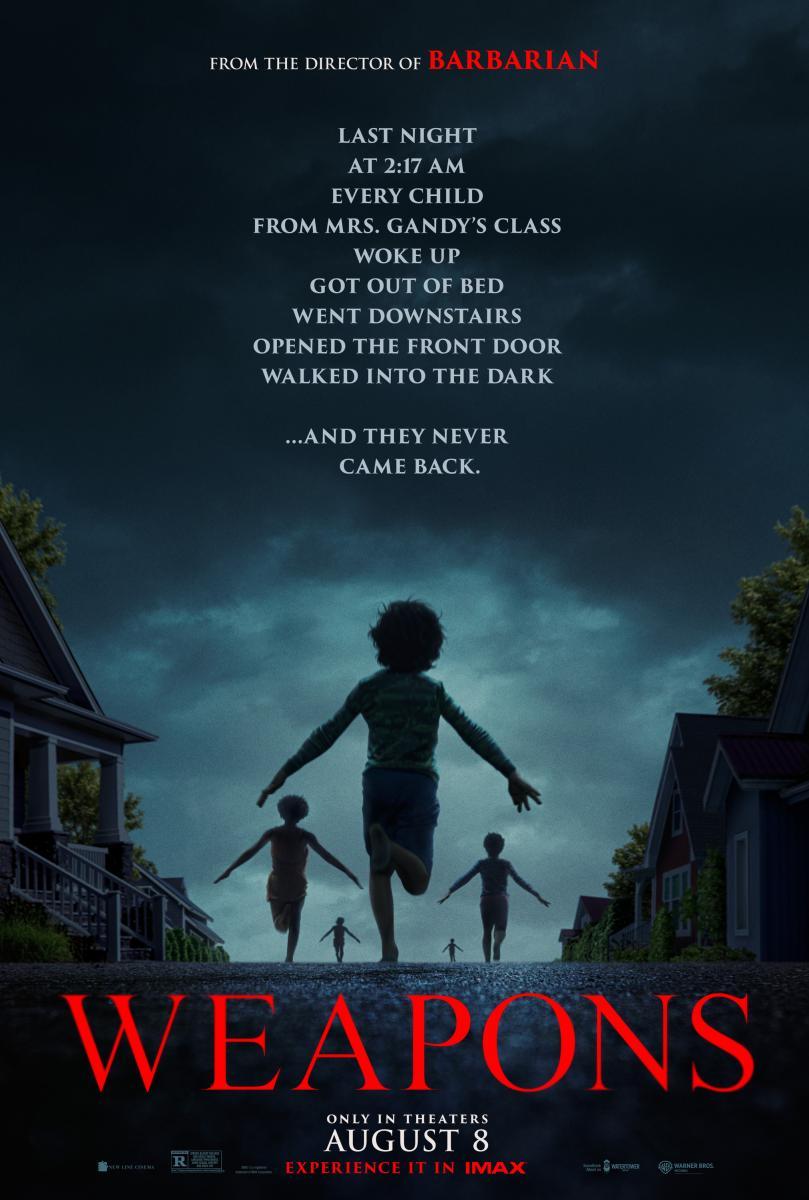
In an era of disposable content and franchises recycled into neural exhaustion—where cinema seems hijacked by streaming algorithms and focus group formulas—along comes Weapons, a cinematic artifact as ambitious as it is uneven, helmed by the hitherto unknown Zach Cregger. This guy, whose prior résumé was limited to forgotten indie comedies (The Civil War on Drugs, 2018) and CollegeHumor sketches, suddenly decides he wants to play in the big leagues with Cronenberg, Fincher, and De Palma. The result? A film that, like a poorly calibrated firearm, shoots in every direction: sometimes it hits the bullseye, sometimes it falls short, and occasionally, it blows your foot clean off by accident.
finalExplicado_en: "In the climax, the vengeful mother and her cult of children unleash a night of surreal, blood-soaked chaos on the town, culminating in a grotesque, ritualistic massacre that consumes the remaining adults. The film ends with the boy protagonist standing amid the carnage as the sole survivor, silently claiming the weapons while the cult dissolves into eerie, childlike play. Symbolically, it’s a blunt, self-satisfied metaphor for generational revenge and the death of adult authority: the kids aren’t all right, they’re the monsters now, and the movie smugly insists this inversion is profound when it’s mostly empty, adolescent edge."
The Direction: When Amateur Hour Wears the Mask of Audacity
Zach Cregger arrives at Weapons with the energy of a kid who just discovered Pulp Fiction on a bootleg VHS and decides, "Hey, I can do ‘arthouse’ too." His direction is relentless, yes—but more for its lack of filter than its mastery. Cregger seems obsessed with proving he can juggle suspense, drama, and even a dash of psychological noir, but instead of weaving a symphony, he delivers a collage of half-digested references.The problem isn’t the ambition—it’s the execution. Cregger tries to emulate David Fincher’s fragmented style in Gone Girl (2014), but without the master’s surgical precision. Instead, we get an edit that oscillates between frenetic and outright chaotic, as if the editor had a panic attack mid-cut. There are brilliant sequences, like the opening long take following Julia Garner down a dimly lit hallway, the camera gliding with almost Hitchcockian elegance. But then we plunge into scenes where the pacing deflates like a popped balloon. Is it intentional? A nod to slow cinema? No—it’s just inconsistency.
And then there’s the color palette. Cregger and cinematographer Jeff Cutter seem to have watched Drive (2011) one too many times, because Weapons is a neon-soaked festival of blues, oversaturated reds, and elongated shadows screaming, "Look at me, I’m a cult film!" The problem? Unlike Nicolas Winding Refn, Cregger lacks the visual coherence to pull it off. Some moments look like a The Weeknd music video; others, like a CSI episode shot on an iPhone.
The Script: Smart, But with Plot Holes the Size of Texas
Cregger’s script is, without a doubt, Weapons’ most laudable element. It’s complex, multi-layered, and packed with dialogue that cuts like a knife. The plot follows Tess (Julia Garner), a young woman entangled in a web of blackmail, betrayal, and violence after her boyfriend (Austin Abrams) steals a briefcase full of cash and drugs from a local drug lord. What starts as a conventional thriller soon spirals into a labyrinth of twists, where every character has a secret and every revelation is designed to leave you slack-jawed.But here’s the catch: Cregger wants his film to be "smart" so badly that he ends up overloading it. There are so many twists, subplots, and side characters that, more than once, you’ll lose the thread. It’s not that the plot is confusing per se—it’s that Cregger seems incapable of pruning the dead branches. Take Josh Brolin’s character, Detective Weller: a corrupt cop with a magnetic, dangerous charm and a murky past. On paper, he’s fascinating. In execution? His arc feels incomplete, like Cregger wrote three versions of him and duct-taped them together.
Then there are the side characters, those poor souls plucked straight from a "How to Write a Thriller in 10 Steps" manual. We’ve got the treacherous boyfriend (Alden Ehrenreich, wasted in a role that could’ve been played by any Riverdale alum), the overprotective mother (Amy Madigan, doing her best with a walking cliché), and the philosopher-thug (a cameo from an actor whose name you’ll forget by morning). They all have moments, but none escape the stereotype trap.
The Performances: Julia Garner Saves the Ship (and Cregger from Himself)
If anything redeems Weapons from total disaster, it’s Julia Garner’s performance. The Ozark alum proves here why she’s one of her generation’s most underrated actors. Garner achieves the extraordinary: making an irregularly written character feel real. Tess is a protagonist full of contradictions—vulnerable yet cunning, naive yet calculating—and Garner navigates these turbulent waters with breathtaking naturalism.In a pivotal scene, Tess confronts Weller (Brolin) in a dive bar, and the tension between them is so palpable you can almost smell the sweat and cheap whiskey. Garner doesn’t need to shout or overact to convey her character’s fear and resolve—a glance, a silence, a fidgety hand does the trick. It’s the kind of performance that makes you forget you’re watching a movie and pulls you fully into the story.
Josh Brolin, for his part, delivers as expected. He’s intimidating, charismatic, and oozes that magnetic presence that’s made him Hollywood’s go-to heavy. But, as mentioned, his character is a puzzle missing pieces. Brolin does his best to add depth to Weller, but the script leaves him stranded between tragic villain and bad boy with a heart of gold.
The rest of the cast, sadly, doesn’t fare as well. Alden Ehrenreich, who’s shown real talent in films like Hail, Caesar! (2016), seems lost here, as if someone told him to play a "bad boy" but forgot to give him the instruction manual. Austin Abrams (Tess’s boyfriend) has a few decent moments, but his character is so predictable you can guess his every move five minutes ahead. And Amy Madigan, a respected actress, is reduced to yelling and crying, like her character was written by a first-year screenwriting student.
The Atmosphere: A Cocktail of Muddled Influences
Weapons tries to craft an atmosphere that oscillates between classic noir and modern psychological thriller, but it ends up feeling like a mashup of films Cregger binged at a Sundance marathon. There are echoes of Nightcrawler (2014) in how the camera stalks characters through L.A.’s shadowy streets, and a whiff of Prisoners (2013) in its exploration of moral ambiguity. But where Denis Villeneuve created a claustrophobic sense of dread, Cregger delivers a pastiche of styles without its own identity.The score, composed by Cliff Martinez (Refn’s go-to collaborator), is another example of this stylistic whiplash. Martinez is a master at crafting ominous, hypnotic soundscapes, but here, his music feels like it’s from two different films. One moment, it’s Drive’s retro synths; the next, it’s aping the minimalism of There Will Be Blood (2007). The result? A score that undermines the atmosphere instead of enhancing it.
The Editing: Innovative or Just Plain Chaotic?
The editing in Weapons is another divisive element. At its best, it recalls Thelma Schoonmaker’s work in Goodfellas (1990): fast, precise, and brimming with energy. The car chase midway through is a standout, with cuts so fluid they keep you on the edge of your seat.But then there are moments where the editing feels forced, like Cregger watched one too many YouTube tutorials on "How to Make Your Film Look Cool." Abrupt transitions, unnecessary flashbacks, and an overuse of jump cuts that distract more than they add tension. It’s as if the editor decided that if the film couldn’t be good, at least it could look "interesting."
The Best
Jeff Cutter’s cinematography: A visual feast that, at its peak, captures the essence of modern noir*. The shots of Julia Garner bathed in neon blues as she walks down a dark alley are pure cinematic poetry. Julia Garner’s performance: An acting masterclass that elevates Weapons from "decent film" to "worth watching."* Garner proves, once again, that she can convey more with a silence than most actors can with a monologue.The Worst
- The uneven pacing: One moment, the film races like a bullet train; the next, it crawls like a hungover snail. Cregger doesn’t seem to know when to speed up or slow down.
- The side characters: A parade of clichés and archetypes plucked straight from a 1990s screenwriting manual. Ehrenreich and Abrams deserved better.
The Verdict of Claqueta Ácida (7/10)
Weapons is like a firearm with a crooked barrel: it’s got power, style, and ambition, but sometimes it shoots where it shouldn’t. Zach Cregger proves he’s got talent, but he’s still rough around the edges. The film is a collage of half-digested influences, uneven performances, and flashes of brilliance that get lost in its own pretension. That said, if you can overlook its flaws, you’ll find a cinematic experience that, at the very least, won’t leave you indifferent. And in an era of sanitized, predictable cinema, that’s something. Just don’t expect to leave the theater feeling like you’ve witnessed a masterpiece—you’ll leave feeling like you’ve watched a promising director shooting in the dark. And sometimes, that’s enough.Ending Explained: Weapons
Ficha de Daños Colaterales en Sala
Certificado de impacto psicofísico emitido por Camilo K.O.
3 amagos en el tramo intermedio; pestañeo pesado en las transiciones más innecesarias.
Minuto 44 y minuto 77 (comprobando cuánto quedaba de suplicio).
1 espresso para no dejarse vencer por la mediocridad cómoda.
"A mitad del segundo acto cuando la subtrama secundaria empezó a pesar más de lo que aportaba."
💬 El Veredicto de la Comunidad
¿Qué te ha parecido la película? Deja tu nota de 0 a 10 para contrastarla con el análisis de la redacción.
Aún no has votado
📢 ¿Te ha gustado el ácido?
Comparte esta crítica con tus amigos cinéfilos o desata la polémica en redes.
⚡ THE CINEMATIC VENOM YOUR INBOX CRAVES
No sugarcoated ratings, no corporate fluff. Subscribe for our uncensored weekly analysis or join the private Telegram for press previews, poll clashes, and instant alerts.
Alertas de estrenos en 1 segundo, encuestas en caliente y audios al salir de pases de prensa.
Recibe la dosis semanal en tu mail + regalo inmediato del PDF con 50 joyas ocultas de culto.
Related Reviews
Recommended autopsies for demanding film buffs.
 🔥 Fusión Nuclear8.6
*Barbarian: The Airbnb from Hell and Basements That Never End*
⚡Del mismo director (Zach Cregger): analiza la evolución o degradación de su estilo.
Zach Cregger makes his horror debut in spectacular, suicidal fashion, splitting his film in half to deliver the world’s most dangerous Airbnb.
 ⚡ Ácido Cítrico6.6
28 Years Later: The Rage Virus Returns... Along with the Boredom
⚡Comparten trinchera editorial en la sección de Perros Verdes.
Danny Boyle and Alex Garland attempt to resurrect post-apocalyptic terror with an iPhone 15 Pro Max. Spoiler: it doesn’t work.
 ⚡ Ácido Cítrico7.1
28 años después
⚡Comparten trinchera editorial en la sección de Perros Verdes.
Una secuela que huele a podrido desde el primer fotograma. Garland y DaCosta intentan revivir el género, pero el resultado es un KO técnico disfrazado de obra maestra.
Editorial Ecosystem
Cinephile connections, archive interviews and related analyses.
🎞️ In Claqueta Cinematheque2
💬 Debate Cinéfilo & Autopsia de Lectores
0 veredictos¿Discrepas con nuestra nota? ¿Es una obra maestra o veneno puro? Deja tu veredicto abajo sin necesidad de registro.


Aún nadie ha dejado su veredicto para esta película.
Sé el primero en clavarle el colmillo rellenando el formulario de arriba.