Seven — The Darkness That Defines Us
A descent into the abyss of the human condition—bring a vomit bag and a therapist on standby


Seven: full review


The first time I saw Seven in a grimy Madrid neighborhood cinema—sticky seats, the stench of stale popcorn mingling with the BO of some guy who hadn’t showered since Jurassic Park hit theaters—I knew I was in for something that would leave a mark. Not like those forgettable flicks you watch and can’t even recall the title of the next day, but like a searing brand on your retinas, one that burns every time you dare to close your eyes. David Fincher, that guy who’d directed Madonna music videos and then gifted us Alien³ (yes, that abomination even die-hard franchise fans pretend never happened), had decided his third film would be a sucker punch to the audience’s collective jaw. And damn, did he deliver. Seven isn’t just a movie—it’s a sensory deep-dive into human misery, a 3 AM subway ride when you suddenly realize the world is an ugly, filthy place crawling with people who belong in prison, a psych ward, or both simultaneously.
Andrew Kevin Walker’s script, which—according to the rumor mill—was rewritten into oblivion by Fincher himself and a legion of ghostwriters (including, allegedly, a desperate young Aaron Sorkin in his pre-West Wing days), is one of those rare beasts that feels like it was written in blood. Not ink, not tears, but blood. The story of two detectives—one on the verge of retirement, the other the fresh-faced new guy—hunting a serial killer who uses the seven deadly sins as his twisted muse could’ve been a bloated CSI episode if not for two critical details: the city is never named (because it could be any city, since they’re all equally rotten) and the killer isn’t the monster you expect. John Doe, played by a Kevin Spacey who seems plucked straight from a fever dream, isn’t some wide-eyed psychopath or a drooling maniac. He’s calm, polite, almost kind, offering you tea while explaining why he’s about to saw your head off. That eerie normalcy is what makes Seven so goddamn terrifying. It’s not the what that chills you—it’s the how.
The chemistry between Morgan Freeman and Brad Pitt is one of those rare cosmic alignments, like when the universe briefly decides to give a damn. Freeman, as Somerset, is the embodiment of existential exhaustion. A man who’s seen so much horror it no longer shocks him, but he keeps showing up to work because, well, someone’s gotta do it. His voiceover, deep and measured, is like a salve in the chaos—though it’s a salve that reeks of cheap whiskey and cigarettes stubbed out in overflowing ashtrays. Pitt, meanwhile, is Mills in his purest form: young, idealistic, brimming with that contained rage only those who still believe the world can be fixed possess. His performance is physical, sweaty, almost feral at times. When he screams, “What’s in the fucking box?!”, it’s not just a movie moment—it’s a battle cry for everyone who’s ever felt like life was playing a cruel joke on them. That final shot, Pitt sobbing in the middle of nowhere as the rain drenches everything, is cinema in its rawest form. No music, no dialogue, just the sound of the storm and the silence of a man who’s just realized evil isn’t something you fight—it’s something you inherit.
But if there’s one thing that elevates Seven above the rest of the grimy thriller pack, it’s its production design. Fincher, a control freak so obsessive rumors claim he made a scene reshoot 70 times until it met his exacting standards, turns the city into a character in its own right. It’s not New York, not Los Angeles, not Chicago. It’s a generic, suffocating hellscape where it’s always raining, buildings are caked in graffiti, and trash piles up on corners like some grotesque, filthy snow. Darius Khondji’s cinematography, with its sickly green and yellow hues, looks like it was plucked from a David Lynch nightmare after a particularly heavy cheese fondue. Every frame is meticulously calculated: the glutton’s apartment, the victim strapped to a chair as the camera circles like a vulture; the moment Somerset and Mills discover the lust victim, dangling from the ceiling like some grotesque trophy; or that final tracking shot down the deserted highway, the cardboard box in the backseat like a macabre delivery from a Cronenberg wet dream. Fincher doesn’t shoot scenes—he crafts atmospheres. And he nails it.
Howard Shore’s score is another one of those elements that slithers under your skin until you realize the film wouldn’t work without it. It’s not some grand, sweeping soundtrack—it’s a series of ambient sounds, almost subliminal, that burrow into your brain like needles. The main theme, with its repetitive, obsessive piano, is like a heartbeat accelerating until it flatlines. And then there’s the silence. Fincher wields it like a weapon, especially in the tensest moments. When Somerset enters the library and uncovers the killer’s annotated books, there’s no music—just the sound of footsteps and the rustle of pages. It’s as if the director is whispering, “There’s no safety net here. This is real life, and in real life, silence is sometimes scarier than any scream.”
Of course, Seven isn’t flawless. There are moments where the film stumbles, particularly in the second half, when the script seems to hit the gas pedal like a drunk driver. The final reveal, with John Doe surrendering and explaining his “masterpiece,” is so theatrical it skirts the edge of ridiculous. It’s as if Fincher, after two hours of gritty realism, decided he needed a dash of grand guignol to tie it all together. And then there’s the violence. It’s not gratuitous (nothing in Seven is), but some scenes are so explicit they make you wonder if you really needed to see them to get the point. The glutton’s corpse, the lust victim, the greedy bastard—they’re images that stick with you, though not always in the way the film intends. Sometimes, the shock is so overwhelming it distracts from what really matters: the story of two men trying to understand evil while evil gnaws at them from the inside.
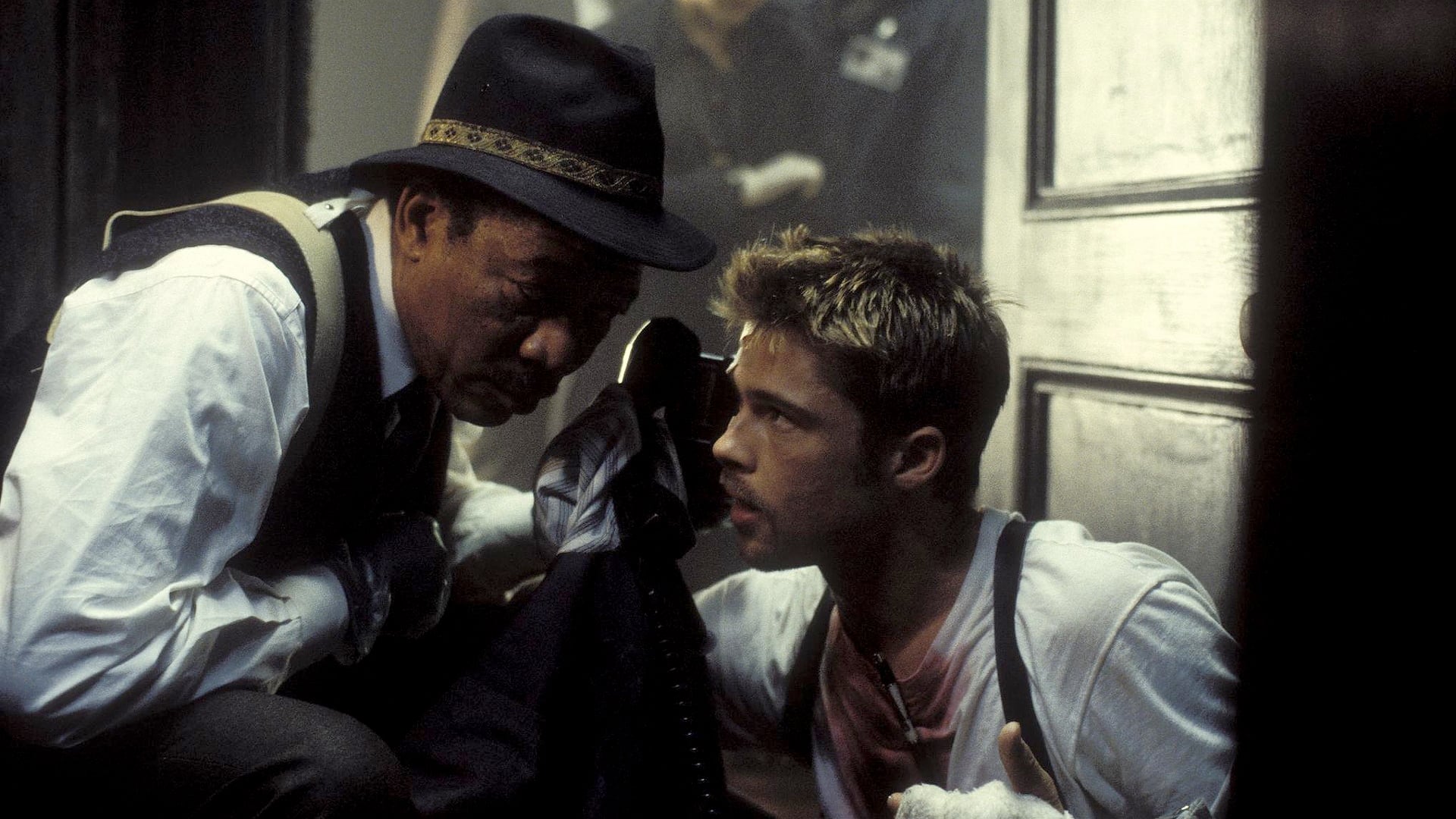
Direction and Production Design: Hell on 35mm
David Fincher doesn’t direct movies—he directs traumatic experiences. From the very first frame of Seven, with Somerset methodically preparing his gun as rain lashes against the window, it’s clear this isn’t going to be a leisurely stroll through the park. Fincher uses the 2.35:1 aspect ratio like a coffin: narrow, elongated, claustrophobic. Every scene is designed to make you feel trapped, as if you’re in a room with no doors or windows. The editing, handled by Richard Francis-Bruce, is another standout. Transitions between scenes are so seamless you don’t even realize you’ve changed locations until it’s too late. Like when Somerset and Mills are at the precinct discussing the case, and suddenly—without a visible cut—they’re in the glutton’s apartment. It’s as if time doesn’t exist, as if everything is happening all at once.
But where Fincher truly shines is in his work with actors. He’s not the kind of director who just yells “action” and “cut.” He’s a sick perfectionist who demands every last detail. Rumor has it he made Pitt and Freeman reshoot the glutton’s apartment scene over 50 times, pushing them to the brink of a nervous breakdown. And it shows. Every gesture, every glance, every sigh is calculated to convey something. When Somerset tells Mills, “Ernest Hemingway once wrote, ‘The world is a fine place and worth fighting for.’ I agree with the second part,” it’s not just dialogue—it’s a manifesto. It’s Fincher saying, “This is what I think of the world, and if you don’t like it, go watch Pretty Woman.”
The production design, helmed by Arthur Max, is another element that makes Seven unforgettable. The city where the film unfolds isn’t real, but it feels real. It’s a filthy, decaying place where trash piles up on corners and buildings look like they’re one strong wind away from collapse. It’s as if someone took New York and dunked it in a vat of acid. The interiors are just as oppressive: Somerset’s apartment, with its bookshelves and air of solitude; the precinct, with its flickering fluorescents and walls plastered with crime scene photos; John Doe’s house, its walls covered in scribbled notes and drawings like some deranged artist’s studio. Everything is designed to make you uncomfortable, to make you want to bolt from the theater and never look back.
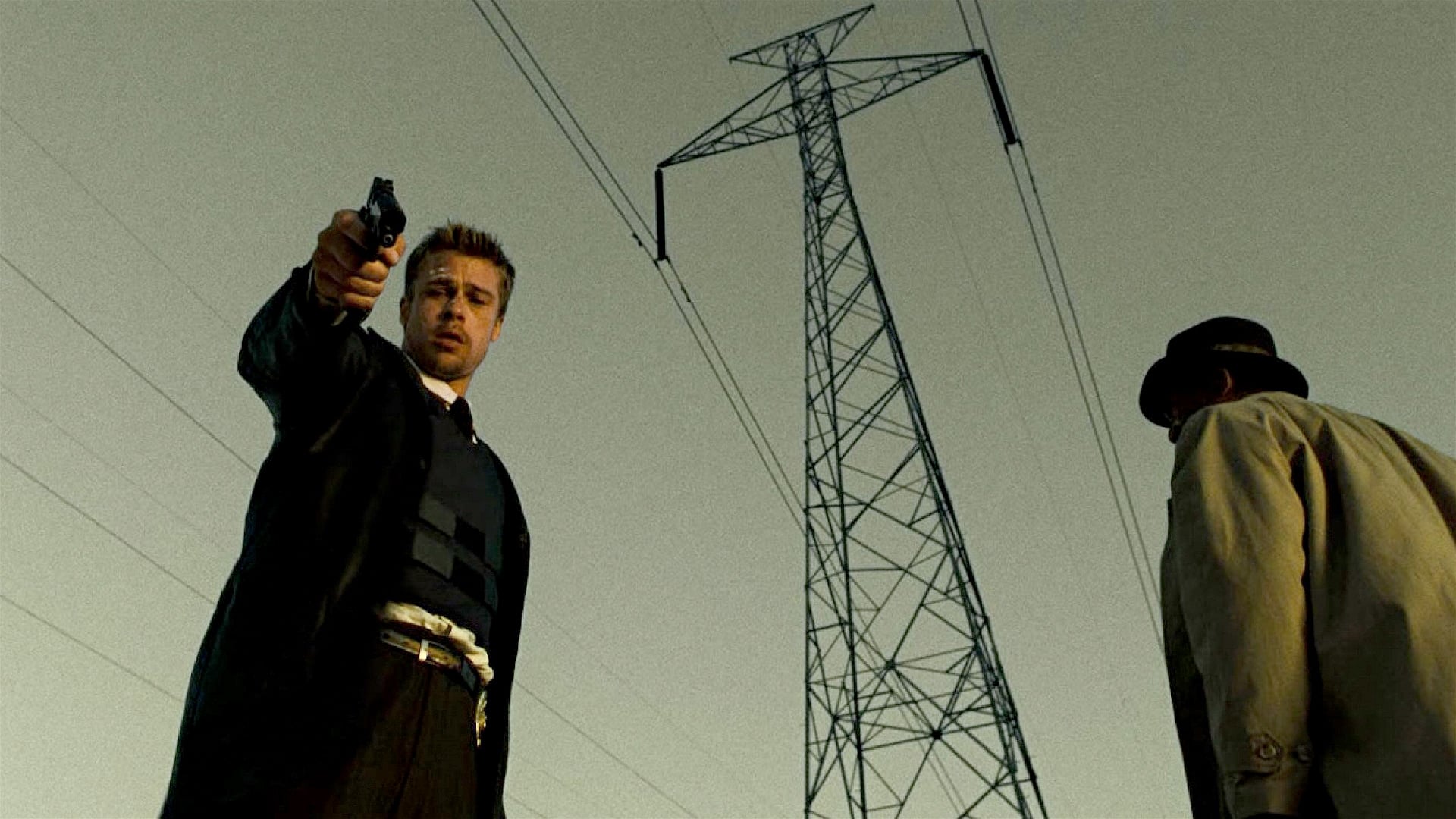
Performances: When Talent Meets Horror
Morgan Freeman as Somerset is one of those performances that makes you wonder how someone can convey so much with so little. He’s not a character who delivers grand speeches or has emotional outbursts. He’s a tired man, someone who’s seen too much and expects nothing from life anymore. But when he speaks, every word carries the weight of a tombstone. His monologue about the seven deadly sins, recited while flipping through a book in the library, is one of those moments that defines a film. No music, no special effects—just Freeman and his voice, explaining why the world is doomed. It’s as if Fincher decided that, amid all the horror, he needed a moment of calm so the audience could catch their breath before diving back into the nightmare.
Brad Pitt, meanwhile, is at a point in his career before he became the untouchable Hollywood icon he is today. In Seven, he’s Mills in his rawest form: young, idealistic, brimming with that contained fury only those who still believe they can change things possess. His performance is physical, almost animalistic. When he screams, when he cries, when he pounds his fist on the precinct table, he’s not acting—he’s living. The moment he discovers the lust victim’s body, that mix of horror and fascination in his eyes, is one of those shots that haunts you forever. And then there’s the ending, when Mills realizes it’s all been a trap and there’s no escape. Pitt doesn’t wail, doesn’t flail—he just stands there, staring into the void, as if he’s just realized the world is a far darker place than he ever imagined.
But if there’s one performance that steals the show, it’s Kevin Spacey as John Doe. Spacey doesn’t play a serial killer—he plays a man who believes he’s doing God’s work. He’s not a psychopath, not a lunatic—he’s an ordinary guy who’s decided the world needs a purge. His scene in the car with Somerset and Mills, calmly explaining his “masterpiece,” is one of the most chilling moments in modern cinema. It’s not the what that terrifies you—it’s the how. Spacey doesn’t need to shout or overact. He just talks, and with every word, you realize you’re in the presence of someone who feels no remorse, no guilt, who genuinely believes what he’s doing is just. It’s as if the devil himself decided to take human form and sit down to explain why hell is necessary.
The best
Darius Khondji’s cinematography: It’s not just that the film is dark—the darkness hurts*. Khondji uses light like a scalpel, carving out frames, creating shadows that seem alive. The glutton’s apartment scene, with its sickly, institutional lighting, is a masterclass in visual terror. And then there’s that final shot, rain pouring over the car as Mills sobs, like something plucked from a David Lynch fever dream after a sleepless night.- Andrew Kevin Walker’s script: A script that isn’t afraid to be uncomfortable. No redemption, no hope, no happy ending. Just two men chasing a monster who turns out to be more human than they’d like. The dialogue is razor-sharp, and every scene drives the plot forward without getting bogged down in unnecessary subplots. It’s a script that leaves you breathless, like you’ve been sprinting for two hours.
- David Fincher’s direction: Fincher doesn’t make movies—he makes nightmares. Every frame is meticulously calculated, every scene designed to make you squirm. There’s not a single moment of relief, not a single shot that doesn’t serve a purpose. It’s as if the director decided that if the audience didn’t leave the theater traumatized, he hadn’t done his job.
The worst
- The graphic violence: It’s not gratuitous, but there are moments where the shock value is so high it distracts from what really matters. The glutton’s corpse, the lust victim, the greedy bastard—they’re images that stick with you, but not always in the way the film intends. Sometimes, the horror is so explicit it stops being effective and becomes a spectacle.
- The pacing in the second half: The film starts like a runaway train, but in the second half, it’s like someone slammed the brakes. The final reveal, with John Doe explaining his “masterpiece,” is so theatrical it verges on ridiculous. It’s as if Fincher, after two hours of gritty realism, decided he needed a dash of grand guignol to wrap things up.
- Tracy’s character (Gwyneth Paltrow): She’s completely unnecessary. She adds nothing to the plot, has no development, and her sole purpose seems to be the final victim. Paltrow does what she can with the material, but it’s like the script decided it needed a woman in the story just to tick a box.
- The ending: It’s not bad, but it’s so abrupt it feels like the film was cut off mid-sentence. After two hours of tension, the climax hits like a gut punch, but then there’s no moment to breathe. It’s as if Fincher decided that after all that horror, you didn’t deserve a proper ending—just a cheap shot.
The Verdict of Claqueta Ácida
Seven isn’t a movie—it’s an experience. One that leaves you breathless, makes you question everything you thought you knew about good and evil, and leaves a bitter taste in your mouth. David Fincher doesn’t direct thrillers—he directs exorcisms, and Seven is his magnum opus. It’s not a film for everyone, not even for every cinephile. It’s for those willing to stare into the abyss and refuse to look away. It’s dark, violent, hopeless, and brilliant. It’s the kind of movie that makes you want to call your mom just to tell her you love her, if only to remind yourself you’re still alive.🎬 Tráiler Oficial
Abrir en YouTube
Seven: frequently asked questions
- What is the rating of "Seven" on Claqueta Ácida?
- "Seven" scored 9/10 on Claqueta Ácida in the review by Dr. Cinismo.
- Is "Seven" worth watching?
- Yes. We gave it 9/10 (Nuclear Fusion), our rating for must-see films.
- Who directed "Seven"?
- "Seven" was directed by David Fincher.
Theater Collateral Damage Report
Psychophysical impact certificate issued by Dr. Cinismo
Cero. La pantalla absorbió cada segundo de atención disponible.
Ninguna comprobación del tiempo. Se agradece la rareza.
Ninguna. Guarda el café para la sesión siguiente.
"Inexistente: pulso de hierro hasta los créditos finales."
💬 Community Verdict
What did you think of the film? Rate it from 0 to 10 to compare it with the editorial review.
You haven't voted yet
📢 ¿Te ha gustado el ácido?
Comparte esta crítica con tus amigos cinéfilos o desata la polémica en redes.
⚡ THE CINEMATIC VENOM YOUR INBOX CRAVES
No sugarcoated ratings, no corporate fluff. Subscribe for our uncensored weekly analysis or join the private Telegram for press previews, poll clashes, and instant alerts.
Alertas de estrenos en 1 segundo, encuestas en caliente y audios al salir de pases de prensa.
Recibe la dosis semanal en tu mail + regalo inmediato del PDF con 50 joyas ocultas de culto.
Related Reviews
Recommended autopsies for demanding film buffs.
 🔥 Fusión Nuclear 9.0
 *Fight Club (1999): The Satire the Gen X Deserved and Capitalism Couldn’t Stomach*
⚡ Del mismo director (David Fincher): analiza la evolución o degradación de su estilo.
An in-depth review of *Fight Club* (1999). We dissect David Fincher’s cult masterpiece—a scathing take on consumerism, the crisis of masculinity, and human-soap alchemy.
 🔥 Fusión Nuclear 9.3
 2001: A Space Odyssey — The Day Kubrick Left Us Speechless (and Oxygenless)
⚡ Afinidad temática directa en atmósfera, estilo y fijaciones visuales.
Kubrick turned science fiction into pure art: 149 minutes of eloquent silence, bone-wielding apes, and a psychopathic computer. Masterpiece or pretentious fraud? Here’s the verdict.
 🔥 Fusión Nuclear 8.5
 *A Clockwork Orange: The Sweet, Rusty Aftertaste of Violent Haute Couture*
⚡ Afinidad temática directa en atmósfera, estilo y fijaciones visuales.
A scathing review of Kubrick’s masterpiece, where ultraviolence meets 60s fashion in a twisted pas de deux.
Editorial Ecosystem
Cinephile connections, archive interviews and related analyses.
🎞️ In Claqueta Cinematheque 1
💬 Debate Cinéfilo & Autopsia de Lectores
0 veredictos¿Discrepas con nuestra nota? ¿Es una obra maestra o veneno puro? Deja tu veredicto abajo sin necesidad de registro.


Aún nadie ha dejado su veredicto para esta película.
Sé el primero en clavarle el colmillo rellenando el formulario de arriba.