'The Substance' — When Body Horror Becomes a Metaphor for a Rotten Industry (and Nobody Notices)
Fargeat directs a pretentious mess where body horror is more predictable than a Netflix script. Demi Moore wastes away in vain.

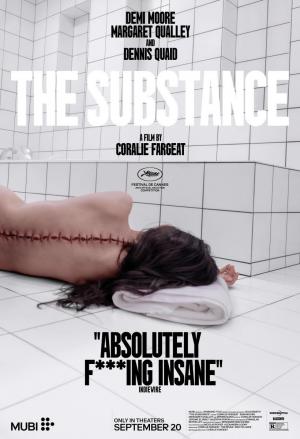


Ah, The Substance. The latest cinematic abomination from Coralie Fargeat, a director who seems obsessed with demonstrating that body horror is not just a subgenre, but a perfect metaphor for her own career: something that starts with promises and ends up as a mess of rotting flesh and intellectual pretensions. Presented at Cannes 2024 with the pomp of someone who believes they are revealing the new Videodrome, this film is, in reality, an exercise in self-indulgence so exaggerated that even Cronenberg himself would have asked for a less pretentious cut. But no, Fargeat presses on, like a drunken surgeon who insists on operating with a butter knife and a cheap philosophy manual. Welcome to the festival of the grotesque, where the only body that decomposes faster than Demi Moore's is the script itself.
Body Horror as an Excuse for Having Nothing to Say (Or How to Turn Misogyny into Art... or Not)
The Substance introduces us to Elizabeth Sparkle (Demi Moore), an aging action star who, after being fired from her TV series by a ruthless executive (played with the subtlety of a pneumatic hammer by Margaret Qualley), decides to inject herself with a mysterious compound called, of course, The Substance. This miraculous elixir promises to restore her youth, but, like everything in life (and in this film), it has a price: your dignity, your sanity, and eventually, your entire body. What follows is a succession of scenes where Moore decomposes, literally, in a series of sequences that oscillate between the repugnant and the hilariously ridiculous. It's as if The Fly and Black Swan had a bastard child with an episode of Grey's Anatomy written by a Reddit intern on a ketamine bad trip. But here's the problem: Fargeat seems to believe that body horror is an end in itself, not a means. The genre doesn't exist for you to marvel at the practical effects (no matter how well done they are), but to explore something deeper: the fear of decay, the obsession with perfection, the internalized misogyny of an industry that devours women. And yet, The Substance stays on the surface, like a teenager who discovers Nietzsche and thinks that makes them a philosopher. There are moments when the film seems like an unintentional parody of itself, like when Elizabeth looks in the mirror and cries as her skin peels off like cheap wrapping paper. Is this a critique of ageism in Hollywood? A reflection on the self-destruction of stars? No, it's just a director masturbating with her own reflection in the monitor, convinced she's doing something revolutionary when in reality she's just repeating formulas that Cronenberg perfected (and surpassed) four decades ago. And then there's the issue of misogyny. Because, let's be honest, this film is not a critique of machismo in the film industry, it's a symptom of it. Elizabeth Sparkle is not a character, she's a punching bag with legs. Her narrative arc consists of being humiliated, discarded, and finally reduced to a pile of pulsing flesh. There's no agency, no complexity, just a woman being punished for the sin of aging. And the worst part is that Fargeat seems to believe this is feminism, as if showing a woman suffering was equivalent to making a political statement. It's the same mistake all those directors make who confuse shock with depth: they think that because something is unpleasant, it's automatically intelligent. Spoiler: it's not. If you wanted to make a film about ageism in Hollywood, perhaps you should start by not reducing your protagonist to a bag of flesh that screams while melting.Demi Moore and the Art of Self-Destruction (Or How to Become Your Own Special Effect)
Demi Moore has had such an irregular career that one could argue her greatest talent is surviving her own disasters. But even for her, The Substance is a new level of self-humiliation. Moore, who in her day was the queen of Hollywood (and Vanity Fair covers with a baby in her arms and an abdomen sculpted by the gods), here throws herself into a role that seems designed to remind the world that, yes, the years don't pass in vain. She succeeds: her performance is so over-the-top that one doesn't know whether to laugh or call an exorcist. There are moments when her acting is so exaggerated that it's like she's competing with Nicolas Cage for the title of «Actor Who Screams the Most in a Body Horror Scene». It's as if someone told her: «Demi, we want you to fall apart on screen», and she took it as a personal challenge, like she was determined to prove she could be more grotesque than an episode of American Horror Story directed by a first-year film school student. But, you know what's the saddest part? Moore deserved better. Not a better script (because, let's be honest, this script is beyond salvation), but a role that wouldn't reduce her to a traveling freak show. Instead of exploring the psychology of a woman trapped in an industry that discards her, the film limits itself to turning her into a horror spectacle, as if her only value lay in how much she could suffer on screen. And that, dear readers, is not acting; it's exploitation masquerading as art. Demi Moore is not an actress here, she's a special effect with legs, a mannequin that's been injected with so much latex and makeup that she no longer looks human. And the worst part is that, deep down, one suspects she knows it. Because, let's be honest, no one submits to that level of physical and emotional degradation without being aware they're digging their own cinematic grave. And then there's Margaret Qualley, who plays the young executive who replaces Elizabeth. Qualley, bless her, tries to give her character some depth, but the script condemns her to being nothing more than an archetype: the villain without nuances, the femme fatale without a soul. Her performance is the only thing that saves the film from being a complete disaster, although even she seems aware that she's swimming in an ocean of mediocrity. There's a scene where Qualley and Moore face off in a bathroom, and it's so ridiculous that one doesn't know whether to applaud their commitment or ask someone to throw them a lifeline. Because, at the end of the day, this film is not a duel of actresses, it's a contest to see who can stomach the most without vomiting on set.The Best
- The Practical Effects: Because, let's be fair, the makeup and special effects team did a job so meticulous that one almost feels sorry for Demi Moore. Watching her body decompose bit by bit is as unpleasant as it is fascinating, like a car accident that you can't look away from. If this film had been a 10-minute short about the effects of The Substance, it would have been a masterpiece of body horror. Too bad Fargeat decided to stretch the agony for two and a half hours.
- Robbie Ryan's Photography: Because, despite the material being a mess, Ryan manages to give the film an air of decadent elegance. The cold tones, the claustrophobic frames, and that color palette that oscillates between neon pink and cadaverous gray give The Substance a visual appearance that, at least, makes it look like an art film and not an episode of Toddlers & Tiaras directed by David Lynch. It's as if someone had taken The Neon Demon and injected it with cheap steroids. Too bad visual beauty can't save a script that reeks of rot.
- The Moment Margaret Qualley Eats a Sandwich: Because, amidst so much horror and pretension, there's a scene where Qualley eats a sandwich with such naturalness that it almost makes you forget you're in a film about a woman melting. It's a breath of fresh air so unexpected that it almost seems like a continuity error. If Fargeat had had the courage to make a film about a Hollywood executive who just wants to eat a sandwich in peace, we might have had a masterpiece. But no, she had to ruin it all with The Substance.
The Worst
- The Script: A Mess of Clichés and Pretensions: If body horror is a metaphor for decay, the script of The Substance is living proof that auteur cinema can be as predictable as a Hallmark romantic comedy. Fargeat seems to believe that repeating the same themes over and over (ageism, misogyny, the film industry as a devouring monster) makes them profound. Spoiler: it doesn't. It's as if someone took a university essay on feminism in Hollywood, mixed it with an episode of Black Mirror, and then regurgitated it in the form of a script. The result is a film that feels as original as a 90s remake.
- Demi Moore Being Reduced to a Walking Joke: There's something deeply sad about seeing an actress who was once synonymous with power and glamour being turned into a traveling freak show. Moore throws herself into the role with a commitment that borders on the self-destructive, but the script doesn't give her anything to work with, beyond «suffer, suffer a lot». It's as if Fargeat had seen Monster and decided that all she needed to make a great film was an actress willing to humiliate herself on screen. But body horror isn't just physical suffering; it's an exploration of the human psyche, and here there's no psyche, just flesh. Demi Moore deserved better than being the cinematic equivalent of a failed laboratory experiment.
- The Lack of Nuance in the Characters: All the characters in The Substance are archetypes without depth, as if Fargeat had decided that complexity was a luxury she couldn't afford. Elizabeth is the victim, the executive is the villain, and Dennis Quaid (in a role so small it seems like a courtesy cameo) is the white man who, of course, still has more agency than the two protagonists combined. It's as if someone had taken a screenwriting manual from the 80s and followed it to the letter, without realizing that the world has changed. In 2024, a film that reduces its female characters to victims and villains without nuances isn't transgressive; it's lazy.
The Verdict of Claqueta Ácida
The Substance is the kind of film that leaves you with a sense of existential emptiness, like you've just witnessed a train wreck in slow motion and, instead of feeling compassion for the victims, you can only think: «Why in the hell did someone decide to film this?». Coralie Fargeat had a golden opportunity to make a fierce and necessary critique of ageism and misogyny in Hollywood, but instead, she delivered an intellectualized torture porn that confuses shock with depth and self-destruction with art. It's a film that takes itself so seriously that one can't help but laugh, not because it's funny, but because it's so ridiculous it borders on the sublime. Demi Moore falls apart on screen with a commitment that borders on the pathetic, Margaret Qualley tries to save the furniture with a performance that, at least, has some dignity, and Dennis Quaid passes by so unnoticed that one almost feels sorry for him. In the end, The Substance is not a film about the decay of Hollywood, but about the decay of cinema itself: a grotesque spectacle that thinks it's revolutionary when in reality it's just a symptom of an industry that has lost its way. If this is the best that Cannes 2024 has to offer, maybe it's time to turn off the lights and let body horror devour everything. 💀Ending Explained: 'The Substance'
Ficha de Daños Colaterales en Sala
Certificado de impacto psicofísico emitido por Dante Sangre
6 bostezos, 3 con quejido audible distribuidos con inquietante regularidad.
Minuto 18, 27, 43, 65 y varios momentos indistinguibles entre sí.
2 espressos triples o aceptar la derrota con dignidad.
"Desde el primer acto, cuando quedó claro que nadie en la sala de montaje había visto la película completa."
💬 El Veredicto de la Comunidad
¿Qué te ha parecido la película? Deja tu nota de 0 a 10 para contrastarla con el análisis de la redacción.
Aún no has votado
📢 ¿Te ha gustado el ácido?
Comparte esta crítica con tus amigos cinéfilos o desata la polémica en redes.
⚡ THE CINEMATIC VENOM YOUR INBOX CRAVES
No sugarcoated ratings, no corporate fluff. Subscribe for our uncensored weekly analysis or join the private Telegram for press previews, poll clashes, and instant alerts.
Alertas de estrenos en 1 segundo, encuestas en caliente y audios al salir de pases de prensa.
Recibe la dosis semanal en tu mail + regalo inmediato del PDF con 50 joyas ocultas de culto.
Related Reviews
Recommended autopsies for demanding film buffs.
 ⚠️ Ácido Sulfúrico4.2
The Priest: Thanksgiving Massacre – When the Turkey’s a Cannibal and the Sermon Smells Like Blood
⚡Afinidad temática directa en atmósfera, estilo y fijaciones visuales.
Steve Lawson serves up a low-budget terror feast with more salt than scares. Folk horror for microwave fans: fast, cheap, and leaves the same aftertaste.
 ⚠️ Ácido Sulfúrico4.2
**Good Boy: The Dog That Saved No One (Not Even Itself)**
⚡Afinidad temática directa en atmósfera, estilo y fijaciones visuales.
A supernatural canine stars in a film that barks up the wrong tree. *Claqueta Ácida* dissects this rural dud with the precision of a scalpel in a slaughterhouse.
 ⚠️ Ácido Sulfúrico4.0
*Humane*: The Family Euthanasia That Leaves Us Deader Than the Weather
⚡Afinidad temática directa en atmósfera, estilo y fijaciones visuales.
Caitlin Cronenberg serves up this nightmare dinner where emotional cannibalism outdoes the ecological kind. Euthanasia or scam? Claqueta Ácida dissects the corpse.
Editorial Ecosystem
Cinephile connections, archive interviews and related analyses.
💬 Debate Cinéfilo & Autopsia de Lectores
0 veredictos¿Discrepas con nuestra nota? ¿Es una obra maestra o veneno puro? Deja tu veredicto abajo sin necesidad de registro.


Aún nadie ha dejado su veredicto para esta película.
Sé el primero en clavarle el colmillo rellenando el formulario de arriba.