Blow Out (1981) — When Brian De Palma Stopped Imitating Hitchcock to Piss on His Grave—With Style
An in-depth review of Brian De Palma’s definitive paranoid thriller. We dissect his obsession with sound, his visual suspense tricks, and a devastating finale that still packs a punch.

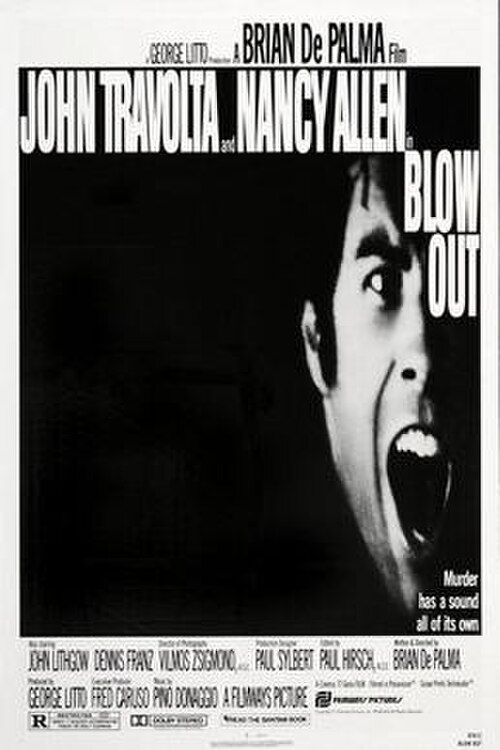
Blow Out (1981): When Brian De Palma Stopped Imitating Hitchcock to Outdo Him (or at Least Piss on His Grave with Panache)
Ah, Blow Out. That movie lazy critics—those same folks who confuse "homage" with "plagiarism" and "style" with "gimmickry"—dismiss as "Blow-Up for the poor, but with sound." As if Brian De Palma, that enfant terrible of American cinema who turned voyeurism into a religion and paranoia into art, needed a reminder that Antonioni had already filmed a mystery on celluloid. But here’s the kicker: while Blow-Up (1966) drowned in its own existential pretension—with David Hemmings staring at blurry photos like they were Finnegans Wake in 35mm—Blow Out takes the premise and injects it with pure adrenaline, turning the mystery into a political thriller as elegant as it is ruthless, and the process of discovery into an ode to cinema as a lie machine that, paradoxically, can reveal truths.
And De Palma, that master of visual manipulation whom Hollywood loves to hate (or vice versa), doesn’t just copy: he deconstructs, perverts, and elevates. If Antonioni questioned perception through the image, De Palma does it through sound—cinema’s most underrated element, which here becomes the absolute protagonist. It’s no coincidence that the protagonist, Jack Terry (John Travolta, in his best role before life gifted him Pulp Fiction and ruined him with Battlefield Earth), is a sound technician for B-movie horror flicks. Because Blow Out is, above all, a film about the craft of cinema: about how it’s recorded, edited, manipulated, and ultimately exploited. And De Palma, who knows more about editing than most modern "auteurs," films every cut, every split screen, and every camera movement as if he were carving a diamond with a scalpel.
finalExplicado: "Jack graba el asesinato del gobernador y el grito agonizante de Sally mientras el coche se hunde. Tras perder a la chica en una trampa brutal, sincroniza su cinta con la foto del tabloide y obtiene la prueba irrefutable. Sin embargo, el asesino Burke lo obliga a entregar el original a cambio de la vida de Sally, que ya está muerta. En el clímax, Jack mata a Burke con un rifle de precisión justo cuando los fuegos artificiales estallan. Simbólicamente, el final es demoledor: Jack usa su propia grabación del grito de Sally como efecto de sonido para la película de terror que estaba montando. El cine devora la realidad, convierte la muerte real en espectáculo barato y el testigo en cómplice definitivo de la mentira que pretendía desenmascarar. La verdad se transforma en mero ruido de fondo."
Sound as a Weapon: When the Tape Recorder Becomes a Silent Witness (and the Viewer, an Accomplice)
The premise is as simple as it is brilliant: Jack Terry, a guy who spends his nights recording wind sounds for cheesy horror movies, witnesses a car accident on a lonely bridge. When he reviews the tape, he discovers that what sounded like a blown tire was actually a gunshot. A political assassination disguised as a random tragedy. At this point, we could be watching an episode of Columbo with a bigger budget. But De Palma, as Hitchcock’s rebellious disciple, knows the devil is in the details. And in Blow Out, the details are sonic.
The sequence where Jack syncs his audio recording with the accident photos published in a tabloid is, possibly, the most beautiful and analog scene ever filmed about the film editing process. No computers, no editing software—just magnetic tape, scissors, celluloid, and the obsession of a man searching for truth in the noise. De Palma films this process with almost fetishistic devotion, as if paying homage to the pioneers of silent cinema who discovered that the magic of film lay in the juxtaposition of images. But there’s a sinister twist: the closer Jack gets to the truth, the more he becomes an accomplice to the lie. Because, in the end, what is cinema if not a machine for fabricating realities? And Jack, unwittingly, is about to turn a murdered woman’s scream into the perfect jump scare for a cheap horror flick.
This paradox—the art of exploitation, truth as spectacle—is the rotten heart of Blow Out. And De Palma explores it with a coldness that borders on clinical. There’s no moralizing here, no easy redemption. Just the harsh reality that, in a world where everything is manipulation, the only honest act possible is turning pain into art. Even if that art is, ultimately, a lie.
The Cast: Travolta Before the Fall, Lithgow as the Psychopath Hollywood Never Deserved
If there’s one thing that saves Blow Out from the bottomless pit of '70s conspiracy cinema (where films like Three Days of the Condor and The Parallax View drowned in their own solemnity), it’s the cast. And, in particular, John Travolta in his most restrained and tragic performance. Far from the hip-swinging icon that made him a pop legend, here Travolta plays Jack Terry as a man broken inside but functional outside—a guy who lives among audio tapes and low-budget horror films, so obsessed with his craft that he doesn’t realize reality is about to swallow him whole.
Travolta, in a display of subtlety he’d never repeat (thanks, Grease 2 and Perfect), conveys the desperation of a man who knows he’s playing against a system that always wins but can’t help trying anyway. His chemistry with Nancy Allen—who plays Sally, the accident survivor and unwilling pawn in the conspiracy—is believable precisely because it’s not romantic in the traditional sense. No fireworks, no grand speeches: just two people trapped in a nightmare they didn’t ask for, trying to help each other while the world collapses around them. Allen, by the way, is excellent: vulnerable but not weak, naive but not stupid. A character who could’ve been a cliché (the standard "damsel in distress") but whom De Palma turns into a flesh-and-blood human being.
And then there’s John Lithgow as Burke, the psychopathic killer with the smile of an insurance salesman. Lithgow, who in the '80s seemed to specialize in memorable villains (The World According to Garp, Twilight Zone: The Movie), here reaches heights of evil that border on the supernatural. He’s not the over-the-top psychopath of Dexter or the monster of American Psycho: Burke is the embodiment of bureaucratic murder, a guy who kills with the same indifference others sign a report. His coldness is chilling precisely because there’s no grandiosity in his crimes. He doesn’t enjoy killing; he just does it because it’s his job. And Lithgow conveys that banality of evil with a naturalness that sends shivers down your spine. When, in one scene, Burke strangles a woman while humming a children’s song, it’s not a "cartoonish villain" moment—it’s the most terrifying depiction of evil as routine.
The Climax: Fireworks, Screams, and the Cruelest Irony of '80s Cinema
If there’s one thing that defines Brian De Palma, it’s his ability to turn a film’s climax into an overwhelming sensory experience. And Blow Out is no exception. The final sequence, set during a patriotic parade in Philadelphia—with red, white, and blue fireworks lighting up the night—is a symphony of despair, irony, and tragedy.
Jack, armed with an audio transmitter, tries to locate Sally while Burke chases her to silence her forever. The tension is unbearable not just because of what’s at stake, but because of how De Palma films it: with split screens dividing the frame into multiple perspectives, 360-degree camera movements that disorient the viewer, and editing that alternates between the chaos of the parade and the intimacy of the murder. It’s as if Rear Window and The Man Who Wasn’t There had fused into a Molotov cocktail of paranoia and visual style.
But what’s truly brilliant—and what elevates Blow Out to masterpiece status—is the final twist. After failing to save Sally, Jack uses her death scream as the jump scare in the horror movie he’s working on, turning the sound of her murder into the perfect cheap thrill. It’s a moment so cynical, so ruthless, it hurts. Because, in the end, art doesn’t just imitate life: it exploits it. And De Palma, with a sadistic grin, reminds us that cinema—that wonderful invention that makes us laugh, cry, and scream—can also be an accomplice to tragedy.
De Palma’s Style: Formal Virtuosity or Visual Masturbation? (Spoiler: It’s the First)
If there’s one thing De Palma’s detractors have always held against him, it’s his obsession with style. His split screens, his impossible long takes, his camera movements that look like choreographed macabre ballets... To some, it’s pure showboating. To others (those of us with souls), it’s cinema in its purest form.
Blow Out is, arguably, the film where De Palma achieves the perfect balance between form and substance. Every visual device serves a narrative purpose:
- The split screens aren’t just a technical flourish: they’re used to show multiple perspectives of the same event, reinforcing the idea that truth is subjective and cinema is, above all, manipulation.
- The split-diopter shots (those lenses that keep two planes in focus at once, creating a "frame within a frame" effect) are used to disorient the viewer, forcing them to question what’s real and what’s fiction.
- The 360-degree camera movements, far from being a mere trick, reflect the characters’ paranoia, as if the whole world were spinning out of control.
And then there’s Pino Donaggio’s score, that Italian composer who understood De Palma’s style better than anyone. His soundtrack, with its screeching violins and Italian melodrama flair, is the perfect complement to the film’s tone: operatic, tragic, and slightly ridiculous, as if The Godfather and Radio Days had an illegitimate child.
The Best
De Palma’s formal virtuosity, which turns every frame into a purposeful exercise in style: If cinema is manipulation, Blow Out* is its instruction manual.- John Travolta in his best dramatic role: Before fate condemned him to dance with wolves (and Uma Thurman), he proved he could act without shaking his hips.
The Worst
- Some romantic dialogue between Jack and Sally that reeks of '80s TV movies: Luckily, De Palma dispatches it quickly, like swatting away a mosquito.
- John Lithgow nailing the psychopath role but occasionally veering into caricature: Though, let’s be honest, who doesn’t enjoy watching Lithgow play a monster with the smile of an encyclopedia salesman?
The Verdict of Claqueta Ácida (8.7/10)
Blow Out is the film that proved Brian De Palma wasn’t just a Hitchcock imitator but a surgeon who operated with a butcher’s knife and a showman’s flair worthy of P.T. Barnum. It’s a political thriller disguised as a love letter to cinema, a Greek tragedy with tape recorders, and a reminder that sometimes the truth doesn’t just hurt—it gets exploited. With an ending as cynical as it is brilliant, De Palma delivers his most mature, devastating, and formally flawless work. Or, in other words: if Blow-Up was an intellectual crossword puzzle, Blow Out is a punch to the throat. And cinema, dear readers, always needs more punches.🎬 Tráiler Oficial
Abrir en YouTube
Ending Explained: Blow Out (1981)
Ficha de Daños Colaterales en Sala
Certificado de impacto psicofísico emitido por Valeria Von Doom
Cero. La pantalla absorbió cada segundo de atención disponible.
Ninguna comprobación del tiempo. Se agradece la rareza.
Ninguna. Guarda el café para la sesión siguiente.
"Inexistente: pulso de hierro hasta los créditos finales."
💬 El Veredicto de la Comunidad
¿Qué te ha parecido la película? Deja tu nota de 0 a 10 para contrastarla con el análisis de la redacción.
Aún no has votado
📢 ¿Te ha gustado el ácido?
Comparte esta crítica con tus amigos cinéfilos o desata la polémica en redes.
⚡ THE CINEMATIC VENOM YOUR INBOX CRAVES
No sugarcoated ratings, no corporate fluff. Subscribe for our uncensored weekly analysis or join the private Telegram for press previews, poll clashes, and instant alerts.
Alertas de estrenos en 1 segundo, encuestas en caliente y audios al salir de pases de prensa.
Recibe la dosis semanal en tu mail + regalo inmediato del PDF con 50 joyas ocultas de culto.
Related Reviews
Recommended autopsies for demanding film buffs.
 🔥 Fusión Nuclear9.5
*2001: A Space Odyssey – A Monkey, a Monolith, and Two Hours of Cosmic Pretentiousness*
⚡Afinidad temática directa en atmósfera, estilo y fijaciones visuales.
We dissect Stanley Kubrick’s magnum opus. A visual feast of minimalism and space hypnosis that cemented "serious" sci-fi—and bored half of humanity to tears.
 🔥 Fusión Nuclear9.3
2001: A Space Odyssey — The Day Kubrick Left Us Speechless (and Oxygenless)
⚡Afinidad temática directa en atmósfera, estilo y fijaciones visuales.
Kubrick turned science fiction into pure art: 149 minutes of eloquent silence, bone-wielding apes, and a psychopathic computer. Masterpiece or pretentious fraud? Here’s the verdict.
 🔥 Fusión Nuclear8.5
*A Clockwork Orange: The Sweet, Rusty Aftertaste of Violent Haute Couture*
⚡Afinidad temática directa en atmósfera, estilo y fijaciones visuales.
A scathing review of Kubrick’s masterpiece, where ultraviolence meets 60s fashion in a twisted pas de deux.
Editorial Ecosystem
Cinephile connections, archive interviews and related analyses.
💬 Debate Cinéfilo & Autopsia de Lectores
0 veredictos¿Discrepas con nuestra nota? ¿Es una obra maestra o veneno puro? Deja tu veredicto abajo sin necesidad de registro.


Aún nadie ha dejado su veredicto para esta película.
Sé el primero en clavarle el colmillo rellenando el formulario de arriba.