Raw — A Vegetarian Awakening with a Side of Human Flesh
Julia Ducournau made her feature debut with this wild, exquisite cannibal fable about coming of age, college hazing, and forbidden appetites.

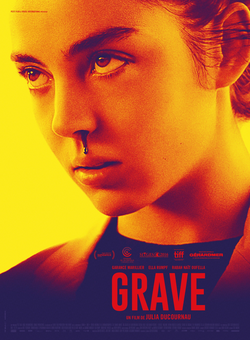
Grave (or Raw, for the international marketing purists who prefer their titles in English—as if cannibalism were somehow more palatable in Shakespeare’s tongue) is that rare cinematic beast that pulls off the impossible: turning the act of chewing human flesh into such a sophisticated metaphor that even the Sorbonne’s academics are clutching their pearls in approval. Julia Ducournau, barely 32 at the time of its release, didn’t just storm Cannes like a bull in a china shop—she did it with a film that demands to be seen, provokes without apology, and refuses to be ignored. And oh, how it succeeded: between fainting spells in the theater (was it the gore or the sheer envy of not having the guts to make something this bold?), vomit in the aisles (critics or just audiences with porcelain stomachs?), and standing ovations, Raw became a beacon of transgression in an era where cinema is increasingly neutered by Netflix’s algorithm.
finalExplicado: "Justine, ya completamente transformada, descubre que su hermana Alexia ha matado y devorado a sus padres. En un arrebato final de rabia y hambre, Justine la muerde salvajemente en la mejilla y se come su carne. La madre, también caníbal reprimida, interviene y encierra a las dos hermanas en el sótano como animales, aceptando por fin su naturaleza familiar. El desenlace simboliza la transmisión inevitable de la violencia y el deseo reprimido: la madurez no es elección, sino despertar de una herencia carnívora que la familia vegetariana había intentado negar. Justine ya no puede volver; la inocencia se ha comido a sí misma. El cuerpo femenino se revela como un organismo predador que la sociedad solo puede contener, nunca civilizar."
Cannibalism as Metaphor: When Biting Is More Than Just Instinct
The premise of Raw is as simple as it is brilliant: Justine (Garance Marillier, delivering a performance that swings between fragile adolescence and the ferocity of a predator in the making), a veterinary student and vegetarian by family conviction, is forced to taste raw meat during a brutal university hazing ritual. What begins as an act of rebellion against her suffocating moral upbringing spirals into an insatiable hunger, where cannibalism isn’t just a shock tactic—it’s the physical manifestation of losing innocence, embracing one’s darkest instincts, and the social pressure to fit into a world that demands blood, sweat, and tears (literally).
Ducournau doesn’t fall into the trap of turning Raw into a low-budget slasher. There are no masked killers or chases through dark forests here. Instead, the French director opts for gritty, clinical realism, where the horror doesn’t come from the supernatural but from the terrifyingly human. The veterinary school, with its cold concrete hallways and sterile labs, becomes a microcosm of society: a place where rules are arbitrary, hierarchies are brutal, and survival depends on how much you’re willing to swallow (pun very much intended). The hazing scenes, depicted with a rawness reminiscent of Kinji Fukasaku’s Battle Royale, aren’t just pranks—they’re initiation rituals demanding absolute submission. In this context, Justine’s cannibalism isn’t an aberration; it’s the logical consequence of a system that forces you to devour your own humanity to be accepted.
Ducournau’s Direction: When the Body Rebels Against the Soul
Julia Ducournau proves in Raw that she possesses a visual and narrative maturity that belies her debut status. Her direction is a mix of surgical precision and controlled chaos, where every frame seems designed to unsettle the viewer. There are no cheap thrills here: the cannibalism scenes are shot with almost documentary-like realism, where the sound of teeth tearing flesh and bones crunching is amplified to unbearable levels. But the truly disturbing part isn’t the gore itself—it’s how naturally Ducournau weaves it into Justine’s daily life. A key scene, for example, shows the protagonist devouring a human finger while Plus Putes que Toutes les Putes by Orties blares in the background, a French pop song that grotesquely contrasts with the act she’s committing. It’s as if Ducournau is reminding us that horror and banality can coexist in the same frame, and that monstrosity doesn’t always wear a mask.
Ruben Impens’ cinematography is another standout. The use of cold, blue tones dominates most of the film, creating a sterile atmosphere that violently clashes with the bursts of red and neon lights during the university parties. This visual contrast isn’t accidental: it mirrors Justine’s duality, trapped between her puritanical upbringing and her primal instincts. The sequences in the veterinary school, with its endless hallways and claustrophobic classrooms, evoke the work of David Cronenberg at his most visceral (Videodrome, Scanners), where the human body is a battleground between reason and desire.
The Human Zoo: When the University Becomes a Cage
The veterinary school in Raw isn’t just a setting—it’s a character in its own right. Ducournau portrays it as a human zoo, where students are both the keepers and the caged animals. The scenes in the labs, with horses and cows anesthetized and waiting their turn on the dissection table, are a mirror of what happens to the characters themselves: they’re all cannon fodder in a system that strips them of their humanity. The relationship between Justine and her sister Alexia (Ella Rumpf, in a performance that oscillates between magnetic and terrifying) is the heart of this metaphor. Their love-hate, domination-submission dynamic reflects the power struggle in an environment where survival depends on how much you’re willing to sacrifice. The scene where Alexia forcibly cuts Justine’s hair—a gesture of enforced submission—is as symbolic as it is disturbing: the hair, a symbol of femininity and rebellion, is ripped out by the roots, leaving Justine naked, both physically and emotionally.
And then there’s the finger. Yes, that finger Justine accidentally devours in one of modern cinema’s most iconic sequences. The scene is a tour de force of direction and acting, where horror, dark humor, and tragedy intertwine in a single shot. The finger isn’t just a piece of flesh—it’s the symbol of Justine’s definitive break from childhood, the moment she accepts there’s no going back. And she does it while pop music plays, as if Ducournau is reminding us that horror always arrives disguised as normalcy.
The Soundtrack: When French Pop Tastes Like Blood
The music in Raw isn’t just background noise—it’s a key narrative element. The choice of French pop songs for the party scenes (like Plus Putes que Toutes les Putes or Je M’en Fous) isn’t random: the catchy, superficial pop contrasts with the darkness unfolding on screen, creating a cognitive dissonance that heightens the unease. It’s as if Ducournau is telling us: "Horror doesn’t always come with a dramatic string score; sometimes, it arrives with a club banger."
The sound design, meanwhile, is a masterclass in the organic. The sounds of the school—the crunch of bones, the drip of blood, the rustle of lab coats—are amplified to unbearable levels, creating a sensory immersion that forces you to feel every bite, every wound, every drop of sweat. It’s a reminder that cinema isn’t just a visual medium—it’s auditory too, and sometimes what you don’t see is more terrifying than what you do.
The Performances: When Hunger Becomes Art
Garance Marillier delivers a performance in Raw that haunts you long after the credits roll. Her Justine is a complex character, caught between the girl she was and the monster she’s becoming. Marillier balances vulnerability and ferocity with terrifying naturalism, shifting from shy adolescence to ravenous cannibalism in a way that’s genuinely unsettling. Her chemistry with Ella Rumpf (Alexia) is electric and toxic, a relationship of love and hate that swings between complicity and violence. Rumpf, for her part, is magnetic in her role as the older sister, a figure who’s both protector and predator.
The rest of the cast, though with less screen time, delivers admirably. Rabah Nait Oufella (Adrien) brings a touch of humanity to the story, while Laurent Lucas (Justine’s father) embodies the hypocrisy of bourgeois morality: a man who preaches vegetarianism but doesn’t hesitate to sacrifice animals in his veterinary clinic. It’s a small but significant detail that reinforces the idea that we’re all complicit in violence, even if we refuse to see it.
The best
- Julia Ducournau’s direction: A debutante who films like she’s been bleeding the horror genre dry for decades. Every frame is a visual gut-punch, every sequence a reminder that horror doesn’t need special effects to be effective.
The worst
Not for the squeamish: If the sound of a bone cracking turns your stomach, Raw* will make you reconsider your career as a film critic. Ducournau doesn’t skimp on clinical details, and the realism of the cannibalism scenes may be too much for some. A divisive ending: Raw*’s finale is poetic, cynical, and open to interpretation, but it might leave fans of conventional horror feeling like they’ve been left hungry (pun very much intended). It’s not a cathartic ending—it’s a cold, calculated slap in the face.The Verdict of Claqueta Ácida (8.8/10)
Raw isn’t just a movie—it’s a social experiment in celluloid form. Julia Ducournau didn’t just crown herself the queen of French visceral cinema with this film (something she’d confirm with Titane and its Palme d’Or)—she redefined the horror genre from the ground up. It’s a film that forces you to look at what you don’t want to see, to accept that the monster isn’t on the screen but inside you. And it does so with such perverse elegance that, by the end, you’ll be left with the feeling that you’ve just attended a banquet where you were the main course. If you can stomach it without throwing up, congratulations: you’ve just earned your degree in auteur cinema. If not, you can always blame the undercooked meat.🎬 Tráiler Oficial
Abrir en YouTube
Ending Explained: Raw
Ficha de Daños Colaterales en Sala
Certificado de impacto psicofísico emitido por Dante Sangre
Cero bostezos. Pupilas dilatadas y tensión mandibular constante.
Ni una sola mirada al móvil.
Ninguna: la adrenalina cinematográfica es suficiente.
"No aplica. La obra se sostiene sola."
💬 El Veredicto de la Comunidad
¿Qué te ha parecido la película? Deja tu nota de 0 a 10 para contrastarla con el análisis de la redacción.
Aún no has votado
📢 ¿Te ha gustado el ácido?
Comparte esta crítica con tus amigos cinéfilos o desata la polémica en redes.
⚡ THE CINEMATIC VENOM YOUR INBOX CRAVES
No sugarcoated ratings, no corporate fluff. Subscribe for our uncensored weekly analysis or join the private Telegram for press previews, poll clashes, and instant alerts.
Alertas de estrenos en 1 segundo, encuestas en caliente y audios al salir de pases de prensa.
Recibe la dosis semanal en tu mail + regalo inmediato del PDF con 50 joyas ocultas de culto.
Related Reviews
Recommended autopsies for demanding film buffs.
 🔥 Fusión Nuclear9.0
*Titane: The Palme d’Or That Spit in the Face of Conventional Cinema (And We Loved It)*
⚡Del mismo director (Julia Ducournau): analiza la evolución o degradación de su estilo.
Julia Ducournau shocked and captivated the Cannes Film Festival with a hypnotic, violent, and tender odyssey about human hybrids, cars, and familial redemption.
 🔥 Fusión Nuclear8.5
*Alleluia: Love as a Terminal Illness (or How to Turn Crimes of Passion into a Sweaty, Fleshy Spectacle)*
⚡Afinidad temática directa en atmósfera, estilo y fijaciones visuales.
Fabrice Du Welz reimagines the myth of the lonely hearts killers in a feverish whirlwind of jealousy, submission, and blood, led by Lola Dueñas in a performance that’s equal parts hypnotic and harrowing.
 🔥 Fusión Nuclear8.5
*High Tension (Haute Tension): The Brutal Birth of the New French Extremism – Or How to Turn Flesh into Poetry with a Machete*
⚡Afinidad temática directa en atmósfera, estilo y fijaciones visuales.
Alexandre Aja shocked global screens with a relentless rural bloodbath, redefined by breakneck pacing and a divisive twist that splits serious cinephiles right down the middle.
Editorial Ecosystem
Cinephile connections, archive interviews and related analyses.
🎞️ In Claqueta Cinematheque2
💬 Debate Cinéfilo & Autopsia de Lectores
0 veredictos¿Discrepas con nuestra nota? ¿Es una obra maestra o veneno puro? Deja tu veredicto abajo sin necesidad de registro.

Aún nadie ha dejado su veredicto para esta película.
Sé el primero en clavarle el colmillo rellenando el formulario de arriba.