Gremlins — The Ageless Chaos That Still Stares at Us with the Eyes of a Mogwai
Joe Dante turned holiday terror into black comedy with absurd rules. Forty years later, it remains a marvel of controlled chaos and a how-to manual on making monsters adorable.


Gremlins: full review

The summer of 1984 smelled of burnt popcorn, lukewarm Coca-Cola and that cheap fear only genre cinema knows how to sell with such affection, even if it was snowing on screen. Joe Dante, that alchemist of controlled disaster who had already proven his love for chaos in Piranha (1978), stormed into theaters with a script by Chris Columbus that promised to turn a Christmas gift into a nightmare of green scales, razor-sharp teeth and a thirst for destructive partying that only those who had seen The Shining too young could understand. Amblin Entertainment and Warner Bros., with Steven Spielberg as executive producer, bet on a project that sounded insane: an adorable creature that turned into an army of little demons if you got it wet or fed it after midnight. The result was a film that, forty years later, is still smarter than most of today's cinema. It's no coincidence that the gremlins have survived trends, sequels and even cheap nostalgia like a resistant virus: Dante understood that horror doesn't need screams, just absurd rules and logical consequences. And boy did he apply them ruthlessly, as if every shot were a lab experiment where the test subject was you, the unsuspecting viewer, sitting in your seat with a bag of popcorn and the silly grin of someone who doesn't yet know what awaits when the first mogwai rule is broken: don't get it wet. Spoiler: someone gets it wet. And hell breaks loose among tinsel and carols, as if someone had mixed The Shining with a 70s Saturday Night Live special, but with more charm and less Jack Nicholson screaming in the hallway.
The film premiered in June 1984, just as horror cinema was starting to take itself seriously, as if Hollywood executives had suddenly discovered the genre could be profitable without characters dying screaming on screen. Dante decided to play with fire: he blended black comedy, B-movie horror and an unapologetic homage to classic monster cinema, with a touch of humor only he could pull off. The result was so unexpected that even Warner executives scratched their heads wondering how a film about a creature that multiplies with a glass of water could be so profitable. The answer, of course, is on screen: Dante understood that fear isn't just darkness and blood, but also the panic of breaking the rules of an instruction manual written in a language nobody bothers to read. And break everything he did, grinning from ear to ear, with a mogwai that seemed straight out of a fairy tale… until its offspring ate after midnight and became your worst nightmare.
The box office proved him right: on a budget of around 11 million dollars, it grossed close to 150 million in the United States alone and was one of the big hits of that summer, alongside Ghostbusters and Indiana Jones and the Temple of Doom. It also left a bureaucratic mark: the violence of the kitchen scene, together with that of Temple of Doom, pushed the MPAA to create the PG-13 rating that same year. Not everyone applauded: some parents felt cheated by a poster that sold a family film and sent their kids home with blender nightmares.
But let's talk about what really matters: the film itself. Because Gremlins isn't just a monster comedy—it's a genre cinema manual written in chalk on a high school blackboard. Dante and Columbus built a universe where rules are sacred until someone breaks them, and when that happens, chaos erupts like a virus in a biology lab. The film opens with Rand Peltzer (Hoyt Axton), an inventor of gadgets that never work, buying a mogwai in a Chinatown shop as a Christmas present for his son Billy (Zach Galligan), a young bank teller in Kingston Falls. The mogwai, named Gizmo, is adorable, furry and looks like it came out of a fairy tale. But it comes with three rules: keep it away from bright light, don't get it wet and, above all, never feed it after midnight. Spoiler: little Pete (Corey Feldman) spills a glass of water on it. Double spoiler: the offspring trick Billy by unplugging his alarm clock and eat past midnight. Triple spoiler: hell breaks loose.
What's most brilliant about Gremlins is how Dante plays with the audience. It's not just that the rules are clear—it's that the director makes us complicit in breaking them. When the water hits, Gizmo writhes in pain and furballs burst from his back, turning into new mogwai that are far less friendly, led by Stripe, the one with the white mohawk. The sequence is a lesson in tension: Jerry Goldsmith's score turns shrill, the creatures twitch in the dim bedroom and the viewer feels the same panic as Billy when he realizes his Christmas present has become a nightmare. It's not a jump scare, it's a revelation: horror isn't in what you see, but in what you sense is coming.
Direction and Staging
Joe Dante doesn't direct Gremlins like a horror film—he directs it like a failed science experiment. Every shot is calculated to generate discomfort, but also laughter. The opening sequence in Chinatown, where Rand buys Gizmo in Mr. Wing's shop (Keye Luke), is a homage to 50s B-movies, with smoke, gloom and an old man warning that a mogwai is a responsibility. Kingston Falls, by contrast, is a Frank Capra postcard: snow, carols and a town that seems lifted from It's a Wonderful Life, which actually shows up on a TV in the film. Dante stages the contrast with malice: the prettier the postcard, the more fun it is to watch it burn.
The scene at Dorry's tavern, where the gremlins take over the place—drinking, smoking, playing cards, one even flashing in a trench coat—while Kate tries to serve them without getting eaten, is one of the most iconic of 80s cinema. Dante uses sound masterfully: the gremlins speak an incomprehensible language, but their cackles are instantly recognizable. And then there's the town cinema: hundreds of gremlins watching Snow White and the Seven Dwarfs and singing along to Heigh-Ho, pure surrealism. It's not a horror scene, it's a nightmare unfolding in real time, with a choreography of chaos only Dante could conceive.
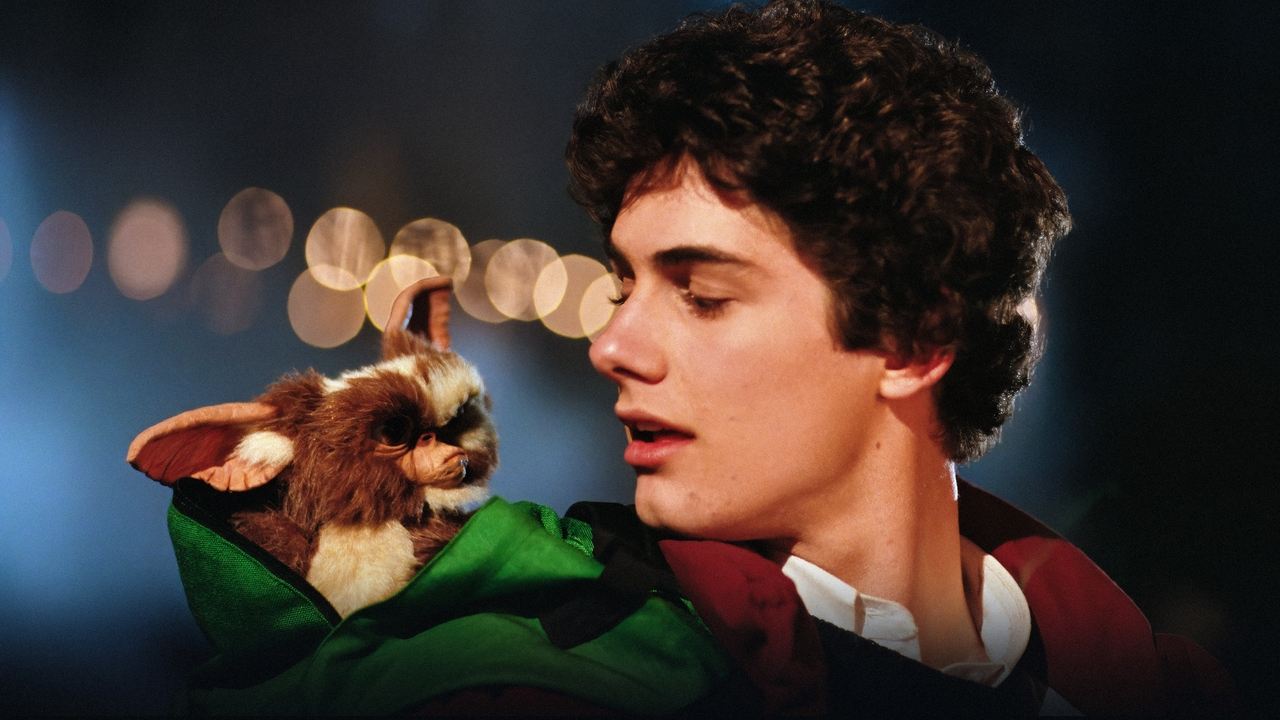
The direction of the actors is also key. Zach Galligan is the perfect Billy: a regular guy dragged into a nightmare he doesn't understand. His look of disbelief when he first sees the gremlins is scarier than any special effect. Phoebe Cates, as Kate, the girl he's in love with, has a small but memorable role, especially in the department store scene where she explains why she hates Christmas (spoiler: it's not because of the gremlins). But the real star is Gizmo, an animatronic puppet built by Chris Walas's team and voiced by Howie Mandel. With a few coos and one song, Gizmo becomes a character rather than a mere special effect. When Gizmo cries, the audience cries with him. When Gizmo smiles, the audience smiles. And when his offspring turn into gremlins, the audience feels the same vertigo as Billy.

Cast Performances
The cast of Gremlins is an example of how a good script can turn supporting actors into legends. Zach Galligan, barely twenty in 1984, became the face of Christmas horror without meaning to. His Billy Peltzer is a regular guy trapped in an absurd situation, and his journey from disbelief to panic works. Galligan isn't a method actor, but in Gremlins he conveys the same bewilderment anyone would feel if a mogwai became their worst nightmare.
Phoebe Cates has a small but crucial role, and her chemistry with Galligan is palpable. But the real discovery is Hoyt Axton as Rand Peltzer. Axton, a country singer-songwriter, gives Rand a touch of charming madness: an inventor whose contraptions always fail at the worst moment, like a mad scientist out of a 60s comic book. His voice-over opens and closes the film like a twisted Christmas tale.
Frances Lee McCain, as Lynn Peltzer, stars in the wildest sequence: a mother dispatching gremlins in her kitchen with a knife, a blender and a microwave. And a twelve-year-old Corey Feldman, as Pete, is the kid who sells Christmas trees and spills the glass of water that sets everything off. Even though he isn't an actor, Gizmo steals the film: Chris Walas's puppets and Howie Mandel's voice make a latex doll the emotional heart of the story. Without him, Gremlins would be just another monster movie.
The supporting cast shines too. Polly Holliday as Mrs. Deagle, the greedy neighbor who threatens to get rid of Barney, Billy's dog, steals every scene she's in; her exit, launched upstairs by her sabotaged stairlift, is pure physical comedy. Judge Reinhold, as Gerald, Billy's smug coworker at the bank who is also after Kate, is the typical rival begging for comeuppance. And Dick Miller, as veteran Murray Futterman, convinced that foreign machines come with gremlins inside, is a gift.
Cinematography, Music, and Production Design
John Hora, the cinematographer, deserves an award for his work on Gremlins. The film is shot in a style that blends the gritty realism of the 80s with fairy-tale surrealism. The colors are saturated, almost as if the film were hand-painted, and the lighting plays with shadows to create a nightmarish atmosphere. The opening sequence in Chinatown, with its neon lights and long shadows, looks like it came out of a 60s comic book. But when the gremlins infiltrate the bar, the palette darkens, as if hell had moved into a small-town tavern.
Jerry Goldsmith's score is another pillar of the film. Goldsmith, who had already worked with Dante on Twilight Zone: The Movie (1983), composes a soundtrack that mixes symphonic and electronic. The main theme, the playful Gremlins Rag, contrasts with the tension of the action scenes. But it's in the tense moments where Goldsmith shines: when Gizmo multiplies, the music turns shrill and dissonant, as if the viewer were hearing their own heartbeat. And when the gremlins sing Heigh-Ho at the cinema, the film mocks its own fairy-tale disguise.
The mogwai and the gremlins are the work of Chris Walas, who had just melted faces in Raiders of the Lost Ark (1981) and would win the Oscar two years later for The Fly (1986). Walas and his team created creatures that seem to come from a fever dream: Gizmo is adorable, but the gremlins are grotesque, with bulging eyes, sharp teeth and scaly skin. The practical effects are so good that today, forty years later, they're still more convincing than most modern CGI. The scene where Gizmo multiplies is an example of how puppetry and practical effects can create horror without computers.
James H. Spencer's production design also covers the sets, from Billy's attic room in the family house, full of drawings and posters, to Dorry's tavern, where the gremlins throw their party, and the department store of the climax. Dante and Spencer created a town that looks like a Christmas postcard, but with a touch of gritty realism that makes it believable.
The best
- Joe Dante's direction: Because he turned an absurd premise into a horror-comedy classic. Dante understood that the genre doesn't have to be serious to be scary.
- Chris Columbus's script: Because the gremlin rules are so clear that the viewer feels guilty when they're broken. And because the film knows when to laugh and when to scare.
- Gizmo: Because a Chris Walas puppet voiced by Howie Mandel conveys more emotion than many actors with dialogue. Gizmo is the heart of the film.
- Jerry Goldsmith's score: Because the soundtrack doesn't just accompany the action—it anticipates it.
The worst
- A first act with the handbrake on: Because Kingston Falls takes too long to stop being a Christmas postcard. Between the bank, the greedy neighbour and the hero's dog, the mogwai waits its turn like a customer in a post-office queue.
- Mrs. Deagle: Because she is a cartoon villain, stairlift included. Her exit is funny, but the character is a one-shot gag the film stretches as if it were a dramatic arc.
- Kate's Christmas monologue: Because the story of the father stuck in the chimney slams the brakes on the final chase. Dante defended it as black humour; the pacing doesn't.
- A tone that leaves part of the audience behind: Because Billy's mother dispatching gremlins in the kitchen with a blender and a microwave is glorious, but it turns the family film on the poster into something many 1984 parents hadn't signed up for.
The Verdict of Claqueta Ácida
Gremlins is a classic because it dares to do something today's family cinema no longer allows itself: unleash real chaos inside a Christmas postcard. Dante and Columbus write three simple rules, break them with malice aforethought and let Chris Walas do the rest with latex and spite. It has too many small-town minutes before the disaster, a comic-strip villain weighs it down and Kate's monologue stalls the party just as it's racing, so it isn't the masterpiece nostalgia keeps selling. It's something more useful: a broken toy that, forty years later, still bites. 💀
🎬 Tráiler Oficial
Abrir en YouTube
Gremlins: frequently asked questions
- What is the rating of "Gremlins" on Claqueta Ácida?
- "Gremlins" scored 7.1/10 on Claqueta Ácida in the review by Héctor Veneno.
- Is "Gremlins" worth watching?
- With reservations. We gave it 7.1/10 (Citric Acid), our rating for uneven films with something worth saving.
- Who directed "Gremlins"?
- "Gremlins" was directed by Joe Dante.
Theater Collateral Damage Report
Psychophysical impact certificate issued by Héctor Veneno
1 amago en el tramo intermedio; pestañeo pesado en las transiciones más innecesarias.
Alguna consulta furtiva al móvil en el segundo acto. Nada que no se perdone.
2 espressos para no dejarse vencer por la mediocridad cómoda.
"A mitad del segundo acto cuando la subtrama secundaria empezó a pesar más de lo que aportaba."
💬 Community Verdict
What did you think of the film? Rate it from 0 to 10 to compare it with the editorial review.
You haven't voted yet
📢 ¿Te ha gustado el ácido?
Comparte esta crítica con tus amigos cinéfilos o desata la polémica en redes.
⚡ THE CINEMATIC VENOM YOUR INBOX CRAVES
No sugarcoated ratings, no corporate fluff. Subscribe for our uncensored weekly analysis or join the private Telegram for press previews, poll clashes, and instant alerts.
Alertas de estrenos en 1 segundo, encuestas en caliente y audios al salir de pases de prensa.
Recibe la dosis semanal en tu mail + regalo inmediato del PDF con 50 joyas ocultas de culto.
Related Reviews
Recommended autopsies for demanding film buffs.
 🔥 Fusión Nuclear 9.3
2001: A Space Odyssey — The Day Kubrick Left Us Speechless (and Oxygenless)
⚡ Afinidad temática directa en atmósfera, estilo y fijaciones visuales.
Kubrick turned science fiction into pure art: 149 minutes of eloquent silence, bone-wielding apes, and a psychopathic computer. Masterpiece or pretentious fraud? Here’s the verdict.
 🔥 Fusión Nuclear 8.5
*A Clockwork Orange: The Sweet, Rusty Aftertaste of Violent Haute Couture*
⚡ Afinidad temática directa en atmósfera, estilo y fijaciones visuales.
A scathing review of Kubrick’s masterpiece, where ultraviolence meets 60s fashion in a twisted pas de deux.
 🔥 Fusión Nuclear 8.5
*Airbag: The 90s’ Orgy of Chaos with Style (or How the Decade Taught Us to Laugh at Death)*
⚡ Afinidad temática directa en atmósfera, estilo y fijaciones visuales.
Juanma Bajo Ulloa turns mayhem into art with this psychedelic road movie, where the A/C reeks of cheap whiskey and the celluloid sweats testosterone. A cult gem that time hasn’t been able to tarnish.
Editorial Ecosystem
Cinephile connections, archive interviews and related analyses.
💬 Debate Cinéfilo & Autopsia de Lectores
0 veredictos¿Discrepas con nuestra nota? ¿Es una obra maestra o veneno puro? Deja tu veredicto abajo sin necesidad de registro.

Aún nadie ha dejado su veredicto para esta película.
Sé el primero en clavarle el colmillo rellenando el formulario de arriba.