In the Earth — Forest Psychedelia, Mutant Spores, and Nature’s Descent into Madness
Ben Wheatley shoots a pandemic-era trip—equal parts lysergic, hallucinatory, and horrifying—blending folk horror, sci-fi, and mutilation deep in the woods.

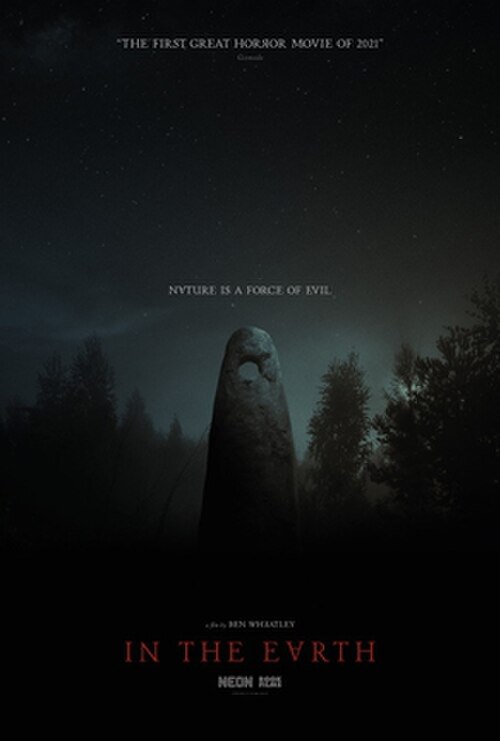
At Claqueta Ácida, we celebrate with near-religious fervor those films that don’t just defy narrative conventions but insist on violating the viewer’s senses with all the delicacy of a butcher’s cleaver sinking into a finger. In the Earth (2021), Ben Wheatley’s latest cinematic exorcism, is precisely that: a sensory survival experiment shot in fifteen days of pandemic lockdown, as if the director decided to transmute collective anxiety into a ritual of techno-folk horror and mutilations so graphic they’d make Eli Roth blanch in his worst nightmares. Wheatley, that enfant terrible of British cinema—who went from disemboweling capitalism in High-Rise (2015) to massacring tourists in Free Fire (2016)—returns here to his underground roots to birth a film that reeks of sweat, mold, and rotting analog synthesizers. This isn’t a movie; it’s an infection.
finalExplicado: "En el clímax, Martin y Alma, bajo el influjo de las esporas, llegan al monolito ancestral que actúa como nodo neural del bosque. Allí ejecutan un ritual de sangre y sonido generado por un sintetizador rudimentario, provocando una erupción masiva de esporas alucinógenas que inunda el bosque entero. La naturaleza responde con una visión psicodélica abrumadora: patrones geométricos, rostros deformados y una conexión total que borra la individualidad humana. Simbólicamente, el desenlace significa la victoria absoluta de la inteligencia vegetal sobre la razón humana. El hombre no es conquistado por un virus, sino absorbido y reprogramado como simple vector reproductivo de la consciencia forestal. La pandemia exterior solo era el preludio; la verdadera infección es la demencia mística que devuelve al ser humano a su lugar: abono consciente."
The Forest as Character (and Executioner)
The premise of In the Earth is deceptively simple: Martin Lowery (Joel Fry, an actor whose expression of perpetual panic seems carved into his DNA), a scientist with the moral fiber of a customs bureaucrat, arrives at a remote research outpost deep in an English forest to reconnect with his colleague, Dr. Olivia Wendle (Hayley Squires, whose gaze of scientific despair evokes a lab mouse just injected with a placebo). The world is in the grip of a pandemic—how ironic, right?—and the forest, that organic entity cinema usually romanticizes as a haven of peace and harmony, reveals itself here as a living, hostile, ravenous organism, a Lovecraftian take on The Blair Witch Project (1999) but with fewer sticks and more mutant fungi.
Wheatley, a director obsessed with pushing the audience to the brink of nervous collapse, constructs the forest as a claustrophobic labyrinth where every tree is a potential threat. Nick Gillespie’s cinematography, a virtuoso of sickly light, deliberately avoids the clichés of the "enchanted forest" to plunge us into a moss-green nightmare, illuminated by computer monitors casting a spectral glow over sweaty faces and oozing wounds. There’s no beauty in this forest; only dampness, decay, and the constant hum of something that isn’t quite life but isn’t death either. It’s the perfect setting for a journey that oscillates between the oneiric and the abject, where the line between science and shamanism blurs into a bloody smear.
Zach: The Hermit Who Invites You to Dinner (Then Drives a Screwdriver Into Your Knee)
The true stroke of genius in In the Earth—or, depending on your tolerance for cinematic sadism, its cardinal sin—is the introduction of Zach, played by Reece Shearsmith with a mix of disturbing rural charm and homicidal madness that recalls the best villains from The League of Gentlemen. Shearsmith, an actor whose mere presence on screen should come with a "may cause nightmares" warning, shifts from seemingly kind host to a pagan priest of the hammer-and-nail school in a matter of minutes. His cabin, a den of rotting wood and rusted tools, is the perfect setting for one of the most uncomfortable sequences in recent cinema: a dinner that begins with herbal tea and ends with a broken finger and a confession about mycological deities.
What’s fascinating about Zach isn’t just his violence but his shoddy philosophy, a hodgepodge of New Age mysticism and social Darwinism that justifies his actions as "necessary for evolution." In less capable hands, this character might have veered into ridiculousness, but Wheatley handles him with clinical detachment, making him all the more terrifying. He’s not a madman; he’s a fanatic, and fanatics, as we know, are the only ones who elevate horror from the personal to the systemic. Shearsmith, by the way, deserves an award just for the scene where he explains his fungus theory while holding a bloodied screwdriver with the same calm as a biology teacher dissecting a frog.
Science as Religion (and Religion as Technological Nightmare)
If Zach embodies primitive shamanism, Dr. Wendle is his technological counterpart: a scientist who’s crossed the line between research and cult worship of the unknown. Her lab, a cave lit by strobe panels and surrounded by speakers emitting inaudible frequencies, is a cathedral of postmodern paranoia, where faith in science has become an almost mystical obsession. Wheatley, who seems to relish torturing his audience as much as his characters, turns the film’s final act into a sensory experience so intense it borders on unbearable: flashing lights seemingly designed to trigger epileptic seizures, synthesizer sounds buzzing like a swarm of deranged bees, and an atmosphere of collective trance where reality unravels like a photographic negative exposed to light.
This contrast between the analog and the digital—between Zach’s hammer and Wendle’s synthesizers—is the rotten core of In the Earth. Wheatley doesn’t judge either side; instead, he presents them as two sides of the same diseased coin: humanity’s need to find meaning in chaos, whether through blood rituals or data charts. The sequence where Wendle attempts to "communicate" with the forest through lights and sounds is as ridiculous as it is mesmerizing, a mix of Close Encounters of the Third Kind (1977) and a Black Mirror episode directed by a shaman in withdrawal. Is this a metaphor for blind faith in technology? Or just a director having fun watching his audience squirm in their seats? Probably both.
Violence, Mutilation, and the Gritty Realism of B-Movies
Wheatley has always had a knack for physical violence, but in In the Earth, he takes this talent to new heights of calculated repugnance. The mutilation scenes—from the protagonists’ bare feet lacerated by branches to the hammer-and-finger moment, straight out of a medieval torture manual—are so graphic you can almost smell the blood and sweat. There’s no glamour in this violence; it’s dirty, clumsy, and painfully realistic, as if the director filmed every blow with the same brutality as a child crushing a bug under their shoe.
What’s most interesting, though, isn’t the violence itself but the indifference with which the characters accept it. Martin, Alma, and Wendle aren’t heroes; they’re survivors, and their response to mutilation is a mix of resignation and scientific curiosity, as if pain were just another data point to log in their field notebooks. It’s a bleak vision of humanity, where adaptability is confused with submission, and the only way to conquer the forest is to become part of it—even if that means losing a finger or your sanity.
Sound as a Weapon of Psychological Warfare
If Gillespie’s cinematography is a visual nightmare, Clint Mansell’s score is the auditory equivalent of needles being driven into your eardrums. Mansell, a composer obsessed with pushing the listener to the brink of nervous collapse (see Requiem for a Dream, 2000), crafts a soundtrack that oscillates between the hypnotic and the unbearable. Analog synthesizers—sounds straight out of a 1970s lab left to rot—blend with electronic buzzes that mimic a swarm of insects or a heartbeat on the verge of explosion. In the final act, as the film becomes a ritual of light and sound, the music stops being an accompaniment and becomes another character, one that grabs you by the throat and doesn’t let go until the screen fades to black.
A Masterpiece or a Failed Experiment?
In the Earth isn’t a film for everyone. It’s an extreme sensory experience, a work that demands the viewer surrender to its current of controlled madness—but it can also provoke physical revulsion in those with low tolerance for strobe lights or graphic violence. Wheatley, in his quest to create something unique, sometimes falls into the trap of gratuitous excess: the final act, with its barrage of lights and sounds, can be exhausting even for die-hard fans of experimental cinema. Moreover, the script, though fascinating in its ambiguity, suffers from excessive crypticism, leaving too many questions unanswered and too many theories dangling by a thread as thin as a spore in the wind.
But does it matter? Cinema doesn’t always have to be coherent; sometimes it just needs to be visceral, disturbing, and memorable. In the Earth is all that and more: an ecological nightmare, a techno-folk horror ritual, a meditation on faith in science and the madness lurking at the edges of civilization. It’s a film that doesn’t leave you indifferent—whether it fascinates you or makes you want to vomit (or both). And in an era of algorithm-driven, franchise-dominated cinema, that’s an achievement in itself.
The best
- The lysergic sensory experience: The final act is an overdose of lights, sounds, and paranoia that will leave your senses so saturated you’ll need a week to recover. Wheatley doesn’t invite you to watch his film; he kidnaps you and subjects you to an audiovisual brainwashing.
- Reece Shearsmith’s performance: An acting tour de force that swings between charm and terror with the ease of a psychopath changing masks. Shearsmith doesn’t play Zach; he becomes him, and the result is as fascinating as it is repulsive.
The worst
- The strobe-light excess: Wheatley seems obsessed with blinding his audience, and the final act is so intense it could trigger migraines, panic attacks, or—in the worst case—an irresistible urge to burn down the nearest cinema.
The Verdict of Claqueta Ácida (7.8/10)
In the Earth is a film that doesn’t settle for scaring you; it wants to violate your senses, challenge your sanity, and leave you with the feeling you’ve just survived a pagan ritual you were never invited to. Ben Wheatley delivers a work as ambitious as it is uneven, as mesmerizing as it is exhausting, a descent into the heart of forest darkness that teeters between genius and gratuitous excess. This isn’t a film to watch; it’s an experience to endure, and in that endurance lies its greatness. If you leave the theater with sore eyes, ringing ears, and the sense that the forest followed you home, congratulations: Wheatley has achieved his goal. Cinema, after all, shouldn’t be comfortable; it should be an infection. 🍄🔪🎬 Tráiler Oficial
Abrir en YouTube
Ending Explained: In the Earth
Ficha de Daños Colaterales en Sala
Certificado de impacto psicofísico emitido por Lúa Ácida
3 amagos en el tramo intermedio; pestañeo pesado en las transiciones más innecesarias.
Minuto 39 y minuto 69 (comprobando cuánto quedaba de suplicio).
2 espresso para no dejarse vencer por la mediocridad cómoda.
"A mitad del segundo acto cuando la subtrama secundaria empezó a pesar más de lo que aportaba."
💬 El Veredicto de la Comunidad
¿Qué te ha parecido la película? Deja tu nota de 0 a 10 para contrastarla con el análisis de la redacción.
Aún no has votado
📢 ¿Te ha gustado el ácido?
Comparte esta crítica con tus amigos cinéfilos o desata la polémica en redes.
⚡ THE CINEMATIC VENOM YOUR INBOX CRAVES
No sugarcoated ratings, no corporate fluff. Subscribe for our uncensored weekly analysis or join the private Telegram for press previews, poll clashes, and instant alerts.
Alertas de estrenos en 1 segundo, encuestas en caliente y audios al salir de pases de prensa.
Recibe la dosis semanal en tu mail + regalo inmediato del PDF con 50 joyas ocultas de culto.
Related Reviews
Recommended autopsies for demanding film buffs.
 🔥 Fusión Nuclear9.1
*Kill List*: Broken Domesticity, Discount Hitmen, and the Unfathomable Abyss of British Folk Horror
⚡Del mismo director (Ben Wheatley): analiza la evolución o degradación de su estilo.
Ben Wheatley blends British kitchen-sink drama with hitman cinema and the most devastating pagan folk horror of the 21st century.
 🔥 Fusión Nuclear8.5
*Sightseers*: Caravan Holidays, Homicidal Hillbillies, and a Hilariously Dark British Comedy
⚡Del mismo director (Ben Wheatley): analiza la evolución o degradación de su estilo.
Ben Wheatley delivers a pitch-black, quintessentially British, and uproariously funny comedy about a pair of rural serial killers touring England in a retro caravan.
 🔥 Fusión Nuclear8.5
*Alleluia: Love as a Terminal Illness (or How to Turn Crimes of Passion into a Sweaty, Fleshy Spectacle)*
⚡Afinidad temática directa en atmósfera, estilo y fijaciones visuales.
Fabrice Du Welz reimagines the myth of the lonely hearts killers in a feverish whirlwind of jealousy, submission, and blood, led by Lola Dueñas in a performance that’s equal parts hypnotic and harrowing.
Editorial Ecosystem
Cinephile connections, archive interviews and related analyses.
🎞️ In Claqueta Cinematheque3
💬 Debate Cinéfilo & Autopsia de Lectores
0 veredictos¿Discrepas con nuestra nota? ¿Es una obra maestra o veneno puro? Deja tu veredicto abajo sin necesidad de registro.

Aún nadie ha dejado su veredicto para esta película.
Sé el primero en clavarle el colmillo rellenando el formulario de arriba.