Inexorable – The Literary Parasite and the Decaying Bourgeoisie’s Obsession
Fabrice Du Welz crafts an obsessive, elegant, and relentless psychological thriller set in a mansion hiding unspeakable creative secrets.

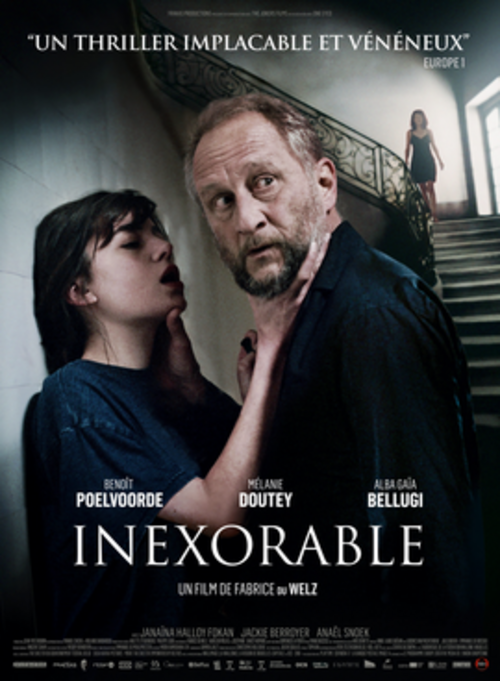

Fabrice Du Welz has turned his filmography into a laboratory of intimate nightmares, where characters rot alive under the weight of their own obsessions. With Inexorable, the Belgian director seems to have decided it was high time to dress his demons in Armani, abandoning the visceral savagery of Alleluia or Vinyan for a more polished psychological thriller—though no less corrosive. Here, the poison isn’t injected with a syringe; it drips slowly into the five-o’clock tea while Europe’s literary bourgeoisie bleeds out between velvet curtains and limited-edition hardcovers. Welcome to the Bellmer mansion, where success is a farce, respectability a set piece, and the intruder needs nothing more than a smile to blow it all to hell.
Impostor Syndrome and the Silent Intruder: When the Parasite Writes Better Than the Host
Marcel Bellmer (Benoît Poelvoorde) is that writer we’ve all met at some literary party: the man who achieved glory with a single book (Inexorable, how ironic) and has since lived trapped in the shadow of his own success. Married to Jeanne (Mélanie Doutey), heiress to a publishing empire that reeks of mothballs and privilege, Marcel is a ghost in his own life—a man who writes hollow sentences while his wife reminds him, with the condescension of someone born with a silver spoon in her mouth, that "the public expects something great." His creative block isn’t just professional; it’s existential. Marcel knows his best work is behind him, and all that remains is an empty shell, an impostor signing copies with a plastic smile.
The arrival of Gloria (Alba Gaïa Bellugi) at the family mansion—that Gothic mausoleum where even the ancestors’ portraits seem to judge you—is the catalyst Du Welz needed to unleash chaos. Gloria isn’t just any intruder: she’s an admirer, an obsessive reader, a young woman who sneaks into the house under the pretense of dusting the books but ends up cleaning something far darker—the lies on which the Bellmer family is built. What’s fascinating about Inexorable is that there are no conventional villains, only victims of their own contradictions. Gloria doesn’t need a knife to sow terror; she just needs to listen, to observe, to whisper in Marcel’s ear the words he dares not speak himself. She’s Pasolini’s Theorem angel turned nanny, a domestic and lethal version of the visitor in Teorema—but with a twist: here, the descending god isn’t divine but all too human.
The Mansion as a Character: A Set Piece That Bleeds
Manuel Dacosse’s cinematography is one of Inexorable’s greatest strengths. If in Alleluia the grain and visual grime reflected the moral rot of its characters, here Dacosse opts for a palette of ochres, golds, and elongated shadows that turn the Bellmer mansion into a character in its own right. Every frame looks like a poisoned Pre-Raphaelite painting: endless hallways, staircases spiraling into nothingness, mirrors returning distorted reflections. The house isn’t just a setting; it’s a living organism breathing decay. Du Welz, alongside his production designer, has created a space that is both prison and refuge, a place where secrets fester in drawers and the walls sweat guilt.
Vincent Cahay’s score deserves special mention. It’s not invasive music but a constant hum, like a fly trapped in a jar. Deep, almost subliminal notes dig into the viewer’s gut, reminding them that no matter how elegant the packaging, what they’re watching is a story of decomposition. Cahay avoids easy jump scares, opting instead for a score that blends with the ambient sound—the creak of a wooden floor, the ticking of a clock, Gloria’s whisper as she reads aloud from Marcel’s novel. The tension isn’t built on shocks but on the certainty that something inexorable is about to happen.
Performances: Poelvoorde in "Man Drowning in His Own Bile" Mode
Benoît Poelvoorde, that actor capable of swinging from absurdist comedy (Podría ser peor) to raw terror (Alleluia), delivers one of his most restrained and devastating performances here. Marcel Bellmer is a man at war with himself—a writer who hates his own work, a husband who despises his wife but depends on her, a father who ignores his daughter because he can’t bear to see himself in her eyes. Poelvoorde conveys all this with minimal gestures: a trembling hand signing a book, a lost gaze while Jeanne talks sales figures, a stifled sigh when Gloria asks why he stopped writing. It’s a physical performance, yes, but also deeply internal, as if the actor had decided his character didn’t even deserve the luxury of screaming.
Opposite him, Alba Gaïa Bellugi crafts a Gloria who is both fragile and lethal. There’s no histrionics in her performance, just an unsettling calm, as if she knows time is on her side. Her character is a mirror reflecting Marcel’s insecurities, but also a black hole absorbing the house’s energy. Bellugi makes the audience sympathize with Gloria—after all, who hasn’t dreamed of getting revenge on those bourgeois snobs who look down on you?—while also feeling terror at her determination. It’s one of those performances that leaves you wondering: How much of what she does is manipulation, and how much is instinct?
Mélanie Doutey, meanwhile, perfectly embodies that type of woman who confuses power with cruelty. Jeanne isn’t a victim but an active accomplice in the family farce. Her relationship with Marcel is a power game disguised as marriage: she constantly reminds him that without her money and name, he’d be nothing; he hates her for it but needs her all the same. Doutey conveys that mix of moral superiority and vulnerability with a chilling detachment. When Jeanne discovers the truth about Gloria, her reaction isn’t fear but outrage: How dare this intruder threaten what’s mine?
The Climax: When Melodrama Dresses Up as Greek Tragedy
The final act of Inexorable is where Du Welz decides subtlety can go to hell and lets the blood stain the Persian rugs. What had been a chamber thriller—elegant and restrained—turns into a festival of screams, blows, and revelations that reek of mothballs. It’s not that the final twist is bad (in fact, it has impeccable internal logic), but it’s too much: too violent, too explicit, too cinematic in the worst sense of the word.
Up to that point, Inexorable had been a film about the power of words: the ones Marcel can’t write, the ones Gloria whispers, the ones Jeanne wields like weapons. But in the climax, Du Welz opts for the most primitive language: physical violence. It’s not a mistake but a stylistic choice that clashes with the previous elegance. It’s as if the director, after keeping us on edge for two hours with the blade of a kitchen knife, decided to finish the job with an axe. It works, but it hurts.
Cinematic Comparisons: From Pasolini to Polanski, with a Dash of Belgian Funny Games
Inexorable drinks from many sources, but none overshadow it. It has the analytical coldness of Teorema (Pasolini, 1968), where a mysterious visitor destabilizes a bourgeois family, but also the claustrophobia of The Tenant (Polanski, 1976), where the real monster is paranoia. Yet Du Welz adds his own signature: an obsession with Catholic guilt and moral rot that recalls his compatriot Chantal Akerman, but with a touch of dark humor that lightens (or poisons, depending on how you see it) the whole.
There’s also something of Funny Games (Haneke, 1997) in the way Gloria dismantles the Bellmers’ facade, though without falling into the Austrian’s intellectual sadism. Du Welz doesn’t judge his characters; he exposes them for what they are: victims of a system that rewards appearances over truth. Marcel isn’t a misunderstood genius but a fraud; Jeanne isn’t a strong woman but a domestic tyrant; Gloria isn’t a heroine but a mirror reflecting the family’s own ugliness.
Conclusion: A Thriller That Devours Itself
Inexorable is a film to be enjoyed and suffered in equal measure. Du Welz proves you can make a high-level psychological thriller without resorting to genre clichés (no jump scares, no chases, no masked villains), but also that sometimes elegance can be a trap. The film moves like a Swiss watch, with millimetric precision, but in its eagerness to avoid the conventional, it risks veering into pretension.
Is Inexorable a masterpiece? No. Is it an intelligent, well-acted, and visually stunning thriller? Without a doubt. Du Welz has created a film that devours itself, like a cannibal feeding on its own flesh. And that, in the end, is the most honest thing you can say about psychological horror cinema: there are no innocent victims, not even among the audience.
finalExplicado: "En el clímax de Inexorable, Gloria, la joven fanática y aspirante a escritora, revela que ha estado manipulando y asesinando sistemáticamente a la familia Bellmer para robar la identidad literaria del patriarca Marcel. En una orgía de violencia repentina, degüella a la esposa, apuñala al marido y quema la mansión con los manuscritos inéditos dentro, mientras dicta su propia versión de la obra maestra que ahora reclama como suya. Simbólicamente, el desenlace es una brutal metáfora de la parásita ambición creativa: la burguesía literaria, decadente y estéril, es devorada y reemplazada por el parásito joven y hambriento. El fuego purifica y borra la autoría original; solo queda la mentira victoriosa. El éxito, como dice la película, siempre huele a cadáver."
The best
- Alba Gaïa Bellugi as Gloria: An exterminating angel with the face of someone who’s never broken a plate (but whose hands are stained with ink and blood).
The worst
- The melodramatic climax: Du Welz goes from subtlety to butchery in the blink of an eye, as if he suddenly remembered the audience paid to see blood.
The Verdict of Claqueta Ácida (8/10)
Inexorable is the kind of film that leaves a bitter aftertaste, like a fine whiskey laced with poison. Fabrice Du Welz dissects the rot of the literary bourgeoisie with the precision of a surgeon and the sadism of a cat playing with a wounded mouse. It’s not perfect—its ending is too explosive for what promised to be a chamber thriller—but it’s intelligent, elegant, and deeply unsettling. As Marcel Bellmer himself might say: Success is a lie that smells like mothballs, and lies, sooner or later, always smell like corpses. 🩸📖🔥🎬 Tráiler Oficial
Abrir en YouTube
Ending Explained: Inexorable – The Literary Parasite and the Decaying Bourgeoisie’s Obsession
Ficha de Daños Colaterales en Sala
Certificado de impacto psicofísico emitido por Héctor Veneno
Ni un solo parpadeo voluntario. El asiento, inusualmente cómodo.
Ni una sola mirada al móvil.
Ninguna. Guarda el café para la sesión siguiente.
"No aplica. La obra se sostiene sola."
💬 El Veredicto de la Comunidad
¿Qué te ha parecido la película? Deja tu nota de 0 a 10 para contrastarla con el análisis de la redacción.
Aún no has votado
📢 ¿Te ha gustado el ácido?
Comparte esta crítica con tus amigos cinéfilos o desata la polémica en redes.
⚡ THE CINEMATIC VENOM YOUR INBOX CRAVES
No sugarcoated ratings, no corporate fluff. Subscribe for our uncensored weekly analysis or join the private Telegram for press previews, poll clashes, and instant alerts.
Alertas de estrenos en 1 segundo, encuestas en caliente y audios al salir de pases de prensa.
Recibe la dosis semanal en tu mail + regalo inmediato del PDF con 50 joyas ocultas de culto.
Related Reviews
Recommended autopsies for demanding film buffs.
 🔥 Fusión Nuclear8.5
*Alleluia: Love as a Terminal Illness (or How to Turn Crimes of Passion into a Sweaty, Fleshy Spectacle)*
⚡Del mismo director (Fabrice Du Welz): analiza la evolución o degradación de su estilo.
Fabrice Du Welz reimagines the myth of the lonely hearts killers in a feverish whirlwind of jealousy, submission, and blood, led by Lola Dueñas in a performance that’s equal parts hypnotic and harrowing.
 🔥 Fusión Nuclear9.0
*Calvaire: The Belgian Nightmare Hollywood Will Never Understand (And That’s Why It’s Perfect)*
⚡Del mismo director (Fabrice Du Welz): analiza la evolución o degradación de su estilo.
Fabrice Du Welz makes his debut with a masterpiece of European transgressive cinema—a fog-drenched, deeply unsettling ordeal that dissects loneliness and rural madness.
 ⚡ Ácido Cítrico7.5
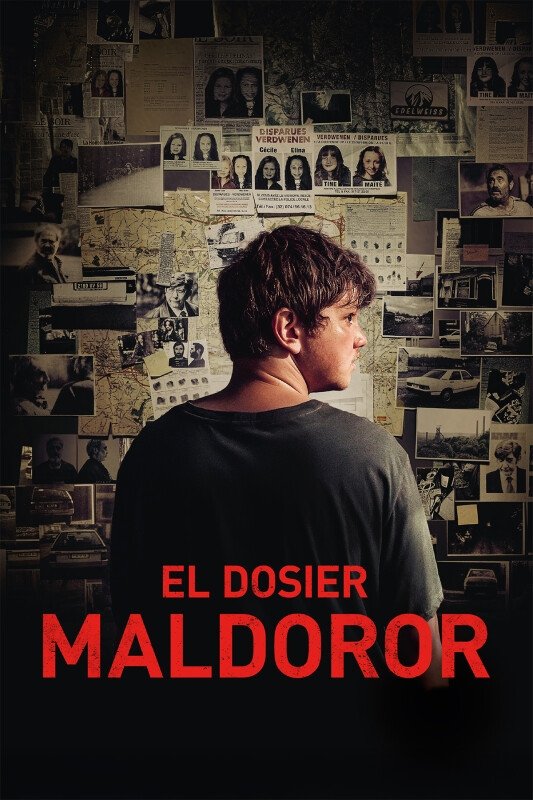
*The Maldoror Dossier: Claqueta Ácida’s Verdict*
⚡Del mismo director (Fabrice Du Welz): analiza la evolución o degradación de su estilo.
Fabrice Du Welz and his shadow ballet in the Belgian underworld. Du Welz delivers a gothic thriller teetering between visual virtuosity and baroque excess—155 minutes of nightmare and obsession.
Editorial Ecosystem
Cinephile connections, archive interviews and related analyses.
🎞️ In Claqueta Cinematheque3
💬 Debate Cinéfilo & Autopsia de Lectores
0 veredictos¿Discrepas con nuestra nota? ¿Es una obra maestra o veneno puro? Deja tu veredicto abajo sin necesidad de registro.


Aún nadie ha dejado su veredicto para esta película.
Sé el primero en clavarle el colmillo rellenando el formulario de arriba.