Kill List — Broken Domesticity, Discount Hitmen, and the Unfathomable Abyss of British Folk Horror
Ben Wheatley blends British kitchen-sink drama with hitman cinema and the most devastating pagan folk horror of the 21st century.

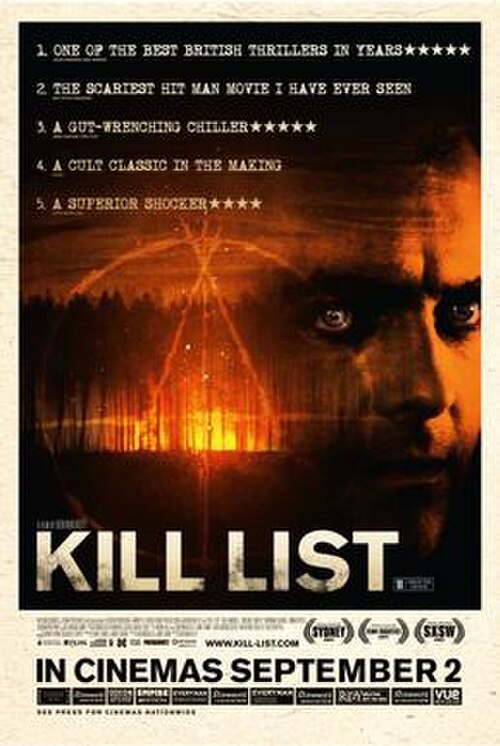
Kill List (2011): The Gospel According to Ben Wheatley, or How to Turn Trauma into a Ritual of Blood and Madness
In the sacred crypt of Claqueta Ácida, where we worship films that squirm like worms on the viewer’s hook, Kill List (2011) isn’t just a movie—it’s a cinematic exorcism, a black mass officiated by Ben Wheatley and his accomplice Amy Jump, where the incense is the smoke of cheap cigarettes, the sacramental wine is lukewarm pub lager, and the altar… well, the altar is a list of names scrawled on paper stained with sweat and guilt. This masterpiece of contemporary pagan terror doesn’t settle for scaring you; it drags you into the hell of shattered domesticity, drowns you in the froth of domestic violence, and spits you out, bleeding, into a forest where the trees whisper in Latin and ancient gods demand human sacrifices at union rates.
Kitchen-Sink Drama as the Prelude to Apocalypse
Wheatley, that maestro of discomfort, begins Kill List with a deceptively simple premise: a British family drama in the style of Ken Loach, but with more testosterone and less hope. Jay (Neil Maskell, in a performance that should’ve earned him a posthumous Oscar for "Best Actor in a State of Mental Decay") is a former soldier turned bargain-bin hitman, whose life is crumbling like a house of cards in a pub during happy hour. His wife Shel (MyAnna Buring, whose acting is a reminder that hell is paved with good intentions and bad marriages) nags him with reproaches while their young son, Sam, watches in silence, as if he already knows his father’s legacy is a cocktail of PTSD and bounced checks.
The first 25 minutes of Kill List are a tour de force of grimy realism: improvised dialogue that sounds like real arguments between people who hate each other but can’t afford to split up, forced laughter over a dinner with friends who reek of desperation and reheated fish and chips, and domestic tension so thick you could cut it with the kitchen knife Jay wields a little too often. Wheatley isn’t in a hurry; he knows the most effective terror isn’t the kind that jumps out at you, but the kind that seeps in drop by drop, like water from a rusted pipe rotting the foundations of your sanity.
And then, as if it were a Faustian pact, Gal (Michael Smiley, whose charisma is as unsettling as a door-to-door encyclopedia salesman in a war zone) appears—Jay’s old army buddy—with a proposition: a job, a list, a mysterious client who pays in cash and smiles like sulfur. What could possibly go wrong?
The List: A Tasting Menu of Horrors with a Side of Madness
What follows is a downward spiral into paranoia and ritualistic violence, where each name Jay and Gal cross off the list isn’t just a job—it’s another step into the abyss of the inexplicable. The first victim, a pedophile priest (because of course, in British cinema, absolute evil always wears a cassock), is dispatched with brutal efficiency that borders on the pornographic. But there’s something off about his expression as Jay stabs him: no fear, just relief. As if, instead of killing him, Jay were doing him a favor.
And so, with each name scratched off the list, the film ventures deeper into murkier territory. Wheatley and Jump toy with the audience like a cat with a dying mouse: Is this a crime thriller? A psychological drama? Or are we dealing with a pagan cult that’s infiltrated every corner of British society? The answer, of course, is a resounding "yes" to all—served with an ambiguity so deliciously frustrating it’ll leave you scratching your head until it bleeds.
The second act of Kill List is a masterclass in sustained tension, where violence erupts with an analog rawness that recalls the best moments of Sam Peckinpah’s Straw Dogs (1971), but with a touch of Lovecraftian surrealism. The hammer blow to a suspect’s hands isn’t just torture; it’s an initiation ritual, a way of telling the audience: "This isn’t a movie—this is a nightmare you won’t wake up from." Laurie Rose’s cinematography, with its desaturated grays and elongated shadows, turns every scene into a Francis Bacon painting: distorted, painful, and profoundly human in its ugliness.
The Third Act: When Folk Horror Devours the Thriller
And then, as if the film had been holding its breath from the start, we arrive at the climax in the woods—a sequence seared into the viewer’s retina that, years later, will still haunt your nightmares like an uninvited guest. Wheatley abandons any pretense of realism and dives headfirst into pure folk horror, a subgenre indebted as much to The Wicker Man (1973) as to rural legends of children stolen by fairies and cursed harvests.
The cult, clad in straw masks that look like they were plucked from a Neolithic ritual, emerges from the mist like a collective nightmare. No explanations, no grand monologues about the end of the world—just blood, fire, and the sound of drums pounding like the heartbeat of a dying man. The final twist, that moment when Jay realizes (too late) he’s been a pawn in a game much bigger than himself, is so morally ruthless it’ll leave you breathless. It’s not just a plot twist; it’s a metaphysical slap, a reminder that sometimes the real horror isn’t in the monsters, but in the acceptance that evil is banal, everyday, and, above all, human.
The Sound of the Abyss: A Soundtrack That Eats Away at Your Nerves
If there’s one thing that elevates Kill List above other horror films, it’s its sound design—a symphony of analog noises that acts like corrosive acid on the viewer’s nerves. The score, composed by Jim Williams, is a mix of electronic hums, tribal percussion, and metallic distortions that sound like someone scraping a chalkboard with iron nails. No cheap jump scares or melodramatic orchestrations; instead, Wheatley opts for an oppressive sonic atmosphere, where silence is as threatening as the crash of a hammer blow.
And then there are the diegetic sounds: the crunch of leaves under Jay’s feet as he pursues his victim, the drip of blood on the floor, Shel’s whisper in Swedish that sounds like a curse. Every auditory detail is calculated to raise the hairs on the back of your neck, as if the film were whispering in your ear: "You’re not safe. You never were."
Performances: When the Stanislavski Method Meets the Apocalypse
The cast of Kill List is so perfectly chosen it feels like it was plucked from a documentary about human despair. Neil Maskell, as Jay, delivers a performance that oscillates between the vulnerability of a broken man and the ferocity of a cornered animal. His Jay isn’t a hero or a villain; he’s a distorted mirror of toxic masculinity, a guy who thinks he can control his violence until the violence controls him. The scene where, drunk and unhinged, he beats his wife while their son cries in the background is so brutally realistic it hurts physically.
MyAnna Buring, meanwhile, steals every scene she’s in as Shel, Jay’s Swedish wife. Her performance is a study in resignation and repressed rage, a woman who knows her marriage is a sinking ship but, for some reason, keeps bailing water instead of jumping overboard. And then there’s Michael Smiley as Gal, the sinister catalyst of the tragedy, a man whose smile is as warm as a knife in the back.
Cinephile Comparisons: Where Does Kill List Fit in the Horror Pantheon?
Kill List isn’t an easy film to classify, and that’s part of its genius. It’s a monstrous genre hybrid, a cinematic Frankenstein’s monster that blends elements of:
- British crime thrillers: Echoes of Get Carter (1971) and The Long Good Friday (1980), but with a surrealism that feels more like Nicolas Roeg’s Performance (1970).
- Folk horror: Here, Wheatley drinks directly from the well of The Wicker Man (1973) and Blood on Satan’s Claw (1971), but with a gritty, urban modernity that distances it from the rural romanticism of those films.
- Lovecraftian psychological horror: The sense that something is deeply wrong with the world, that the rules of reality are dissolving like smoke, is pure H.P. Lovecraft. Though instead of ancient gods, Wheatley gives us a cult so British their rituals seem organized by the local Conservative Party committee.
- Ken Loach-style social drama: The film’s early acts are a merciless portrait of the British working class, where lack of money and past wounds are just as important as knives and guns.
Opacity as a Virtue (or the Art of Frustrating the Audience with Style)
One of Kill List’s most divisive aspects is its lack of clear answers. Who is the mysterious client? What does the cult want? Why do the victims seem grateful for their deaths? Wheatley and Jump have no interest in explanations; their film is a puzzle with missing pieces, and that’s precisely what makes it so fascinating.
For some viewers, this will be a cardinal sin, a sign of pretentiousness or, worse, lazy storytelling. But for those willing to dive into its ambiguity, Kill List offers an experience so rich in symbolism and atmosphere that each viewing reveals new layers of meaning. Is the cult real, or is it a manifestation of Jay’s trauma? Is the list a trap, or has Jay become the monster he always feared? The film doesn’t give you answers, but it leaves you with questions that will haunt you for days.
Conclusion: A Masterpiece That Brands You Like a Red-Hot Iron
Kill List isn’t a film you watch—it’s a film you endure, live, curse, and worship in equal measure. Ben Wheatley has crafted a work that defies genre conventions, blending the mundane with the supernatural, the realistic with the oneiric, and culminating in a climax so disturbing it’ll leave you staring at the ceiling at 3 a.m., wondering if the world is really as stable as you think.
It’s a film that’s gritty, violent, uncomfortable, and deeply human—one that doesn’t settle for scaring you, but forces you to confront your own fears, your own shadows. And in the end, when the credits roll and the screen fades to black, you realize you haven’t just watched a film—you’ve attended a ritual.
finalExplicado: "En el clímax de Kill List, Jay y Gal completan su último encargo en una ceremonia pagana en el bosque: tras asesinar a varias víctimas marcadas, Jay es obligado a matar a Gal y, finalmente, a su propia esposa e hijo, que resultan ser parte del ritual. La secta lo corona como el nuevo líder, coronándolo con una máscara de conejo mientras él grita enloquecido. Simbólicamente, el desenlace revela que Jay nunca fue el depredador, sino la presa sacrificial desde el principio. Su violencia doméstica, su frustración masculina y su degradación moral lo convierten en el candidato perfecto para renovar el ciclo pagano. El folk horror devora el drama social británico: la familia rota no se arregla, se sacrifica. El abismo no está en el bosque, sino dentro de él."
The best
- Wheatley’s structural audacity: Blending British kitchen-sink drama with pagan folk horror is like mixing whiskey with dragon’s blood—explosive, unpredictable, and guaranteed to leave you with an existential hangover.
- Neil Maskell at his finest: His Jay is a monument to broken masculinity, a man who goes from frustrated family man to deranged killer without losing an ounce of humanity (or what’s left of it).
The worst
Narrative opacity: If you’re the type who needs everything to fit together like a Swiss watch, Kill List* will leave you more lost than a tourist in the Tokyo subway during rush hour.- The pacing early on: The first 25 minutes are so dense you could use them as anesthesia for open-heart surgery.
The Verdict of Claqueta Ácida (9.1/10)
Kill List is that rare breed of horror film that doesn’t just scare you—it dismantles you piece by piece and reassembles you as a paranoid, traumatized wreck. Ben Wheatley delivers a film as grimy as a dive bar, as violent as a hammer blow to the temple, and so ambitious it skirts pretentiousness without ever falling into it. If you’re looking for a film that leaves you with more questions than answers, that churns your stomach and haunts you for weeks, here it is. Just don’t say we didn’t warn you: after watching Kill List, you’ll eye every forest, every shopping list, and every overly wide smile with suspicion. 🔪🌲🎬 Tráiler Oficial
Abrir en YouTube
Ending Explained: Kill List
Ficha de Daños Colaterales en Sala
Certificado de impacto psicofísico emitido por Héctor Veneno
Cero bostezos. Pupilas dilatadas y tensión mandibular constante.
Ni una sola mirada al móvil.
Ninguna. Esta obra no necesita muletas estimulantes.
"No aplica. La obra se sostiene sola."
💬 El Veredicto de la Comunidad
¿Qué te ha parecido la película? Deja tu nota de 0 a 10 para contrastarla con el análisis de la redacción.
Aún no has votado
📢 ¿Te ha gustado el ácido?
Comparte esta crítica con tus amigos cinéfilos o desata la polémica en redes.
⚡ THE CINEMATIC VENOM YOUR INBOX CRAVES
No sugarcoated ratings, no corporate fluff. Subscribe for our uncensored weekly analysis or join the private Telegram for press previews, poll clashes, and instant alerts.
Alertas de estrenos en 1 segundo, encuestas en caliente y audios al salir de pases de prensa.
Recibe la dosis semanal en tu mail + regalo inmediato del PDF con 50 joyas ocultas de culto.
Related Reviews
Recommended autopsies for demanding film buffs.
 🔥 Fusión Nuclear7.8
*In the Earth: Forest Psychedelia, Mutant Spores, and Nature’s Descent into Madness*
⚡Del mismo director (Ben Wheatley): analiza la evolución o degradación de su estilo.
Ben Wheatley shoots a pandemic-era trip—equal parts lysergic, hallucinatory, and horrifying—blending folk horror, sci-fi, and mutilation deep in the woods.
 🔥 Fusión Nuclear8.5
*Sightseers*: Caravan Holidays, Homicidal Hillbillies, and a Hilariously Dark British Comedy
⚡Del mismo director (Ben Wheatley): analiza la evolución o degradación de su estilo.
Ben Wheatley delivers a pitch-black, quintessentially British, and uproariously funny comedy about a pair of rural serial killers touring England in a retro caravan.
 🔥 Fusión Nuclear8.5
*Alleluia: Love as a Terminal Illness (or How to Turn Crimes of Passion into a Sweaty, Fleshy Spectacle)*
⚡Afinidad temática directa en atmósfera, estilo y fijaciones visuales.
Fabrice Du Welz reimagines the myth of the lonely hearts killers in a feverish whirlwind of jealousy, submission, and blood, led by Lola Dueñas in a performance that’s equal parts hypnotic and harrowing.
Editorial Ecosystem
Cinephile connections, archive interviews and related analyses.
🎞️ In Claqueta Cinematheque3
💬 Debate Cinéfilo & Autopsia de Lectores
0 veredictos¿Discrepas con nuestra nota? ¿Es una obra maestra o veneno puro? Deja tu veredicto abajo sin necesidad de registro.

Aún nadie ha dejado su veredicto para esta película.
Sé el primero en clavarle el colmillo rellenando el formulario de arriba.