Inside — The Ultimate Symphony of Pain—Stitched Together with Sewing Scissors
Bustillo, Maury, and the unholy spirit of the era deliver the most blood-soaked, poetic, and merciless home invasion in cinema history.

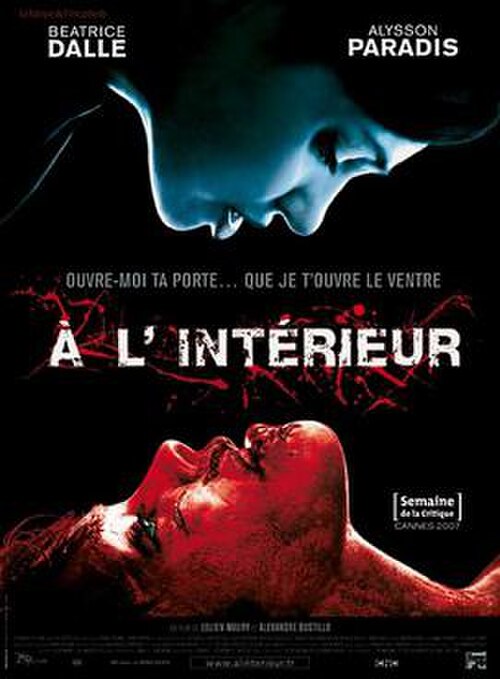


Here at Claqueta Ácida HQ—where we’ve surgically dissected everything from Uwe Boll’s cinematic dumpster fires to Terrence Malick’s hollow pretensions with a silver scalpel—À l’intérieur (2007) stands as a glorious anomaly: a film that doesn’t just grab you by the guts but yanks them out, examines them under clinical light, and hands them back as art. Co-directed by Alexandre Bustillo and Julien Maury—two names that deserve a place in the pantheon of cinema’s heretics alongside Fulci and Argento—this 80-minute nightmare is France’s answer to the New French Extremity, proving once again that Europe doesn’t need spandex-clad superheroes to craft images that sear into your retinas like rusted nails.
Maternity as a Battleground: A Shakespearean Duel Reimagined as a Slasher
The premise of Inside is as simple as it is devastating: Sarah (Alysson Paradis), a nine-months-pregnant photographer, spends Christmas Eve alone after her husband’s death in a car crash. Her only company is the echo of grief—a pain the film materializes in the form of an intruder (Béatrice Dalle), a woman dressed in black who bursts into her home with the determination of a specter and the precision of a surgeon. Her goal isn’t to rape, torture, or even kill Sarah. She wants to carve the baby out of her womb with sewing scissors. Yes, you read that right. And no, there’s no psychological explanation that holds water. This isn’t Psycho; it’s Macbeth meets home invasion, where blood isn’t an accessory but the primary pigment on a canvas slowly drenched in red, one meticulous stroke at a time.
What’s fascinating about Inside is how it transforms a premise that, in lesser hands, would’ve devolved into cheap torture porn into a modern Greek tragedy. There are no cartoonish villains or invincible heroes: Sarah isn’t an ‘80s final girl—she’s a vulnerable, exhausted, terrified woman; Dalle isn’t a monologuing psychopath with a tragic backstory—she’s a force of nature, the embodiment of cruel fate lurking in silence, like a predator in the dark. The film erases any shred of hope with the same cold efficiency Dalle uses to plunge scissors into flesh: cops who show up to help are dispatched with a brutality that’d make John Wick blush; Sarah’s mother (Nathalie Roussel) is reduced to a puddle of blood in seconds; even the well-meaning neighbor ends up with his throat slit like a pig at the slaughterhouse. There’s no salvation here—just the survival instinct and the grim certainty that someone is going to suffer.
Cinematography as a Weapon: When Terror Becomes a Painting
What elevates Inside above its peers is the visual obsession of Laurent Barès, the cinematographer who’d already proven his mastery in Xavier Gens’ Frontière(s) (2007). Barès doesn’t just light the scene—he paints it. Every frame is a deliberate, almost Baroque composition where light and shadow clash like opposing forces. The pristine white of Sarah’s nightgown and bathroom walls contrasts with Dalle’s jet-black coat, creating a visual effect reminiscent of Caravaggio’s chiaroscuro—except here, light doesn’t symbolize redemption but the fragility of life.
The house’s hallways become a claustrophobic labyrinth, shot in long takes that force the audience to feel Sarah’s desperation. The stairs, lit from below, cast elongated shadows that foreshadow the intruder’s arrival, as if hell itself were climbing the steps. And then there’s the bathroom, that sanctum of domestic terror where the film reaches its bloody climax. Barès turns the space into a nightmare stage, with blood splattering the white walls like someone hurling buckets of red paint at a canvas. It’s ugly, it’s brutal, but it’s also beautiful—in the same way a Francis Bacon painting is: a raw, unflinching depiction of human pain.
The Sound of Terror: When Silence Hurts More Than Screams
In a film where violence is so explicit, it’s ironic that silence is one of its greatest weapons. Bustillo and Maury understand something many horror filmmakers forget: fear doesn’t always need eerie music or cheap jump scares. Sometimes, all it takes is the creak of a floorboard, the snip of scissors opening, or the ragged breath of a woman on the verge of collapse.
François-Eudes Chanfrault’s score is minimalist but effective, with dissonant strings that drill into your brain like needles. Yet it’s the diegetic sounds—the running water, the stealthy footsteps, the muffled whimpers—that generate unbearable tension. There’s one scene near the end where Sarah, wounded and exhausted, drags herself across the floor while Dalle watches from the shadows. No music, no dialogue—just the sound of her breathing and the audience’s pounding heartbeat. It’s in moments like these that Inside proves terror doesn’t need CGI monsters or special effects: all it needs is the suggestion that something horrible is about to happen.
Performances: When Pain Feels Real
If there’s one element that lifts Inside above the torture porn pack, it’s the acting duel between Alysson Paradis and Béatrice Dalle. Paradis, as Sarah, conveys a heartbreaking vulnerability without veering into histrionics. Her performance is physical, almost animalistic: every scream, every grimace of pain, every desperate attempt to escape feels real because it probably was. It’s not hard to imagine Paradis enduring genuine discomfort—whether from awkward positions or the psychological strain of filming such intense scenes.
But if Paradis is the perfect victim, Béatrice Dalle is the ultimate monster. With her piercing gaze, unsettling smile, and magnetic presence, Dalle crafts a character that transcends the villain archetype. She’s not a psychopath who revels in suffering; she’s a force of nature, the embodiment of trauma and obsession. Her performance is nearly silent, but every gesture, every calculated movement, radiates terrifying determination. She doesn’t run, doesn’t scream, doesn’t lose composure—she simply advances, like a predator who knows her prey has no escape. It’s one of the most memorable performances in modern horror, on par with Anthony Hopkins’ Hannibal Lecter or Isabelle Adjani’s Possession.
The Legacy of Inside: When Terror Becomes Art
Inside isn’t a film for everyone. It’s not something you watch while munching popcorn or scrolling through your phone. It’s a physical, almost visceral experience that forces you to confront your deepest fears about motherhood, violence, and the fragility of the human body. In a genre drowning in unnecessary sequels and soulless reboots, this film stands out for its conceptual purity: no subplots, no supporting characters stealing the spotlight, no forced twists. It’s a linear, relentless, merciless story—like a knife stabbing the same spot over and over.
Its influence echoes in later films like The Strangers (2008) and Hush (2016), but none have captured the same poetic terror. Bustillo and Maury didn’t just make a horror film—they created a work of art. And like all great art, Inside divides its audience: some will see it as repulsive and gratuitous; others, as a brutal meditation on maternal instinct and violence. But what’s undeniable is that, 15 years after its release, it remains as disturbing as the day it premiered.
finalExplicado: "La mujer de negro irrumpe en la casa y, en un clímax de violencia primitiva y casi ritual, desgarra el vientre de Sarah con unas tijeras de costura mientras esta da a luz. Extrae al feto vivo del útero abierto, lo abraza como propio y deja a la madre desangrándose en el suelo. La policía llega demasiado tarde; solo queda la intrusa saliendo con el recién nacido en brazos bajo la luz roja del amanecer. Simbólicamente, el desenlace es una brutal transferencia de maternidad a través de la carnicería: la Muerte (o el duelo encarnado) devora y reemplaza a la vida, robando el futuro que la embarazada ya no merece. El útero se convierte en portal de horror absoluto; la tijera, en instrumento de un parto invertido y sacrílego. No hay redención, solo un ciclo de dolor que se perpetúa."
The Best
- Béatrice Dalle as the embodiment of pure terror: If hell had a face, it’d be hers. No screams, no monologues—just a presence that freezes your blood with a single glance.
- Laurent Barès’ cinematography: Every frame is a macabre masterpiece worthy of a contemporary art museum. Caravaggio would weep with envy.
The Worst
That damn CGI fetus: A moment of uncanny valley* that shatters immersion. The budget in 2007 didn’t stretch that far, but it hurts to see how poorly the effects have aged—like a vampire left in the sun.- The characters’ logic: Sarah surviving wounds that’d kill a bull is the only time the film asks you to suspend disbelief. Though, to be fair, if she didn’t, the movie would last 20 minutes.
The Verdict of Claqueta Ácida (9.4/10)
Inside isn’t a movie—it’s a real-time autopsy of the human condition, performed with a surgeon’s precision and a damned poet’s sensitivity. Bustillo and Maury achieved the impossible: turning torture porn into art, gore into poetry, and motherhood into a nightmare you can’t wake up from. If you’ve ever wondered what it feels like to be hunted by Death herself, this film shows you without anesthesia. And the worst part? When it’s over, you’ll want to watch it again. 🩸🔪🎬 Tráiler Oficial
Abrir en YouTube
Ending Explained: Inside
Ficha de Daños Colaterales en Sala
Certificado de impacto psicofísico emitido por Lúa Ácida
Ni un solo parpadeo voluntario. El asiento, inusualmente cómodo.
El móvil permaneció en el bolsillo donde debía estar.
Ninguna. Guarda el café para la sesión siguiente.
"No aplica. La obra se sostiene sola."
💬 El Veredicto de la Comunidad
¿Qué te ha parecido la película? Deja tu nota de 0 a 10 para contrastarla con el análisis de la redacción.
Aún no has votado
📢 ¿Te ha gustado el ácido?
Comparte esta crítica con tus amigos cinéfilos o desata la polémica en redes.
⚡ THE CINEMATIC VENOM YOUR INBOX CRAVES
No sugarcoated ratings, no corporate fluff. Subscribe for our uncensored weekly analysis or join the private Telegram for press previews, poll clashes, and instant alerts.
Alertas de estrenos en 1 segundo, encuestas en caliente y audios al salir de pases de prensa.
Recibe la dosis semanal en tu mail + regalo inmediato del PDF con 50 joyas ocultas de culto.
Related Reviews
Recommended autopsies for demanding film buffs.
 ⚡ Ácido Cítrico7.5
*Among the Living: Lost Childhood, the Deep America Slasher Transplanted to the French Countryside*
⚡Del mismo director (Alexandre Bustillo, Julien Maury): analiza la evolución o degradación de su estilo.
Bustillo and Maury fuse the spirit of *Stand by Me* with the ultra-violent rural slasher vibe of *The Texas Chain Saw Massacre* in a raw, physical film that hits like a sucker punch.
 🔥 Fusión Nuclear8.0
*Livid*: A Gothic Nightmare of Blood Ballet, Dead Dolls, and the French Extreme’s Most Posh Descent into Madness
⚡Del mismo director (Alexandre Bustillo, Julien Maury): analiza la evolución o degradación de su estilo.
Bustillo and Maury ditch the grimy brutality of *Inside* to birth a stunningly perverse Gothic fairy tale of vampirism and decay.
 🔥 Fusión Nuclear7.7
*The Soul Eater: Mountain Legends, Lost Kids, and Rural Offal – A Feast for the Damned*
⚡Del mismo director (Alexandre Bustillo, Julien Maury): analiza la evolución o degradación de su estilo.
Bustillo and Maury return in 2024 with a dark, filthy, and suffocating police-gothic thriller set deep in the forests of France—where the trees whisper and the locals *really* don’t like outsiders.
Editorial Ecosystem
Cinephile connections, archive interviews and related analyses.
💬 Debate Cinéfilo & Autopsia de Lectores
0 veredictos¿Discrepas con nuestra nota? ¿Es una obra maestra o veneno puro? Deja tu veredicto abajo sin necesidad de registro.

Aún nadie ha dejado su veredicto para esta película.
Sé el primero en clavarle el colmillo rellenando el formulario de arriba.