Livid — A Gothic Nightmare of Blood Ballet, Dead Dolls, and the French Extreme’s Most Posh Descent into Madness
Bustillo and Maury ditch the grimy brutality of Inside to birth a stunningly perverse Gothic fairy tale of vampirism and decay.

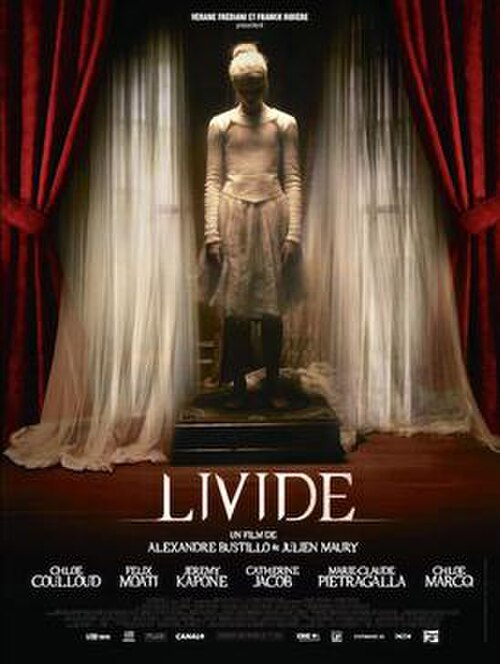
Livid (2011) is that rare cinematic specimen that emerges when two directors raised at the altar of the New French Extremity—that movement which blessed us with gems like Martyrs or À l’intérieur—decide that, instead of popping eyeballs with a rusty screwdriver, they’d rather play Mario Bava in an abandoned spa. Alexandre Bustillo and Julien Maury, the architects of the urban slaughterhouse that was Inside, here don their velvet gothic fairy-tale suits and deliver a film that reeks of mothballs, melted wax, and that stale perfume of libraries where books bite. This isn’t a betrayal of their style, but an evolution as unexpected as a vampire who prefers Earl Grey to blood plasma. And they pull it off: Livid is a nightmare of macabre ballet, a symphony of rusted automatons and mummified ballerinas dancing Swan Lake while draining you with the elegance of a Victorian lady.
finalExplicado: "En el clímax, Lucie descubre que Madame Jessel no está en coma: es una vampira ancestral que usa el cuerpo de su hija muerta, Anna, como marioneta. Tras una orgía de sangre y violencia, Lucie es mordida y convertida. La anciana transfiere su conciencia al cuerpo joven de Lucie, que ahora danza sola en el salón, convertida en la nueva y eterna bailarina-prisionera de la mansión. Simbólicamente, el final sella un ciclo de posesión y decadencia: la juventud es solo un recipiente vacío que la vejez vampírica ocupa. La casa devora a sus habitantes y los transforma en muñecas de carne, perpetuando una eternidad grotesca donde la belleza y el arte solo existen como control y decadencia eterna. Un cuento de hadas perverso sin redención."
The Jessel Mansion: A Character More Alive Than the Protagonists
The plot, seemingly simple, is a Trojan horse packed with references and layers of meaning. Lucie (Chloé Coulloud), a trainee nurse with the charisma of a dead fish, takes a night job in rural Brittany to care for Madame Jessel (Marie-Claude Pietragalla), a comatose former ballerina lying in a mansion straight out of one of Edgar Allan Poe’s fever dreams. What begins as a home-invasion thriller—echoing The Descent or The Others—quickly veers into far stranger territory: the treasure these kids seek isn’t gold, but a twisted form of immortality, a biological inheritance that turns the living into flesh-and-bone marionettes.
The Jessel mansion isn’t just a setting; it’s a living organism, a rotting womb that breathes through its rusted pipes and moss-covered walls. Bustillo and Maury, alongside cinematographer Laurent Barès, craft a visual universe that drinks directly from Argento’s gialli (Suspiria, Inferno) and Jean Rollin’s gothic nightmares, but with a lo-fi touch that shuns digital sheen like garlic to a vampire. Moldy greens, muted golds, and rusty reds flood every frame, creating a palette seemingly plucked from a 1970s film rescued from a flooded basement. There are no cheap jump scares or jarring post-production effects: here, terror is born from texture, from the creak of rotting wood underfoot, from the whisper of curtains moving on their own.
And then there are the automatons. Good God, the automatons. These 19th-century mechanical dolls, with their cracked porcelain faces and spasmodic movements, are the soul of the film. They’re not mere haunted house props, but living metaphors for the obsession with physical perfection, immortality as imprisonment, and motherhood as an act of cannibalism. Madame Jessel didn’t just collect ballerinas—she manufactured them, mummified them, and hung them from the ceiling like broken marionettes. There’s a scene where Lucie discovers a room filled with these blind dancers, swaying in the dark as if performing a pas de deux with death, that is one of the most beautiful and disturbing images in modern horror cinema. No blood, no screams—just the sound of rusted gears and the echo of a waltz that never ends. It’s poetic terror in its purest form, the kind that leaves you with a hollow feeling in your stomach and an urge to burn your antique doll collection.
The Ballet of Flesh: Lyrical Violence and Gothic Melancholy
Bustillo and Maury haven’t abandoned their love for graphic violence, but here they meter it out with the precision of a plastic surgeon. Blood doesn’t splatter—it drips, slides, tangles like a thread of red silk. When the film decides to bare its claws, it does so with a rawness reminiscent of their debut, but wrapped in a lyricism that makes it even more unsettling. There’s a sequence where an anthropophagic automaton attacks one of the intruders, tearing out his throat with a ferocity that contrasts with its mechanical elegance. This isn’t your average slasher—it’s a choreographed murder, a ballet of flesh and metal where every movement seems rehearsed for centuries.
But Livid’s most fascinating trick is how it turns violence into a meditation on the passage of time and the obsession with eternal youth. Madame Jessel isn’t a run-of-the-mill villain—she’s a monstrous mother, a sinister Pygmalion trying to preserve her "daughters’" beauty through macabre rituals. Her treasure isn’t material, but a promise of physical immortality, an elixir that turns the living into mummified marionettes of flesh. In this sense, the film dialogues with myths like Frankenstein or The Picture of Dorian Gray, but with a sensibility that draws from the French gothic tradition (Rollin, Franju) and Cronenberg’s body horror. What’s more terrifying: dying or living forever as an animated corpse?
Performances: When Elegance Is More Terrifying Than a Scream
The cast of Livid is uneven, but it boasts two absolute gems. Marie-Claude Pietragalla, a legend of French ballet, steals the film with her ethereal and terrifying presence. Her Madame Jessel is a character who doesn’t need to speak to convey menace—her rigid posture, bony hands, and a gaze that cuts like a scalpel do the work. She’s a villain who recalls the great dames of classic horror (Fisher’s vampire, Corpse Bride’s countess), but with a camp edge that makes her even more memorable. Pietragalla doesn’t act—she possesses. And when she finally awakens from her coma, she does so with a supernatural grace that leaves you breathless.
On the flip side, the male characters are the film’s weak spot. Lucie’s boyfriend (Jérémy Kapone) and his friend (Félix Bossuet) are so flat they might as well be cardboard cutouts. Their sole purpose is to die creatively so the plot can advance, like extras in a horror video game. Fortunately, Chloé Coulloud holds up the protagonist’s weight with a restrained but effective performance. She’s not a charismatic heroine, but her vulnerability makes her relatable: she’s the audience trapped in this nightmare labyrinth.
The Script: When Surrealism Oversteps Its Bounds
This is where Livid stumbles, though not fatally. The film flirts so heavily with surrealism and dream logic that, by the third act, some plot elements float away like helium-less balloons. What exactly is Madame Jessel’s "treasure"? How does her immortality ritual work? Why is there a scene where Lucie encounters a child version of herself? Ambiguity isn’t inherently bad—it’s one of the film’s strengths—but there are moments when the script seems more interested in crafting striking images than building a coherent narrative.
That said, does it really matter? Livid isn’t a film to rationalize—it’s one to feel. It’s a sensory experience, a journey through a gothic nightmare where logic takes a backseat. If you’re looking for clear answers, go watch Saw. If you want to lose yourself in a maze of symbols and atmospheres, Livid is your film.
Score: The Waltz of the Dead
The music of Livid, composed by Raphaël Gesqua, is another character in the film. It’s not a conventional score, but a collection of pieces that oscillate between classical waltzes, ambient drone, and industrial noise. There are moments when the music seems to emanate directly from the automatons, with metallic, screeching sounds blending into the creak of an out-of-tune violin’s strings. It’s a soundtrack that ensnares you like a spiderweb, dragging you into the abyss with the elegance of a poisoned ballerina.
Cinematic Comparisons: Where Does Livid Fit?
Livid is a film that defies labels, but if we had to find it a place in the horror pantheon, it would be in that corner where the following coexist:
- Italian giallo (Suspiria, Inferno): for its use of color, stylized violence, and obsession with the oneiric.
- French Gothic horror (Jean Rollin’s The Devil’s Manor, Eyes Without a Face*): for its decadent atmosphere and love of poetic macabre.
- Cronenberg’s body horror (Videodrome, The Fly): for its exploration of flesh as prison and its fascination with physical transformation.
- The New French Extremity (Martyrs, À l’intérieur): for its rawness and its drive to push horror into uncomfortable territories.
But above all, Livid is a film that refuses to be pigeonholed. It’s a giallo shot in a haunted mansion, a dark fairy tale with slasher touches, a meditation on immortality disguised as a teen thriller. In short, it’s a delicious anomaly, a black diamond in a genre that often settles for coal.
The Best
- The Jessel Mansion: A nightmare character. Every hallway, every room, every rusted automaton breathes life (and death). It’s the most memorable horror setting since the Overlook Hotel.
- Marie-Claude Pietragalla: The villain who dances on your grave. Her Madame Jessel is the perfect blend of gothic elegance and supernatural menace. When she awakens, the world should tremble.
The Worst
- Lucie’s friends: Cannon fodder with cardboard dialogue. If their only purpose is to die, why not off them in the first act and spare us their insufferable presence?
- The script loses itself in its own labyrinth. There are moments when the film seems more interested in creating pretty images than telling a coherent story. Surrealism is fine, but chaos isn’t.
The Verdict of Claqueta Ácida (8/10)
Livid is that rare bird that proves horror doesn’t need gushing blood to be disturbing. Bustillo and Maury, the kings of visceral gore, here don their tutus and gift us a gothic nightmare where elegance and horror waltz together. It’s not a perfect film—its side characters are as flat as an ironing board—but its atmosphere, art direction, and ambition make it a misunderstood gem. If you’ve ever dreamed of getting lost in a mansion where the dead dance and automatons whisper secrets from beyond, Livid is your one-way ticket. Just remember: in this ballet, the final act always ends with a bloody plié. 🩰💀🎬 Tráiler Oficial
Abrir en YouTube
Ending Explained: Livid
Ficha de Daños Colaterales en Sala
Certificado de impacto psicofísico emitido por Lúa Ácida
Cero bostezos. Pupilas dilatadas y tensión mandibular constante.
El móvil permaneció en el bolsillo donde debía estar.
Ninguna. Esta obra no necesita muletas estimulantes.
"No aplica. La obra se sostiene sola."
💬 El Veredicto de la Comunidad
¿Qué te ha parecido la película? Deja tu nota de 0 a 10 para contrastarla con el análisis de la redacción.
Aún no has votado
📢 ¿Te ha gustado el ácido?
Comparte esta crítica con tus amigos cinéfilos o desata la polémica en redes.
⚡ THE CINEMATIC VENOM YOUR INBOX CRAVES
No sugarcoated ratings, no corporate fluff. Subscribe for our uncensored weekly analysis or join the private Telegram for press previews, poll clashes, and instant alerts.
Alertas de estrenos en 1 segundo, encuestas en caliente y audios al salir de pases de prensa.
Recibe la dosis semanal en tu mail + regalo inmediato del PDF con 50 joyas ocultas de culto.
Related Reviews
Recommended autopsies for demanding film buffs.
 ⚡ Ácido Cítrico7.5
*Among the Living: Lost Childhood, the Deep America Slasher Transplanted to the French Countryside*
⚡Del mismo director (Alexandre Bustillo, Julien Maury): analiza la evolución o degradación de su estilo.
Bustillo and Maury fuse the spirit of *Stand by Me* with the ultra-violent rural slasher vibe of *The Texas Chain Saw Massacre* in a raw, physical film that hits like a sucker punch.
 🔥 Fusión Nuclear7.7
*The Soul Eater: Mountain Legends, Lost Kids, and Rural Offal – A Feast for the Damned*
⚡Del mismo director (Alexandre Bustillo, Julien Maury): analiza la evolución o degradación de su estilo.
Bustillo and Maury return in 2024 with a dark, filthy, and suffocating police-gothic thriller set deep in the forests of France—where the trees whisper and the locals *really* don’t like outsiders.
 🔥 Fusión Nuclear8.5
*Alleluia: Love as a Terminal Illness (or How to Turn Crimes of Passion into a Sweaty, Fleshy Spectacle)*
⚡Afinidad temática directa en atmósfera, estilo y fijaciones visuales.
Fabrice Du Welz reimagines the myth of the lonely hearts killers in a feverish whirlwind of jealousy, submission, and blood, led by Lola Dueñas in a performance that’s equal parts hypnotic and harrowing.
Editorial Ecosystem
Cinephile connections, archive interviews and related analyses.
💬 Debate Cinéfilo & Autopsia de Lectores
0 veredictos¿Discrepas con nuestra nota? ¿Es una obra maestra o veneno puro? Deja tu veredicto abajo sin necesidad de registro.


Aún nadie ha dejado su veredicto para esta película.
Sé el primero en clavarle el colmillo rellenando el formulario de arriba.