Persepolis — When the Revolution Forces You to Grow Up (or Invent Your Own God)
Iranian director Marjane Satrapi takes us on an odyssey of self-discovery and rebellion in a chiaroscuro world.

 Movistar Plus+ ↗
  Filmin ↗ ▶ FlixOlé ↗ ▶ FlixOlé Amazon Channel ↗ ▶ Tivify ↗ ▶ AMC Channels Amazon Channel ↗
 Persepolis: When the Revolution Forces You to Grow Up (or Invent Your Own God)
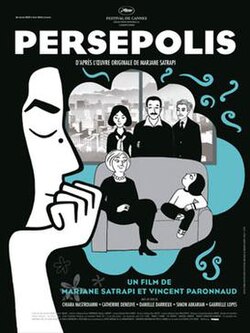
In the big top of animated cinema, where Disney sells us princesses with eating disorders and Pixar drowns us in single-dad tears with Up, Persepolis emerges as that weird kid who not only refuses to eat the cotton candy, but also explains—in excruciating detail—why refined sugar is a capitalist tool. Marjane Satrapi, in her directorial debut alongside Vincent Paronnaud, doesn’t just adapt her autobiographical graphic novel: she exhumes it, dresses it in mourning, and parades it through the streets of Tehran, Vienna, and Paris as a reminder that growing up isn’t a journey of self-discovery, but a series of low blows disguised as life lessons.
The film begins with an adult Marjane (Chiara Mastroianni, whose voice is so warm you suspect they injected honey into her vocal cords) sitting in an airport, smoking like her cigarette is her last tether to sanity. Suddenly, a flashback hurls us into her childhood in Iran, where little Marjane (Gabrielle Lopes Benites, who pulls off the miracle of sounding like a child without resorting to the unbearable squeakiness of kids’ movies) dreams of being a prophet. Not a saint, not a superhero—a prophet. Because in a country where ayatollahs decide which women can show their hair and which deserve to be stoned, what better rebellion than inventing your own god? Here’s Satrapi’s first stroke of genius: turning childhood into an act of resistance. While other kids draw monsters under the bed, Marjane sketches Karl Marx as a superhero and God as a bearded old man dispensing existential advice between sips of tea. It’s The Little Prince rewritten by an Iranian punk.
Direction: When Trauma Becomes Art
Marjane Satrapi and Vincent Paronnaud don’t direct this film—they dissect it. There’s a calculated coldness in how they present the Islamic Revolution of 1979, as if they know the horror is grotesque enough without melodramatic embellishments. The camera (or rather, the pencil) moves with brutal economy: static shots capturing the chaos of protests, close-ups of Marjane’s eyes when she learns her uncle Anouche (François Jerosme, in a performance so real it hurts) has been executed, and entire sequences where the animation turns almost abstract to convey the vertigo of war. There’s no slow motion or epic music when bombs fall on Tehran; just silence and Satrapi’s black strokes, sketching fear with the same precision she once used to draw Bruce Lee in her notebooks.The most fascinating thing is how they balance the intimate and the political. Persepolis isn’t a film about the Iranian Revolution; it’s a film about how the Iranian Revolution ruins birthday parties, corrupts friendships, and turns parents into paranoid wrecks who hide alcohol like it’s enriched uranium. The scene where Marjane’s mother (Catherine Deneuve, lending her voice with an elegance that deliciously contrasts the surrounding chaos) teaches her daughter to lie to revolutionary guards is a masterclass in contained tension. No screams, no chases: just a mother and daughter rehearsing phrases like, "No, sir, I’ve never listened to Western music," while the camera lingers on their faces, revealing the cold sweat of complicity.
Animation: Black and White, or How to Draw Pain Without Blood
The choice of black and white isn’t an aesthetic decision—it’s an act of war. In a world where animated cinema has become a festival of saturated colors and hyper-realistic textures, Persepolis opts for the minimalism of the graphic novel, as if to say: "Reality is ugly enough; I don’t need to sugarcoat it." The linework is deliberately imperfect, with strokes that sometimes seem to tremble, as if Satrapi’s hand remembers the fear while drawing. The backgrounds are skeletal, almost theatrical, and the characters move with a stiffness that, far from detracting from realism, enhances it. It’s as if every frame were drawn on newspaper, reminding us that this story is made of scraps of reality glued together-la-cueva-de-los-espejos-rotos" class="text-amber-400 font-black hover:text-amber-300 transition underline decoration-amber-500/40 hover:decoration-amber-300" title="[6.5/10 ⚡ Ácido Cítrico] Lee nuestra autopsia de «Together»" data-acid-interlink="together-la-cueva-de-los-espejos-rotos">together with spit and desperation.But where the animation truly shines is in the dream sequences. When rebellious teenage Marjane imagines herself as an anarchist punk smashing ayatollah statues, the style shifts: the lines become looser, almost cartoonish, and the black and white gives way to a blood-red that floods the screen. It’s the only moment the film allows itself color, and it does so with fierce irony: the red isn’t the color of revolution, but of rage, of menstruation, of the blood Marjane spits out when, in Vienna, she discovers that exile isn’t freedom—it’s just another kind of loneliness.
The Cast: Painfully Human Voices
Chiara Mastroianni doesn’t play Marjane—she inhabits her. Her voice is a precision instrument, capable of shifting from childlike innocence to adult bitterness in a single line. When Marjane, now in Europe, screams at her Austrian boyfriend that he "doesn’t understand anything," Mastroianni doesn’t act—she spits the words like venom. But the real acting tour de force comes from Catherine Deneuve, who voices Marjane’s mother with a mix of irony and despair that only a French actress could pull off. Hearing Deneuve deliver a line like, "Marjane, don’t wear that veil crooked—you’ll look like a whore!" with the same elegance she’d recite Baudelaire is one of the film’s guilty pleasures.And then there’s Danielle Darrieux as Marjane’s grandmother, a character who could’ve been a cliché of "ancestral wisdom" but, in Darrieux’s hands, becomes a force of nature. Her grandmother doesn’t give advice—she fires truths like bullets. "Life is short, and if you don’t have fun, you’ll die bitter," she tells Marjane while smoking a cigarette with the same ease others breathe. She’s the perfect counterpoint to the parents’ seriousness, a reminder that even in the midst of horror, life remains absurd, beautiful, and, above all, ridiculous.
The Music: When Punk Saves Lives
Olivier Bernet’s score is another character in this story. It’s not music that accompanies—it’s music that confronts. In Iran, we hear revolutionary choirs mixed with the sound of bombs, as if war were a bad rock concert. But when Marjane arrives in Europe, the music changes: now it’s New Order, The Cure, Iggy Pop. It’s no coincidence that the scene where Marjane discovers punk is also the scene where she realizes exile isn’t freedom—it’s another cage. Western music doesn’t save her; it just gives her a language to curse her new prison.And then there’s the traditional Iranian song "Ay Deli Bidad," which plays at two key moments: when Marjane leaves Iran and, years later, when she returns. The same melody, two opposite meanings. The first time, it’s a lament; the second, an acceptance. It’s the perfect soundtrack for a film that doesn’t believe in happy endings, only real ones: messy, painful, and sometimes a little ridiculous.
The Script: When Autobiography Becomes Art
Vincent Paronnaud, tasked with adapting Satrapi’s graphic novel, doesn’t fall into the trap of trying to "improve" the original material. Instead, he condenses it with surgical precision, cutting redundant scenes but preserving the chaotic essence of real life. Persepolis isn’t a film with three clear acts; it’s a succession of moments that, taken together, form a devastating portrait of adolescence as a battleground.The script’s brilliance lies in how it avoids manichaeism. The "villains" aren’t just the revolutionary guards or the ayatollahs; they’re also the Europeans who look at Marjane with pity, the Austrians who treat her like an exotic pet, and even the Iranians in exile who judge her clothes or thoughts. The film spares no one, not even Marjane, who in her eagerness to rebel sometimes becomes a caricature of herself. When, in a fit of rage, she screams at her mother that she "hates Iran," the film doesn’t redeem her with a patriotic speech. It simply shows the consequences of her words—the awkward silence that follows—and the sadness of knowing that sometimes, hating is easier than understanding.
The Technique of Revolution: Cinematography, Lighting, and Sound
If Persepolis were a person, it’d be that friend who, after three drinks, confesses that life is shit but, for some reason, still fascinating. The black-and-white cinematography isn’t just an aesthetic choice—it’s a political statement. In a world where animated cinema is synonymous with escapism, Persepolis uses black and white to remind us that reality has no Instagram filters. The chiaroscuro isn’t decorative—it’s the reflection of a society split in two, where light is a luxury and darkness, a sentence.Lighting plays a crucial role in the narrative. In the childhood scenes, the light is warm, almost dreamlike, as if Marjane’s memory is trying to soften the pain. But as the film progresses, the light becomes harsher, more contrasted, until in the war scenes there are no shadows—just darkness and flashes of explosions. It’s as if the film is saying: "This is how trauma is remembered: in blinding flashes."
The sound, meanwhile, is a masterpiece of sound design. The silences are as eloquent as the dialogue, and the sound effects (the rustle of a veil being adjusted, the sound of a door locking) are loaded with meaning. When Marjane, in Vienna, hears an ambulance siren, the film doesn’t need to show anything—the sound already tells us everything we need to know about her loneliness.
The Power of Imagination: When Fantasy is the Only Rebellion
Marjane’s imagination isn’t an escape—it’s an act of war. In a country where the government decides which books you can read, which music you can listen to, and what clothes you can wear, dreaming of being a prophet or having Karl Marx give you existential advice is the purest form of resistance. The film understands this and celebrates it, but it also shows the price of that imagination. When adult Marjane realizes she can no longer distinguish between her dreams and reality, the film doesn’t judge her—it simply shows her, with brutal honesty, as a broken but not defeated woman.Satrapi’s creativity isn’t in grand gestures, but in small details. In how she draws God as a pipe-smoking old man, in how she turns revolutionary guards into grotesque figures with hyena grins, in how she uses dark humor to ease the pain. Persepolis isn’t a film about revolution—it’s a film about how to survive it without losing the ability to laugh at yourself.
finalExplicado: "En el clímax, Marjane, ya adulta y de regreso en Irán tras años de exilio en Europa, sufre una crisis de identidad total: se casa sin convicción, se divorcia, se siente extranjera en su propio país y, finalmente, decide abandonar Irán para siempre. La escena final la muestra en el aeropuerto de Teherán, quitándose el velo con gesto cansado mientras camina hacia el avión. Su abuela ya ha muerto; la revolución devoró todo. Simbólicamente, el desenlace significa la derrota absoluta de la ilusión revolucionaria y la aceptación dolorosa de que uno no puede volver a casa. El blanco y negro se vuelve definitivo: Marjane elige la libertad individual sobre la pertenencia, cargando con el exilio como única identidad posible. No hay redención ni esperanza edulcorada; solo supervivencia lúcida y amarga."
The Best
- The black-and-white cinematography: Because in a world of pastel colors, pain deserves to be in grayscale.
- Chiara Mastroianni as Marjane: Her voice is so perfect you suspect Satrapi wrote the role with her in mind.
The Worst
- Some secondary characters: The grandmother steals every scene, leaving the rest as mere extras in her show.
The Verdict of Claqueta Ácida (8.5/10)
Persepolis isn’t a film—it’s a sucker punch disguised as a graphic novel. Marjane Satrapi and Vincent Paronnaud take the most uncomfortable autobiography in the world and turn it into art, proving that animation isn’t just for kids or adults who refuse to grow up. It’s a film about exile, identity, and rage, but also about life’s absurdity—that bad joke that only makes sense if you tell it through tears. If you’re looking for a hopeful film, go watch Wall-E. If you’re looking for one that reminds you life is shit but, damn it, worth living, Persepolis is your film. And if you don’t feel like burning something afterward, you weren’t paying attention. 🔥💀🎬 Tráiler Oficial
Abrir en YouTube
Ending Explained: Persepolis
Ficha de Daños Colaterales en Sala
Certificado de impacto psicofísico emitido por Bastian Noir
Cero. La pantalla absorbió cada segundo de atención disponible.
Ninguna comprobación del tiempo. Se agradece la rareza.
Ninguna. Guarda el café para la sesión siguiente.
"No hubo. La coherencia se mantuvo hasta el último fotograma."
💬 El Veredicto de la Comunidad
¿Qué te ha parecido la película? Deja tu nota de 0 a 10 para contrastarla con el análisis de la redacción.
Aún no has votado
📢 ¿Te ha gustado el ácido?
Comparte esta crítica con tus amigos cinéfilos o desata la polémica en redes.
⚡ THE CINEMATIC VENOM YOUR INBOX CRAVES
No sugarcoated ratings, no corporate fluff. Subscribe for our uncensored weekly analysis or join the private Telegram for press previews, poll clashes, and instant alerts.
Alertas de estrenos en 1 segundo, encuestas en caliente y audios al salir de pases de prensa.
Recibe la dosis semanal en tu mail + regalo inmediato del PDF con 50 joyas ocultas de culto.
Related Reviews
Recommended autopsies for demanding film buffs.
 🔥 Fusión Nuclear9.5
*2001: A Space Odyssey – A Monkey, a Monolith, and Two Hours of Cosmic Pretentiousness*
⚡Consagradas en el olimpo transgresor con 🔥 Fusión Nuclear.
We dissect Stanley Kubrick’s magnum opus. A visual feast of minimalism and space hypnosis that cemented "serious" sci-fi—and bored half of humanity to tears.
 🔥 Fusión Nuclear9.3
2001: A Space Odyssey — The Day Kubrick Left Us Speechless (and Oxygenless)
⚡Consagradas en el olimpo transgresor con 🔥 Fusión Nuclear.
Kubrick turned science fiction into pure art: 149 minutes of eloquent silence, bone-wielding apes, and a psychopathic computer. Masterpiece or pretentious fraud? Here’s the verdict.
 🔥 Fusión Nuclear8.5
*A Clockwork Orange: The Sweet, Rusty Aftertaste of Violent Haute Couture*
⚡Consagradas en el olimpo transgresor con 🔥 Fusión Nuclear.
A scathing review of Kubrick’s masterpiece, where ultraviolence meets 60s fashion in a twisted pas de deux.
Editorial Ecosystem
Cinephile connections, archive interviews and related analyses.
💬 Debate Cinéfilo & Autopsia de Lectores
0 veredictos¿Discrepas con nuestra nota? ¿Es una obra maestra o veneno puro? Deja tu veredicto abajo sin necesidad de registro.


Aún nadie ha dejado su veredicto para esta película.
Sé el primero en clavarle el colmillo rellenando el formulario de arriba.