The Loved Ones — The Most Unhinged and Blood-Soaked Prom Night in Cinema History
Sean Byrne bursts onto the Australian horror scene with a bubblegum-pink gem of sadism and suffocating tension that redefines torture porn.


tweets_alternativos:
tweets_alternativos_en:
The Crown of Thorns and the Power Drill: When Hell Has Air Conditioning
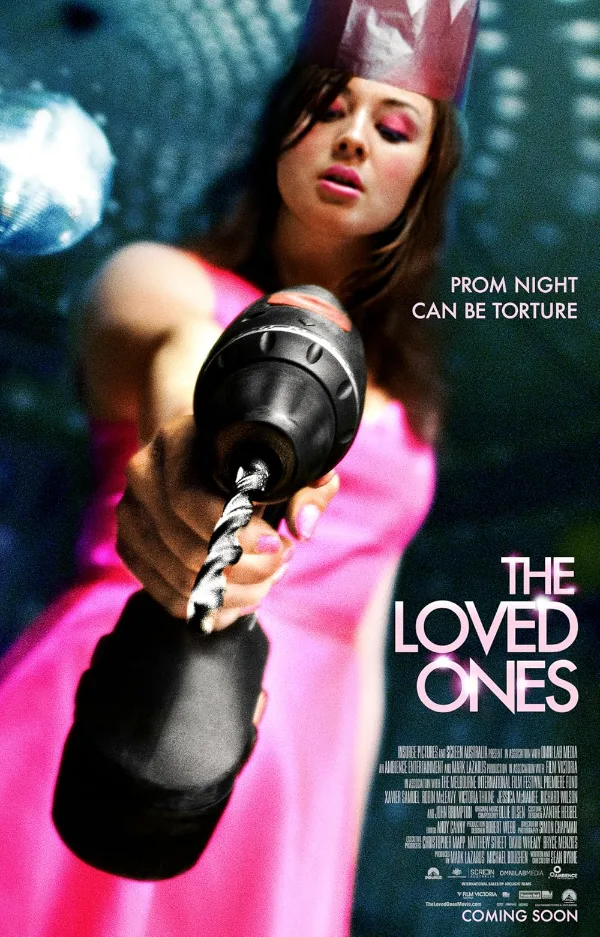
The Loved Ones has a premise as simple as it is terrifying: Brent (Xavier Samuel), a teenager haunted by guilt after a car accident that killed his father, politely declines an invitation to the prom from Lola Stone (Robin McLeavy), a classmate who looks like she stepped out of a Dawson’s Creek episode directed by David Lynch. What Brent doesn’t know—and what the audience intuits with growing horror—is that in Lola’s world, “no” isn’t an option. It’s a declaration of war. And Lola, dear friends, doesn’t lose wars. What follows is a descent into the domestic hell of the Stones, a family that makes the Sawyers from The Texas Chain Saw Massacre look like the Von Trapps from The Sound of Music.
Byrne doesn’t beat around the bush. From the get-go, it’s clear we’re not dealing with your run-of-the-mill torture porn—the kind that wallows in industrial bleakness and sterile nihilism like Saw or Hostel. No, The Loved Ones is something far more twisted: a black comedy of high school life that mutates into a family torture ritual, styled like a Katy Perry music video directed by Eli Roth in his worst nightmare. The film understands something many filmmakers forget: physical pain hurts more when it’s served with a psychopathic smile and a pop ballad soundtrack. And Lola Stone is the undisputed queen of this sugar-coated hell.
The Art of Torture with Glitter: Direction, Cinematography, and Editing
Sean Byrne proves from the first frame that he’s no amateur. His direction is precise, stylized, and ruthless, as if he studied at Quentin Tarantino’s film school and graduated with a thesis titled "How to Make the Audience Squirm in Their Seats While Laughing Like a Maniac." Byrne doesn’t just film torture; he choreographs it. Every hammer blow, every adrenaline shot, every scream muffled by a dirty rag is calculated to the millimeter for maximum impact. There’s no room for improvisation here: this is precision surgery, and Byrne is the surgeon who knows exactly where to cut to hurt the most.
But what truly elevates The Loved Ones above the rest of the torture porn pack is its cinematography, courtesy of Simon Chapman. If the genre is usually associated with grimy grays, sickly greens, and cold blues, Chapman decides to paint the Stones’ hell with a palette of bubblegum pinks, neon yellows, and electric blues that would make Wes Anderson green with envy. The contrast between the pop aesthetic and the physical torment is so jarring it creates a mental short circuit in the viewer. Are we watching a horror movie or an episode of Glee directed by a maniac with a power drill? The answer, of course, is both. And it’s glorious.
The editing, meanwhile, is relentless. Byrne and his editor, Andy Canny, know exactly when to linger on a shot to make the suspense unbearable and when to cut abruptly for maximum impact. The film runs a tight 84 minutes, but every one of them is packed with tension, dark humor, and graphic violence. There’s no filler, no superfluous scenes: it’s a Swiss watch of sadism, where every gear meshes perfectly to create a cinematic experience that leaves you breathless.
Lola Stone: The Villain Hollywood Should Clone (But Won’t Dare To)
If there’s one element that cements The Loved Ones as an instant cult classic, it’s Robin McLeavy and her portrayal of Lola Stone. Lola isn’t your typical villain: she’s not a cold, calculating serial killer like Hannibal Lecter, nor an unhinged psychopath like Patrick Bateman. No, Lola is a wounded, obsessive, and dangerously childlike teenager—an explosive mix of Annie Wilkes (Misery) and Wednesday Addams, but with a Black & Decker drill and a pink princess dress. McLeavy achieves the near-impossible: making Lola terrifying, pathetic, funny, and deeply sad all at once. She’s a villain who sings pop ballads while driving needles into her victim’s knees, who cries because her “prince” won’t dance with her, and then sweetly smiles as she injects him with something you really shouldn’t inject into anyone.
In many ways, Lola Stone is the distorted reflection of adolescence: that phase where unrequited love hurts so much you want to burn the world down. And that’s exactly what Lola does. She doesn’t kill for pleasure (or at least, not just for pleasure), but for love. A sick, obsessive, violent love—but love nonetheless. McLeavy navigates this terrain with a mastery that borders on the supernatural, shifting from tenderness to cruelty in the blink of an eye. She’s, without a doubt, one of the most iconic villains in 21st-century horror, and one of those performances that leaves you wondering why the hell Hollywood hasn’t cloned her ad nauseam.
The Macabre Parallel: When Prom Night Becomes a Nightmare
One of The Loved Ones’ most brilliant strokes is its parallel narrative structure, contrasting Brent’s descent into the Stones’ basement hell with the seemingly innocent subplot of his friend Jamie (Richard Wilson) at the actual prom. While Brent suffers Lola and her father’s “special attentions,” Jamie tries to pick up a girl at a party that looks like it’s straight out of American Pie, but with more beer and less common sense.
This duality isn’t accidental. Byrne uses this contrast to explore teenage alienation and the violence lurking beneath the surface of normalcy. In The Loved Ones’ world, the real horror isn’t in dark basements or haunted woods—it’s in broad daylight, in sugar-coated smiles, and in prom night invitations. The film understands that monsters don’t always wear masks or live in haunted houses: sometimes, they’re your classmates, your neighbors, or even your parents. And that, dear readers, is far more terrifying than any ghost or serial killer.
The Climax: When Torture Porn Becomes Art
By the end, The Loved Ones sheds its theatrical restraint and unleashes a manhunt in the Australian woods that’s as brutal as it is poetic. Byrne proves here that he’s not afraid to get his hands dirty: the final sequence is an orgy of graphic violence, unbearable tension, and bloody catharsis that dignifies the torture porn genre and elevates it to something resembling art. This isn’t a film that just shows blood and guts for shock value; there’s intent, rhythm, and narrative construction behind every torture scene, something many of its contemporaries forgot in their rush to outdo each other in brutality.
The Loved Ones’ ending is, without a doubt, one of the most satisfying in modern horror. It’s not a cheap deus ex machina, a forced twist, or an ambiguous conclusion that leaves the audience with more questions than answers. No, it’s a brutal, coherent, and emotionally devastating resolution that closes the film with the same elegance it opened with: a psychopathic smile and a power drill in hand.
Cinephile Comparisons: Where Does The Loved Ones Fit in the Horror Pantheon?
The Loved Ones isn’t an easy film to classify. It’s not a traditional slasher, nor is it conventional torture porn, nor even folk horror like the kind that usually comes out of Australia. It’s a hybrid beast, a mix of black comedy, teen drama, and extreme horror that draws from sources as diverse as Carrie (1976), Misery (1990), and Heathers (1988), but with a style all its own.
If we had to find a close relative in horror cinema, it’d probably be American Psycho (2000), but with more glitter and fewer monologues about Huey Lewis and the News. Both films share that distorted pop aesthetic, that twisted dark humor, and that fierce critique of consumerist, superficial society. But while American Psycho focuses on urban psychopathy and existential emptiness, The Loved Ones explores domestic violence, teenage obsession, and family dysfunction with a rawness that borders on the poetic.
There are also echoes of The Texas Chain Saw Massacre (1974) in how Byrne portrays the Stone family as a dysfunctional unit that feeds on violence and emotional cannibalism. But while the Sawyers are grotesque creatures living on the fringes of society, the Stones are your neighbors, your classmates, the people you pass in the supermarket. And that, my friends, is far more terrifying.
### The Best
- Robin McLeavy as Lola Stone: A villain so iconic she makes Hannibal Lecter look like an amateur. Terrifying, pathetic, funny, and deeply sad, all in one. The kind of character Hollywood should clone—but won’t, because it requires too much talent.
- Simon Chapman’s cinematography: A festival of bubblegum pinks, neon yellows, and electric blues that turns hell into something almost beautiful. If hell had an Instagram, this would be it.
### The Worst
- The friend’s subplot in the car: While it serves its narrative purpose, there are moments when it cuts into the main climax’s rhythm like a rusty knife in an open wound. A minor stumble in an otherwise flawless film.
### The Verdict of Claqueta Ácida (8.8/10)
The Loved Ones is a masterpiece of contemporary Australian horror, a glitter-drenched nightmare of power drills and family dysfunction that you devour with your heart in your throat and a knowing grin of pure macabre delight. Sean Byrne doesn’t just prove that torture porn can be smart, stylish, and emotionally resonant—he shows that the real horror doesn’t lurk in dark woods, but in the sweetest smiles and prom night invitations. Essential viewing for any lover of strong emotions, unapologetic cinema, and villains who make you want to burn the world down. Eight point eight crowns of thorns out of ten. 👑🩸🔨🎬 Tráiler Oficial
Abrir en YouTube
Ficha de Daños Colaterales en Sala
Certificado de impacto psicofísico emitido por Héctor Veneno
Cero bostezos. Pupilas dilatadas y tensión mandibular constante.
Ninguna comprobación del tiempo. Se agradece la rareza.
Ninguna: la adrenalina cinematográfica es suficiente.
"No hubo. La coherencia se mantuvo hasta el último fotograma."
💬 El Veredicto de la Comunidad
¿Qué te ha parecido la película? Deja tu nota de 0 a 10 para contrastarla con el análisis de la redacción.
Aún no has votado
📢 ¿Te ha gustado el ácido?
Comparte esta crítica con tus amigos cinéfilos o desata la polémica en redes.
⚡ THE CINEMATIC VENOM YOUR INBOX CRAVES
No sugarcoated ratings, no corporate fluff. Subscribe for our uncensored weekly analysis or join the private Telegram for press previews, poll clashes, and instant alerts.
Alertas de estrenos en 1 segundo, encuestas en caliente y audios al salir de pases de prensa.
Recibe la dosis semanal en tu mail + regalo inmediato del PDF con 50 joyas ocultas de culto.
Related Reviews
Recommended autopsies for demanding film buffs.
 🔥 Fusión Nuclear8.3
*The Devil’s Candy: When Metal and Hell Collide on a Canvas of Blood and Distortion*
⚡Del mismo director (Sean Byrne): analiza la evolución o degradación de su estilo.
Sean Byrne returns with a visceral canvas of auditory and visual horror where extreme art, electric guitars, and demonic possession crash together in a symphony of chaos.
 🔥 Fusión Nuclear8.5
*Alleluia: Love as a Terminal Illness (or How to Turn Crimes of Passion into a Sweaty, Fleshy Spectacle)*
⚡Afinidad temática directa en atmósfera, estilo y fijaciones visuales.
Fabrice Du Welz reimagines the myth of the lonely hearts killers in a feverish whirlwind of jealousy, submission, and blood, led by Lola Dueñas in a performance that’s equal parts hypnotic and harrowing.
 🔥 Fusión Nuclear8.5
*High Tension (Haute Tension): The Brutal Birth of the New French Extremism – Or How to Turn Flesh into Poetry with a Machete*
⚡Afinidad temática directa en atmósfera, estilo y fijaciones visuales.
Alexandre Aja shocked global screens with a relentless rural bloodbath, redefined by breakneck pacing and a divisive twist that splits serious cinephiles right down the middle.
Editorial Ecosystem
Cinephile connections, archive interviews and related analyses.
🎞️ In Claqueta Cinematheque1
💬 Debate Cinéfilo & Autopsia de Lectores
0 veredictos¿Discrepas con nuestra nota? ¿Es una obra maestra o veneno puro? Deja tu veredicto abajo sin necesidad de registro.

Aún nadie ha dejado su veredicto para esta película.
Sé el primero en clavarle el colmillo rellenando el formulario de arriba.