"The Perfect Heist — The Master Plan That Collapsed Like a House of Cards (or How Kubrick Taught Us Crime Doesn’t Pay—But Cinema Does)"
Stanley Kubrick dismantles the noir genre with a heist that reeks of gasoline and betrayal. 83 minutes of surgical precision, actors sweating ambition, and an ending that tastes like ashes. A masterpiece or a cold stylistic exercise? We dissect it here.

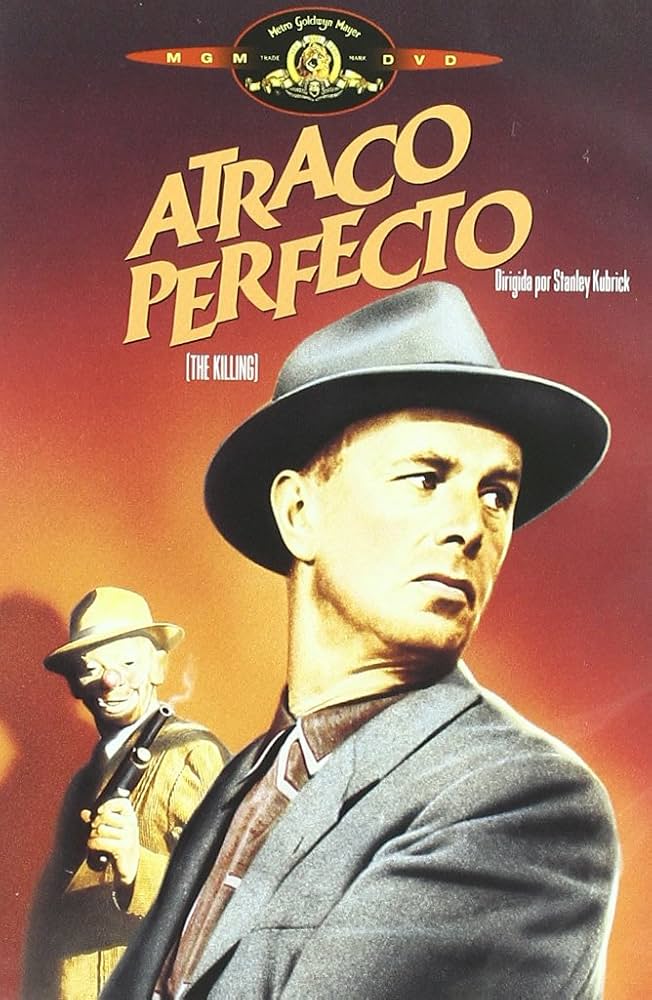

Celluloid groans under the weight of Stanley Kubrick like a racetrack in the seventh race—where the horses aren’t the only ones sweating bullets. The Killing (1956) isn’t just a film; it’s a forensic dissection of the noir genre, an instruction manual for stealing the American Dream, one that reeks of gasoline, stale tobacco, and lipstick-stained bills. At just 28 years old, the future master of cold, calculated cinema was already proving his mind worked like a Swiss timepiece: every gear in place, every tick-tock a step closer to disaster. But where did this gem of narrative precision come from? The answer stinks of ambition and a shoestring budget—two ingredients that, like any good Molotov cocktail, blow up in the face of those who mix them carelessly.
Hollywood in 1956 had no idea that a guy with thick-rimmed glasses and the gaze of a surgeon was about to blow up their little beachside bar. Kubrick, a photographer turned filmmaker thanks to testosterone and a family loan, had already flirted with noir in Killer’s Kiss (1955), but it was with The Killing that he decided the genre needed a live autopsy. The project was born from Lionel White’s pulp novel Clean Break, a writer who understood crime as a ballet of egos and betrayals. Kubrick, obsessed with nonlinear narrative structure—something he’d later perfect in 2001-una-odisea-del-espacio-kubrick-y-el-monolito-que-nos-dejo-mudos" class="text-amber-400 font-black hover:text-amber-300 transition underline decoration-amber-500/40 hover:decoration-amber-300" title="[9.3/10 🔥 Fusión Nuclear] Lee nuestra autopsia de «2001»" data-acid-interlink="2001-una-odisea-del-espacio-kubrick-y-el-monolito-que-nos-dejo-mudos">2001: A Space Odyssey—decided the heist wouldn’t be told as a linear story but as a puzzle of perspectives, where each piece fit with the precision of a bullet to the temple. The problem? Money. With a budget of just $320,000 (a pittance even for the time), Kubrick had to shoot in real locations, use second-rate actors, and pray the audience wouldn’t notice the horse in the seventh race was actually a mannequin with wooden legs.
But here’s the young Kubrick’s genius: he turned his limitations into virtues. Without special effects or Hollywood stars, he decided the real spectacle would be the psychology of the characters—those gray men sweating ambition from every pore. Sterling Hayden, an actor with the face of a retired boxer and the voice of a late-night radio host, plays Johnny Clay, the mastermind of the heist. Clay isn’t your typical gangster; he’s a philosopher of crime, a guy who plans every detail as if solving a chess problem. Around him, a cast of losers in cheap suits and coffee-stained ties: the corrupt cop, the cashier drowning in debt, the bartender with delusions of grandeur, and the femme fatale who looks like she stepped out of a Crime Does Not Pay comic. Kubrick films them as if they’re insects under a microscope, every gesture, every glance, every nervous tic amplified to the grotesque. And then there’s time: the clock isn’t just set dressing—it’s the real villain of the film, an implacable tick-tock turning every second into a countdown to disaster.
The cultural climate of the era also played into The Killing’s hands. America was living in the paranoia of McCarthyism, where betrayal was the daily bread and ambition was paid for with the electric chair. Kubrick, a man who never married any ideology but understood the power of distrust, turned his film into a funhouse mirror of American society. The heist isn’t just a robbery; it’s a metaphor for the American Dream, where everyone wants their slice of the pie and is willing to stomp on their neighbor to get it. The nonlinear structure, inspired by Citizen Kane but taken to its most radical extreme, reflects that feeling that nothing is what it seems: the same moment told from different angles, like a Rubik’s Cube no one can solve. And then there’s the ending, that macabre dance of flying suitcases and bills scattered like confetti, straight out of a Kafkaesque nightmare. Kubrick doesn’t just tell us crime doesn’t pay; he spits in our face that greed is the only capital sin that always gets punished.
Direction: The Clockmaker Who Hated Clocks
If there’s one thing that defines Stanley Kubrick, it’s his obsession with control, and in The Killing, that obsession reaches pathological perfectionism. The director doesn’t just tell a story; he dismantles it, analyzes it, and reassembles it like a mechanic who knows the engine’s going to explode but can’t help admiring its engineering. The nonlinear structure isn’t a gimmick; it’s a statement of intent: Kubrick wants the audience to sweat as much as his characters, to feel the weight of every decision, every mistake, every betrayal. And he pulls it off thanks to an editing style that works like a scalpel, cutting from one shot to the next with the precision of a surgeon who knows exactly where to make the next incision. There’s no respite, no mercy: every scene is a tick-tock closer to disaster, and the audience, like the characters, can’t do a damn thing to stop it.
The cinematography by Lucien Ballard, a noir veteran who’d worked with Fritz Lang and Raoul Walsh, is another standout. Ballard understood the power of shadows like few others, turning the racetrack into a labyrinth of light and darkness, where every corner hides a betrayal and every mirror’s reflection is a warning. The shots are geometric, almost abstract: diagonal lines slicing the screen like blades, compositions that look like they’re ripped from an Edward Hopper painting. Kubrick and Ballard don’t want you to watch a movie; they want you to feel the sweat on the back of your neck, the stench of stale tobacco, the metallic taste of blood in your mouth. And they succeed. Every shot is a visual gut-punch, a reminder that when cinema is done right, it doesn’t need special effects or explosions to take your breath away.
But where Kubrick truly shines is in his direction of actors. There are no stars in The Killing, just cannon fodder with talent and something to prove. Sterling Hayden, who’d worked with Kubrick on Killer’s Kiss, plays Johnny Clay with chilling detachment: he’s the brains of the heist, but also its victim, a man who thinks he’s in control until chaos sweeps him away. Around him, a supporting cast that steals every scene they’re in: Marie Windsor as Sherry Peatty, the femme fatale with more venom in her gaze than a scorpion in a jar of honey; Elisha Cook Jr. as George Peatty, the cashier with the face of a beaten dog and gangster ambitions; Ted de Corsia as the corrupt cop, a guy who looks like he stepped out of a Raymond Chandler nightmare. Kubrick doesn’t ask them to act; he asks them to be, to breathe, to sweat, to betray. And they do, with a rawness that hurts.
Screenplay: The Perfect Plan (Until Humans Get Involved)
The screenplay for The Killing, written by Kubrick and Jim Thompson (the king of dirty, desperate noir), is a masterclass in narrative economy. There’s not a single extraneous line of dialogue, not a superfluous character, not a second that doesn’t serve the tension. Every word, every gesture, every glance is calculated to ratchet up the pressure, like a pressure cooker about to explode. The nonlinear structure, which in another director’s hands might’ve been a gimmick, is essential here: Kubrick doesn’t want us to know what’s going to happen; he wants us to feel the weight of every decision, to understand that a heist isn’t just a robbery—it’s a chess game where every move could be your last.
But the script’s real brilliance lies in how it humanizes the criminals. These aren’t movie gangsters with gold-plated pistols and tailored suits; they’re losers with debts, broken dreams, and wives who make their lives hell. Johnny Clay is the only one who seems to have a cool head, but even he makes mistakes, because mistakes are human, and crime, in the end, is a business too human for its own good. Kubrick and Thompson don’t judge their characters; they expose them, strip them bare, show them for what they are: men and women trapped in their own lies, willing to do anything for a slice of pie that’ll never be enough. And then there’s the ending, that moment of absolute chaos where everything falls apart, where perfect plans turn to dust and dreams to ashes. Kubrick doesn’t give us a happy ending; he gives us the truth, and the truth, like crime, always stings.
Technical Aspects: When the Devil’s in the Details
The production design of The Killing is simple but effective, like a well-honed knife: it doesn’t need embellishments to kill. The racetrack, with its dark corridors and smoke-filled betting rooms, is the perfect setting for a heist, a place where money changes hands as easily as friendships are betrayed. The costumes, designed to reflect the mediocrity of the characters, are another win: cheap suits, stained ties, hats that look like they came from a thrift store. Nothing gleams, nothing stands out, because in Kubrick’s world, ambition doesn’t wear diamonds—it wears sweat and blood.
The score, composed by Gerald Fried, is another highlight. Fried, who’d later work with Kubrick on Paths of Glory, understands that music shouldn’t compete with tension—it should amplify it. The themes are simple, almost minimalist, but every note is placed with the precision of a sniper. There are no grand melodies, no epic choirs—just a steady heartbeat, like the tick-tock of a clock, reminding us that time’s running out and, in the end, we’ll all pay for our mistakes.
But if there’s one thing that elevates The Killing above other films in the genre, it’s its editing. Kubrick, obsessed with rhythm, cuts from one shot to the next with surgical precision, creating a sense of controlled urgency and chaos. Every scene flows into the next like a river of black ink, dragging the viewer along in its current. There’s no respite, no mercy: the editing is relentless, like the characters’ fate, and by the end, when everything collapses, we understand that there was no other way to tell this story. Kubrick doesn’t give us a happy ending; he gives us the only possible ending, and that, in the end, is what makes The Killing a masterpiece.
The best
- Kubrick’s direction: A masterclass in narrative precision that turns a simple heist into an autopsy of the American Dream.
- Lucien Ballard’s cinematography: Every shot is a visual gut-punch, a reminder that noir doesn’t need color to be brutal.
- The cast: Sterling Hayden and Marie Windsor lead a memorable ensemble of losers, each with their own dose of venom and despair.
- The screenplay: A clockwork mechanism where every word, every gesture, every glance serves the tension.
- The editing: Relentless and precise, like the characters’ fate—no respite, no mercy.
- The ending: A macabre dance of flying suitcases and scattered bills, the only possible finale for a plan that never stood a chance.
The worst
- Some forced dialogue: There are moments when characters spout textbook noir lines that clash with the film’s otherwise raw naturalism.
- Pacing in the first half: While the nonlinear structure is brilliant, it takes a while to get hooked on the plot and figure out who’s who.
- Underdeveloped side characters: Some supporting players, like the bartender Mike, get left on the cutting room floor and don’t contribute as much as they could.
- The limited budget: Though Kubrick turns it into a virtue, you can feel the financial constraints, especially in the action scenes.
- The score: While effective, it fades into the background and doesn’t leave as strong an impression as other technical elements.
The Verdict of Claqueta Ácida
The Killing isn’t just a film; it’s an act of sabotage against conventional cinema, a time bomb that explodes in the viewer’s face and leaves them with the bitter taste of betrayal. At just 28 years old, Kubrick proved that cinema wasn’t a business—it was a precision art, where every shot, every line, every glance mattered. It’s not a perfect film—what masterpiece is?—but it’s essential, a reminder that crime doesn’t pay, but when cinema is done right, it’s eternal. And if you don’t believe us, ask the flying bills in the finale: money fades, but art endures. 💀
🎬 Tráiler Oficial
Abrir en YouTube
Ending Explained: "The Perfect Heist
Ficha de Daños Colaterales en Sala
Certificado de impacto psicofísico emitido por Silvia Mordaz
Ni un solo parpadeo voluntario. El asiento, inusualmente cómodo.
Ninguna comprobación del tiempo. Se agradece la rareza.
Ninguna: la adrenalina cinematográfica es suficiente.
"No aplica. La obra se sostiene sola."
💬 El Veredicto de la Comunidad
¿Qué te ha parecido la película? Deja tu nota de 0 a 10 para contrastarla con el análisis de la redacción.
Aún no has votado
📢 ¿Te ha gustado el ácido?
Comparte esta crítica con tus amigos cinéfilos o desata la polémica en redes.
⚡ THE CINEMATIC VENOM YOUR INBOX CRAVES
No sugarcoated ratings, no corporate fluff. Subscribe for our uncensored weekly analysis or join the private Telegram for press previews, poll clashes, and instant alerts.
Alertas de estrenos en 1 segundo, encuestas en caliente y audios al salir de pases de prensa.
Recibe la dosis semanal en tu mail + regalo inmediato del PDF con 50 joyas ocultas de culto.
Related Reviews
Recommended autopsies for demanding film buffs.
 🔥 Fusión Nuclear9.5
*2001: A Space Odyssey – A Monkey, a Monolith, and Two Hours of Cosmic Pretentiousness*
⚡Del mismo director (Stanley Kubrick): analiza la evolución o degradación de su estilo.
We dissect Stanley Kubrick’s magnum opus. A visual feast of minimalism and space hypnosis that cemented "serious" sci-fi—and bored half of humanity to tears.
 🔥 Fusión Nuclear9.3
2001: A Space Odyssey — The Day Kubrick Left Us Speechless (and Oxygenless)
⚡Del mismo director (Stanley Kubrick): analiza la evolución o degradación de su estilo.
Kubrick turned science fiction into pure art: 149 minutes of eloquent silence, bone-wielding apes, and a psychopathic computer. Masterpiece or pretentious fraud? Here’s the verdict.
 🔥 Fusión Nuclear8.5
*A Clockwork Orange: The Sweet, Rusty Aftertaste of Violent Haute Couture*
⚡Del mismo director (Stanley Kubrick): analiza la evolución o degradación de su estilo.
A scathing review of Kubrick’s masterpiece, where ultraviolence meets 60s fashion in a twisted pas de deux.
Editorial Ecosystem
Cinephile connections, archive interviews and related analyses.
🎞️ In Claqueta Cinematheque3
💬 Debate Cinéfilo & Autopsia de Lectores
0 veredictos¿Discrepas con nuestra nota? ¿Es una obra maestra o veneno puro? Deja tu veredicto abajo sin necesidad de registro.


Aún nadie ha dejado su veredicto para esta película.
Sé el primero en clavarle el colmillo rellenando el formulario de arriba.