Prince of Darkness — When Satan is a Glowing Green Goo and Quantum Physics Rules the Apocalypse
John Carpenter fuses religious theology with particle physics in this claustrophobic, nightmarish gem about a cylinder of green liquid and the end of the world.

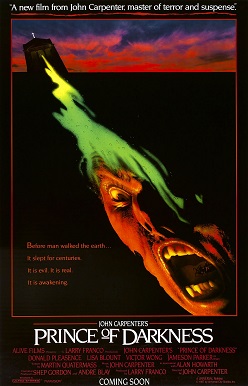

John Carpenter and the Gospel According to Saint Quatermass: Prince of Darkness as a Quantum Sermon in an Abandoned Church
Here at Claqueta Ácida, where we worship cinematic experiments that reek of gasoline and glorious failure, Prince of Darkness (1987) stands as one of those rare specimens where genius and delirium don’t just flirt—they get hitched in a ceremony officiated by Lucifer himself, dressed as a theoretical physicist. John Carpenter, hiding behind the pseudonym Martin Quatermass—a nod so obvious to British horror tradition it almost hurts—decided the best way to terrify audiences wasn’t with crucifixes, holy water, or run-of-the-mill demonic possessions, but by sitting a bunch of academics around a table to debate the nature of evil while a cylinder of cosmic green soup spits in their faces. And, against all odds, it worked. Not just worked, but left a mark so deep on the genre that it’s still cited as an influence by filmmakers who probably can’t even spell "quantum thermodynamics."
The Premise: God, the Devil, and Schrödinger’s Equation
The plot of Prince of Darkness is an exercise in narrative audacity that borders on suicidal. After the death of an elderly priest, his successor (Donald Pleasence in a state of grace, blending solemnity and fragility like only he could) discovers his order has guarded a terrifying secret for centuries: a metal cylinder hidden in the basement of an abandoned church in downtown Los Angeles. Inside, a glowing green fluid that, according to ancient texts and equations scribbled on chalkboards, is nothing less than the physical body of Satan, a primordial entity that has lain dormant for millions of years. But the real horror isn’t the Devil himself—it’s what he’s planning: to open a portal and bring his father, the Anti-God, from an antimatter universe on the other side of mirrors. Yes, you read that right. Carpenter doesn’t settle for "the Devil wants to destroy the world"; here, the apocalypse is a particle physics problem with theological implications.
What’s fascinating about this premise is how Carpenter makes it sound not just plausible, but scientifically rigorous within its own madness. The priest and Professor Howard Birack (Victor Wong, oscillating between wisdom and sinisterness) gather a group of graduate students—physicists, mathematicians, theologians—to unravel the mystery. The church becomes an improvised lab where chalkboards fill with formulas, debates on the nature of evil mix with discussions on quantum mechanics, and the green fluid starts behaving like a living thing, infecting those present with a plague of possession that recalls, in its rawness, the worst moments of The Thing (1982), but with an even more disturbing twist: here, the contagion isn’t just physical—it’s ontological.
Academic Claustrophobia: When Hell Smells Like Mold and Chalk
One of Prince of Darkness’s greatest strengths is its oppressive atmosphere, achieved through a mise-en-scène that turns the abandoned church into a character in its own right. Carpenter, master of claustrophobic suspense (see Assault on Precinct 13 or The Fog), knows terror works best when there’s no escape, and here the space becomes a stone trap, with narrow hallways, low ceilings, and lighting filtered through centuries of dust and guilt. Gary B. Kibbe’s cinematography, a frequent Carpenter collaborator, reinforces this with a muted color palette dominated by sickly greens and ashen grays, as if the building itself were rotting from within.
The external siege, led by a horde of possessed vagrants with Alice Cooper at the helm—looking like he just stepped out of a gothic horror music video—adds another layer of tension. Cooper, in his brief but memorable role, embodies the "Street Preacher," a prophet of doom who preaches the end times with the same intensity his fans once screamed for "School’s Out." His presence is a reminder that, in Carpenter’s universe, evil doesn’t need elaborate disguises—it walks among us in dirty clothes and a grin of rotten teeth.
Meanwhile, inside the church, the scientists fall one by one, infected by the green fluid spewing from their mouths like cosmic vomit. Carpenter films these body horror sequences with clinical detachment, making them even more unsettling. There’s no blaring music or exaggerated sound effects—just the wet sound of decomposing flesh, faces warped by possession, and the sense that evil isn’t supernatural, but a natural force, like gravity or entropy. In one of the most harrowing scenes, a student, Kelly (Susan Blanchard), is possessed, her face melting into a mass of worms and pus. It’s a moment that recalls Cronenberg at his best, but with Carpenter’s unmistakable stamp: less dreamlike nightmare, more scientific nightmare.
The Recorded Dreams: When the Future Spits in Our Faces
But if there’s one element that elevates Prince of Darkness above conventional horror, it’s the device of the dream transmissions. Several characters begin experiencing the same recurring nightmare: a distorted VHS recording, with analog grain and saturated colors, showing a dark figure emerging from the church’s portal. A robotic voice repeats over and over: "This is not a dream. This is a transmission from the year 1999. We are sending this message to the past to warn you. The one you will see is the Antichrist." It’s a simple yet brilliant concept: the future trying to communicate with the past to prevent its own creation, using the most primitive and disturbing technology possible.
This narrative device not only ramps up the tension but raises uncomfortable philosophical questions about free will, determinism, and the nature of time. Can the future change the past? Or are we doomed to repeat the same mistakes, like a cosmic loop? Carpenter doesn’t offer easy answers; instead, he leaves the audience squirming in their seats, trapped between scientific fascination and existential dread. Plus, the use of the VHS recording—with its lo-fi aesthetic and degraded quality—anticipates the analog horror that films like The Ring or V/H/S would later exploit, but with a rawness they never matched.
The Climax: When the Mirror Shatters (and the Universe With It)
The third act of Prince of Darkness is a masterclass in sustained tension, culminating in an ending that’s as poetic as it is bleak. After discovering the green fluid is actually an extraterrestrial life form acting as a bridge between our universe and antimatter, the survivors try to seal the portal before the Anti-God crosses over. The solution, of course, is to destroy the mirror serving as the gateway, but not without consequences: the possessed attack, the fluid runs amok, and the church becomes a hellscape of screams and corrupted flesh.
The climax arrives when Jameson Parker’s character, Brian Marsh, confronts his reflection in the mirror, only to realize his double isn’t a reflection, but an entity from the other side—a version of himself made of antimatter. The sequence is pure Carpenterian nightmare fuel: a subjective shot where the audience sees the "other" Brian emerge from the mirror, with hollow eyes and a smile promising unspeakable horrors. It’s an ending that recalls In the Mouth of Madness (1994), but with an even more disturbing metaphysical weight: if evil is a physical force, what’s left but to surrender to it?
And then there’s the final shot, that moment when Carpenter gifts us an image that sears into the retina like a dagger: the camera pulls back from the ruined church, and in a shattered mirror, the face of one of the survivors—now possessed by the Anti-God—is reflected. It’s an ambiguous, hopeless, and deeply poetic ending, leaving the audience with the sense that, no matter what we do, evil will always find a way into our world.
Direction, Cinematography, and Score: The Carpenterian Trident at Its Peak
John Carpenter didn’t just write and direct Prince of Darkness—he also composed its score under the pseudonym "The Coupe de Villes." And, as expected, the music is a key piece in creating that oppressive, supernatural atmosphere. Carpenter opts for a minimalist approach, with synthesizers emitting hypnotic electronic pulses and distorted Gregorian chants that seem to rise from the depths of hell. The main theme, with its repetitive rhythm and eerie melody, acts like a mantra dragging you toward madness, just as the green fluid drags its victims.
As for the direction, Carpenter proves once again why he’s a master of suspense. His style is cold, calculated, and devoid of unnecessary flourishes. There are no superfluous shots or redundant dialogue; every scene advances the plot or deepens the terror, with an economy of means that borders on asceticism. Carpenter understands that terror works best when suggested, not shown, and so the possessions, attacks, and even the Anti-God himself remain in the shadows, letting the audience’s imagination fill in the blanks.
Gary B. Kibbe’s cinematography deserves special mention. Kibbe, who worked on several Carpenter films, knows how to use light and color to create a sense of decay and impending danger. The church’s interiors are lit with a dim, greenish glow, as if the building itself were sick, and the nighttime exteriors are bathed in a darkness that seems to swallow what little hope remains. Kibbe also uses mirrors and reflections masterfully, turning them into portals to another world and reminding us that, in Carpenter’s universe, even the most mundane things can hide indescribable horror.
Performances: Pleasence and Wong Save the Ship (While the Rest Drown)
If there’s a weak point in Prince of Darkness, it’s the supporting cast. While Donald Pleasence and Victor Wong deliver memorable performances—the former with his usual blend of solemnity and vulnerability, the latter with a presence that oscillates between wisdom and menace—the group of graduate students is, at best, functional. Jameson Parker (Brian Marsh) has his moments, especially in the possession scenes, but others, like Lisa Blount (Catherine Danforth), seem more concerned with reciting their lines than conveying real emotion. A couple of performances border on amateurish, as if Carpenter cast his actors more for availability than talent.
That said, the real star of the film isn’t any of the actors—it’s the green fluid. That viscous, glowing liquid, seemingly alive, steals every scene it’s in, becoming a perfect metaphor for evil: invasive, unstoppable, and insatiable.
Cinematic Comparisons: Between Lovecraft, Cronenberg, and Religious Horror
Prince of Darkness doesn’t exist in a vacuum. Its DNA is a mix of influences ranging from H.P. Lovecraft’s cosmic horror (the idea of an ancient, extraterrestrial evil that defies human comprehension) to David Cronenberg’s body horror (physical corruption as a metaphor for moral decay). But Carpenter adds his own personal touch, blending these influences with a scientific sensibility reminiscent of films like Altered States (1980) or The Andromeda Strain (1971).
In the realm of religious horror, Prince of Darkness occupies a unique space. It’s not a movie about exorcisms or conventional possessions; here, evil isn’t a demon taking over bodies, but a physical, almost scientific force that corrupts matter and mind alike. In that sense, it’s closer to Rosemary’s Baby (1968) than The Exorcist (1973), but with a sci-fi veneer that makes it even more disturbing.
Legacy: Why Prince of Darkness Remains Relevant
Despite its limited budget and some special effects that haven’t aged well, Prince of Darkness is still a film ahead of its time. Its blend of horror, science fiction, and existential philosophy anticipated modern weird fiction, and its use of analog technology as a medium for horror influenced generations of filmmakers, from The Ring to Stranger Things.
But beyond its influence, what makes Prince of Darkness a cult classic is its boundless ambition. Carpenter didn’t settle for a conventional horror film; he wanted to create an experience that challenged the audience intellectually, emotionally, and even spiritually. And, against all odds, he succeeded. This isn’t a movie you watch once and forget—it’s a movie that lodges in your mind like a virus, making you question the nature of reality and, every time you look in the mirror, wonder: "What if the other side is watching too?"
finalExplicado: "En el clímax, el líquido verde (el Príncipe de las Tinieblas) posee a la estudiante Kelly, quien abre un portal dimensional en el espejo del sótano para permitir el paso del Anti-Dios, una entidad antimateria procedente de un universo paralelo. El padre Birack y los supervivientes logran empujarla al otro lado, sellando temporalmente la puerta. Sin embargo, el último plano revela que el mal ya ha cruzado: Kelly despierta en un futuro postapocalíptico, convertida en mensajera del Anticristo. Simbólicamente, Carpenter invierte el dogma cristiano: Dios es un ser de materia atrapado en un agujero negro, y el Diablo es su opuesto cuántico. El final significa que el Apocalipsis ya ocurrió y que el mal no solo triunfa, sino que siempre ha estado del otro lado del espejo, esperándonos. El ser humano solo es un conducto temporal en una guerra física entre dos dioses científicos. El mal gana porque ya ganó."
The Best
- Conceptual audacity: That someone would even attempt to fuse quantum physics with Christian theology without ending up in an asylum is a miracle. That it works is the mark of a genius.
- Claustrophobic atmosphere: The abandoned church smells of mold, chalk, and despair. Carpenter turns a set into a character—and what a character it is.
The Worst
- Uneven performances: Pleasence and Wong save the day, but some of the students look like they wandered in from a casting call for extras in a student film.
- Effects that age like bad wine: The possessed makeup and the digital light beams in the finale are older than a trilobite fossil.
The Verdict of Claqueta Ácida (8.8/10)
Prince of Darkness is that rare horror film that manages to be intellectually stimulating, visually disturbing, and emotionally devastating without ever becoming self-indulgent. Carpenter proves that terror doesn’t need cheap jump scares or latex monsters to raise the hairs on the back of your neck—all it takes is a brilliant idea, an oppressive atmosphere, and the certainty that, in the end, evil always wins. If you don’t eye your mirrors with suspicion after watching it, you weren’t paying attention. And if you do, don’t say we didn’t warn you. The Anti-God might be on the other side, smiling. 🔥💀🎬 Tráiler Oficial
Abrir en YouTube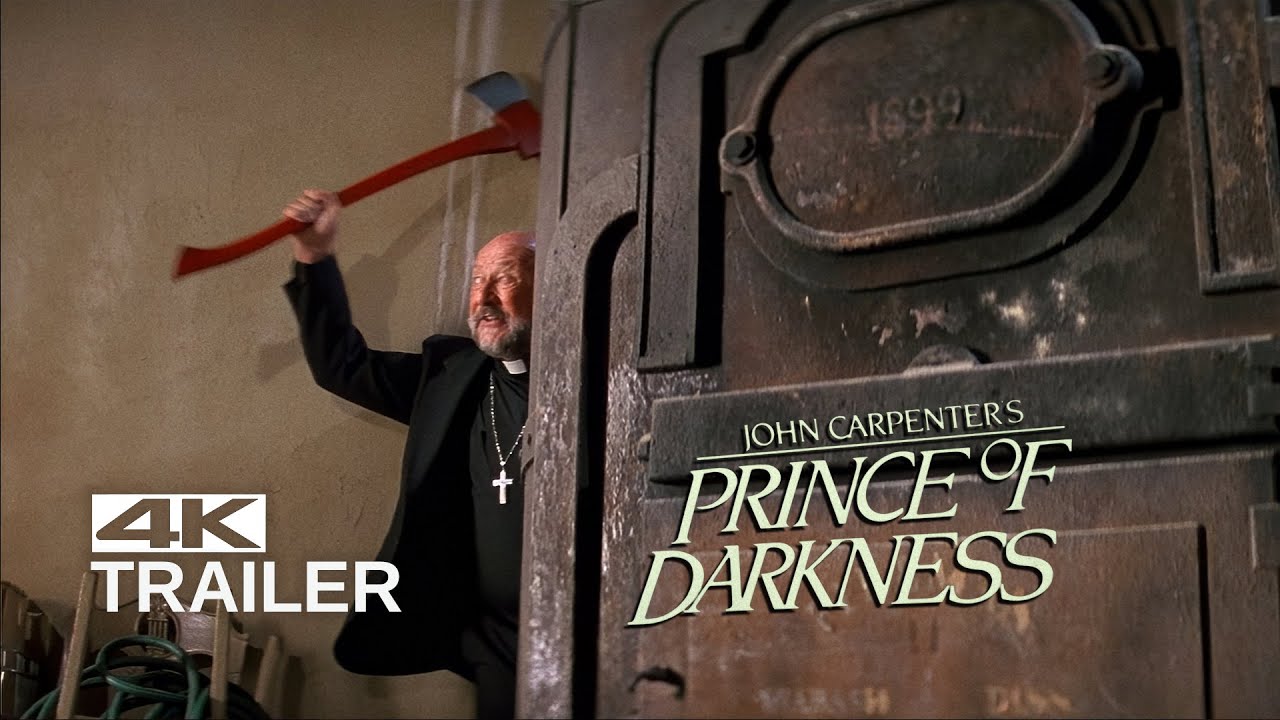
Ending Explained: Prince of Darkness
Ficha de Daños Colaterales en Sala
Certificado de impacto psicofísico emitido por Lúa Ácida
Cero bostezos. Pupilas dilatadas y tensión mandibular constante.
Ni una sola mirada al móvil.
Ninguna. Esta obra no necesita muletas estimulantes.
"No hubo. La coherencia se mantuvo hasta el último fotograma."
💬 El Veredicto de la Comunidad
¿Qué te ha parecido la película? Deja tu nota de 0 a 10 para contrastarla con el análisis de la redacción.
Aún no has votado
📢 ¿Te ha gustado el ácido?
Comparte esta crítica con tus amigos cinéfilos o desata la polémica en redes.
⚡ THE CINEMATIC VENOM YOUR INBOX CRAVES
No sugarcoated ratings, no corporate fluff. Subscribe for our uncensored weekly analysis or join the private Telegram for press previews, poll clashes, and instant alerts.
Alertas de estrenos en 1 segundo, encuestas en caliente y audios al salir de pases de prensa.
Recibe la dosis semanal en tu mail + regalo inmediato del PDF con 50 joyas ocultas de culto.
Related Reviews
Recommended autopsies for demanding film buffs.
 🔥 Fusión Nuclear8.2
*Christine*: The Most Toxic and Brilliant Mechanical Romance in Cinema History
⚡Del mismo director (John Carpenter): analiza la evolución o degradación de su estilo.
John Carpenter takes Stephen King’s eponymous novel and soups it up to deliver a staggering fable about teenage obsession, rock ‘n’ roll, and a 1958 Plymouth Fury with the jealous rage of a scorned lover.
 🔥 Fusión Nuclear8.5
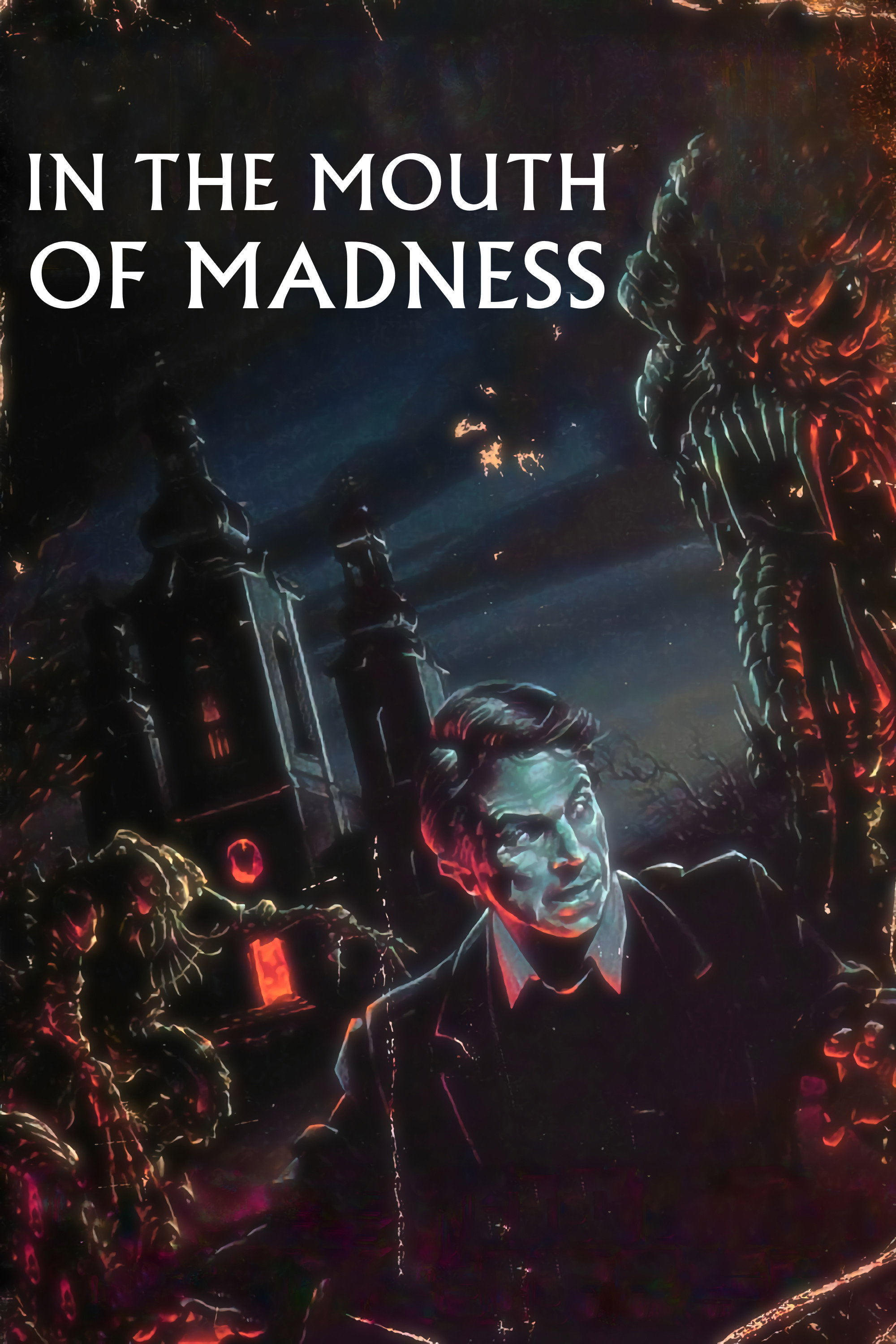
In the Mouth of Madness: When John Carpenter Swallowed Lovecraft (And Spat Out Our Sanity)
⚡Del mismo director (John Carpenter): analiza la evolución o degradación de su estilo.
John Carpenter delivers a Lovecraftian nightmare with Sam Neill teetering on the edge of the abyss. A masterpiece of cosmic horror or a self-parody with literary pretensions? Here’s the autopsy.
 🔥 Fusión Nuclear8.5
"They Live: The Satire Capitalism Would’ve Buried Alive (If It Hadn’t Already Sold It as Merch)"
⚡Del mismo director (John Carpenter): analiza la evolución o degradación de su estilo.
In 1988, John Carpenter handed us a shattered mirror of alienating consumerism. Today, it’s a meme with legs—but its acid still burns hotter than a Monopoly bill on Wall Street.
Editorial Ecosystem
Cinephile connections, archive interviews and related analyses.

💬 Debate Cinéfilo & Autopsia de Lectores
0 veredictos¿Discrepas con nuestra nota? ¿Es una obra maestra o veneno puro? Deja tu veredicto abajo sin necesidad de registro.


Aún nadie ha dejado su veredicto para esta película.
Sé el primero en clavarle el colmillo rellenando el formulario de arriba.