Talk to Me — Viral Possessions, the Plaster Hand, and Teenage Grief Turned Demon Addiction
The Philippou brothers make their explosive A24 debut with a suffocating, hyper-realistic horror film that reinvents possession movies for the TikTok era.

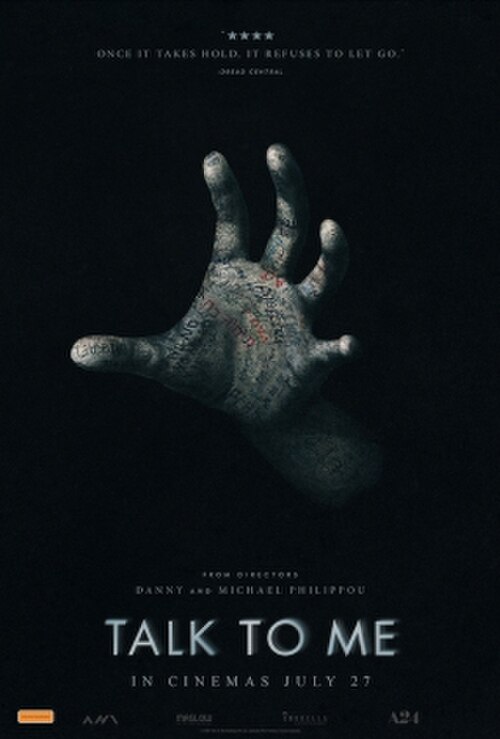
Talk to Me isn’t a horror movie. It’s a shattered mirror that Australian twin brothers Danny and Michael Philippou—those meme-lord escapees from RackaRacka who leapt from YouTube to the big screen without losing their troublemaker edge—smash into the audience’s face to remind them that real horror isn’t in ghosts, but in the flesh we inhabit, the secrets we bury, and the addiction to feeling something, even if that something is the blade of a knife grazing your own throat. And they do it with a ferocity that exposes every filmmaker who confuses horror with cheap jump scares and possessions with badly dubbed Latin incantations.
The premise is deceptively simple: a mummified hand, encased in plaster and covered in indecipherable runes, becomes the ultimate status symbol for a generation of bored, broken, and thrill-seeking teenagers. "Talk to me," they whisper as they grip it, and for ninety seconds, a spirit takes control of their body. Ninety seconds of ecstasy, of hysterical laughter, of visions that might be hallucinations or someone else’s memories. Ninety seconds that become the most addictive drug in their Australian suburb, a place where life is as gray as Aaron McLisky’s cinematography, bathing every scene in sickly blues, cold tones, and shadows that seem to devour the characters from the corners of the frame. There’s no escape in this world—not in middle-class homes, not in parks lit by flickering streetlights, not even in the friendship that should be a refuge. Because Talk to Me isn’t a movie about ghosts. It’s a movie about how unprocessed pain becomes a virus, infecting everyone who gets too close.
Grief as Hard Drugs: Mia and Emotional Withdrawal Syndrome
Sophie Wilde doesn’t play Mia. She haunts her. And she does it with an intensity that recalls the great female protagonists of psychological horror—those young women cinema has turned into sacrificial victims (think Regan in The Exorcist or Dani in Midsommar)—but with one crucial difference: Mia isn’t an innocent corrupted by external forces. She’s a ticking time bomb of emotion, a girl dragging her mother’s suicide like an invisible anchor, who finds in paranormal possession the equivalent of a morphine overdose. The plaster hand isn’t a cursed object; it’s a mirror reflecting her need to feel anything, even if that anything is the most extreme physical pain.
The Philippous film trauma with a rawness that borders on unbearable. There’s no romanticism in Mia’s grief. No easy redemption. Instead, there’s a sequence that lodges in your memory like a rusty nail: Toby, Jade’s little brother, possessed by a spirit, tries to gouge his own eye out against the edge of a table. The camera doesn’t look away. There are no clean cuts, no digital effects to soften the impact. It’s practical makeup, real sweat, and the wet sound of tearing flesh. It’s horror in its purest, most visceral, physical form. And above all, it’s a perfect metaphor for what it means to live with pain you can’t rip out, no matter how hard you try.
This obsession with the physicality of horror isn’t accidental. The Philippous come from a world (YouTube) where the digital reigns supreme, but here they opt for the analog: bleeding hands, writhing bodies, screams that tear at the throat. It’s as if they want to remind us that, in the age of Instagram filters and virtual identities, the body is still the last real territory. And when that body breaks—as it does for Mia, Toby, and everyone who falls into the hand’s trap—there’s no algorithm that can fix it.
The Plaster Hand: Cursed Object or Scapegoat?
One of Talk to Me’s most brilliant strokes is its deliberate ambiguity. The embalmed hand is the perfect MacGuffin: it doesn’t matter where it came from, who made it, or why it works. All that matters is what it does. And what it does is act as a catalyst for its users’ worst instincts. It’s not the typical cursed object that corrupts the innocent; it’s a mirror reflecting what they already carried inside. Mia sees her mother because she needs to see her, not because the spirit has a message from beyond. Toby self-harms because his family life is a hellscape of indifference. Even Jade, the seemingly most grounded friend, falls into the trap because, deep down, she’s broken too.
This lack of conventional supernatural explanations might frustrate those looking for a more "traditional" horror film, with clear rules and a defined villain. But the Philippous aren’t interested in folklore. Their movie is a brutal allegory of addiction, and as such, it refuses to offer easy solutions. The hand isn’t the problem; the problem is what the characters do with it. And what they do is the same thing we all do when trying to escape pain: numb ourselves, even if it’s with something that destroys us.
Horror in the Age of Influencers: When the Like Becomes a Curse
It’s no coincidence that possession in Talk to Me is tied to social media. The characters film their trances, upload them online, share them as if they were just another viral trend. It’s the same mechanism that drives teens to record dangerous challenges or adults to expose their private lives for validation. The Philippous nail this obsession with performance, with turning pain into spectacle. And they do it without judgment, because they come from that world themselves. They know the line between entertainment and self-destruction is as thin as a razor’s edge.
There’s one scene that’s especially revealing: after Toby suffers his most violent possession, his friends film him instead of helping. It’s not cruelty, or not just cruelty. It’s the logic of a generation raised on the idea that everything—even suffering—must be documented, shared, monetized. Talk to Me takes that logic to its most extreme conclusion: What happens when the content you consume (and produce) is literally toxic? When the dopamine hit you chase in a like becomes a one-way ticket to hell?
Direction, Cinematography, and Editing: The Iron Grip of the YouTube Twins
Don’t expect a clumsy or amateurish debut. The Philippous demonstrate a mastery of cinematic language that puts many established directors to shame. Their shot composition is impeccable, with intelligent use of long takes to ramp up tension (like Mia’s first trance, filmed in a single breathless shot) and editing that knows exactly when to cut for maximum impact. There’s no filler in Talk to Me. Every scene advances the plot or deepens the characters, and by the time the climax hits, the film has left you so emotionally drained that you have no choice but to surrender to its relentless pace.
Aaron McLisky’s cinematography deserves special mention. His color palette—cold blues, sickly greens, deep blacks—creates an oppressive atmosphere that mirrors the characters’ mental states. Interiors are lit with harsh, artificial light, as if the houses were film sets rather than homes. And the exteriors, bathed in perpetual fog, convey that sense of isolation so typical of Australian horror (think The Babadook or Wolf Creek), but with a contemporary twist that ties it to found footage and digital horror.
The score, composed by Cornel Wilczek, is another triumph. There are no grand themes or epic orchestrations. Just a series of distorted electronic sounds, sharp beats, and ethereal choirs that slither into your subconscious like a virus. It’s music that hurts, that raises the hairs on the back of your neck without you quite knowing why. And when silence breaks through—like in the final scene, where ambient sound reduces to Mia’s ragged breathing—the effect is devastating.
Performances: Sophie Wilde and a Cast That Burns
Sophie Wilde doesn’t just steal the movie; she consumes it alive. Her Mia is an explosive mix of vulnerability and rage, desperation and defiance. Wilde has a physical presence that’s overwhelming, capable of conveying pain with a single gesture or glance. She’s not a heroine, not a victim, not an antihero. She’s a broken girl clinging to anything that lets her feel, even if it’s the edge of a knife. And she does it with a naturalness that makes every one of her outbursts—whether of euphoria, terror, or self-destruction—completely believable.
The rest of the cast doesn’t lag behind. Alexandra Jensen (Jade) brings a calculated coldness that contrasts with Wilde’s intensity, and Joe Bird (Toby) is simply chilling in his portrayal of a possessed child. But if there’s a supporting actor who deserves a standing ovation, it’s Otis Dhanji as Daniel, the group’s friend whose obsession with the hand borders on the pathological. Dhanji makes a potentially hateable character tragic, especially in his final scene, where his desperation to "feel something" becomes one of the film’s most heart-wrenching moments.
Cinematic Comparisons: From Hereditary to Uncut Gems, via The Ring
Talk to Me draws from many sources but synthesizes them into something unique. It has the emotional rawness of Hereditary (2018), with its exploration of grief and family guilt, but without falling into gothic melodrama. It shares with Uncut Gems (2019) that sense of a protagonist hurtling toward self-destruction, but with a slower pace and a more oppressive atmosphere. And like The Ring (2002), it turns an everyday object (in this case, a hand instead of a videotape) into a symbol of generational anxiety.
But where The Ring leaned on folklore and Hereditary on symbolism, Talk to Me bets on hyper-realism. There are no supernatural explanations, no ancient prophecies, not even a clear villain. Instead, there’s a series of human decisions—selfish, desperate, addictive—that lead the characters to their doom. It’s horror in its purest form, unadorned, without redemption. And for that very reason, it’s much more terrifying.
The best
- Sophie Wilde’s performance: An emotional hurricane that leaves you breathless, with no excuses and no desire to see her suffer again (though you can’t look away).
- The Philippou brothers’ direction: Two guys who went from making YouTube videos to delivering one of the smartest and most brutal horror films of the decade. Who said the "Australian dream" was dead?
The worst
The fuzzy mythology: If you’re looking for answers about the hand’s origin or the rules of the game, prepare to leave the theater with more questions than when you walked in. Though, let’s be honest—did you really* want answers?- Teen clichés: There are a couple of characters (especially in the first half) who fall into the tropes of the "selfish friend" and the "superficial popular girl." Thankfully, the film rises above them.
The Verdict of Claqueta Ácida (8.7/10)
Talk to Me is the kind of movie that leaves you feeling like you’ve survived a car crash: bruised, shaken, and wondering how the hell you made it out alive. The Philippou brothers have crafted a debut that’s as brutal as it is intelligent, a film that turns horror into a mirror of our worst vices (addiction, unresolved grief, the obsession with external validation) and does it with a physical and emotional violence that’s hard to forget. This isn’t a movie to watch before bed. It’s a movie to watch and then try to sleep, knowing that somewhere out there, a plaster hand is waiting for someone to whisper "talk to me." And the worst part? Deep down, we all know that someone could be us. 🔪💀🎬 Tráiler Oficial
Abrir en YouTube
Ending Explained: Talk to Me
Ficha de Daños Colaterales en Sala
Certificado de impacto psicofísico emitido por Héctor Veneno
Cero bostezos. Pupilas dilatadas y tensión mandibular constante.
El móvil permaneció en el bolsillo donde debía estar.
Ninguna. Esta obra no necesita muletas estimulantes.
"No aplica. La obra se sostiene sola."
💬 El Veredicto de la Comunidad
¿Qué te ha parecido la película? Deja tu nota de 0 a 10 para contrastarla con el análisis de la redacción.
Aún no has votado
📢 ¿Te ha gustado el ácido?
Comparte esta crítica con tus amigos cinéfilos o desata la polémica en redes.
⚡ THE CINEMATIC VENOM YOUR INBOX CRAVES
No sugarcoated ratings, no corporate fluff. Subscribe for our uncensored weekly analysis or join the private Telegram for press previews, poll clashes, and instant alerts.
Alertas de estrenos en 1 segundo, encuestas en caliente y audios al salir de pases de prensa.
Recibe la dosis semanal en tu mail + regalo inmediato del PDF con 50 joyas ocultas de culto.
Related Reviews
Recommended autopsies for demanding film buffs.
 🔥 Fusión Nuclear8.5
*Alleluia: Love as a Terminal Illness (or How to Turn Crimes of Passion into a Sweaty, Fleshy Spectacle)*
⚡Afinidad temática directa en atmósfera, estilo y fijaciones visuales.
Fabrice Du Welz reimagines the myth of the lonely hearts killers in a feverish whirlwind of jealousy, submission, and blood, led by Lola Dueñas in a performance that’s equal parts hypnotic and harrowing.
 🔥 Fusión Nuclear8.5
*High Tension (Haute Tension): The Brutal Birth of the New French Extremism – Or How to Turn Flesh into Poetry with a Machete*
⚡Afinidad temática directa en atmósfera, estilo y fijaciones visuales.
Alexandre Aja shocked global screens with a relentless rural bloodbath, redefined by breakneck pacing and a divisive twist that splits serious cinephiles right down the middle.
 🔥 Fusión Nuclear8.5
*Aterrados: The Rebirth of Ghost Stories in the Raw Grit of Buenos Aires*
⚡Afinidad temática directa en atmósfera, estilo y fijaciones visuales.
Demian Rugna revolutionizes paranormal horror—possessions, poltergeists, and all—by transplanting it to a residential neighborhood in Buenos Aires, armed with a devastating sound design that rattles your bones.
Editorial Ecosystem
Cinephile connections, archive interviews and related analyses.
🎞️ In Claqueta Cinematheque1
💬 Debate Cinéfilo & Autopsia de Lectores
0 veredictos¿Discrepas con nuestra nota? ¿Es una obra maestra o veneno puro? Deja tu veredicto abajo sin necesidad de registro.

Aún nadie ha dejado su veredicto para esta película.
Sé el primero en clavarle el colmillo rellenando el formulario de arriba.