The Deep House — Haunted Mansions Underwater and Oxygen-Deprived YouTubers
Bustillo & Maury dive into a secluded French lake to film one of the most visually complex and intriguing horror propositions in recent memory.

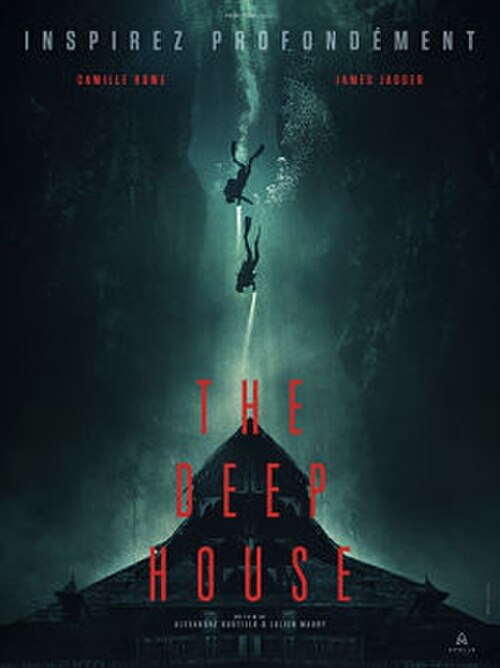


The Deep House (2021) is the kind of film that arrives with the fanfare of "This has never been done before!" only to slink away with its tail between its legs, leaving behind a trail of broken promises and the faint scent of stale chlorine. Alexandre Bustillo and Julien Maury, those two Frenchmen who fancy themselves the direct heirs of Fulci and Bava simply because they film guts and burst eyeballs, plunged into this underwater adventure with the same arrogance as an influencer unboxing their latest PR package. And boy, did they try: a submerged Gothic mansion, waterlogged ghosts, satanic possessions, and a pair of idiots with GoPros. It sounds like a Lovecraftian wet dream mixed with the cheapest YouTube reality show, right? Well, brace yourself, because the final result is like watching a diver attempt parkour in a shark tank: technically impressive, but with a script that reads like it was scribbled on a bar napkin after three rounds of absinthe.
finalExplicado_en: "In the climax, the YouTubers discover the submerged mansion is not haunted by ghosts but infested with a parasitic, aquatic entity that has possessed the drowned family. As their oxygen runs out, the creatures attack; the wife is killed and reanimated, while the husband barely escapes to the surface, only to realize the parasite has hitched a ride inside him. The ending symbolizes the futility of chasing viral fame through invasive exploration: the ultimate price is losing your humanity to the very abyss you exploit for content, turning the seeker into the next monster for someone else’s views."
The Premise: When Urban Exploration Meets Hell (and Loses)
The plot of The Deep House is so simple even a TikTok algorithm could’ve generated it: two bottom-tier influencers, Ben (James Jagger—yes, Mick’s son, because nepotism knows no bounds, not even in underwater horror) and Tina (Camille Rowe, a former model turned French horror actress, as if that leap were natural), travel to a remote French forest to explore a submerged abandoned sanatorium. But—oh, surprise—the place is crawling with selfie-stick-wielding tourists, so a local who looks like he’s seen The Wicker Man one too many times offers to take them to "the real house," a 19th-century manor preserved intact at the bottom of an artificial lake. Armed with diving suits, underwater drones, and an ego the size of the Titanic, they submerge... and discover the house isn’t just haunted—it looks like it was plucked from an American Horror Story episode directed by an intern with a hangover.
This is where the film could have been brilliant. The idea of a Gothic mansion underwater is as ridiculous as it is fascinating: furniture floating, portraits covered in algae, dark hallways where flashlight beams dissolve into the murky water... It’s as if The Haunting of Hill House and The Abyss had a bastard child in a roadside motel. The problem? Instead of exploiting this unique atmosphere, Bustillo and Maury decide the best course of action is to turn it into a bargain-bin aquatic slasher with cut-rate demonic possessions. And just like that, what could’ve been a claustrophobic, slow-burn exploration of Gothic horror becomes a festival of screams, slamming doors, and a villain straight out of an insidious" class="text-amber-400 font-black hover:text-amber-300 transition underline decoration-amber-500/40 hover:decoration-amber-300" title="[7.2/10 ⚡ Ácido Cítrico] Lee nuestra autopsia de «Insidious»" data-acid-interlink="insidious">insidious-fuera-del-mas-alla" class="text-amber-400 font-black hover:text-amber-300 transition underline decoration-amber-500/40 hover:decoration-amber-300" title="[6.8/10 ⚡ Ácido Cítrico] Lee nuestra autopsia de «Insidious»" data-acid-interlink="insidious-fuera-del-mas-alla">Insidious fan film.
The Technical Miracle: When Cinema Drowns in Its Own Ambition
If anything saves The Deep House from being a complete disaster, it’s—ironically—the water. The film is a technical marvel of absurd complexity, and that deserves recognition. Shooting an entire movie underwater isn’t like filming a sequence in Pirates of the Caribbean: it requires actors who can hold their breath like Olympic freedivers, professional divers maneuvering cameras in zero visibility, and a production design that makes a mansion look realistic at the bottom of a pond. Cinematographer Jacques Ballard deserves a Cannes statue for his work here. The way he captures light filtering through the water, objects floating in slow motion, actors’ faces distorted by pressure... It’s a visual nightmare so hypnotic it almost makes you forget you’re watching a movie about two YouTubers screaming "TINA! TINAAAAA!" every five minutes.
The underwater set is an engineering marvel: the mansion, built to full scale, looks like it was plucked from one of Edgar Allan Poe’s fever dreams. The details are impeccable: antique furniture covered in moss, paintings with faces warped by time, staircases that seem to lead straight to hell. It’s the kind of production design that makes The Conjuring look like it was made with cardboard. Yet all this effort is constantly undermined by a script that reads like it was written by someone who confused "Gothic horror" with "carnival haunted house."
The Characters: Or How to Turn the Protagonists Into the Villains
If there’s anything more painful than watching a great premise go to waste, it’s realizing the protagonists are so insufferable you start rooting for the ghosts to kill them already. Ben and Tina aren’t characters; they’re archetypes of everything wrong with influencer culture: narcissistic, reckless, obsessed with likes, and with a survival instinct weaker than a goldfish out of water. James Jagger plays Ben like he’s auditioning for a frat-boy role in an ‘80s slasher: he yells, flails, and makes stupid decisions with the same ease he’d breathe—if he weren’t underwater. Camille Rowe tries to give Tina some depth, but the script makes it so difficult that she’s reduced to making terrified faces and repeating "We have to get out of here!" like a mantra.
The problem isn’t just that they’re annoying; it’s that their dynamic ruins any chance of tension. Instead of building a believable relationship, the film turns them into caricatures: Ben is the reckless macho idiot who never listens, and Tina is the sensible girl who, of course, ends up possessed by a demon because the script demands it. It’s as if the writers watched Open Water and Paranormal Activity and decided to mash them together without understanding what made either good. What could’ve been a psychological exploration of two people trapped in a nightmare becomes a horror reality show where the protagonists won’t stop screaming and filming themselves like vloggers at an amusement park.
The Horror: When the Ghosts Smell Like Mothballs
The Deep House has one fundamental problem: it doesn’t know what kind of movie it wants to be. Is it a psychological thriller about two people trapped in a claustrophobic space? A Gothic ghost story? An aquatic slasher? The answer is a disappointing "all of the above, but badly." The first half-hour is promising: the exploration of the mansion, the discovery of the first signs that something’s wrong, the tension of knowing their oxygen is running out... It’s the kind of slow, atmospheric suspense that recalls The Descent, but with water instead of caves. But as soon as the ghosts show up, the film collapses like a house of cards in a hurricane.
The specters of The Deep House are so generic they look like they were plucked from a Halloween Horror Nights catalog: a possessed girl floating like she’s in The Ring, a satanic priest straight out of The Nun, and a barrage of cheap jump scares that rely more on sound volume than actual terror. It’s as if the directors watched every horror movie from the last 20 years and decided to copy the worst parts of each. And the worst part? After building such a unique, oppressive atmosphere, the climax resolves with an exorcism so predictable you could’ve guessed it five minutes in.
The Sound: When Silence Is Scarier Than Screams
If anything works halfway in The Deep House, it’s the sound design. The water distorts sound in a fascinating way: the characters’ screams sound muffled, as if coming from far away, and the absolute silence of the depths creates a genuinely terrifying sense of isolation. Too bad Raphaël Gesqua’s score isn’t up to par. Instead of complementing the atmosphere, it opts for the usual horror stings (those screeching violins that scream "SOMETHING’S ABOUT TO JUMP OUT!") and a score that oscillates between forgettable and irritating.
The real problem, though, is the dialogue. Ben and Tina spend the entire movie screaming each other’s names like they’re at an underwater football match. "TINA! TINAAAAA!" "BEN! NOOOO!" It’s so repetitive and annoying that at some point, you start hoping the ghosts will kill them just to shut them up. And let’s not even talk about the satanic priest’s monologues, which sound like they were written by a teenager after watching The Exorcist for the first time.
Cinematic Comparisons: What The Deep House Could’ve Been (And Wasn’t)
To understand what The Deep House squanders, just look at its references. It could’ve been The Descent underwater: a claustrophobic thriller about survival and psychological terror. It could’ve been The Others with an aquatic twist: a Gothic ghost story with a shocking ending. Hell, it could’ve been Jaws, but with a mansion instead of a shark. Instead, it ends up as a hybrid of Paranormal Activity and Open Water, with a dash of The Conjuring for prestige.
There are glimpses of what it could’ve been: the scene where Tina explores the mansion alone and discovers the floating corpses of its former inhabitants is genuinely unsettling. The problem is these moments are so few and far between they end up drowned (pun intended) by the rest of the film. It’s as if the directors were afraid to trust their own premise and decided to load it up with clichés to "play it safe."
Conclusion: A Film That Sinks Under Its Own Weight
The Deep House is the perfect example of how a great idea can be ruined by a lazy script, insufferable characters, and a lack of narrative ambition. It deserves credit for its technical audacity and production design, but loses all others for its inability to craft a story worthy of its premise. It’s like watching an Olympic athlete trip at the finish line: you know they’ve done something incredible, but you can’t help feeling they’ve wasted their potential.
Bustillo and Maury proved with Inside (2007) that they know how to create tension and terror on a shoestring budget. Here, however, they seem to have confused "ambition" with "excessive budget," and the result is a film that drowns in its own grandiosity. It’s not a bad movie, but it’s a disappointment with merit: one that leaves you with the feeling that, if they’d spent half as much time on the script as they did on the underwater set, we’d be talking about a modern horror masterpiece.
The Best
- The technical feat: Shooting an entire movie underwater is such an absurd and ambitious achievement it deserves applause, if only for the actors’ physical endurance.
- The initial atmosphere: The first half-hour, with that silent exploration of the submerged mansion, is so hypnotic it almost makes you forget what’s coming next.
The Worst
- Ben, the protagonist: James Jagger plays the most irritating influencer in cinema history, and that’s saying something.
- The script: After such an original premise, the execution is so predictable it feels like it was written by a Netflix algorithm.
The Verdict of Claqueta Ácida (6/10)
The Deep House is like a diver in a designer wetsuit with an empty oxygen tank: impressive at first glance, but unable to stay afloat when it matters most. Bustillo and Maury have crafted a visual nightmare that, sadly, drowns in a sea of clichés and insufferable characters. It’s a film that deserves respect for its ambition, but leaves you with the feeling that, in the end, the only thing floating was its creators’ egos. If you’re looking for original horror, stay on the surface. If you want to watch two YouTubers scream underwater, here’s your movie. 🧜♂️💀🎬 Tráiler Oficial
Abrir en YouTube
Ending Explained: The Deep House
Ficha de Daños Colaterales en Sala
Certificado de impacto psicofísico emitido por Silvia Mordaz
1 amago en el tramo intermedio; pestañeo pesado en las transiciones más innecesarias.
Minuto 36 y minuto 72 (comprobando cuánto quedaba de suplicio).
2 espresso para no dejarse vencer por la mediocridad cómoda.
"A mitad del segundo acto cuando la subtrama secundaria empezó a pesar más de lo que aportaba."
💬 El Veredicto de la Comunidad
¿Qué te ha parecido la película? Deja tu nota de 0 a 10 para contrastarla con el análisis de la redacción.
Aún no has votado
📢 ¿Te ha gustado el ácido?
Comparte esta crítica con tus amigos cinéfilos o desata la polémica en redes.
⚡ THE CINEMATIC VENOM YOUR INBOX CRAVES
No sugarcoated ratings, no corporate fluff. Subscribe for our uncensored weekly analysis or join the private Telegram for press previews, poll clashes, and instant alerts.
Alertas de estrenos en 1 segundo, encuestas en caliente y audios al salir de pases de prensa.
Recibe la dosis semanal en tu mail + regalo inmediato del PDF con 50 joyas ocultas de culto.
Related Reviews
Recommended autopsies for demanding film buffs.
 ⚡ Ácido Cítrico7.5
*Among the Living: Lost Childhood, the Deep America Slasher Transplanted to the French Countryside*
⚡Del mismo director (Alexandre Bustillo, Julien Maury): analiza la evolución o degradación de su estilo.
Bustillo and Maury fuse the spirit of *Stand by Me* with the ultra-violent rural slasher vibe of *The Texas Chain Saw Massacre* in a raw, physical film that hits like a sucker punch.
 ⚡ Ácido Cítrico6.8
*Leatherface* (2017): When New French Extremism Laces Up Its Texas Boots (And Fills Them with Blood)
⚡Del mismo director (Alexandre Bustillo, Julien Maury): analiza la evolución o degradación de su estilo.
Bustillo and Maury cross the pond to deliver a grimy, violent, and unpredictable prequel that blows up the chainsaw myth from the ground up.
 🔥 Fusión Nuclear8.0
*Livid*: A Gothic Nightmare of Blood Ballet, Dead Dolls, and the French Extreme’s Most Posh Descent into Madness
⚡Del mismo director (Alexandre Bustillo, Julien Maury): analiza la evolución o degradación de su estilo.
Bustillo and Maury ditch the grimy brutality of *Inside* to birth a stunningly perverse Gothic fairy tale of vampirism and decay.
Editorial Ecosystem
Cinephile connections, archive interviews and related analyses.
💬 Debate Cinéfilo & Autopsia de Lectores
0 veredictos¿Discrepas con nuestra nota? ¿Es una obra maestra o veneno puro? Deja tu veredicto abajo sin necesidad de registro.

Aún nadie ha dejado su veredicto para esta película.
Sé el primero en clavarle el colmillo rellenando el formulario de arriba.