The Dark and the Wicked — When the Devil’s the Only Friendly Neighbor in Texas
Bryan Bertino delivers one of the darkest, most nihilistic, and terrifying films in contemporary horror, where grief paves the way for absolute evil.

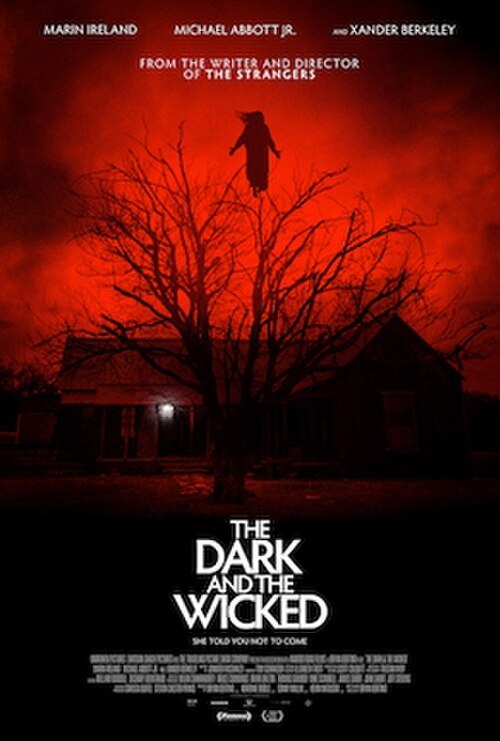
The Dark and the Wicked: When the Devil’s the Only Friendly Neighbor in Texas
Bryan Bertino, that clinically observant Texan with a knack for dismantling the very foundations of domestic safety, has refined his craft into a macabre science. If The Strangers (2008) reminded us that homes are just wooden boxes with flimsy locks, and The Monster (2016) spat in our faces that maternal love could be as toxic as a barrel of pesticides, The Dark and the Wicked (2020) arrives to crown itself as his most ruthless work: an instruction manual on how hell doesn’t need flames when it can just move into your living room, pour itself some tea, and wait for the family to rot from the inside out. Released in the year the whole world learned that quarantine could be both a prison and a death sentence, this film isn’t just a suffocating experience—it’s a fogged-up mirror, steamed by the breath of something breathing right behind you, something in no hurry because it knows that, sooner or later, we’ll all end up in that bed, tubes up our noses, certain no one’s coming to save us.
finalExplicado_en: "In the climax, the possessed mother slits her own throat in a final act of demonic defiance, while the father’s rotting corpse rises one last time to murder the surviving son. Louise, broken and alone, sets the family farm ablaze and walks into the flames as the devil’s laughter echoes across the scorched Texas plains. The ending means there is no escape, no redemption, and no God; once the devil has claimed a bloodline, the only mercy left is self-annihilation. The fire doesn’t purify; it simply finishes what Hell already owns."
The Farm as Purgatory: Architecture of Despair
The family farm in The Dark and the Wicked isn’t just a setting—it’s a character, one that breathes with the rhythm of a diseased lung and reeks of damp earth, stale sweat, and generations of accumulated despair. Bertino and cinematographer Tristan Nyby turn this rural space into a twilight purgatory where every corner hides a threat or an omen. There are no cheap jump scares or latex-clad demons here: the terror is organic, like mold creeping up the walls of a forgotten basement. Nyby, who already proved his mastery in The Wind (2018), uses a palette of leaden grays, filthy ochres, and inky blacks that seem to suck the light right out of the frame. The exterior shots—those oppressive, low-hanging Texas skies—aren’t landscapes; they’re the visual manifestation of eternal damnation. When the wind shakes the trees or the animals shift restlessly in the fields, it’s not the wind or the animals: it’s the whisper of something rubbing its hands together-la-cueva-de-los-espejos-rotos" class="text-amber-400 font-black hover:text-amber-300 transition underline decoration-amber-500/40 hover:decoration-amber-300" title="[6.5/10 ⚡ Ácido Cítrico] Lee nuestra autopsia de «Together»" data-acid-interlink="together-la-cueva-de-los-espejos-rotos">together, impatiently waiting its turn.
Editing, handled by Adrian Molina, is a masterclass in sadistic patience. Bertino isn’t in a rush to show his cards; he’d rather let the tension pile up like dust on the furniture of an abandoned house, until the viewer starts to feel like every shot lasts an eternity. The silences aren’t pauses—they’re black holes swallowing any hope of relief. And when something finally happens—a stifled scream, a falling object, an unintelligible whisper—it’s not a moment of catharsis, but a reminder that the evil is already inside, and there’s no way to kick it out.
The Devil as Theater Critic: A Metaphor for Human Powerlessness
In contemporary horror, the devil is usually a showman: from Regan MacNeil’s exorcism theatrics to the operatic screams of Hereditary (2018), evil tends to arrive with pyrotechnics and vomit choreography. But Bertino, that bastard lovechild of Ingmar Bergman and Tobe Hooper, knows the real horror isn’t in special effects—it’s in the certainty that there’s nothing you can do about it. In The Dark and the Wicked, the demon doesn’t need to possess bodies; it just sits back and watches the family bleed out emotionally, like a theater critic savoring the actors’ collapse on stage.
The premise is simple: Louise (Marin Ireland) and Michael (Michael Abbott Jr.) return to the family farm to be with their mother (Julie Oliver-Touchstone) during their father’s (Michael Zagst) final days. But upon arrival, they find their mother not in mourning, but in a state of shock, as if she’d seen something that ripped her soul out and dragged it away. “You shouldn’t have come,” she repeats, like those words are a spell to ward off the inevitable. And the inevitable arrives, of course, because the devil isn’t an uninvited guest—it’s the homeowner, and it’s been waiting for this moment for decades.
What’s fascinating about the film is how Bertino dismantles the idea of family love as a shield against evil. Here, blood ties don’t protect—they’re the fuel feeding the fire. The relationship between Louise and Michael is tense, laden with unresolved resentment and awkward silences. There are no comforting hugs or speeches about the value of family; there are two people trapped in a hell they didn’t choose, but can’t escape either. Their mother, played with chilling fragility by Julie Oliver-Touchstone, is the weakest link, but also the mirror reflecting what awaits her children: a lonely old age, a slow death, and—worst of all—the certainty that no one will remember their names when the last breath fades.
Marin Ireland: The Actress Who Turns Pain into Art
If there’s a beacon in this storm of hopelessness, it’s Marin Ireland’s performance. There’s no histrionics in her portrayal—just a painful sobriety, as if every line of dialogue costs her a piece of her soul. Ireland, an actress who’s proven her versatility in shows like The Umbrella Academy and films like Hell or High Water (2016), delivers one of the most powerful female performances in recent horror, rivaling Toni Collette in Hereditary or Florence Pugh in Midsommar (2019). Louise isn’t a heroine; she’s a pragmatic woman, a skeptic forced to confront the supernatural when it’s already too late. Ireland conveys this transition with a devastating economy of gestures: a tremor in her hands, a lost look, a sigh torn from the depths of her being.
The rest of the cast holds their own. Michael Abbott Jr., as Michael, embodies masculine helplessness with an authenticity that stings: he’s the brother trying to keep it together, but his eyes betray the panic of a man losing the battle. Julie Oliver-Touchstone, as the mother, is pure fragility made flesh, a woman who’s seen too much and has no strength left to fight. And Michael Zagst, as the dying father, is almost a ghostly presence, a reminder that death isn’t the end—it’s the threshold to something much worse.
Soundtrack: Silence as a Lethal Weapon
The music in The Dark and the Wicked is so subtle it’s almost invisible, yet it’s one of the most effective tools for generating dread. Composed by Danny Bensi and Saunder Jurriaans (the same duo behind the scores for The Gift (2015) and Martha Marcy May Marlene (2011)), the soundtrack isn’t a succession of jarring chords, but a constant hum, like an old fridge that never turns off. There are moments when the music vanishes entirely, leaving only ambient sound: the creak of wood, the moan of the wind, the whisper of a voice that shouldn’t be there. It’s in these moments that the terror becomes almost physical, as if something is breathing right behind your neck, waiting for the perfect moment to whisper in your ear.
Cinematic Comparisons: Horror as Shock Therapy
The Dark and the Wicked isn’t a film for everyone. It’s not the kind of horror that makes you scream in the theater and then laugh it off with friends at the bar; it’s a solitary experience, a wound that refuses to heal. If we had to find its relatives in the horror family tree, we might mention:
- The rural nihilism of The Witch (2015): Like Robert Eggers’ film, The Dark and the Wicked explores the idea that evil doesn’t need explanations—it just is, rooted in the land and in blood. But while Eggers wallows in folklore and Puritan aesthetics, Bertino prefers minimalism, as if the devil were a nuisance neighbor who doesn’t even need a costume to ruin your life.
- The hopelessness of The Babadook (2014): Both films use horror as a metaphor for emotional pain that can’t be exorcised. But while Jennifer Kent offers a glimmer of hope in acceptance, Bertino doesn’t grant even that: here, the monster doesn’t leave, because the monster is part of you.
- The existential terror of The Lighthouse (2019): Like Eggers’ masterpiece, The Dark and the Wicked plays with the idea that madness isn’t a consequence of horror—it’s the cause. But while The Lighthouse is a lysergic nightmare full of symbolism, Bertino bets on grimy realism, as if hell were just an abandoned farm in the middle of nowhere.
The Ending: When the Devil Wins (and Applauds You)
Without spoilers, the climax of The Dark and the Wicked is one of the coldest, most brutal, and hopeless sequences in recent cinema. Bertino offers no redemption, no narrative twists to lighten the load. There’s no “it was all a dream,” no hero to save the day, not even a satisfying explanation. What there is, is the certainty that evil has won, and there’s nothing you can do about it. It’s an ending that leaves you exhausted, as if you’ve run a marathon only to find the finish line was a cliff.
The best
- Tristan Nyby’s cinematography, which turns the farm into a purgatory of shadows and grime, where every frame seems plucked from a fever dream.
- Marin Ireland, who delivers a performance so restrained and devastating it makes you forget you’re watching a horror movie (until something moves in the corner of the shot).
- The use of ambient sound as a tool for psychological terror: those creaks, whispers, and moans that force you to strain your ears as if the devil were whispering to you from the screen.
The worst
- Its relentlessly bleak tone may be unbearable for those seeking horror with a happy ending—or at least a breather. There are no jump scares to relieve the tension; just a slab of despair slowly crushing you.
- Some narrative questions are left unanswered, as if Bertino decided the answers are a luxury the audience doesn’t deserve. Where does the demon come from? Why this family? Who cares, the film seems to say, when the evil is already inside you.
The Verdict of Claqueta Ácida (8.6/10)
The Dark and the Wicked isn’t a film—it’s a failed exorcism, a therapy session that ends with the therapist possessed and you, the patient, crawling toward the exit with tear-filled eyes and the certainty you’ll never feel safe again. Bryan Bertino has crafted a masterpiece of existential horror, a gut-punch that hurts more with every memory, like a wound that refuses to close. It’s not a film to watch with company; it’s an intimate experience, like jerking off in an abandoned church: you know it’s wrong, but you can’t help it. And when it’s over, you’ll just stare at the screen in silence, wondering if what you just saw was a movie or a premonition. 🐐🔥💀🎬 Tráiler Oficial
Abrir en YouTube
Ending Explained: The Dark and the Wicked
Ficha de Daños Colaterales en Sala
Certificado de impacto psicofísico emitido por Héctor Veneno
Ni un solo parpadeo voluntario. El asiento, inusualmente cómodo.
Ninguna comprobación del tiempo. Se agradece la rareza.
Ninguna. Esta obra no necesita muletas estimulantes.
"No aplica. La obra se sostiene sola."
💬 El Veredicto de la Comunidad
¿Qué te ha parecido la película? Deja tu nota de 0 a 10 para contrastarla con el análisis de la redacción.
Aún no has votado
📢 ¿Te ha gustado el ácido?
Comparte esta crítica con tus amigos cinéfilos o desata la polémica en redes.
⚡ THE CINEMATIC VENOM YOUR INBOX CRAVES
No sugarcoated ratings, no corporate fluff. Subscribe for our uncensored weekly analysis or join the private Telegram for press previews, poll clashes, and instant alerts.
Alertas de estrenos en 1 segundo, encuestas en caliente y audios al salir de pases de prensa.
Recibe la dosis semanal en tu mail + regalo inmediato del PDF con 50 joyas ocultas de culto.
Related Reviews
Recommended autopsies for demanding film buffs.
 ⚡ Ácido Cítrico7.5
*The Monster: When Motherhood Is Scarier Than Any Forest Creature*
⚡Del mismo director (Bryan Bertino): analiza la evolución o degradación de su estilo.
Bryan Bertino fuses the raw intimacy of addiction drama with classic monster horror, crafting a claustrophobic, rain-soaked, and heart-wrenching tale.
 🔥 Fusión Nuclear8.9
*The Strangers: When Home Becomes Your Worst Nightmare (And No, It’s Not Because of IKEA)*
⚡Del mismo director (Bryan Bertino): analiza la evolución o degradación de su estilo.
Bryan Bertino crafts an absolute masterpiece of minimalist suspense, turning an isolated cabin into a gallows of relentless dread.
 🔥 Fusión Nuclear8.5
*Alleluia: Love as a Terminal Illness (or How to Turn Crimes of Passion into a Sweaty, Fleshy Spectacle)*
⚡Afinidad temática directa en atmósfera, estilo y fijaciones visuales.
Fabrice Du Welz reimagines the myth of the lonely hearts killers in a feverish whirlwind of jealousy, submission, and blood, led by Lola Dueñas in a performance that’s equal parts hypnotic and harrowing.
Editorial Ecosystem
Cinephile connections, archive interviews and related analyses.
🎞️ In Claqueta Cinematheque2
💬 Debate Cinéfilo & Autopsia de Lectores
0 veredictos¿Discrepas con nuestra nota? ¿Es una obra maestra o veneno puro? Deja tu veredicto abajo sin necesidad de registro.

Aún nadie ha dejado su veredicto para esta película.
Sé el primero en clavarle el colmillo rellenando el formulario de arriba.