The Drama — A24 Destroys Romance with a Millennial Paranoia and Neurosis Overdose
A review of Kristoffer Borgli’s acclaimed A24-produced film. A suffocating, uncomfortable, and brilliant journey into the mental collapse of an engaged couple.

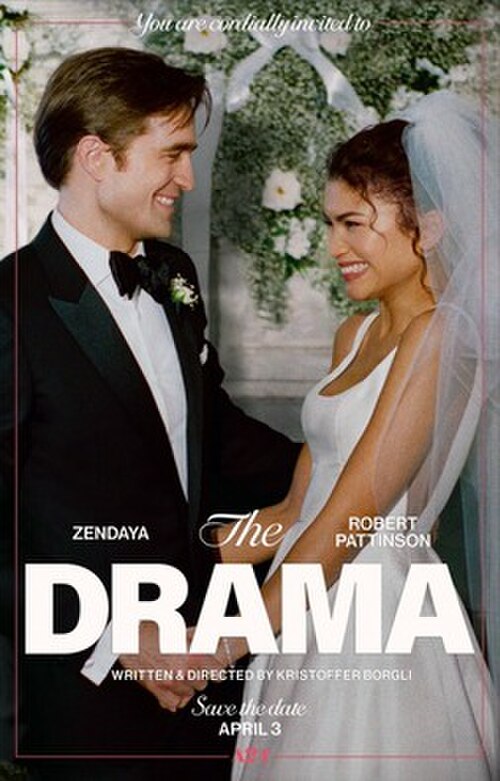


The Drama: When Love Is a Psychological Horror Reality Show with Nordic Design
Just when you thought A24 had squeezed the last drop of cold sweat from urban neurosis—with its Hereditary family traumas, its Uncut Gems capitalist anxiety, and its Everything Everywhere All at Once existential crises with martial arts flourishes—along comes Norwegian Kristoffer Borgli, that surgeon of secondhand discomfort, to remind us that hell isn’t other people; it’s the person you share Wi-Fi and bills with. The Drama isn’t a rom-com; it’s a couple’s thriller where the villain doesn’t wear a mask but a cashmere sweater and a "honey, are you okay?" smile that hides the abyss of "I hope an Uber Black runs you over."
The premise, seemingly innocuous, is the cinematic equivalent of those perfume ads where two androgynous models gaze at each other with desire in a salt desert: Zendaya and Robert Pattinson play Chloe and Will, a young, beautiful, successful couple so emotionally disabled that they make Marriage Story’s leads look like the Von Trapps singing in the Alps. Their relationship is a Pinterest mood board: a wedding in a minimalist country house with exposed concrete walls, cool guests sipping cocktails with names like "The Detachment," and a photographer capturing every moment as if it were a still from an Acne Studios campaign. But, as in every good upper-middle-class nightmare, everything crumbles when they discover their pasts aren’t as immaculate as their Instagram feeds. A teenage infidelity here, a deleted message there, and suddenly, what was supposed to be a "I do" weekend turns into a psychological escape room where the only exit is divorce.
Borgli, the Master of Ceremonies of Emotional Collapse (or How to Film a Wedding Like an IKEA Snuff Film)
Kristoffer Borgli doesn’t direct scenes; he dissects egos with the precision of a taxidermist. If Dream Scenario was his calling card as a chronicler of secondhand embarrassment—with Nicolas Cage as a college professor whose face goes viral in strangers’ dreams—The Drama is his masterpiece: a manual on how to turn love into a reality show where contestants sabotage each other with "everything’s fine" smiles while their eyes scream "I hate you, but I need you to love me to validate my existence." Borgli doesn’t believe in romance; he believes in gaslighting as a couple’s language. Every shot is a trap, every dialogue a minefield, and every silence a ticking time bomb.
The Norwegian director demonstrates absolute mastery of cinematic tempo, stretching scenes to the breaking point before dropping a dark joke that acts as a pressure valve. It’s as if Michael Haneke had directed an episode of Sex and the City after a Valium overdose. The sequence where Will (Pattinson) tries to "break the ice" with a joke about his ex while Chloe (Zendaya) stares at him with a frozen smile is so uncomfortable that you expect a clapperboard to appear and someone to yell "Cut! This is unbearable!" But no. This is real life. Or at least, the real life of those who think love is a TED Talk on nonviolent communication.
Cinematography: When Nordic Minimalism Becomes a Design Prison
Benjamin Loeb, the cinematographer, doesn’t film a wedding; he designs a luxury prison where every frame is a cell. The country house where the action takes place is a character in itself: cold, impersonal, with walls so white they seem painted with the tears of a disappointed influencer. Loeb uses symmetry as a psychological weapon, placing Chloe and Will at opposite ends of the frame like two chess pieces about to be sacrificed. There’s no warmth in these spaces; they’re mausoleums of failed relationships, where even the cushions seem to judge you.
The colors are pale, almost clinical, as if the film were shot through a "couples therapy in crisis" filter. Pastel tones don’t evoke sweetness but anesthesia: the viewer doesn’t feel empathy but the numbness of someone witnessing a car crash in slow motion. And the reflections. My God, the reflections. Borgli and Loeb turn every polished surface—mirrors, windows, coffee tables—into silent witnesses of the farce. Chloe and Will don’t look at each other; they spy on each other through glass, like two spies in a Cold War movie, except instead of state secrets, they exchange resentments wrapped in passive-aggressive compliments.
Soundtrack: The Score That’ll Make You Delete Tinder
If the cinematography is the prison, Anna Meredith’s score is the sadistic warden whispering in your ear: "You’ll never escape." Meredith, known for her work in Living (2022) and her ability to compose music that sounds like an orchestrated panic attack, delivers a score here that oscillates between the sublime and the unbearable. Shrill strings that seem to scratch the eardrum, percussion mimicking a heart about to have a coronary, and choirs that sound like a children’s chorus singing from the bottom of a well. It’s the perfect music for a film where love isn’t blind but deaf, mute, and suffering from generalized anxiety disorder.
The score doesn’t accompany the action; it sabotages it. When Chloe and Will have their first big confrontation, the music doesn’t underscore the drama; it ridicules it, as if Meredith were laughing at the couple from the sound booth. And in moments of "truce," when they seem to reconnect, the soundtrack becomes even more ominous, as if warning: "Don’t get comfortable; this is gonna blow." It’s the sonic equivalent of that friend who, in the middle of a couple’s fight, says: "Guys, this isn’t gonna end well."
Performances: Zendaya and Pattinson, or the Art of Hating Each Other in Style
Robert Pattinson is no longer the teenage vampire sighing for Bella Swan; he’s now the most interesting actor of his generation when it comes to playing pathetic, fragile, emotionally illiterate men. Will, his character in The Drama, is a collage of all the worst traits of toxic masculinity: insecure yet arrogant, needy yet distant, with an astonishing ability to turn every conversation into a monologue about himself. Pattinson plays him with a mix of vulnerability and ridiculousness that borders on genius. There’s a scene where he cries—yes, cries—while trying to explain why he can’t commit, and it’s so uncomfortable that you feel the need to look away, like when someone trips on the street and you pretend not to have seen it. But you can’t look away. Because Pattinson makes patheticness hypnotic.
Zendaya, for her part, is a master of calculated coldness. Chloe doesn’t yell, doesn’t cry, doesn’t make scenes; she simply destroys you with a smile and a "sure, honey, whatever you say." Her performance is a masterclass in passive-aggressiveness, where every silence is a poisoned dart and every glance, a dagger. When she finally explodes—in a scene involving a wedding cake and an improvised speech—it’s like watching an iceberg melt in real time. There’s no hysteria, just a sadness so deep it hurts more than any scream. Together, Zendaya and Pattinson achieve something extraordinary: they make the viewer hate their characters but at the same time see themselves in them. Because, let’s be honest, we’ve all been Will at some point (wanting to flee) or Chloe (wanting to be chased).
Film Buff Comparisons: From Haneke to Fleabag, via IKEA Hell
The Drama doesn’t exist in a vacuum. It’s the result of a long tradition of films exploring the dark side of love and relationships, but with a contemporary twist that makes it unique. If Ingmar Bergman’s Scenes from a Marriage (1973) was the raw portrait of a couple disintegrating in real time, and Mike Nichols’ Who’s Afraid of Virginia Woolf? (1966) was a theatrical drama about two alcoholics destroying each other with words, The Drama is their millennial version: just as cruel, but with better styling and a Spotify Wrapped soundtrack.
There are echoes of Michael Haneke in the way Borgli films psychological violence as something mundane and almost banal. As in Funny Games (1997), the torture isn’t physical but emotional, and the viewer is complicit because they can’t stop watching. There’s also something of Fleabag (2016-2019) in the way Chloe and Will address the audience with their gaze, as if seeking complicity in their misery. But where Fleabag used humor to ease the pain, The Drama gives no respite. It’s as if Phoebe Waller-Bridge and Haneke had an illegitimate child and raised it in an Airbnb with bad Wi-Fi.
And then there’s Nordic minimalism, that architectural style that seems designed to make humans feel like intruders in their own lives. The house where the film takes place is the cinematic equivalent of those Scandinavian Design apartments you see in magazines, the ones that look like they’re from a furniture catalog for people without souls. It’s cold, impersonal, and so perfect it hurts. Like Chloe and Will’s relationship.
The Middle Act: When Repetition Becomes an Autopsy
The Drama’s only venial sin is its middle act, where the film seems stuck in a loop of manipulations and reproaches. Borgli stretches certain dynamics to the point where, at times, you wonder if the film couldn’t have been a 40-minute short. There’s one scene in particular—a car argument replayed three times from different perspectives—that, while clever, borders on pretentious. It’s as if the director wanted to remind us: "Look how smart I am; I can film the same fight three different ways." And yes, it’s smart. But it’s also a bit tiresome.
That said, even in its most redundant moments, The Drama never loses its edge. Because, in the end, repetition is part of the message: love in the 21st century is nothing more than a loop of unmet expectations and recycled resentments.
finalExplicado_en: "In the climax, the neurotic couple's endless meta-analysis of their 'perfect' relationship spirals into a public meltdown during a staged couples' therapy event turned performance art piece. She finally snaps, screaming that their love was never real but a curated simulation for social validation, while he collapses into paranoid catatonia, convinced everyone is an actor in his personal drama. The ending is a brutal A24 gut-punch: modern romance dies not from betrayal but from suffocating self-awareness. It symbolizes how millennial hyper-analysis and performative vulnerability have poisoned genuine connection, leaving only hollow spectacle and mutual psychic disintegration. Love becomes content, and content devours the lovers."
The Best
- Zendaya and Pattinson’s toxic chemistry: Two actors who’ve turned mutual disdain into performance art. Watching them interact is like witnessing a slow-motion train wreck—but with better wardrobes.
- Kristoffer Borgli’s direction: A master of discomfort who films love like a documentary about endangered species. His dark humor is so sharp it could cut diamonds (or hearts).
The Worst
Its cruelty without anesthesia: If you’re looking for a romantic movie with a happy ending, The Drama* will leave you more traumatized than a couples therapy session with Dr. Phil. There’s no redemption, only survivors.- The repetitive middle act: Like a scratched record, the film insists on the same manipulation dynamics until you start feeling like you’re in a relationship with the runtime. Less would’ve been more.
The Verdict of Claqueta Ácida (9/10)
The Drama is the film that cynics, divorcees, and anyone who’s ever looked at their partner and thought, "When did we stop liking each other and start just tolerating each other?" needed. Kristoffer Borgli delivers a masterpiece of discomfort, where love isn’t a refuge but a trench. With brutal performances, an aesthetic that hurts, and a script that seems written with the tears of everyone who’s ever cried in a restaurant bathroom over a misinterpreted text, The Drama isn’t just a film; it’s a luxury traumatic experience. If you leave the theater wanting to hug your partner, it’s because you weren’t paying attention. 9/10, and an urgent reminder that sometimes, the happy ending is breaking up before you get broken.🎬 Tráiler Oficial
Abrir en YouTube
Ending Explained: The Drama
Ficha de Daños Colaterales en Sala
Certificado de impacto psicofísico emitido por Héctor Veneno
Ni un solo parpadeo voluntario. El asiento, inusualmente cómodo.
Ninguna comprobación del tiempo. Se agradece la rareza.
Ninguna. Guarda el café para la sesión siguiente.
"No hubo. La coherencia se mantuvo hasta el último fotograma."
💬 El Veredicto de la Comunidad
¿Qué te ha parecido la película? Deja tu nota de 0 a 10 para contrastarla con el análisis de la redacción.
Aún no has votado
📢 ¿Te ha gustado el ácido?
Comparte esta crítica con tus amigos cinéfilos o desata la polémica en redes.
⚡ THE CINEMATIC VENOM YOUR INBOX CRAVES
No sugarcoated ratings, no corporate fluff. Subscribe for our uncensored weekly analysis or join the private Telegram for press previews, poll clashes, and instant alerts.
Alertas de estrenos en 1 segundo, encuestas en caliente y audios al salir de pases de prensa.
Recibe la dosis semanal en tu mail + regalo inmediato del PDF con 50 joyas ocultas de culto.
Related Reviews
Recommended autopsies for demanding film buffs.
 ⚡ Ácido Cítrico7.5
A Ghost Story: A Journey Through Time and Memory
⚡Afinidad temática directa en atmósfera, estilo y fijaciones visuales.
The Claqueta Ácida review of A Ghost Story, a film that explores existence and human connection.
 🔥 Fusión Nuclear8.0
Backrooms: A Descent into the Void
⚡Afinidad temática directa en atmósfera, estilo y fijaciones visuales.
A film that flings wide the door to mystery and terror—if you dare to step through
 ⚡ Ácido Cítrico7.5
**Bugonia: The Cosmic Snatch**
⚡Afinidad temática directa en atmósfera, estilo y fijaciones visuales.
Two young men convinced an executive is an alien kidnap her. Will they save Earth—or just their own delusions?
Editorial Ecosystem
Cinephile connections, archive interviews and related analyses.
💬 Debate Cinéfilo & Autopsia de Lectores
0 veredictos¿Discrepas con nuestra nota? ¿Es una obra maestra o veneno puro? Deja tu veredicto abajo sin necesidad de registro.

Aún nadie ha dejado su veredicto para esta película.
Sé el primero en clavarle el colmillo rellenando el formulario de arriba.