The Lobster — The Ultimate Dystopia on Forced Pairing and Mutant Love
Yorgos Lanthimos makes his English-language debut with a razor-sharp black comedy satire about a fascist hotel where singles must find a partner in 45 days—or be turned into animals.

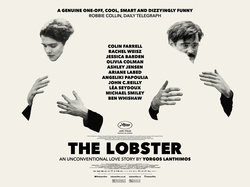


Here at the esteemed offices of Claqueta Ácida, we’ve survived blind dates that felt like they were ripped from a medieval torture manual, marriages that last longer than a saint’s patience in a brothel, and dating apps that function with the same efficiency as a government in crisis. But nothing—absolutely nothing—had prepared us for the emotional, bureaucratic, and existential ordeal that is The Lobster (2015). Yorgos Lanthimos, that Greek with the icy glare and the smile of a predator, leapt into English-language cinema without softening his venom one bit, nor apologizing for it, birthing a masterpiece of dystopian black comedy that’s essentially a poisoned dart straight to the jugular of the bourgeoisie obsessed with marital status. Because, let’s be honest, what’s more terrifying than a society that rewards conformity and punishes individuality with the same ruthlessness as a child stomping on an ant? The Lobster isn’t just a film; it’s a calculated exercise in discomfort, a funhouse mirror reflecting our worst social fears: imposed loneliness, love as a transaction, and identity reduced to a catalog of physical flaws.
finalExplicado_en: "In the climax, David escapes the hotel's transformation into an animal after failing to murder his assigned partner. He joins the loners in the woods but ultimately rejects their rigid no-relationship rules too. The film ends with him in a restaurant bathroom, knife in hand, preparing to blind himself to match his new lover's disability so they can stay together-la-cueva-de-los-espejos-rotos" class="text-amber-400 font-black hover:text-amber-300 transition underline decoration-amber-500/40 hover:decoration-amber-300" title="[6.5/10 ⚡ Ácido Cítrico] Lee nuestra autopsia de «Together»" data-acid-interlink="together-la-cueva-de-los-espejos-rotos">together under the society's twisted logic. Symbolically, the ending exposes the utter inescapability of coercive coupling: even rebellion collapses into the same grotesque, self-mutilating conformity it opposed. Love doesn't liberate; it simply mutates into fresh forms of control and bodily sacrifice."
The Premise: Kafka Meets Black Mirror at a Luxury Spa
The Lobster’s premise is a brilliant fever dream of satirical sci-fi, as absurd on the surface as it is razor-sharp in its critique. Picture this, dear readers: a future world—or perhaps not so distant—where singles are considered a threat to social order, a kind of emotional plague that must be eradicated with the same urgency as an epidemic. The solution? An authoritarian system that rounds up the unattached and imprisons them in a luxury hotel in the middle of nowhere, a place that looks like it was torn from a high-end spa brochure but functions like a prison with a minibar. There, guests have forty-five days to find a compatible partner—someone who shares a singular physical trait: nosebleeds, limps, nearsightedness, or, in the most pathetic case, a genetic predisposition to baldness. Fail to meet the deadline, and you’re subjected to a “surgical procedure” to be transformed into the animal of your choice and released into the wild. Yes, you read that right: turned into beasts. David (a barely recognizable Colin Farrell, sporting extra weight, a melancholic mustache, and the expression of a man who’s just lost a battle against life) chooses to become a lobster if he fails. Why? Lobsters live long, have blue blood, and, according to him, don’t suffer when their partners die. A small comfort, no doubt, for someone who seems to have earned a master’s degree in resignation.
This premise, which could’ve been lifted from a Twilight Zone episode written by a sociopath, is actually a brutal metaphor for the social pressure to couple up. Lanthimos doesn’t beat around the bush: in this dystopia, love isn’t a feeling—it’s red tape. Relationships aren’t built; they’re negotiated. And if you don’t fit the mold, you become a monster. Or a crustacean. The choice is yours.
The Hotel of Conformity: Where Love Is a Transaction and Sex, a Civic Duty
The first half of The Lobster unfolds in the hotel, a place Lanthimos films with the cold detachment of a nature documentary about insects. The production design is impeccable: the hotel, set on the Irish coast, is a sterile, bright, and frigid space, as if Stanley Kubrick had designed a resort for lost souls. The walls are white, the staff uniforms immaculate, and even the furniture seems to judge you in silence. It’s the perfect setting for a nightmare where love is measured in points, like a supermarket loyalty program.
Hotel guests participate in activities designed to encourage pairing off, like awkward dances where everyone stares at each other with the desperation of people who know their time is running out. The rules are clear: masturbation is forbidden (sex is only permitted with your assigned partner), and if you’re caught in “solo-like” behavior, you’ll be punished. The hotel’s manager (Olivia Colman, nailing the role of a bureaucratic villain with a grin that could cut glass) stages moralistic plays dramatizing the dangers of loneliness, as if hell weren’t already the hotel itself. In one of the most hilarious and disturbing scenes, guests are taken hunting in the woods to shoot fugitive “loners.” Each loner taken down earns them an extra day to find a partner. Yes, in this world, love is won at gunpoint.
Lanthimos and co-writer Efthymis Filippou craft a script that’s a scalpel—sharp and merciless. The dialogue is monotone, literal, stripped of all human spontaneity, as if the characters were robots programmed to recite slogans. This stylistic choice isn’t accidental: in a world where love is an obligation, communication is reduced to an exchange of clichés, a hollow ritual. When David tries to seduce a woman with a heart condition (Angeliki Papoulia), their conversation is so forced it feels like a Saturday Night Live sketch directed by David Lynch. “I have a heart condition,” she says. “I have a heart condition too,” he replies, as if they’re comparing discount coupons. The scene is so uncomfortable it hurts, but it’s also brilliant, because it perfectly captures the artificiality of imposed relationships.
The Forest of Anarchy: When Freedom Is Just Another Kind of Prison
If the first half of The Lobster is a satire of conformity, the second is a ferocious critique of anarchy as an alternative system. After escaping the hotel, David joins the “loners,” a group of fugitives living in the woods who, ironically, have imposed their own equally oppressive rules. Here, love and physical contact are forbidden, and those who break the rules are punished with forced self-mutilation. The group’s leader, Léa Seydoux with the gaze of a hawk and the smile of a psychopath, is as authoritarian as the hotel’s manager, but with a hippie handbook twist. In this world, freedom doesn’t exist—there are only different forms of oppression.
It’s in the woods that David meets a nearsighted woman (Rachel Weisz), with whom he forms a connection through a secret code of gestures. Their relationship is bizarrely poignant, like a romance written by Beckett. They communicate through glances, subtle touches, and coded phrases, because in a world where love is forbidden, even the most basic affection becomes an act of resistance. The scene where Weisz whispers Farrell her hotel room number, as if they’re spies on a secret mission, is so absurdly tender it aches. But, as with everything in The Lobster, this relationship is doomed from the start. Because in a totalitarian system, genuine love has no place—whether in the gilded cage of the hotel or the wilderness of the loners.
The Lanthimos Style: When Coldness Becomes Art
Yorgos Lanthimos isn’t a director; he’s a surgeon. His style is cold, precise, and ruthless, as if he’s dissecting the human condition with a scalpel. In The Lobster, his formal control is impeccable: the shots are symmetrical, almost geometric, as if each scene were composed for a graphic design manual. Thimios Bakatakis’ cinematography is stunning, with a color palette that oscillates between the hotel’s clinical white and the forest’s dark greens, creating an atmosphere that’s both beautiful and suffocating. The editing is deliberately slow, as if Lanthimos wants the audience to feel every second of discomfort, every moment of awkward silence.
The score, by Johnnie Burn, is minimalist and unsettling, with ambient sounds that amplify the sense of alienation. There’s no emotive music, no melodies to guide your feelings. Instead, there’s silence, the sound of footsteps, the crunch of leaves underfoot. It’s a soundtrack that doesn’t comfort you—it reminds you that you’re alone, even in a packed movie theater.
And then there are the performances. Colin Farrell, in one of the bravest turns of his career, sheds his leading-man image to play an ordinary, vulnerable, and pathetic man—yet deeply human. His David oscillates between cowardice and tenderness, resignation and rebellion. Rachel Weisz is magnificent as the nearsighted woman, conveying complex emotions with just a gesture or a glance. But if there’s one character who steals the show, it’s Léa Seydoux’s loner leader—a memorable villain, a mix of charisma and cruelty that recalls the best antagonists of A Clockwork Orange or The Handmaid’s Tale. And we can’t forget Olivia Colman, whose hotel manager is one of those everyday villains scarier than any horror movie monster. Her smile is as fake as a politician’s campaign promises.
The Ending: When Ambiguity Is a Knife to the Gut
The Lobster isn’t a film that leaves you smiling. Its ending is ambiguous, unsettling, and morally devastating. Without spoilers, let’s just say Lanthimos refuses to offer comforting answers, because real life doesn’t either. The final shot is a masterstroke of poetic cruelty, an image that sears itself into your retina and leaves you with the sense that, in the end, we’re all doomed to choose between two kinds of prison: conformity or loneliness. Or, in the worst case, becoming a lobster.
The Best
- Colin Farrell: Dismantles his leading-man image with the grace of a man who’s accepted that his best role is that of an adorable loser. His mustache alone is a work of conceptual art.
The Worst
- Second-Half Slump: The pacing falters when the action moves to the woods, where situations repeat like a scratched record of despair. It’s as if Lanthimos got tired of his own genius.
The Verdict of Claqueta Ácida (8.6/10)
The Lobster is one of those films that leaves you feeling like you’ve been run over by a truck of irony and then finished off with a hammer of absurdity. Yorgos Lanthimos makes his English-language debut without losing a drop of his essence: it’s cold, cruel, hilarious, and deeply uncomfortable, like a mirror reflecting a society obsessed with coupling up at any cost. If your grandma asks when you’re going to settle down, gift her this movie and tell her it’s a documentary about the future that awaits us. Just don’t take responsibility for the nightmares it’ll give her. 🦞💀🎬 Tráiler Oficial
Abrir en YouTube
Ending Explained: The Lobster
Ficha de Daños Colaterales en Sala
Certificado de impacto psicofísico emitido por Lúa Ácida
Cero. La pantalla absorbió cada segundo de atención disponible.
Ni una sola mirada al móvil.
Ninguna. Esta obra no necesita muletas estimulantes.
"Inexistente: pulso de hierro hasta los créditos finales."
💬 El Veredicto de la Comunidad
¿Qué te ha parecido la película? Deja tu nota de 0 a 10 para contrastarla con el análisis de la redacción.
Aún no has votado
📢 ¿Te ha gustado el ácido?
Comparte esta crítica con tus amigos cinéfilos o desata la polémica en redes.
⚡ THE CINEMATIC VENOM YOUR INBOX CRAVES
No sugarcoated ratings, no corporate fluff. Subscribe for our uncensored weekly analysis or join the private Telegram for press previews, poll clashes, and instant alerts.
Alertas de estrenos en 1 segundo, encuestas en caliente y audios al salir de pases de prensa.
Recibe la dosis semanal en tu mail + regalo inmediato del PDF con 50 joyas ocultas de culto.
Related Reviews
Recommended autopsies for demanding film buffs.
 🔥 Fusión Nuclear9.0
*Dogtooth (2009): The Instruction Manual for Turning Your Kids Into Lifetime-Guaranteed Automatons*
⚡Del mismo director (Yorgos Lanthimos): analiza la evolución o degradación de su estilo.
Yorgos Lanthimos bursts onto the global cinema scene with a psychological horror satire about a father who keeps his three children isolated from the world using made-up words.
 🔥 Fusión Nuclear8.9
*The Killing of a Sacred Deer: Quantum Greek Tragedy Served on a Sterile Hospital Platter*
⚡Del mismo director (Yorgos Lanthimos): analiza la evolución o degradación de su estilo.
Yorgos Lanthimos takes Euripides' classic myth and injects it with an unrelenting clinical nightmare, where a surgeon’s guilt unleashes an unbearable physical curse.
 🔥 Fusión Nuclear9.2
*Poor Things*: Lanthimos’ Frankenstein Blows Up the Myth with Sex, Color, and Victorian Cynicism
⚡Del mismo director (Yorgos Lanthimos): analiza la evolución o degradación de su estilo.
Yorgos Lanthimos delivers a dazzling, operatic, and hypersexualized steampunk fever dream about the wildest and most entertaining female emancipation in contemporary cinema.
Editorial Ecosystem
Cinephile connections, archive interviews and related analyses.
💬 Debate Cinéfilo & Autopsia de Lectores
0 veredictos¿Discrepas con nuestra nota? ¿Es una obra maestra o veneno puro? Deja tu veredicto abajo sin necesidad de registro.


Aún nadie ha dejado su veredicto para esta película.
Sé el primero en clavarle el colmillo rellenando el formulario de arriba.