The Killing of a Sacred Deer — Quantum Greek Tragedy Served on a Sterile Hospital Platter
Yorgos Lanthimos takes Euripides' classic myth and injects it with an unrelenting clinical nightmare, where a surgeon’s guilt unleashes an unbearable physical curse.


Here at Claqueta Ácida, where we’ve dissected everything from gypsy curses in haunted forests to drooling demons with upside-down crosses—passing, of course, through James Wan’s inevitable jumpscares—we encounter a cinematic beast that doesn’t roar, bleed, or crawl: it simply watches. The Killing of a Sacred Deer (2017) by Yorgos Lanthimos doesn’t need practical effects or gore makeup to freeze your blood. All it takes is a metaphysical scalpel, a cosmic scale, and the smile of a teenager who looks like he stepped out of a Francis Bacon painting. Here, horror isn’t a monster under the bed but the cold equation of a moral debt collected in flesh and bone, served on a bourgeois porcelain plate with a side of clinical ambient.
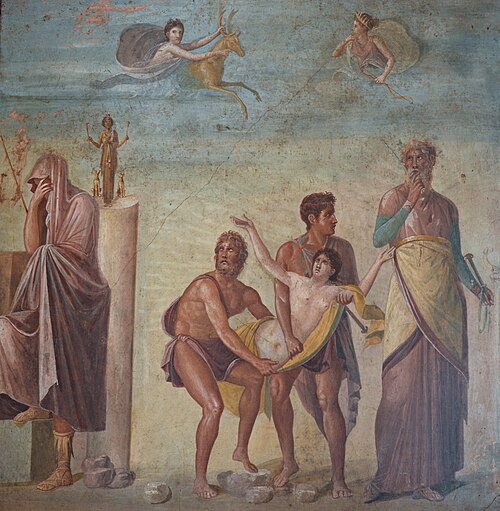
Lanthimos, that misanthropic Greek who seems to have signed a pact with the devil to strip cinema of all residual humanity, takes Euripides’ Iphigenia in Aulis and transplants it into a contemporary operating room with the precision of a surgeon… and the cruelty of an executioner. No gods in robes or prophecies in verse; just a medical error, a grieving father, and a teenager who decides poetic justice is, above all, mathematical. Steven Murphy (Colin Farrell, in his most deflated performance since The Lobster), a successful cardiovascular surgeon, lives in a bubble of emotional sterility: his home is a Nordic design mausoleum, his wife Anna (Nicole Kidman, impeccable in her frostiness) looks like a marble statue with a license to speak, and their children, Kim and Bob, are two porcelain dolls reciting dialogue like IKEA instruction manuals. But everything crumbles when Martin (Barry Keoghan, in a role that should’ve won him an Oscar… or an exorcism), the son of a patient who died on Steven’s operating table—under the influence of alcohol, a detail the good doctor omitted from the report—decides the Murphy family must pay for their sin. Not with money, not with apologies: with blood.
finalExplicado: "Steven mata a su hijo Bob de un disparo en la cabeza en el jardín de su casa, cumpliendo la exigencia de Martin. La maldición se detiene al instante: la hija paralítica recupera las piernas y la familia regresa a una normalidad gélida. Martin observa desde lejos, satisfecho, y se marcha. Simbólicamente, el desenlace es una actualización brutal del sacrificio de Ifigenia y la maldición de Atreo: en un mundo sin dioses, la culpa médica se salda con un acto de barbarie racional y aséptica. El orden geométrico del universo de Lanthimos solo se restablece mediante la ejecución fría de un inocente, revelando que la civilización hospitalaria no es más que un templo griego disfrazado donde la violencia sigue siendo el único pago posible."
The Symmetry of Horror: When the Hospital Becomes a Greek Temple
What elevates The Killing of a Sacred Deer above conventional psychological thrillers is its almost sick obsession with form. Lanthimos, in collaboration with his longtime cinematographer Thimios Bakatakis, constructs a visual universe that is at once an operating room, a labyrinth, and a sacrificial altar. The slow, majestic tracking shots through the hospital corridors evoke Kubrick’s inscrutable gaze in The Shining, but here there are no ghosts or Room 237: the real terror lies in the geometry. The compositions are symmetrical to the point of nausea, the ceilings so high they seem designed for God—or what’s left of Him—to watch from above, and the lighting so white and sterile you can almost smell the disinfectant. There’s no human warmth in this world; only straight lines, right angles, and impossible decisions.
The script, co-written by Lanthimos and Efthymis Filippou (the same duo behind The Lobster and Dogtooth), is a masterpiece of frozen black humor and existential cruelty. The dialogue is delivered without passion, as if the characters were reading the minutes of someone else’s autopsy. When Martin explains his "plan" to Steven—that his family members will suffer paralysis, starvation, eye hemorrhages, and ultimately death unless he chooses one to sacrifice—he does so with the same casualness as a waiter asking if you’d like dessert. No melodrama, no screams, no tears: just the cold logic of a revenge presented as an algebraic equation. In Lanthimos’ universe, feelings are a luxury only the weak can afford.
The scene where Steven’s children pathetically compete for their father’s favor—reciting speeches about why they deserve to live, as if in some macabre talent show—is morally uncomfortable to the point of being unbearable. Kim (Raffey Cassidy) argues she’s the smartest and most useful; Bob (Sunny Suljic) appeals to his innocence and unconditional love. It’s like watching two puppies fight over a bone while their owner decides which one to sacrifice. And then there’s the final scene, where Steven is forced to make his choice through a method as absurd as it is blind—a revolver with one bullet, a family game of Russian roulette—where the suspense doesn’t come from whether he’ll hit the target, but whether the humanity he has left will allow him to pull the trigger.
Performances: When Emptiness Becomes Art
Colin Farrell, that actor who seems born to play broken men in worlds that don’t understand "empathy," shines as Steven Murphy like a surgeon who discovers too late that his biggest mistake wasn’t operating drunk, but believing he could control the consequences. Farrell doesn’t act: he deflates. His Steven is a man who’s spent years numbing his emotions with professional success and now faces a pain he can’t excise with a scalpel. He’s the father we all fear becoming: the one who thinks he can protect his family until reality proves he can’t even protect himself.
Nicole Kidman, meanwhile, is the ice queen in a role that seems written for her. Anna, her character, is an ophthalmologist living in a marriage as sterile as her home. When tragedy strikes, her reaction isn’t to scream or cry, but to offer herself as a sacrifice with a coldness more terrifying than any hysteria. Kidman conveys the horror of a woman who’s spent years denying her emotions and now faces the possibility of losing everything without the luxury of feeling.
But the real monster of this film—and possibly of the decade—is Barry Keoghan as Martin. With his fallen angel smile, empty gaze, and monotone voice, Keoghan creates a villain who doesn’t need threats or physical violence to be terrifying. Martin isn’t a typical psychopath: he’s a teenager who’s figured out that power doesn’t lie in strength, but in the ability to manipulate others’ guilt. His performance is so magnetic that, more than once, you wonder if he isn’t, in fact, the true god of this modern tragedy. He’s not a character; he’s a force of nature, a biblical plague with acne and a hoodie.
The Soundtrack: When Silence Hurts More Than Screams
The music of The Killing of a Sacred Deer, composed by British duo Colin Stetson and Geoff Barrow (the latter of Portishead), is as unsettling as the rest of the film. There are no epic leitmotifs or dramatic choirs: just distorted sounds, out-of-tune strings, and a constant hum that seems to emanate from the walls themselves. The score doesn’t accompany the action; it precedes it, as if it knows what’s going to happen before the characters do. In the scene where Martin first explains his "curse," the music doesn’t swell or become more intense: it simply becomes more present, like a whisper turning into a scream without anyone noticing. It’s the sound of fate approaching, so subtle it hurts more than any jumpscare.
Cinematic Comparisons: When Film Becomes Surgery
If The Killing of a Sacred Deer had a family tree, its parents would be Kubrick and Haneke, with a dash of David Lynch in his most disturbing phase. From Kubrick, it inherits an obsession with symmetry, long takes, and the sense that physical space is really a psychological prison. From Haneke, it takes cold cruelty, a critique of the bourgeoisie, and the idea that true horror isn’t supernatural but human. And from Lynch, dreamlike surrealism and the ability to make the mundane sinister. But Lanthimos isn’t an imitator: he’s a surgeon who’s taken the best from each of his masters and stitched it into a new, grotesque, and fascinating body.
There are moments when the film recalls Funny Games (1997), especially in how psychological violence is wielded without the need for blood. Others evoke Eyes Wide Shut (1999), with that atmosphere of bourgeois nightmare where sex and death intertwine uncomfortably. But where Kubrick used masks and orgies, Lanthimos prefers the coldness of an operating room and the smile of a teenager who seems to know something we don’t.
The Ending: When Sacrifice Redeems No One
Without too many spoilers, the climax of The Killing of a Sacred Deer is as devastating as it is inevitable. Lanthimos doesn’t believe in happy endings, not even ambiguous ones: he believes in endings that leave a bitter taste in your mouth and the feeling you’ve been complicit in something horrible. Steven’s final decision isn’t an act of heroism, nor even of love: it’s an act of cowardice disguised as bravery, a desperate attempt to regain control in a world that’s already lost it. And the worst part is that, in Lanthimos’ universe, there’s no possible redemption. Not for Steven, not for Martin, not for the viewer, who leaves the theater feeling like they’ve just witnessed a ritual they shouldn’t have seen.
The Best
- Barry Keoghan: A villain so disturbing he makes Hannibal Lecter look like an encyclopedia salesman. His smile is the cinematic equivalent of a rusty knife.
The Worst
- Expressive monotony: If you’re looking for a film with warm characters and emotional dialogue, this isn’t it. Here, even hugs feel like autopsies.
- Total lack of explanations: Lanthimos doesn’t believe in easy answers, and that’s fine… until you realize he hasn’t even given you the questions.
The Verdict of Claqueta Ácida (8.9/10)
The Killing of a Sacred Deer is a masterpiece of psychological horror, an exercise in elegant cruelty, and a reminder that sometimes the real horror isn’t in monsters, but in the decisions we make trying to be human. Lanthimos offers no comfort, no morals, not even an ending that lets you sleep easy. He grabs you by the neck, forces you to watch, and then drops you into a world that suddenly feels a little colder. If you leave the theater feeling like you need a shower—not from sweat, but from the film itself—congratulations: you’ve just understood Yorgos Lanthimos’ cinema. 🔪❄️🎬 Tráiler Oficial
Abrir en YouTube
Ending Explained: The Killing of a Sacred Deer
Ficha de Daños Colaterales en Sala
Certificado de impacto psicofísico emitido por Lúa Ácida
Cero. La pantalla absorbió cada segundo de atención disponible.
Ni una sola mirada al móvil.
Ninguna. Esta obra no necesita muletas estimulantes.
"Inexistente: pulso de hierro hasta los créditos finales."
💬 El Veredicto de la Comunidad
¿Qué te ha parecido la película? Deja tu nota de 0 a 10 para contrastarla con el análisis de la redacción.
Aún no has votado
📢 ¿Te ha gustado el ácido?
Comparte esta crítica con tus amigos cinéfilos o desata la polémica en redes.
⚡ THE CINEMATIC VENOM YOUR INBOX CRAVES
No sugarcoated ratings, no corporate fluff. Subscribe for our uncensored weekly analysis or join the private Telegram for press previews, poll clashes, and instant alerts.
Alertas de estrenos en 1 segundo, encuestas en caliente y audios al salir de pases de prensa.
Recibe la dosis semanal en tu mail + regalo inmediato del PDF con 50 joyas ocultas de culto.
Related Reviews
Recommended autopsies for demanding film buffs.
 🔥 Fusión Nuclear9.0
*Dogtooth (2009): The Instruction Manual for Turning Your Kids Into Lifetime-Guaranteed Automatons*
⚡Del mismo director (Yorgos Lanthimos): analiza la evolución o degradación de su estilo.
Yorgos Lanthimos bursts onto the global cinema scene with a psychological horror satire about a father who keeps his three children isolated from the world using made-up words.
 🔥 Fusión Nuclear8.5
The Killing of a Sacred Deer: Yorgos Lanthimos’ Gothic Ritual of Slow-Motion Dread
⚡Hermana de saga: otro capítulo diseccionado con rigor forense.
Lanthimos turns trauma into grand guignol opera with Farrell, Kidman, and a Barry Keoghan who stares into your soul like a rusted scalpel. Chamber cinema hurtling toward horror at a glacial pace.
 🔥 Fusión Nuclear9.2
*Poor Things*: Lanthimos’ Frankenstein Blows Up the Myth with Sex, Color, and Victorian Cynicism
⚡Del mismo director (Yorgos Lanthimos): analiza la evolución o degradación de su estilo.
Yorgos Lanthimos delivers a dazzling, operatic, and hypersexualized steampunk fever dream about the wildest and most entertaining female emancipation in contemporary cinema.
Editorial Ecosystem
Cinephile connections, archive interviews and related analyses.
💬 Debate Cinéfilo & Autopsia de Lectores
0 veredictos¿Discrepas con nuestra nota? ¿Es una obra maestra o veneno puro? Deja tu veredicto abajo sin necesidad de registro.


Aún nadie ha dejado su veredicto para esta película.
Sé el primero en clavarle el colmillo rellenando el formulario de arriba.