Baskin (2015) — When Turkish Hell Spits Fulci in Your Face (And We Love It)
Can Evrenol reinvents Ottoman horror with a literal descent into hell, where surreal gore and dark mythology fuse into an indelible nightmare.

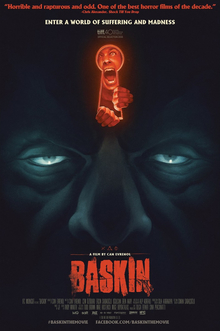
Baskin (2015): When Turkish Hell Spits Fulci in Your Face (And We Love It)
Turkish horror cinema, that poor cousin of the genre that spent decades recycling Hollywood exorcisms and bargain-bin djinns with Windows Movie Maker effects, got a throat punch in 2015 with the arrival of Baskin. Can Evrenol, a director who seems to have nursed on LSD straight from Lucio Fulci’s teat, didn’t just burst onto the international scene like a jihadist of poetic gore—he did it with a film that’s equal parts sacramental splatter, psychedelic trip, and a swift kick in the balls to conventional storytelling. Baskin isn’t a movie; it’s a trench of rotting flesh and Freudian symbolism where the viewer enters as a civilian and exits as a war veteran with PTSD. And the best part? There’s no therapy that can fix the damage.
finalExplicado: "En el clímax, los policías corruptos caen literalmente al infierno a través de los sótanos de la comisaría abandonada. Allí son torturados, violados y desmembrados por criaturas demoníacas y un ser supremo que parece un sultán infernal. El protagonista, Remzi, descubre que su padre ya está allí, condenado, y finalmente es castrado y convertido en uno más de los torturadores del averno. Simbólicamente, el final significa que el infierno no es un lugar lejano: es la comisaría turca misma, metáfora de la autoridad corrupta, la violencia machista y la podredumbre moral del sistema. No hay redención ni escape; el mal no viene de fuera, ya habitaba dentro de ellos. El descenso es irreversible: se convierten en lo que siempre fueron."
Fulci in Istanbul: Or How to Turn an Abandoned Police Station into the Gateway to the Apocalypse
The first half of Baskin is a masterclass in atmospheric buildup, a tour de force proving Evrenol hasn’t just watched Zombi 2 (1979) on VHS until the tape wore out—he’s understood that horror isn’t about cheap scares, but the slow suffocation of the mundane mutating into nightmare. The film kicks off with a seemingly innocuous scene: five Turkish cops—corrupt, misogynistic, boring, and repulsive—eating at a roadside diner. The dialogue is vulgar, testosterone flows like cheap rakı, and you can almost smell the sweat and rancid kebab through the screen. Then, an emergency call drags them onto a backroad shrouded in fog that looks like it was coughed up by the lungs of Silent Hill. And here, dear readers, is where Evrenol lights the fuse.
The cinematography by Alp Korfalı is, quite simply, a knife in the eye of good taste. The sulfuric reds and abyssal blues aren’t just aesthetic choices—they’re open wounds on the viewer’s retina. Every shot of that nighttime road, every elongated shadow, every drop of condensation on the car windows is calculated to induce physical discomfort. It’s no coincidence Evrenol cites Eraserhead (1977) as an influence: like Lynch, the Turkish director knows the most effective terror isn’t the kind that screams, but the kind that whispers while jamming a needle into your eardrum.
When the patrol arrives at the abandoned police station—a decaying Ottoman structure plucked from a Lovecraftian fever dream—the film decides physics and narrative logic can go fuck themselves. What starts as a police thriller morphs into a visual poem dedicated to decay, where space folds in on itself like a rotting intestine. Evrenol has no patience for rational explanations: Baskin is a Freudian nightmare where the characters’ (and, by extension, our) subconscious spills out like guts on the floor. And here, the shadow of Lucio Fulci looms over the film like a vengeful specter.
Like the Italian master in his Gates of Hell Trilogy (City of the Living Dead, The Beyond, The House by the Cemetery), Evrenol understands horror doesn’t need coherence—it needs a dream logic where images hit like hammer blows to the skull. Fulci shot his films as if possessed by a baroque gore demon; Evrenol, on the other hand, seems to have struck a deal with some Turkish ifrit to grant him the gift of sacred abjection. Every frame of Baskin is a tableau of beautiful cruelty: dismembered bodies writhing like maggots in a jar, melting faces sculpted by a drunk artist, and carnal iconography bordering on the liturgical. This isn’t horror—it’s a black mass on celluloid.
The Father (Baba): When the Devil Looks Like a Butcher with a Messiah Complex
But if there’s one moment where Baskin transcends mere splatter to become something akin to degenerate art, it’s with the arrival of The Father (Baba), played by Mehmet Cerrahoğlu, who looks like he was carved from cadaver flesh by Satan himself. Cerrahoğlu doesn’t act—he inhabits his character like a parasite in a dying host. His presence is so overwhelming you can almost smell the stench of rotting meat and rancid semen wafting off him. With his shaved head, rotting-tooth grin, and skeletal frame teetering like a house of cards, Baba isn’t your typical villain: he’s an embodiment of pure evil, an inverted Messiah preaching in viscera instead of parables.
The final act of Baskin is a bacchanal of mutilation, coprophagia, and ritual blasphemy that would make The Human Centipede screenwriters blush. Evrenol doesn’t settle for showing blood—he turns it into a sacrament. There’s a scene where Baba forces a cop to eat his own feces while reciting passages from a holy book (or maybe it’s an IKEA assembly manual—who knows?). It’s not gratuitous: it’s a forced communion with the abject, a reminder that horror isn’t just about seeing—it’s about being complicit. And here’s where Evrenol proves his genius: he’s not interested in cheap exploitation, but in the transubstantiation of terror into something almost mystical.
Comparing Baba to other horror villains is like comparing a McDonald’s to a cannibalistic fine-dining experience. He’s not a Freddy Krueger haunting your dreams—he’s a flesh shaman dragging you into a personalized hell where your worst traumas materialize as guts hanging from a hook. Cerrahoğlu achieves the impossible: a character who spends half the movie naked, blood-soaked, and screaming like a demon is more terrifying than any Insidious jump scare. And that, dear readers, is pure alchemy.
Editing as a Butcher’s Knife: When Chaos Becomes Rhythm
If Korfalı’s cinematography is the brush painting hell, then Osman Bayraktaroğlu’s editing is the knife that carves it up. Baskin doesn’t flow—it crawls, writhes, and sometimes self-destructs like a diseased organism. Some sequences mimic a racing heartbeat, with abrupt cuts that feel like a tachycardia’s staccato. Other times, the film lingers on long, contemplative shots, as if Evrenol wants the viewer to drown in their own discomfort.
The problem—and where Baskin stumbles slightly—is that the narrative fragmentation can feel alienating for those expecting a rational explanation. Evrenol isn’t interested in answering questions—he wants you to drown in them. There are moments where the film feels like a puzzle missing pieces, and while that might be deliberate (hell, after all, doesn’t come with an instruction manual), it can frustrate those craving a conventional narrative. That said, it’s precisely this lack of coherence that makes Baskin a unique experience: it’s not a movie you watch—it’s a movie you endure.
The Soundtrack: When Silence Is More Terrifying Than Screams
Ulas Pakkan’s score is one of those elements that slips under the radar on first viewing but lodges in your brain like splinters. Pakkan doesn’t compose a traditional soundtrack—he crafts a sonic atmosphere oscillating between the buzz of a fly swarm and the thud of a heart about to burst. There are moments when the music vanishes entirely, leaving only ambient sounds: creaking rotten wood, dripping water, the groans of the characters. And it’s in these silences where Baskin grabs you by the balls and doesn’t let go.
Performances: When Turkish Machismo Rots on Screen
The cast of Baskin is mostly unknown actors playing cops as corrupt as they are repulsive. Görkem Kasal (Arda), Ergun Kuyucu (Remzi), and Muharrem Bayrak (Yavuz) don’t win awards for subtlety, but that’s what makes their characters so believable. They’re tough, misogynistic, violent, and, deep down, as lost as children in a slaughterhouse. Their chemistry is palpable, and when the film descends into nightmare territory, their performances become even more brutal and desperate.
Fatih Dokgöz (Sefa), the youngest of the group, best embodies vulnerability amid the chaos. His character is the only one who seems to question what’s happening, and his performance conveys a genuine anguish that contrasts with his buddies’ toxic masculinity. But the real standout is Mehmet Cerrahoğlu, whose portrayal of Baba is one of the most terrifying in horror history.
Cinematic Comparisons: Fulci, Lynch, and the Turkish Giallo
Saying Baskin is "Fulci in Turkey" is underselling it. Evrenol doesn’t just drink from the Italian master’s well—he mixes it with Lynch’s surrealism, the brutality of extreme giallo, and a layer of Ottoman folklore that reeks of burnt incense and rotting meat. If Argento’s Suspiria (1977) is a nightmare ballet, Baskin is a mosh pit in hell.
There are echoes of Żuławski’s Possession (1981) in how the film explores psychological decay, and of The Void (2016) in its Lovecraftian creatures. But Baskin isn’t a copy—it’s a monster with its own identity, a freak born from the union of a snuff film and an epic poem about the fall of man.
The best
The opening atmosphere: That nighttime road sequence is a masterclass in building tension without showing anything, making True Detective look like a Sesame Street* episode. Mehmet Cerrahoğlu (Baba): His performance is so terrifying it should come with an epilepsy warning; a villain who makes Hannibal Lecter* look like the nice guy next door.The worst
Narrative fragmentation: If you want a linear plot, Baskin* will leave you more lost than a tourist in the abandoned police station’s labyrinth.- Repetitive formalism: By the end, the accumulation of grotesque imagery loses steam like an ‘80s slasher in its fifth sequel; the initial impact fades into saturation.
The Verdict of Claqueta Ácida (8/10)
Baskin isn’t a movie—it’s a cinematic exorcism that leaves you dirtier than a public restroom in Istanbul. Can Evrenol delivers a debut that reeks of sulfur, corrupt cop sweat, and rancid lamb meat, proving Turkish horror can be as personal, brutal, and poetic as the best Italian giallo. It’s not for everyone: if you want coherence, go watch Toy Story 4. But if you crave a needle of celluloid jammed into your subconscious, your guts stirred with a rusty fork, Baskin is your film. Just don’t say we didn’t warn you: this nightmare has no emergency exit. 🔪💀🎬 Tráiler Oficial
Abrir en YouTube
Ending Explained: Baskin (2015)
Ficha de Daños Colaterales en Sala
Certificado de impacto psicofísico emitido por Héctor Veneno
Cero bostezos. Pupilas dilatadas y tensión mandibular constante.
Ninguna comprobación del tiempo. Se agradece la rareza.
Ninguna. Esta obra no necesita muletas estimulantes.
"No hubo. La coherencia se mantuvo hasta el último fotograma."
💬 El Veredicto de la Comunidad
¿Qué te ha parecido la película? Deja tu nota de 0 a 10 para contrastarla con el análisis de la redacción.
Aún no has votado
📢 ¿Te ha gustado el ácido?
Comparte esta crítica con tus amigos cinéfilos o desata la polémica en redes.
⚡ THE CINEMATIC VENOM YOUR INBOX CRAVES
No sugarcoated ratings, no corporate fluff. Subscribe for our uncensored weekly analysis or join the private Telegram for press previews, poll clashes, and instant alerts.
Alertas de estrenos en 1 segundo, encuestas en caliente y audios al salir de pases de prensa.
Recibe la dosis semanal en tu mail + regalo inmediato del PDF con 50 joyas ocultas de culto.
Related Reviews
Recommended autopsies for demanding film buffs.
 🔥 Fusión Nuclear8.5
*Alleluia: Love as a Terminal Illness (or How to Turn Crimes of Passion into a Sweaty, Fleshy Spectacle)*
⚡Afinidad temática directa en atmósfera, estilo y fijaciones visuales.
Fabrice Du Welz reimagines the myth of the lonely hearts killers in a feverish whirlwind of jealousy, submission, and blood, led by Lola Dueñas in a performance that’s equal parts hypnotic and harrowing.
 🔥 Fusión Nuclear8.5
*High Tension (Haute Tension): The Brutal Birth of the New French Extremism – Or How to Turn Flesh into Poetry with a Machete*
⚡Afinidad temática directa en atmósfera, estilo y fijaciones visuales.
Alexandre Aja shocked global screens with a relentless rural bloodbath, redefined by breakneck pacing and a divisive twist that splits serious cinephiles right down the middle.
 🔥 Fusión Nuclear8.5
*Aterrados: The Rebirth of Ghost Stories in the Raw Grit of Buenos Aires*
⚡Afinidad temática directa en atmósfera, estilo y fijaciones visuales.
Demian Rugna revolutionizes paranormal horror—possessions, poltergeists, and all—by transplanting it to a residential neighborhood in Buenos Aires, armed with a devastating sound design that rattles your bones.
Editorial Ecosystem
Cinephile connections, archive interviews and related analyses.
💬 Debate Cinéfilo & Autopsia de Lectores
0 veredictos¿Discrepas con nuestra nota? ¿Es una obra maestra o veneno puro? Deja tu veredicto abajo sin necesidad de registro.


Aún nadie ha dejado su veredicto para esta película.
Sé el primero en clavarle el colmillo rellenando el formulario de arriba.