Sinners — Vampires, Racism, and 16 Oscar Noms for an Empty Shell
A review of Ryan Coogler’s Southern Gothic vampire thriller—a stunning aesthetic spectacle that stumbles into self-important dramatics and hollow pretension.

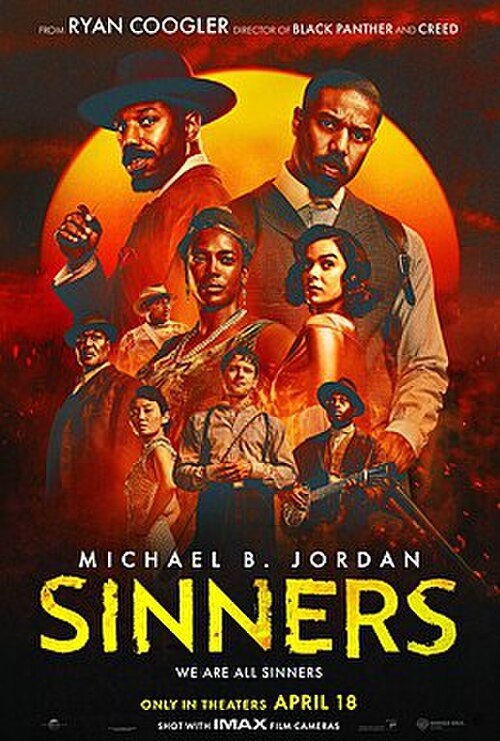

Ryan Coogler has once again proven he’s Hollywood’s golden child—not so much for his overflowing talent, but for his knack for selling smoke wrapped in progressive cellophane. Sinners is the latest evidence that in today’s industry, all it takes is waving a "social consciousness" flag and a stratospheric budget for the Academy to prostrate itself as if they’re witnessing the new Citizen Kane—when what they’re actually holding is Blacula with delusions of a PhD thesis. Sixteen Oscar nominations aren’t recognition; they’re a symptom: that of an industry that confuses solemnity with depth and production design with cinematic genius.
finalExplicado: "En el clímax, los hermanos gemelos se enfrentan en una iglesia abandonada durante una tormenta. Smoke, poseído por el espíritu ancestral de los vampiros, intenta convertir a su hermano Stack y a toda la comunidad negra en una horda eterna que “libere” a los oprimidos devorando a los opresores. Stack se niega, sacrifica a su amada y, con un blues místico y una escopeta bendecida, destruye el corazón del vampiro primigenio, provocando que todos los no-muertos ardan en llamas purificadoras. Simbólicamente, el final significa que la liberación auténtica no puede venir de la venganza eterna ni de la inversión de roles opresores, sino de la renuncia al odio heredado y del retorno al dolor humano, imperfecto y mortal. El fuego que consume a los vampiros es tanto catarsis como advertencia: la rabia justificada, si se convierte en poder absoluto, solo genera un nuevo ciclo de monstruosidad."
Fangs and Metaphors: When Southern Gothic Smells Like Academic Mothballs
Sinners has all the ingredients for a Gothic horror masterpiece with racial undertones: twin brothers (played by a Michael B. Jordan who looks like he stepped out of an Abercrombie & Fitch catalog), a Southern town rotting to its core, vampires who feed on historical oppression, and a 1930s Mississippi where cotton isn’t the only thing bleeding. The problem? Coogler, in his eagerness to tie up every loose end, turns every scene into a cultural studies seminar. The vampires in Sinners don’t bite—they pontificate. Before every attack, there’s a monologue about America’s "original sin" that lasts longer than a Baptist sermon on a hungover Sunday. It’s as if Get Out and True Blood had an illegitimate child with The King’s Speech.
The script, written by Coogler himself, suffers from what we might call "PowerPoint syndrome": every scene is a slide explaining—with all the subtlety of a sledgehammer to the skull—that racism is bad and vampires are a metaphor for systemic exploitation. There’s no room for mystery, suggested terror, or moral ambiguity. The monsters in Sinners are about as subtle as a brick to the face: their mere existence is a walking allegory, and their design—a mix of Nosferatu and Southern preachers—comes off as more ridiculous than terrifying. Instead of evoking the cosmic horror of Dreyer’s Vampyr or the Gothic elegance of Interview with the Vampire, Coogler opts for vampires that look like they escaped from an American Horror Story episode directed by a diversity committee.
The narrative structure is another weak point. The film drags on like gum stuck to a shoe for its two-and-a-half-hour runtime, with subplots that go nowhere and secondary characters who exist solely to deliver grandiose lines about redemption and forgiveness. The climax, when it finally arrives, is as predictable as a telenovela episode and as exciting as an Oscar acceptance speech. Coogler seems more interested in crafting a political manifesto than telling a story, resulting in an uncomfortable hybrid that satisfies neither horror fans nor social drama enthusiasts.
The Circus of Performances: When Charisma Isn’t Enough
Michael B. Jordan, that actor seemingly sculpted by the gods of marketing to be the "new Denzel," faces his most ambitious challenge here: playing twin brothers with opposing personalities. Thanks to visual effects that waver between remarkable and unsettling (in some scenes, his face looks like a melting wax mask), Jordan conveys a certain duality, but the script doesn’t give him enough ammunition to shine. One twin is an ex-con with a violent past, and the other is... well, basically the same, but with a different hairstyle. The chemistry between them is nonexistent because, let’s be honest, there’s nothing to explore: they’re two archetypes circling a message we’ve heard a thousand times before.
Jack O’Connell, as the token villain, does what he can with a character who’s little more than a stereotype of a Southern racist with a messiah complex. His performance is competent, but the script reduces him to a mannequin spouting lines like "blood is the only currency that matters" with the conviction of a televangelist selling Bibles. Delroy Lindo, that actor who always seems on the verge of launching into a Shakespearean monologue even while ordering coffee, fulfills his role as the wise mentor, but his presence is as predictable as sunrise. It’s as if Coogler assembled these actors not to tell a story, but to pose for a poster reading "cinema as a tool for social change."
The Cinematography: When the Wrapper Is Better Than the Gift
If there’s anything in Sinners that justifies its existence, it’s Autumn Durald Arkapaw’s cinematography. The film is, above all, a visual feast: the Louisiana swamps look like they’ve been lifted from an Andrew Wyeth painting, the cotton fields glow under a twilight that evokes both beauty and decay, and the night scenes are bathed in a darkness so dense you can almost smell the mold and blood. Arkapaw, who already demonstrated her mastery in Loki (yes, that Marvel series we all pretend we didn’t like), turns every frame into a work of art, with a color palette that oscillates between sickly amber and the icy blue of the vampires’ eyes.
The sound design complements this visual orgy with a soundtrack that blends raw blues, Gothic choirs, and ambient sounds whispering ancestral secrets. It’s the kind of technical work that makes you wonder why Hollywood doesn’t give Arkapaw an unlimited budget to film a Southern Twin Peaks. But, as is often the case in modern cinema, the wrapper is so dazzling that you almost forget there’s nothing inside. Sinners is like a beautifully decorated wedding cake: on the outside, it’s a masterpiece of pastry, but on the inside, it’s just dry sponge and cardboard filling.
Editing and Direction: Coogler, the Reverse Midas
Ryan Coogler is a director with a natural flair for the epic, as he proved in Black Panther, but in Sinners, he seems to have confused "ambition" with "self-indulgence." The editing is uneven: there are action sequences choreographed with surgical precision (like a swamp chase that evokes the best of True Detective), but also scenes that drag on forever, as if Coogler were in love with the sound of his own voice. The film lurches forward, alternating moments of genuine tension with others where you wonder if the director fell asleep in the editing room.
The direction of actors is another weak spot. Coogler seems more comfortable directing action scenes or grandiose dialogues than exploring his characters’ psychology. The actors move like marionettes on a stage, reciting lines that sound more like political manifestos than organic dialogue. There’s one scene in particular—where the twins argue about their past while walking through a cotton field—that’s so forced it feels like it was lifted from a beginner’s acting workshop. Coogler has talent, but here he seems more interested in impressing academics than telling a story.
Cinephile Comparisons: What Sinners Could Have Been (And Wasn’t)
To understand Sinners’ failure, just compare it to other films that have tried to fuse horror and social critique. Jordan Peele’s Get Out (2017) achieved what Coogler only attempts: combining psychological terror with razor-sharp satire on racism, without falling into pedantry. Peele trusts the audience to grasp his metaphors, while Coogler underlines them with a highlighter. Candyman (1992), directed by Bernard Rose, is another example of how Gothic horror can be a powerful tool for exploring racial oppression, with an oppressive atmosphere and rich mythology that Sinners doesn’t even brush against.
Even Blacula (1972), that B-movie that now seems like a joke, has more authenticity and humor than Sinners. At least in Blacula, the vampires don’t waste time giving speeches about the African diaspora before sucking blood. Coogler, in his quest to be "important," forgets that horror works best when it’s visceral, when it taps into primal fears rather than intellectual debates. Sinners is like a term paper disguised as a monster movie: well-researched, technically flawless, but as boring as a Sunday afternoon in the library.
The best
- Autumn Durald Arkapaw’s cinematography, which turns the Louisiana swamps into a character in their own right, with a beauty as oppressive as original sin.
- Michael B. Jordan’s dual role, proving that even when the script abandons him, his physical charisma remains his best ally.
The worst
- A script that mistakes "depth" for "stating the obvious", as if the audience were five-year-olds who need every metaphor explained with a PowerPoint.
- Vampires who are more terrifying for their verbosity than their fangs, as if Coogler hired Noam Chomsky to write the monsters’ dialogue.
The Verdict of Claqueta Ácida (7/10)
Sinners is definitive proof that in today’s Hollywood, all it takes is wrapping a social message in Gothic horror cellophane and a nine-figure budget for the Academy to melt like butter in a microwave. Ryan Coogler delivers a technically flawless, visually dazzling, and dramatically hollow film—a monstrous hybrid that neither scares nor moves, but, oh boy, does it look gorgeous on the Oscar shelf. Sixteen nominations later, one can only wonder: when will the industry learn that pretty packaging can’t save mediocre filling? In the meantime, Sinners will be remembered as the day Southern Gothic drowned in its own discourse.🎬 Tráiler Oficial
Abrir en YouTube
Ending Explained: Sinners
Ficha de Daños Colaterales en Sala
Certificado de impacto psicofísico emitido por Silvia Mordaz
2 amagos en el tramo intermedio; pestañeo pesado en las transiciones más innecesarias.
Minuto 44 y minuto 74 (comprobando cuánto quedaba de suplicio).
1 espressos para no dejarse vencer por la mediocridad cómoda.
"A mitad del segundo acto cuando la subtrama secundaria empezó a pesar más de lo que aportaba."
💬 El Veredicto de la Comunidad
¿Qué te ha parecido la película? Deja tu nota de 0 a 10 para contrastarla con el análisis de la redacción.
Aún no has votado
📢 ¿Te ha gustado el ácido?
Comparte esta crítica con tus amigos cinéfilos o desata la polémica en redes.
⚡ THE CINEMATIC VENOM YOUR INBOX CRAVES
No sugarcoated ratings, no corporate fluff. Subscribe for our uncensored weekly analysis or join the private Telegram for press previews, poll clashes, and instant alerts.
Alertas de estrenos en 1 segundo, encuestas en caliente y audios al salir de pases de prensa.
Recibe la dosis semanal en tu mail + regalo inmediato del PDF con 50 joyas ocultas de culto.
Related Reviews
Recommended autopsies for demanding film buffs.
 ⚡ Ácido Cítrico7.5
The Sinners: A Technical KO in the Dark
⚡Del mismo director (Ryan Coogler): analiza la evolución o degradación de su estilo.
A scathing look at Ryan Coogler’s latest cinematic gut-punch
 ⚡ Ácido Cítrico7.5
A Ghost Story: A Journey Through Time and Memory
⚡Comparten trinchera editorial en la sección de Críticas.
The Claqueta Ácida review of A Ghost Story, a film that explores existence and human connection.
 ⚡ Ácido Cítrico7.2
Acid in the Veins: Fede Álvarez Revives the Tactile Panic of Alien
⚡Comparten trinchera editorial en la sección de Críticas.
Industrial claustrophobia and pure physical terror. A merciless critique of Ian Holm's CGI and the cheap nostalgia that stains the franchise's return.
Editorial Ecosystem
Cinephile connections, archive interviews and related analyses.
💬 Debate Cinéfilo & Autopsia de Lectores
0 veredictos¿Discrepas con nuestra nota? ¿Es una obra maestra o veneno puro? Deja tu veredicto abajo sin necesidad de registro.


Aún nadie ha dejado su veredicto para esta película.
Sé el primero en clavarle el colmillo rellenando el formulario de arriba.