Censor (2021) — When Censorship Becomes a Shattered Mirror of British Madness
Prano Bailey-Bond crafts a mesmerizing psychological and metacinematic journey into the heart of 1980s British censorship hysteria.

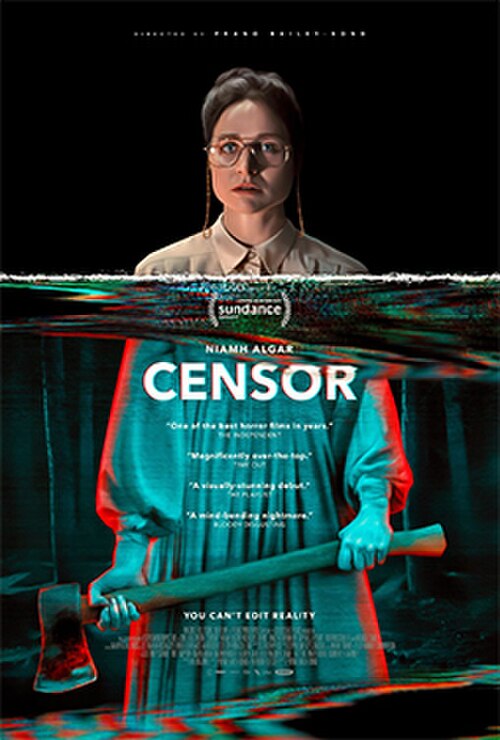
Censor (2021): When Censorship Becomes a Shattered Mirror of British Madness
There was a time when Britain, under Margaret Thatcher’s iron fist, decided that the real enemy of society wasn’t austerity, mass unemployment, or the Falklands War—no, it was a handful of VHS tapes with tacky cover art and special effects that looked like they were made with ketchup and Play-Doh. That collective hysteria against Video Nasties—a delicious term blending Victorian puritanism with Cold War paranoia—was nothing more than a symptom of a society obsessed with controlling what people could watch, as if a low-budget slasher had the power to corrupt souls more than the very real misery ravaging the streets. It’s in this cesspool of moral hypocrisy and cinephilia that Censor (2021), the debut feature from Welsh director Prano Bailey-Bond, plants its flag with the elegance of a rusty knife stabbing into a forgotten VHS tape.
Bailey-Bond doesn’t settle for a simple nostalgic homage to ‘80s horror—far from it. Censor is a metacinematic nightmare that devours its own guts, a meditation on trauma, memory, and the power of images to distort reality beyond recognition. It does so with an intelligence and visual sensitivity that place it in the same league as Peter Strickland’s Berberian Sound Studio (2012) or Andrzej Żuławski’s Possession (1981), but with a British edge as cold and sharp as the blades of a censor’s scissors.
finalExplicado: "En el clímax, Enid rastrea al director Frederick North hasta un bosque donde se proyecta su película maldita. Convencida de que su hermana sigue viva dentro de la cinta, se sumerge literalmente en la pantalla, asesina al director y se adentra en un mundo de violencia gore que se funde con su realidad. La secuencia culmina con Enid convertida en la protagonista sangrienta de su propia película, sonriendo extasiada mientras la celuloide la devora. Simbólicamente, el desenlace significa la victoria total de la represión: la censora no libera a su hermana, sino que se transforma en el monstruo que siempre reprimió. La nostalgia por los Video Nasties no es salvación, sino podredumbre que infecta y destruye. La analogía se pudre y se come a quien intentó controlarla."
The Censor as a Mirror of a Sick Society
At the center of this maelstrom is Enid Baines (Niamh Algar), a British film classification board bureaucrat whose life revolves around two things: watching graphic violence on screen and deciding which bits of it deserve to be amputated to "protect the public." Her existence is an exercise in emotional repression so meticulous that even the most clueless viewer can smell the mothballs and five-o’clock tea wafting from her character. Enid isn’t just a censor; she’s the perfect symbol of a society that prefers to cut, edit, and censor rather than face its own demons.
But, like all good defense mechanisms, Enid’s begins to crack when reality seeps into her sterile bubble. A real-life crime—one of those sensationalist newspaper stories blithely attributing violence to "the influence of violent films"—forces her to question her work. And as if that weren’t enough, watching a cult film directed by an enigmatic filmmaker named Frederick North (a wink as obvious as it is delicious to Video Nasties directors like Pete Walker or Norman J. Warren) reopens the wound of her younger sister’s disappearance, a childhood trauma Enid has buried under layers of bureaucracy and denial.
What’s fascinating about Censor is how Bailey-Bond and cinematographer Annika Summerson visually translate this spiral of madness. The film starts with a palette of cold colors and institutional textures: office grays, muted blues, clinical whites. But as Enid descends into obsession, the movie is drenched in neon reds, acid greens, and sickly yellows—the same colors that adorned the covers of banned VHS tapes in underground video stores. The aspect ratio tightens, shifting from conventional widescreen to the claustrophobic 4:3 of old televisions, as if the format itself is being strangled by the analog distortion of a damaged VHS. It’s an act of love and terror for physical media, a statement of intent that recalls David Lynch’s obsession with degraded textures in Inland Empire (2006) or the glitch aesthetic of Cronenberg’s Videodrome (1983).
The Labyrinth of Memory: What’s Real and What’s Celluloid?
One of Censor’s greatest strengths is its play with narrative ambiguity. Bailey-Bond never gives us clear answers because, in the end, what’s more terrifying: reality or the possibility that reality is just a distorted projection of our fears? The film dives so deep into Enid’s mind that the viewer no longer knows whether what they’re seeing is the main plot or a trauma-induced hallucination.
Is Frederick North a real killer or a projection of Enid’s demons? Is the film she thinks she recognizes a snuff film or just a metaphor for her guilt over failing to protect her sister? Or is the entire plot nothing more than a VHS tape rewinding and playing over and over in the protagonist’s mind, an endless loop she can’t escape? Bailey-Bond refuses to offer easy answers, and that’s what makes Censor so unsettling. It’s not a movie that scares you with jump scares or latex monsters; it’s a movie that gnaws at you from the inside, like a VHS degrading with every viewing.
This ambiguity is reinforced by Mark Towns’ editing, which alternates between the slow pace of the opening scenes—where every cut feels measured with bureaucratic precision—and the frenetic succession of images in moments of psychological tension. There are sequences where the editing becomes almost experimental, as if we’re seeing the scenes through Enid’s eyes, with flashes of memory superimposed on reality. It’s a technique reminiscent of Nicolas Roeg’s work in Don’t Look Now (1973), where past and present intertwine until they become indistinguishable.
The Performances: Niamh Algar and the Art of Repression
If there’s one element that elevates Censor above other psychological horror films, it’s Niamh Algar’s monumental performance as Enid Baines. Algar doesn’t just play a censor; she embodies repression in its purest form. Her face, with its angular features and icy gaze, is like a blank canvas where every microexpression—a blink, a nervous tic, a forced smile—betrays the emotional storm raging beneath the surface. There’s a particular scene near the end of the film where Enid applies blood-red lipstick while staring directly into the camera, and in that moment, Algar conveys more terror with a single gesture than most actors do with dramatic monologues.
The rest of the cast delivers solid performances, though it’s fair to say that the film is, above all, Algar’s show. Nicholas Burns, as Enid’s superior Sanderson, is the spitting image of the cynical bureaucrat who justifies censorship with empty rhetoric about "protecting the public." Vincent Franklin, as Enid’s father, brings a chilling coldness, while Sophia La Porta and Michael Smiley have memorable moments as supporting characters orbiting the protagonist’s obsession.
The Soundtrack: The Hum of Analog Madness
Emilie Levienaise-Farrouch’s score is another of Censor’s triumphs. It’s not a traditional soundtrack with epic themes or catchy melodies. Instead, it’s a symphony of electronic hums, analog distortions, and ambient sounds that seem lifted from a poorly recorded VHS. There are moments when the music blends with the ambient noise—the tracking of a VCR, the crackle of magnetic tape—so seamlessly that the viewer can’t tell if what they’re hearing is part of the film or a technical glitch in their own TV.
This sonic approach reinforces the feeling that we’re watching the film through Enid’s eyes, as if her mind is so saturated with violent images that she can no longer distinguish between sound and noise. It’s a soundtrack that doesn’t just accompany the visuals—it corrupts, distorts, and ultimately destroys them, just as Enid’s obsession destroys her sanity.
Social Critique: Censorship as a Smoke Screen
Beneath its psychological horror facade, Censor is a scathing critique of state censorship and media manipulation. The film acidly portrays how the 1980s British government used the Video Nasties scare as a distraction from real problems like poverty, unemployment, and domestic violence. While Enid and her colleagues obsess over cutting seconds of on-screen violence, the tabloid press blames real crimes on films they’ve approved, creating a vicious cycle of guilt and paranoia.
Bailey-Bond doesn’t judge Enid for her job; she judges her for her complicity. Enid isn’t a villain but another victim of the system, a woman who’s found in censorship a way to control chaos, both professionally and personally. But, as any good cinephile knows, you can’t control cinema. Images take on a life of their own, and once they’re burned into the mind, no bureaucratic scissors can erase them.
The Best
- Niamh Algar: Her dramatic evolution is so subtle it feels like black magic; her face is a topographic map of repression on the verge of explosion.
- The metacinematic staging: Bailey-Bond turns the VHS format into a character in its own right, with its distortions, sickly colors, and power to corrupt reality.
- The social critique: A velvet-gloved slap to censorship hypocrisy and media manipulation, disguised as psychological horror.
The Worst
The ending can be frustrating: If you’re looking for clear answers or a neatly wrapped conclusion, Censor* will leave you with more questions than an unlabeled VHS in an abandoned video store. A slow start: The first twenty minutes are like a poorly adjusted tracking*—you’ll need patience for the film to spiral into obsession.The Verdict of Claqueta Ácida (8.4/10)
Censor isn’t just one of the smartest British horror films of recent years; it’s an exorcism in VHS form, a meditation on how images can save us or destroy us, depending on whether we have the courage to face them or prefer to snip them with scissors. Prano Bailey-Bond delivers a debut that doesn’t just pay homage to Video Nasties—it surpasses them in ambition and depth, proving that the real horror isn’t what we see on screen, but what we choose to erase to avoid going mad. If cinema is a mirror, Censor is that shattered mirror reflecting back your own distorted, bloody, and above all, terrifyingly real image. 📼✂️🎬 Tráiler Oficial
Abrir en YouTube
Ending Explained: Censor (2021)
Ficha de Daños Colaterales en Sala
Certificado de impacto psicofísico emitido por Héctor Veneno
Ni un solo parpadeo voluntario. El asiento, inusualmente cómodo.
Ni una sola mirada al móvil.
Ninguna. Guarda el café para la sesión siguiente.
"No hubo. La coherencia se mantuvo hasta el último fotograma."
💬 El Veredicto de la Comunidad
¿Qué te ha parecido la película? Deja tu nota de 0 a 10 para contrastarla con el análisis de la redacción.
Aún no has votado
📢 ¿Te ha gustado el ácido?
Comparte esta crítica con tus amigos cinéfilos o desata la polémica en redes.
⚡ THE CINEMATIC VENOM YOUR INBOX CRAVES
No sugarcoated ratings, no corporate fluff. Subscribe for our uncensored weekly analysis or join the private Telegram for press previews, poll clashes, and instant alerts.
Alertas de estrenos en 1 segundo, encuestas en caliente y audios al salir de pases de prensa.
Recibe la dosis semanal en tu mail + regalo inmediato del PDF con 50 joyas ocultas de culto.
Related Reviews
Recommended autopsies for demanding film buffs.
 🔥 Fusión Nuclear8.5
*Alleluia: Love as a Terminal Illness (or How to Turn Crimes of Passion into a Sweaty, Fleshy Spectacle)*
⚡Afinidad temática directa en atmósfera, estilo y fijaciones visuales.
Fabrice Du Welz reimagines the myth of the lonely hearts killers in a feverish whirlwind of jealousy, submission, and blood, led by Lola Dueñas in a performance that’s equal parts hypnotic and harrowing.
 🔥 Fusión Nuclear8.5
*High Tension (Haute Tension): The Brutal Birth of the New French Extremism – Or How to Turn Flesh into Poetry with a Machete*
⚡Afinidad temática directa en atmósfera, estilo y fijaciones visuales.
Alexandre Aja shocked global screens with a relentless rural bloodbath, redefined by breakneck pacing and a divisive twist that splits serious cinephiles right down the middle.
 🔥 Fusión Nuclear8.5
*Aterrados: The Rebirth of Ghost Stories in the Raw Grit of Buenos Aires*
⚡Afinidad temática directa en atmósfera, estilo y fijaciones visuales.
Demian Rugna revolutionizes paranormal horror—possessions, poltergeists, and all—by transplanting it to a residential neighborhood in Buenos Aires, armed with a devastating sound design that rattles your bones.
Editorial Ecosystem
Cinephile connections, archive interviews and related analyses.
💬 Debate Cinéfilo & Autopsia de Lectores
0 veredictos¿Discrepas con nuestra nota? ¿Es una obra maestra o veneno puro? Deja tu veredicto abajo sin necesidad de registro.

Aún nadie ha dejado su veredicto para esta película.
Sé el primero en clavarle el colmillo rellenando el formulario de arriba.