Crawl (2019) — Giant Gators, Claustrophobic Floods, and a Lean, Mean Survival Machine
Alexandre Aja delivers a flawless B-movie rollercoaster about a swimmer trapped in a flooded basement during a Category 5 hurricane—with Florida’s oversized gators as the cherry on top.

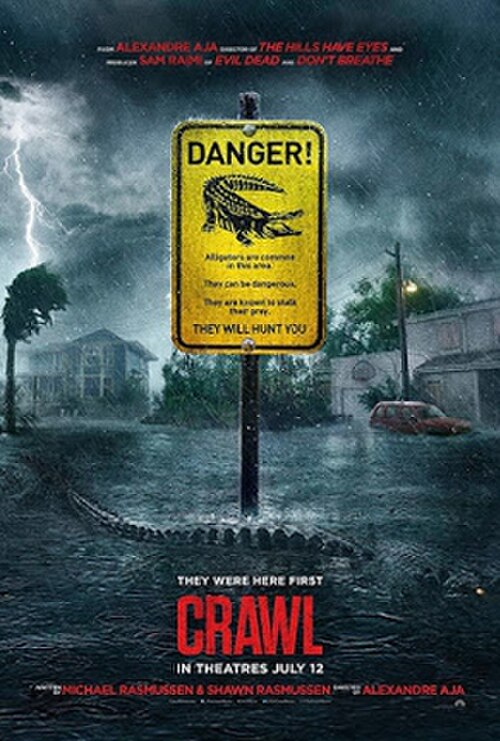


Crawl (2019): When Survival Horror Becomes an Amphibious Gladiator Spectacle
In a cinematic landscape bloated with blockbusters inflated like helium balloons—stuffed with redundant subplots, cardboard motivational speeches, and CGI so polished it looks straight out of an IKEA catalog—Crawl emerges like a breath of foul yet refreshing air. No, this isn’t an arthouse film. It doesn’t aspire to be a metaphor for human fragility or an eco-manifesto disguised as entertainment. It’s controlled sadism in its purest form, a masterclass in turning a flooded basement into a Roman coliseum where gators play the lions and the protagonists are the doomed Christians. Alexandre Aja, the plastic surgeon of horror who already dazzled us with gems like High Tension (2003) and Piranha 3D (2010), proves here why he’s the undisputed king of low-budget, high-voltage survival horror. With Crawl, Aja doesn’t just avoid the existential yawn of three-hour epics—he nails it to the viewer’s forehead with a pneumatic hammer and then drowns it in a puddle of filthy water.
finalExplicado: "Haley y su padre, gravemente heridos, quedan atrapados en el desagüe bajo la casa mientras el huracán alcanza su pico. Con el agua inundándolo todo y los caimanes devorando todo a su paso, ella usa su habilidad como nadadora para atraer a los reptiles, matar al ejemplar alfa con un cuchillo y arrastrar a su padre hasta la superficie justo cuando la casa se derrumba. Simbólicamente, el final invierte la dinámica depredador-presa: la hija se convierte en la cazadora suprema, devorando a los devoradores. El sótano inundado representa el trauma familiar sumergido; salir a la superficie bajo la tormenta es un renacimiento brutal, donde la supervivencia exige convertirse en algo tan salvaje como el entorno. No hay rescate externo, solo evolución o muerte."
The Premise: Less Is More (And More Is a Feast for Predators)
The plot of Crawl is so simple it could fit in a tweet: "Hurricane + flooded basement + gators = soggy nightmare." Haley Keller (Kaya Scodelario), a college swimmer with more determination than common sense, ventures into Florida’s evacuation zone to find her father, Dave (Barry Pepper), a contractor with the uncanny ability to be in the wrong place at the wrong time. She finds him unconscious in the basement of their old house—a maze of rusted pipes and family memories that, under normal circumstances, would be perfect for a therapy session. But circumstances, like the rising water, are anything but normal.
Before Haley can even say, "Dad, we should get out of here," Hurricane Wendy (yes, named like a telenovela villain) turns the basement into an unregulated Olympic-sized pool. And as if fate had a twisted sense of humor, a pack of 10-foot alligators (yes, 10 feet) barge in like bouncers at an exclusive reptile nightclub. What follows is 90 minutes of pure hydraulic tension, where every breath, every movement, and every wrong decision could be the last. There’s no time for existential monologues, no room for romantic subplots, or that one side character who shows up every 20 minutes to yell, "This is insane!" Here, insanity is the natural state of things, and the Rasmussen brothers’ (Michael and Shawn) script knows it. Their writing is a minimalist clockwork machine: every scene advances the plot, every line has a purpose, and every escape attempt by Haley and Dave becomes a brutal yet elegant survival ballet.
The Spatial Design: When the Basement Becomes a Character
One of Crawl’s biggest strengths is its claustrophobic, oppressive production design. The Kellers’ basement isn’t just a set—it’s a subaquatic gothic labyrinth, a space that evolves (or rather, degrades) as the water swallows everything. Alexandre Aja and his go-to cinematographer, Maxime Alexandre (no relation, though they should be), turn every corner of that basement into a visual battleground. Rusty pipes, dangling wires, and floating debris aren’t just decorative—they’re obstacles that add layers of danger to every move the protagonists make.
As the water rises, dry land shrinks to tiny islands of survival, forcing Haley to swim between beams like a dystopian Finding Nemo. The camera moves with her, diving and surfacing in a hydraulic dance reminiscent of the best siege cinema, like Neil Marshall’s The Descent (2005), but with one key difference: the enemy here isn’t mythical creatures but real predators with insatiable appetites. And when the gators attack, they do so with painful physicality. These aren’t the typical CGI monsters floating in a digital void—they have weight, texture, and, above all, hunger. When one clamps onto Haley’s arm, the jolt is so violent the viewer feels it in their own joints. This is tactile terror, the kind that lingers in your skin and bones.
The Pacing: Eighty-Seven Minutes of Cardiac Arrest (No Commercials)
In an industry where movies stretch like taffy to justify their $200 million budgets, Crawl is a narrative oasis of efficiency. At 87 minutes, there’s no room for filler, unnecessary scenes, or that moment where the hero pauses to ponder the meaning of life while the villain sharpens their knife. Here, every second counts, and the pacing is as relentless as the hurricane’s advance.
The editing, by Elliot Greenberg, is surgical in its precision. Transitions between scenes are fluid but never rushed; every cut is calculated to keep tension at its peak. When Haley and Dave try to plug a wall breach with a mattress, the suspense doesn’t dilute into technical explanations—it’s built through pure action, sweat, fear, and urgency. And when the gators appear, they do so without warning, like a jump scare that doesn’t need blaring music to work. Because in Crawl, the real scare isn’t what you see—it’s what you sense: the movement beneath the water, the sound of jaws snapping in the dark, the certainty that something will lunge from the shadows to drag you under at any moment.
The Performances: When Pain Is the Best Makeup
Kaya Scodelario and Barry Pepper don’t need introductions, but in Crawl, they prove why they’re two of the most underrated genre actors working today. Scodelario, who already showcased her chops in The Maze Runner (2014) and Pirates of the Caribbean: Dead Men Tell No Tales (2017), carries the film on her shoulders with a physical and emotional intensity reminiscent of Sigourney Weaver’s best work in Alien (1979). Haley isn’t a damsel in distress—she’s an athlete at her peak, but also a desperate daughter trying to save her father. Scodelario conveys exhaustion, cold, the sting of wounds, and animalistic determination—the refusal to surrender even when the water is literally at her neck.
Barry Pepper, meanwhile, is magnificent in a role that could’ve been a cliché (the wounded but wise father who exists only to dispense advice). Dave Keller is a practical man, a contractor who knows every inch of his house and every survival trick, but he’s also vulnerable, stubborn, and occasionally selfish. Pepper makes the audience empathize with him, even when he makes questionable decisions, like insisting on staying in the basement instead of finding another way out. His chemistry with Scodelario is believable and moving, and their dialogues—when they have any—are laced with a realism that avoids easy melodrama.
The Score: Silence Is the Loudest Scream
The music in Crawl, composed by Max Aruj and Steffen Thum, is as subtle as it is effective. There are no epic themes or dramatic choirs announcing danger; instead, the score enhances tense moments with ambient sounds and minimal percussion, as if the hurricane itself were setting the rhythm. The real sonic star of Crawl is silence—or rather, what lurks behind it: the slosh of water, the creak of rotting wood, the sound of gator jaws snapping inches from the camera. It’s an organic, grimy, terrifying soundscape, one that echoes Jaws (1975) in its ability to generate fear through what isn’t seen.
Cinematic Comparisons: The Bloody Family Tree of Crawl
Crawl doesn’t exist in a vacuum—it’s the heir to a long tradition of survival horror and claustrophobic sieges. Its structure recalls The Descent (2005), where a group of women is trapped in a cave with mutant creatures, but with one key difference: Crawl doesn’t need mythology or supernatural explanations to work. It also draws from Jaws (1975), particularly in its use of water as an oppressive element and the presence of a predator lurking in the dark. However, unlike Spielberg’s film, there are no scuba-suited heroes or epic endings—just two people fighting to survive in an ever-shrinking space.
Another inevitable comparison is Danny Boyle’s 127 Hours (2010), where a man is trapped in a canyon and must amputate his arm to escape. But while 127 Hours is a psychological study of human endurance, Crawl is a pure action spectacle, where physical pain is as important as emotional agony. And, of course, there’s the kinship with Piranha 3D (2010), another Aja film where aquatic predators wreak havoc. But while Piranha was a dark comedy with social satire, Crawl is a serious, raw, no-holds-barred thriller where humor is nowhere to be found (save for the occasional unintentional irony, like when Dave tells Haley, "Don’t worry, gators can’t climb stairs").
The Flaws: When Physics Becomes a Joke (But the Audience Laughs Anyway)
No film is perfect, and Crawl is no exception. While its greatest virtue is physical realism, there are moments when the laws of human anatomy stretch like taffy. Haley and Dave suffer gator bites, pipe collisions, and falls from considerable heights, yet keep moving like Marvel superheroes. At one point, Haley swims with an apparently broken arm, and later, Dave crawls with a fractured leg like he’s in a CrossFit session. It’s a minor detail, but it breaks immersion in a film that otherwise goes to great lengths to be believable.
Another weak point is the CGI in exterior shots. While the gators are convincingly rendered (especially in close-ups), the wide shots of the hurricane and the town’s flooding betray budget limitations. The waves look like they’re from a 2000s video game, and some digital backdrops are so artificial they shatter the film’s grimy realism. It’s not a dealbreaker, but it reminds the viewer they’re watching a B-movie, not a Hollywood blockbuster.
The best
Its tight runtime: Eighty-seven minutes of clockwork precision with no stupid subplots, moralizing speeches, or filler scenes. Crawl* is like an Olympic sprint: short, intense, and no time to catch your breath.- Scodelario and Pepper’s physicality: They don’t need special effects to convey pain, cold, and exhaustion. Their suffering is so real you’ll feel the water in your lungs and the taste of blood in your mouth.
The worst
- Stretchy anatomy laws: Haley and Dave survive gator bites, blows, and fractures like video game characters. Real medicine isn’t this forgiving.
The Verdict of Claqueta Ácida (8/10)
Crawl is the cinematic equivalent of a pure adrenaline shot: grimy, brutal, and unfiltered. Alexandre Aja takes a simple premise—two people trapped in a basement with gators—and turns it into a survival spectacle as elegant as it is merciless. There are no artistic pretensions, no hidden messages, no time to be bored. It’s genre cinema in its purest form, a reminder that sometimes less is more, and a good jump scare is worth a thousand climate change sermons. If you’re looking for a film that leaves you breathless, with white knuckles and a racing heart, Crawl is your best bet. Just maybe avoid flooded basements for a while afterward. Or at least bring a floatie. And a flamethrower. Just in case. 🐊🔥🎬 Tráiler Oficial
Abrir en YouTube
Ending Explained: Crawl (2019)
Ficha de Daños Colaterales en Sala
Certificado de impacto psicofísico emitido por Lúa Ácida
Cero. La pantalla absorbió cada segundo de atención disponible.
Ni una sola mirada al móvil.
Ninguna. Guarda el café para la sesión siguiente.
"No hubo. La coherencia se mantuvo hasta el último fotograma."
💬 El Veredicto de la Comunidad
¿Qué te ha parecido la película? Deja tu nota de 0 a 10 para contrastarla con el análisis de la redacción.
Aún no has votado
📢 ¿Te ha gustado el ácido?
Comparte esta crítica con tus amigos cinéfilos o desata la polémica en redes.
⚡ THE CINEMATIC VENOM YOUR INBOX CRAVES
No sugarcoated ratings, no corporate fluff. Subscribe for our uncensored weekly analysis or join the private Telegram for press previews, poll clashes, and instant alerts.
Alertas de estrenos en 1 segundo, encuestas en caliente y audios al salir de pases de prensa.
Recibe la dosis semanal en tu mail + regalo inmediato del PDF con 50 joyas ocultas de culto.
Related Reviews
Recommended autopsies for demanding film buffs.
 ⚡ Ácido Cítrico7.5
*The Green Inferno: A Trip to the Heart of Darkness (And a One-Way Ticket to Nausea)*
⚡Hermana de saga: otro capítulo diseccionado con rigor forense.
*The most scathing, gut-wrenching takedown of *The Green Inferno*—a film that will make you question humanity (and your own gag reflex).*
 🔥 Fusión Nuclear8.5
*High Tension (Haute Tension): The Brutal Birth of the New French Extremism – Or How to Turn Flesh into Poetry with a Machete*
⚡Del mismo director (Alexandre Aja): analiza la evolución o degradación de su estilo.
Alexandre Aja shocked global screens with a relentless rural bloodbath, redefined by breakneck pacing and a divisive twist that splits serious cinephiles right down the middle.
 🔥 Fusión Nuclear8.8
*The Hills Have Eyes: The Miracle of a Remake That Outshone the Classic with Radioactive Rage*
⚡Del mismo director (Alexandre Aja): analiza la evolución o degradación de su estilo.
Alexandre Aja takes Wes Craven’s classic and transforms it into a savage, blood-soaked, and unbearable nightmare of desert survival and mutant cannibalism.
Editorial Ecosystem
Cinephile connections, archive interviews and related analyses.
💬 Debate Cinéfilo & Autopsia de Lectores
0 veredictos¿Discrepas con nuestra nota? ¿Es una obra maestra o veneno puro? Deja tu veredicto abajo sin necesidad de registro.


Aún nadie ha dejado su veredicto para esta película.
Sé el primero en clavarle el colmillo rellenando el formulario de arriba.